Which Fingerprinting Service Can You Ship Fastest?
To recommend a fast service for digital fingerprinting, measure three things: hours from API key to a server-side visitor ID, p95 latency under your own traffic, and whether the free tier covers a real pilot. Tooling depth decides the rest. Fingerprint and DigitalFingerprint have the shortest server-side path, ThumbmarkJS and Radar Reveal win on price, and a client-side hash on its own is not a fraud check.

📌 TL;DR Executive Summary
- Core Takeaway: Fingerprint Pro Plus costs $99/mo for 20K identifies with $4 per extra 1K; DigitalFingerprint Pro delivers 20K for $40/mo at $2 per 1K overage, so it runs at roughly half the cost at both 100K and 500K identifies a month.
- Key Risk/Challenge: A client-side JavaScript hash is not a fraud check. Vendors say production decisions need a server-side Events or decision API, and “99.9% accurate” claims without a published test design are not evidence.
- Recommended Solution: Shortlist two vendors, run a 200–500 user returning-visitor test on your own traffic, then pick by cost per identify at your real volume — and keep a browser profile manager like Send.win for the accounts your team legitimately operates.
How to Score a Vendor on Speed
Every vendor page promises a quick integration. Four measurements decide whether that is true for your stack, and none of them is the size of the JavaScript bundle.
- Time to first event: hours from creating an API key to a visitor ID landing in your database with a server timestamp you trust.
- Decision latency: the round trip at your edge. Radar publishes roughly 50 ms per verification; most vendors publish nothing, so measure p50 and p95 yourself.
- Signal depth: a returning visitor ID plus bot, tampering, VPN and proxy, and velocity signals returned server-side — not a bare hash in a hidden field.
- Free-tier headroom: enough identifies to test against real traffic without a sales call. Fingerprint and DigitalFingerprint both give 1,000 a month.
If you are still hazy on what the browser exposes, read what a browser fingerprint contains before comparing vendors — entropy sources matter more than dashboard design. Score the four measures above and you can recommend a fast service for digital fingerprinting on evidence rather than on a demo.
6 Fast Digital Fingerprinting Options, Ranked
The ranking favours options you can put in front of real traffic this week, which is the only test that matters when you recommend a fast service for digital fingerprinting. Prices are published list rates reported in August and October 2026; confirm them on each vendor’s page before you sign anything.
1. Fingerprint — the enterprise incumbent
Fingerprint sells device intelligence across web and native mobile, which is why it lands on most enterprise shortlists. The free tier covers 1,000 identifies a month. Pro Plus is $99/mo for 20,000 identifies with $4 per additional 1,000.
- Pro: native mobile SDKs alongside the web script, so one vendor covers both surfaces.
- Pro: server-side risk signals rather than a hash you have to interpret yourself.
- Con: the steepest overage on this list — 500K identifies a month lands near $2,019.
- Con: onboarding assumes a team that already runs a fraud pipeline.
Best for: teams that need one vendor for web and mobile and can absorb enterprise pricing.
2. DigitalFingerprint — cheapest per identify at volume
DigitalFingerprint pairs a hosted visitor ID with a server-side Events API. Free tier: 1,000 identifies a month; Pro: $40/mo for 20,000 with $2 per 1,000 overage, half of Fingerprint’s overage rate. Its published benchmark — 500 returning visitors, 95% confidence interval — claims at least 99% same-browser continuity. Cross-browser linking is explicitly not claimed.
- Pro: the cheapest published overage among the paid APIs here, which matters most above 100K events.
- Pro: the visitor ID is hosted and designed to survive cookie and storage clearing.
- Con: the headline accuracy figure is self-reported — ask for the test design before quoting it internally.
- Con: a younger product than Fingerprint, with fewer worked examples.
Best for: web-only signup and login fraud where cost per identify is the deciding number.
3. Radar Reveal — location-verified device intelligence
Radar Reveal adds verified location to device and IP signals. List pricing starts at $2.00 per 1,000 API calls; a separate review also quotes from $0.04 per MTU per month, where an MTU is one player checked at least monthly. Those are two pricing models, not two conversions of one price. Published vendor figures include roughly 5 m location accuracy, about 50 ms verification and 100B+ location observations a year feeding its location graph.
The signal stack combines GPS, Wi-Fi, IP, Bluetooth, cellular and device sensors into one score, and flags mismatches between GPS and IP location, VPNs and proxies, emulators, root and jailbreak, device farms and screen sharing. Operators tag each check with a reason such as login, sign-up or withdrawal. Radar reports SOC 2 Type II, GLI and BMM Testlabs certifications, and follows US export restrictions, returning HTTP 451 in blocked countries.
- Pro: the fastest published verification time here, with certifications procurement will ask for.
- Pro: reason tagging turns raw checks into something a risk team can audit.
- Con: two pricing models in circulation make budgeting a conversation rather than a calculation.
- Con: location data means a deeper privacy review than a plain visitor ID.
Best for: iGaming, fintech, delivery and marketplaces where you need to know where the device is, not only which device it is.
4. SHIELD — a policy engine in front of the fingerprint
SHIELD is a device-first fraud platform rather than a pure fingerprint API: tamper-resistant device IDs, 20+ configurable fraud signals and a policy engine you configure instead of hard-coding rules. Pricing is sales-led and quoted by unique users or API volume. Third-party pricing listings showed a free tier with limited API calls in October 2026 — confirm with the vendor before planning around it.
- Pro: rule changes live in the product, so tuning thresholds does not need a deployment.
- Pro: 20+ signals arrive pre-built, shortening the path to your first blocked signup.
- Con: no public price list, so procurement runs on the sales team’s calendar.
- Con: unique-user pricing is harder to forecast than a per-identify rate as you grow.
Best for: teams with a fraud-operations function that wants to retune rules without shipping code.
5. ThumbmarkJS — open source first, €15/mo later
ThumbmarkJS starts as an open-source library you can read line by line. The hash is free and the vendor puts its uniqueness at around 80%. The hosted API is free for 1,000 identifies and €15/mo for 15,000, with the vendor claiming roughly 99% uniqueness on the API path.
- Pro: the cheapest paid entry point here, and the only option you can audit before paying.
- Pro: a small invoice makes it easy to trial inside a startup budget.
- Con: 80% uniqueness means roughly one in five visitors collides — fine for analytics, not for blocking.
- Con: no published overage rate above the 15K allowance; ask before you depend on it at scale.
Best for: startups proving that fingerprinting reduces signup abuse before committing to a contract.
6. Open-source hash plus your own event table
Run the ThumbmarkJS hash client-side, post it to your own endpoint, store it against the user record, deduplicate and add your own velocity counters. It is a legitimate starting point at small volume and a good way to learn what the commercial APIs are doing for you.
- Pro: no per-identify fee, and the data never leaves your warehouse.
- Pro: you own retention, deletion and how long scores survive.
- Con: you inherit the collision rate — around 80% uniqueness by the vendor’s own figure for the open-source hash.
- Con: you get a hash, not a decision: no bot, tampering or proxy signals, no support line, and a pipeline to maintain.
Best for: small teams with an engineer who can own the pipeline end to end.
Where Send.win Fits: Profiles for Accounts You Are Authorised to Run
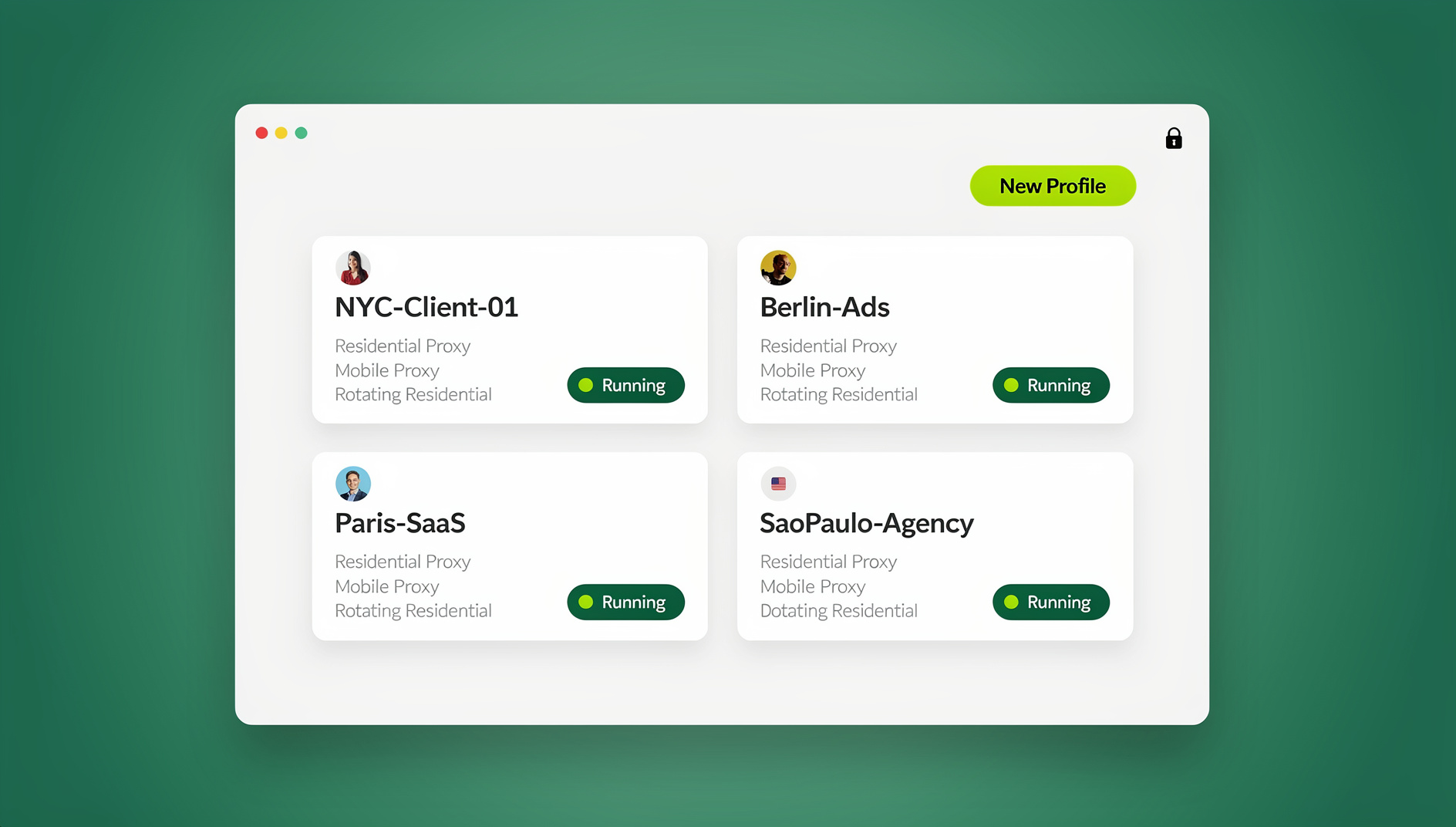
Send.win is not a fingerprinting vendor and does not sit in a risk-scoring pipeline. It is a browser profile manager for accounts you own or are authorised to manage: an agency holding a dozen client logins, a seller running several storefronts, a QA or support team testing as different users and regions. Each profile keeps its own cookies, storage, sessions, fingerprint settings and proxy, handled inside the browser engine, so profiles do not share one browser identity — the same idea as the fingerprinting protection in Firefox or Brave, applied per profile.
Profiles run two ways. Sendwin Browser is a native desktop app for Windows 10/11 (64-bit), macOS 12+ and Linux, built on Chromium and installed locally. The cloud browser runs profiles on Send.win’s server in Helsinki, Finland, from any device with nothing to install. Residential proxies are included on Pro and Team with metered bandwidth, and you can bring your own HTTP or SOCKS5; timezone, locale, WebRTC and geolocation follow the proxy’s exit IP automatically. Sharing a profile with a paid teammate opens it already signed in, and cloud sync keeps logins consistent across devices.
- Pro: consistent per-profile fingerprints plus isolated cookies and storage, so client work stays separate.
- Pro: Pro at $19/mo covers 150 profiles, 5 GB of proxy bandwidth a month and 6 seats; Team at $49/mo covers 500 profiles, 20 GB and 16 seats, with up to 50 profiles open at once on either plan.
- Pro: team sharing without password handoff, plus EU-hosted cloud sessions a client can review live.
- Con: no risk score and no decision layer — pair it with one of the services above if you also need fraud detection.
- Con: no API, SDK, headless mode or automation interface on any plan, and the desktop app itself needs Pro or Team; the cloud demo gives 10 minutes a day.
If your week is juggling client logins for digital services, the workflow for managing multiple accounts maps onto the same profiles-plus-proxy setup while keeping every account inside the platform’s own rules.
Cost per Identify at 50K, 100K and 500K a Month
Published rates only get interesting once you multiply them by your own volume. The table applies each vendor’s list price and overage rate to three monthly volumes, assuming you buy the entry plan and pay overage rather than negotiating a contract.
| Service | Free tier | Paid entry | Overage | 50K/mo | 100K/mo | 500K/mo |
|---|---|---|---|---|---|---|
| Fingerprint (Pro Plus) | 1K identifies/mo | $99/mo for 20K | $4 per 1K | $219 | $419 | $2,019 |
| DigitalFingerprint (Pro) | 1K identifies/mo | $40/mo for 20K | $2 per 1K | $100 | $200 | $1,000 |
| Radar Reveal | Not published | $2.00 per 1K calls | Per call | $100 | $200 | $1,000 |
| ThumbmarkJS (Pro) | 1K identifies/mo + free open source | €15/mo for 15K | Not published | ask | ask | ask |
| SHIELD | Limited API calls (third-party listing) | Custom | By users or volume | quote | quote | quote |
Two notes before you copy those figures into a budget. Radar’s $0.04 per MTU is not interchangeable with $2.00 per 1,000 API calls — do not blend them into one number. And every competitor price here was published in August or October 2026 and may have changed since. For how these line items compound, fingerprinting service costs tend to bite in year two, when event volume grows faster than revenue.
Client-Side Hash or Server-Side Decision API?
A client-side hash runs in a browser you do not control. Privacy modes, content blockers and routine storage clearing break it, headless traffic can skip it entirely, and identical hardware collides. Vendors say plainly that production fraud checks need a server-side Events or decision API: the client script collects, the server decides.
The category has moved with that. What you buy now is device intelligence — a sticky visitor ID that survives cookie clearing, bot and tampering signals, VPN and proxy detection, velocity measured across your own traffic — delivered server-side so your risk engine can join it with signup records. It is also why fingerprinting keeps company with browser isolation: isolation changes what the browser exposes, and fingerprinting is how the other side reads it.
Test Accuracy on Your Own Traffic in a Week
Vendor benchmarks are marketing with a methodology attached. Build your own number before you sign a contract, and keep the test small enough to finish in five working days. This is also the evidence you need when a stakeholder asks you to recommend a fast service for digital fingerprinting.
- Pick 200 to 500 of your own returning users whose devices you can identify through a normal login.
- Log the vendor visitor ID server-side at login, never at signup, so you measure returning continuity rather than first contact.
- Have half the group clear cookies and storage, then re-check within the session. Record how often the ID holds.
- Measure p50 and p95 latency per vendor under identical load, not from a dashboard average.
- Repeat the run inside a privacy-focused browser profile. A vendor that collapses in private mode will collapse in your support queue too.
- Ask for the test design behind any accuracy number. Reject “99.9% accurate” claims that arrive without a defined methodology, sample size and confidence interval.
Comparing fingerprint test tools compared side by side will save you a day of building harnesses from scratch.
Pick by Use Case, Not by Leaderboard
Part of that ranking traces back to a vendor-written shortlist whose top pick is the author’s own product. Sort by what you are actually defending instead.
- Signup abuse on a web app: DigitalFingerprint or ThumbmarkJS if budget leads; Fingerprint if you need the larger ecosystem.
- Account takeover inside a mobile app: Fingerprint, because native SDKs are part of the package.
- Location-dependent risk — withdrawals, bonuses, delivery: Radar Reveal, budgeted per API call rather than per device.
- Rules that change weekly: SHIELD, so fraud-ops can retune without a release.
- Your own team operating client accounts: Send.win, where the requirement is isolated profiles and per-profile fingerprint consistency rather than a risk score.
Privacy and Procurement Checks Before You Sign
Fingerprinting vendors process identifiers that count as personal data in most jurisdictions, so the contract matters as much as the latency. Ask five questions before a pilot converts.
- Data processing terms: is there a DPA you can sign, and which sub-processors appear in it?
- Retention: how long does a visitor ID and its events live, and can you shorten it per account?
- Hosting region: where does the data sit, and does that satisfy the commitments you have made to your own customers?
- Export and geography limits: some vendors enforce export rules and return HTTP 451 in restricted countries — check that against your user base.
- Blocked scripts: what comes back when a content blocker or a consent gate stops the script, and what is your fallback signal?
Then check operations. A vendor that cannot state p95 latency under your load, or refuses a 200-user test on your own traffic, is not fast — it is just well marketed.
🏆 Send.win Verdict
Send.win does not compete with Fingerprint, DigitalFingerprint, Radar or SHIELD — it solves the mirror-image problem. Those services tell a website which device is arriving; Send.win gives your team isolated profiles with their own cookies, storage, sessions, fingerprint settings and proxy, so the accounts you are authorised to run stay separate and consistent. The desktop app covers Windows, macOS and Linux, the cloud browser runs from any device with nothing to install, residential proxies come included on Pro and Team, and a profile shared with a paid teammate opens already signed in. It is the right pick for agency client work, multi-storefront selling or QA testing as different users and regions — and the wrong pick if you need a risk-scoring engine, because there is no API, SDK or automation on any plan.
See Send.win plans — paid plans start at $19/mo with a 7-day money-back guarantee on your first card purchase: Pro includes 150 profiles, 5 GB of proxy bandwidth and 6 seats. The free cloud demo runs in the browser with nothing to install and gives you 10 minutes a day.
Frequently Asked Questions
Which browser fingerprinting service is fastest to integrate?
DigitalFingerprint and ThumbmarkJS are usually quickest to a first server-side event, because both pair a small client script with a hosted API and a free tier of 1,000 identifies a month. Fingerprint is close behind if you only need the web script. When you recommend a fast service for digital fingerprinting, budget a day for a single endpoint and a week if your risk engine also has to consume the signals.
How much does browser fingerprinting cost per month?
Published list prices in late 2026: Fingerprint Pro Plus at $99/mo for 20,000 identifies with $4 per extra 1,000, DigitalFingerprint Pro at $40/mo for 20,000 with $2 per 1,000, ThumbmarkJS Pro at €15/mo for 15,000 identifies, and Radar Reveal from $2.00 per 1,000 API calls. SHIELD quotes by unique users or API volume. Once you pass 100,000 identifies a month, the overage rate decides the bill.
Is client-side fingerprint hashing enough for fraud checks?
No. A hash computed in the browser can be blocked, cleared or skipped, and identical hardware produces collisions. Vendors themselves describe the production pattern as a client-side collector plus a server-side Events or decision API that can also weigh velocity, bot and network signals. Use a client hash as one input, never as the decision.
What is the difference between same-browser and cross-browser accuracy?
Same-browser accuracy asks whether the same browser on the same device receives the same ID next week; DigitalFingerprint’s published benchmark claims at least 99% for that case across 500 visitors. Cross-browser accuracy asks whether the same person on a different browser gets linked, and almost nobody claims it. Do not assume one implies the other.
Which fingerprinting tool has the best free tier?
Fingerprint, DigitalFingerprint and the ThumbmarkJS API all give 1,000 identifies a month, enough for a genuine pilot at modest signup volume. ThumbmarkJS also publishes a free open-source library at around 80% uniqueness. Radar Reveal publishes no free allowance, so a pilot there starts as a commercial conversation.
Can an open-source library replace a paid fingerprinting API?
For analytics and low-volume abuse signals, sometimes. The open-source ThumbmarkJS hash is free and readable, but the vendor itself puts its uniqueness near 80%, which means frequent collisions, and it ships no bot, tampering or proxy intelligence. Treat it as a fallback or a learning step and buy a hosted API once blocking decisions depend on the result.
Is precise location verification necessary, or are IP and device signals enough?
IP and device signals cover most account-takeover cases. Precise location matters when the risk is physical — a withdrawal from a new city, a bonus claimed from the wrong jurisdiction, a delivery address that does not match the device. Radar Reveal targets that case with roughly 5 m accuracy, and it costs more per decision than a plain fingerprint lookup.
How Send.win Helps With Recommend A Fast Service For Digital Fingerprinting
Send.win is a browser profile manager for professionals and teams: every account gets its own isolated browser profile.
- Isolated profiles – separate cookies, storage and sessions per profile
- Fingerprint protection – each profile keeps its own consistent browser fingerprint, so profiles never share one browser identity
- Desktop app + cloud browser – native app for Windows, macOS and Linux, or run profiles in the cloud with no install
- Residential proxies included – on Pro and Team, with timezone and locale matched to the proxy
- Team sharing – share a signed-in profile with a teammate without sharing the password
Try the free cloud demo — no install — or download the desktop app. Paid plans start at $19/month, and your first card purchase is covered by a 7-day money-back guarantee (see pricing).