Can One Browser Run Several Facebook Ad Accounts Without Linking Them?
A working multilogin facebook ads setup is not about hiding one account behind one proxy. It is about giving every ad account a complete, self-consistent identity: its own fingerprint, its own sticky IP, its own cookies, timezone and locale. Meta links accounts by matching exactly those signals, so if two profiles share even one of them, the risk score climbs. Multilogin packages that identity into a saved profile you can launch, sync and share.

📌 TL;DR Executive Summary
- Core Takeaway: One ad account per Multilogin profile, one sticky residential or mobile IP per profile, and separate business assets per account. Anything shared on the asset side links accounts no matter how clean the fingerprint is.
- Key Risk/Challenge: Fingerprint isolation fixes the browser layer only. Shared pixels, catalogs, payment methods and admins still tie accounts together, and Meta One subscriptions do not raise your ad account limits.
- Recommended Solution: Match timezone and locale to the proxy country, test WebRTC and DNS leaks before you log in, warm up spend slowly, and never rotate an exit IP mid-session.
What Multilogin Actually Is for Facebook Ads
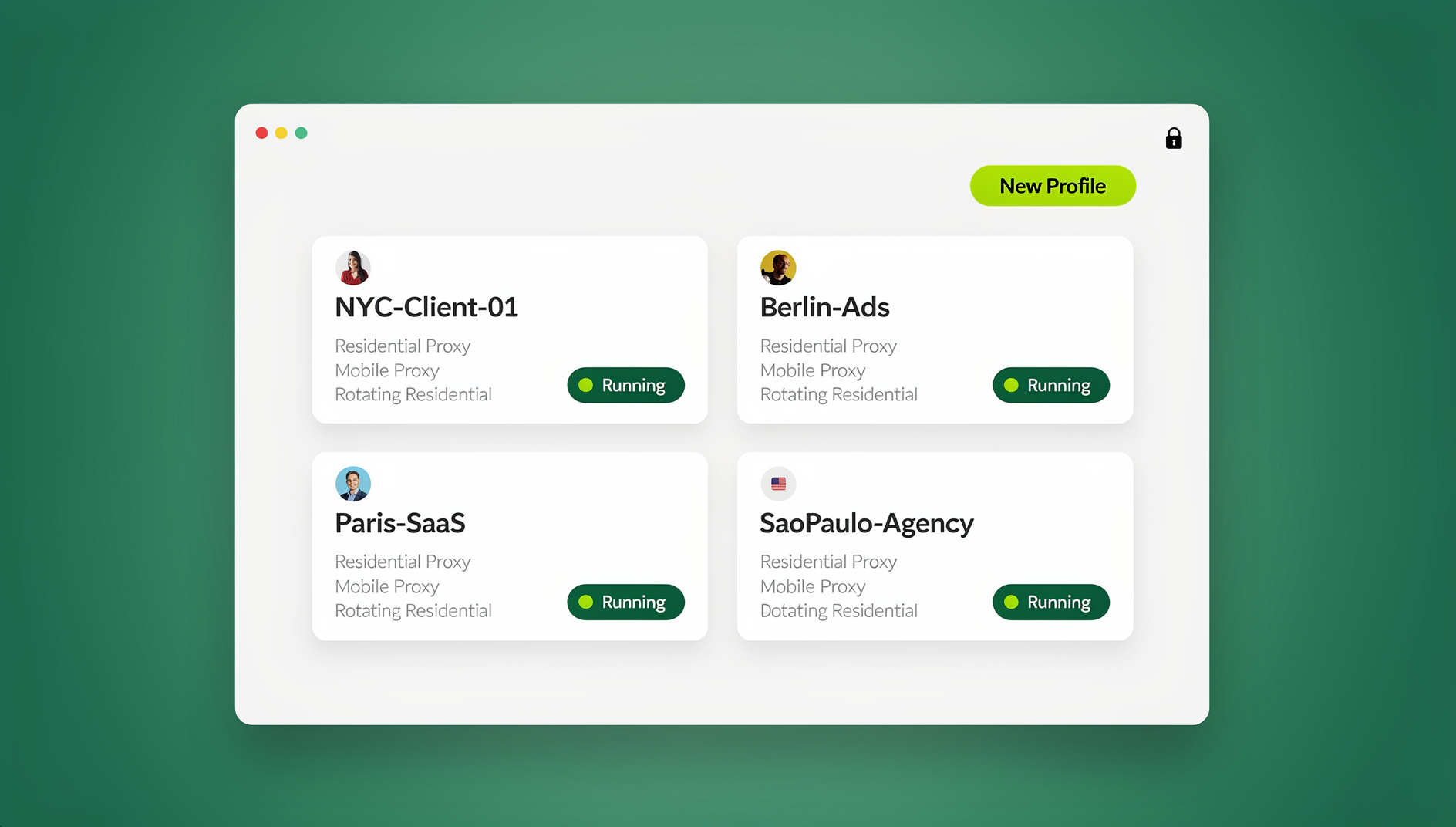
Multilogin is an anti-detect browser built around isolated profiles. Each profile packages its own fingerprint configuration, proxy assignment, cookies, local storage, browser preferences and session state, so opening it gives you an environment that reads like a separate machine on a separate network rather than another tab in the same one.
For a multilogin facebook ads workflow, that translates to one rule: one ad account, one profile, one network exit.
What a Profile Holds
- Fingerprint parameters — canvas, WebGL, audio, fonts, screen and hardware values.
- Proxy settings, including HTTP or SOCKS5 credentials.
- Cookies, local storage and browser preferences for every site you visit inside it.
- Session state, so a logged-in account comes back logged in.
Profiles sync through encrypted cloud storage, so they open on another device or a teammate’s machine without manual exports. That is convenient, and it is the main security trade-off: the same cloud store holds your live Facebook sessions.
Plans and Limits, September 2026
| Plan | Monthly price | Profiles | Team seats |
|---|---|---|---|
| Pro 10 | $11 | 10 | 1 |
| Pro 20 | $19 | 20 | 2 |
| Pro 50 | $29 | 50 | 2 |
| Business 100 | $40 | 100 | Unlimited |
| Business 300 | $89 | 300 | Unlimited |
Proxy traffic is included per plan and extras are billed separately: extra proxy traffic starts at $2.275 per GB and extra mobile minutes at $0.0067 per minute. Unused paid traffic and mobile minutes roll over while the account stays active. The built-in pool covers HTTP and SOCKS5 across 150+ countries and 1400+ cities with rotating residential or mobile IPs.
How Facebook Links Ad Accounts
Meta does not run a single check. It scores overlapping signals, and any signal that repeats across two accounts raises the probability that one operator runs both.
Browser and Device Signals
Canvas rendering, WebGL output, the audio stack, installed fonts, screen resolution, GPU strings, timezone and language combine into a fingerprint. Two accounts on the same fingerprint look like one person on one computer, whatever email addresses you registered.
Cookies and Session Continuity
A shared cookie jar is the most direct link there is: one browser loading two ad accounts is visible in the session data. Behaviour counts too. Instant form fills with no mouse movement and logins at machine-like intervals read as non-human activity.
IP History and Location Patterns
Facebook keeps IP history per account. Reusing an exit IP across accounts, jumping between countries mid-session, or logging in from a datacenter range no residential user would have, all feed the risk model. Datacenter IPs are not intended for residential use and can get accounts restricted quickly when used for login.
Asset Relationships
This is the layer a browser cannot fix. Sharing a pixel, catalog, page, Business Manager admin or payment method across accounts increases the risk score and can lead to restrictions. If you link accounts on the asset side, no amount of fingerprint work separates them. Our guide to multiple Facebook ads accounts without bans covers that account structure in detail.
Multilogin’s Fingerprint Isolation, in Practice
The browser freezes fingerprint values per profile and keeps sessions inside that profile instead of a shared jar. What you configure in a profile stays with it and nothing carries into the next launch.
The catch is coherence. A profile claiming a macOS GPU with a Windows font list, or a US timezone on a German IP, is more suspicious than a plain browser because the values contradict each other. You set platform, browser version, timezone, locale and WebRTC behaviour per profile yourself and keep them consistent with the proxy. Multilogin anti-detect browser isolation walks through each parameter and what breaks when they disagree.
Cloud Sync and Team Access
Synced profiles let a teammate open a specific ad account already signed in, without a password changing hands. Seats scale by tier — one to two on the Pro plans, unlimited on Business. Treat that as a security boundary rather than a perk: anyone who can open the profile can spend in the ad account.
Android Cloud Phones
Multilogin added Android cloud phones in 2026 to isolate mobile app identities separately from desktop profiles. That matters if your funnel depends on in-app Instagram or Facebook behaviour, because app traffic carries device-level signals a desktop browser never touches. Mobile minutes are metered and Smart Auto-Stop cuts idle consumption.
API and Automation
The API launches, manages and schedules sessions programmatically through Playwright, Selenium or Puppeteer. Rate limits scale by plan: 50 requests per minute on Pro 10, 75 on Pro 20, and 100 on Pro 50 and the Business tiers. Driving dozens of ad accounts on a schedule runs into that ceiling fast, so batch operations and stagger launches instead of firing every profile at once.
Proxy Choice Decides Most of Your Ban Risk
Fingerprints are the part vendors sell. Proxies are the part that gets a multilogin facebook ads setup restricted in practice.
| Proxy type | Trust with Facebook | Relative cost | Use it for |
|---|---|---|---|
| Datacenter | Low — ranges are flagged and not meant for residential use | Cheapest | Public data scraping, never logins |
| Residential, rotating | Medium — the exit IP changes and breaks session continuity | Mid | Ads Library research, price checks |
| Residential, sticky | Good when one IP maps to one profile | Mid to high | Facebook logins and ad managers |
| Mobile (4G/5G) | Highest — many real users share the same IP, so blacklisting is impractical | Highest, often metered | Accounts you cannot afford to lose |
Beyond the type, configuration decides the outcome. Run a sticky residential or mobile ASN per profile and keep that exit stable for the life of the account. Align the proxy country with the profile’s locale and timezone. Resolve DNS through the proxy rather than your local resolver, and harden WebRTC so a peer connection cannot reveal your real IP.
What Meta One Changes — and What It Doesn’t
Meta One launched globally in September 2026 with more than 50 features across Instagram, Facebook, WhatsApp and Meta AI. Business and creator tiers run $14.99 for Essential, $49.99 for Advanced, $149 for Expert and $499 for Max per month, with individual bundles at $7.99 Core and $19.99 Premium and single-product plans from $2.99 to $3.99. Advanced adds creator tooling such as scheduling stories up to 30 days ahead, links in organic posts and Reels, exportable analytics and team access without password sharing. Details are in Meta’s announcement.
None of those tiers change how many ad accounts you may run or how Meta links them. That matters because “unlimited Facebook ad accounts” is a misleading phrase in most marketing copy. Facebook sets platform limits on how many ad accounts can sit under one Business Manager, and separate operational limits decide how many can run before reviews start. Those operational limits move with spend patterns, payment history and policy record, so no tool hands you a fixed number. Our browser isolation for ads management guide covers how the rest of the stack fits together.
Step-by-Step: Setting Up Multilogin for Facebook Ads
The order matters in a multilogin facebook ads setup. Tests come before any account is exposed to Meta.
- Map accounts to profiles on paper. One ad account, one profile, one founder email, one payment method.
- Match the profile platform to your hardware class. A Windows machine should not present a macOS fingerprint with font rendering it cannot produce.
- Set timezone, locale and language to the proxy country. A UK exit IP with an Asia/Kolkata timezone is a mismatch you chose yourself.
- Attach one sticky proxy. Residential or mobile, one ASN per profile, country aligned with step 3. Never share an exit IP between two ad accounts.
- Test for leaks before you log in. Check WebRTC exposure, DNS resolution path, IPv6, the browser-reported timezone and geolocation against the proxy country.
- Log in manually the first time. No automation, no clipboard-filled passwords, no instant form submissions.
- Warm up gradually. Browse, complete 2FA, review billing settings. Do not open Ads Manager and launch a high-budget campaign on day one.
- Separate the assets. Distinct pixel, page, Business Manager role and payment method per account wherever the campaign structure allows it.
- Freeze the fingerprint once the account has history. Changing platform, timezone or proxy country on a profile with spend history is the equivalent of moving continents overnight.
- Automate only stable profiles. Schedule API work inside your plan’s request limit and stagger launches across the hour.
Using the Ads Library Without Risking Accounts
The Meta Ads Library is a free public database of ads running on Meta platforms, searchable by advertiser or keyword with filters for country, platform and category, plus API access. Use it for competitor research from a separate research profile or a plain browser tab. Logging into a live ad account to browse competitor pages adds session noise for no benefit.
Common Mistakes That Get Facebook Ad Accounts Restricted
- Two accounts in one profile. The cookie jar, fingerprint and IP match by definition.
- Rotating proxies mid-session. A changing exit IP breaks session continuity and looks nothing like a residential connection.
- Using datacenter IPs for login. Cheap IPs on flagged ranges get accounts restricted regardless of how clean the fingerprint looks.
- Ignoring timezone and locale alignment. The proxy says Germany, the browser says India, the language pack says English (US).
- Reusing a pixel or payment method. Asset relationships link accounts even when every browser signal is distinct.
- Logging in from your home IP “just to check something”. One mixed-network login can undo months of consistent behaviour.
- Publishing identical creatives across accounts. Same copy, same images, same landing page, minutes apart — visible in ad review.
- Scaling faster than you can warm accounts. Every new profile needs a ramp, not a campaign launch.
- Trusting ban-rate percentages. No audited figures on ad account survival are published. Treat any specific number you read as unsubstantiated.
Where Send.win Fits
If your bottleneck is proxy management stacked on top of fingerprint configuration, Send.win attacks the same problem with a different division of labour. The Sendwin Browser is a local desktop app for Windows, macOS and Linux, built on a patched-Chromium engine with the Sendwin Stealth engine included. Canvas, WebGL, audio, fonts and hardware are spoofed at the engine level rather than through injected scripts, and they are kept coherent — each profile reads like a separate real machine and no two profiles share a fingerprint.
The biggest time saver is automatic alignment. Timezone, locale, WebRTC and geolocation follow the proxy’s exit IP on their own, which removes the mismatch category from your checklist. Built-in residential proxies ship on every plan alongside bring-your-own HTTP/SOCKS5, so you are not running a second proxy subscription per profile. If you would rather not install anything, the cloud browser runs profiles on EU and US nodes from any device, with a free 10-minute-a-day preview and unlimited cloud browsing time on Pro and Team.
Collaboration works the way multi-account ad teams actually operate: share a profile with a paid teammate and it opens already signed in, with no password changing hands, and you can share live cloud sessions for reviews. Automation is a Team-plan feature — a local API for Selenium, Puppeteer and Playwright that attaches to a profile you already have open instead of creating a new identity:
from playwright.sync_api import sync_playwright

# Copy this URL from the profile's automation settings in Sendwin Browser.
CDP_URL = "http://127.0.0.1:PORT"

AD_ACCOUNT_ID = "act_XXXXXXXXXXXX"

with sync_playwright() as p:
    browser = p.chromium.connect_over_cdp(CDP_URL)
    context = browser.contexts[0]
    page = context.pages[0] if context.pages else context.new_page()

    page.goto(
        f"https://adsmanager.facebook.com/adsmanager/manage/campaigns?act={AD_ACCOUNT_ID}"
    )
    page.wait_for_load_state("networkidle")
    print(page.title())
    # Leave cleanup to the app so the profile keeps its warmed session.
Worth repeating: the fingerprint layer is the easy part. Send.win removes the proxy-alignment work and keeps local profiles on your own machine, but you still have to separate pixels, payment methods and admins per account. For a side-by-side breakdown of where the two products differ, Send.win vs Multilogin compares plans, proxy handling and automation in one table.
🏆 Send.win Verdict
Multilogin handles this job well, and its Android cloud phones plus tiered API rate limits are genuine advantages if in-app mobile identity is part of your funnel and you are happy to manage proxies as a separate line item. Where Send.win fits better is the setup you repeat for every new shop, client or test: residential proxies are included on every plan, timezone, locale, WebRTC and geolocation follow the exit IP automatically, and sharing a profile with a paid teammate opens it already signed in. Both products isolate the browser only — neither fixes a shared pixel, payment method or Business Manager admin.
Try Send.win free today — 30 days at $0, cancel anytime, local profiles stored on your own machine, plus a cloud preview you can open in the browser with no install.
Frequently Asked Questions
How many Facebook ad accounts can I run with Multilogin?
Your profile count is the technical ceiling — 10 on Pro 10 up to 300 on Business 300. Facebook’s limits are separate: a Business Manager holds a set number of ad accounts, and operational limits decide how many can run before reviews begin. Those depend on spend patterns, payment history and policy record, so nobody can promise you a fixed number.
How Send.win Helps With Multilogin Facebook Ads
Send.win is an antidetect browser built for exactly this kind of work — every profile is a clean, isolated identity:
- Isolated profiles – unique fingerprint, separate cookies and storage per profile
- Stealth engine – canvas, WebGL, fonts, and audio spoofed at the engine level
- Desktop app + cloud sessions – native app for Windows, macOS, and Linux, or run profiles in the cloud with no install
- Built-in residential proxies – with automatic timezone, locale, and WebRTC matching
- Team features – share logged-in profiles with teammates without sharing passwords
Try the instant cloud browser demo — no install, no signup — or download the desktop app. The 30-day free trial needs no credit card, and paid plans start at $6.99/month billed annually (see pricing).
Does Multilogin prevent Facebook from linking my accounts?
It removes browser and network overlaps: fingerprint, cookies, IP, timezone, hardware. It does nothing about asset overlaps. If two ad accounts share a pixel, a catalog, a payment method or the same admins, Facebook can still associate them.
What proxies work best with Multilogin for Facebook ads?
Sticky residential or mobile IPs, one ASN per profile, with the proxy country matching the profile’s timezone and locale. Mobile is treated as the most trusted category because many real users share the same IP, which makes blacklisting impractical. Datacenter IPs are the wrong tool for logins — they are cheap, flagged and not meant for residential use.
How does Facebook detect multiple ad accounts from the same user?
It scores overlapping signals: browser environment, cookies, IP history, location and timezone patterns, session continuity, hardware fingerprints, non-human login behaviour and relationships between business assets. Any single repeated signal raises the probability that one operator runs both accounts. It is a risk model, not a single switch.
Is Multilogin enough to avoid Facebook ad account bans?
No. A multilogin facebook ads setup removes one class of signal behind restrictions, but accounts are also restricted for policy violations, rejected payment methods and unusual spend behaviour. Treat anti-detect tooling as one layer in a process that includes separate assets, gradual warm-up and clean ad copy.
Can I automate Facebook ads with Multilogin and Selenium?
Yes. The API launches and manages sessions programmatically and supports Playwright, Selenium and Puppeteer. Rate limits scale with your plan — 50 requests per minute on Pro 10, 75 on Pro 20 and 100 on Pro 50 and the Business tiers — so batch scheduled jobs instead of firing every profile at once.
Can I use the Facebook Ads Library to research competitors?
Yes, and it costs nothing. It is a public database of ads running across Meta platforms, searchable by advertiser or keyword with filters for country, platform and category, plus API access for automated monitoring. Run that research from a separate profile rather than inside a live ad account session.
How much does Multilogin cost in 2026?
Monthly plans run from $11 for Pro 10 to $89 for Business 300, with Pro 20 at $19 and Pro 50 at $29. Extra proxy traffic starts at $2.275 per GB and extra mobile minutes at $0.0067 per minute, and unused paid balances roll over while the account is active. Its pricing page currently lists a 40% annual discount promotion ending 18 September 2026, but the help centre warns that yearly prices, discounts, taxes and VAT can change — check the checkout total before you commit.