Why Your Facebook Account Was Disabled With No Appeal Option
A Facebook account disabled without appeal usually means one of two things: Meta judged the violation severe or time-sensitive and disabled the account outright without a suspension stage, or your suspension is not eligible for a self-serve review. Recovery is still possible through the login-screen prompt, the Help Center feedback flow, or paid human support, and most suspensions carry a 180-day filing window before the disable becomes permanent.

📌 TL;DR Executive Summary
- Core Takeaway: A missing appeal button does not end recovery. It means the case is ineligible for self-serve review, or the account was disabled immediately — the login prompt, Help Center feedback and a paid support route are what remain.
- Key Risk/Challenge: Deadlines end more cases than decisions do. For a facebook account disabled without appeal, most suspensions still allow 180 days to file, follow-up documents must arrive within 30 days, and a denied appeal is normally final.
- Recommended Solution: File once with details that match your profile exactly, then break the linkage that caused the disable — one isolated browser profile per identity, on a residential IP that agrees with the profile’s timezone and locale.
What “Disabled Without Appeal” Actually Means
Three different problems get described with the same words, and each needs a different response. A policy suspension means Meta decided the account broke Community Standards. A security lock means you are being asked for a code, a selfie or a friend confirmation — nothing was deleted and there is no appeal to file. A permanent disable means Meta skipped the warning stage because it judged the violation severe or time-sensitive.
| What you see at login | What it usually is | Where to go | Deadline |
|---|---|---|---|
| “Your account has been disabled” with a Request Review button | Standard policy suspension | Login-screen prompt or Help Center form | 180 days to file |
| Locked for security, asked for a code or friend confirmation | Login or 2FA lock, not a policy disable | Security verification flow, not an appeal | No published window |
| Disabled message with no button on any surface | Ineligible for self-serve review, or a severe-violation disable | Help Center feedback, live paid support chat | 180 days still applies to most suspensions |
| Appeal submitted, then “this decision is final” | Appeal reviewed and denied | Escalation only; a bare resubmission rarely reopens it | Final unless support reopens the case |
Mixing the middle case with the other two burns the days you actually have. Aggregator guides often reuse screenshots from older interfaces, so write down the exact sentence on your login screen and the date it appeared before you touch anything else. The clock starts at the suspension date, not the day you noticed it.
If business assets came down at the same time, treat them as a separate case with its own queue. The review path for a Page or an ad account is not the same as for a personal profile, so it pays to know how to recover a disabled ad account before you file the wrong form and add noise to your record.
Why the Appeal Button Disappears
The standalone appeal form is gone. Meta retired it and pushed appeals back into the login-screen prompt and the Help Center path, which is why older tutorials send you to a page that no longer loads. If step one of a guide 404s, assume the rest is stale too.
Eligibility explains most missing buttons. Not every suspension qualifies for a review request, and Meta can disable an account immediately and permanently for violations it considers severe or time-sensitive. There is no guaranteed warning stage before that happens. Those two conditions — a severe or time-sensitive classification, and a case marked ineligible for self-serve review — are what a facebook account disabled without appeal almost always traces back to.
Where an appeal does exist, it lands in a semi-automated review queue rather than on a person’s desk. That shows up in what people report: a rejection within hours, a boilerplate paragraph that never names the broken rule, no hint of what evidence would have changed the outcome. It also explains why resubmitting the same appeal rarely flips anything — you are feeding identical signals to the same classifier.
The deadlines are unforgiving. Most suspensions give you 180 days from the suspension date to file, though the exact window can vary by region. If Meta asks for more documentation, you get 30 days to supply it, and missing that makes the disable permanent. A denial inside the window is normally final as well.
What Triggers an Instant Disable
Enforcement looks at the account, the device and the network together. When several signals point the same way, the platform stops asking questions and disables.
Fingerprint and device clustering
Your browser exposes hundreds of values: canvas rendering, WebGL output, audio processing, the font list, screen dimensions, hardware concurrency, timezone. If two accounts log in from the same fingerprint, Meta can link them without ever seeing the same email or phone number. Log into five accounts from one unmodified Chrome install and the fifth inherits the reputation of the first four — which is why a working setup tends to collapse all at once instead of one account at a time. It is also the problem the best browser for multiple Facebook accounts has to solve before anything else.
Cookies and shared storage
Linked cookies are the most common accidental bridge. Facebook cookies persist inside a shared profile, so switching “accounts” without clearing storage leaves a trail that connects the identities. When one account goes down, everything attached to the same device signature comes under review with it.
IP reputation and location mismatch
Datacenter ranges, heavily abused VPN exit nodes and proxies shared by hundreds of users all carry poor reputation. A mismatch is worse than a mediocre IP on its own: an account that has logged in from Warsaw for two years and suddenly appears in Frankfurt while the browser reports US English and Pacific time is a strong anomaly signal. Meta has never published a rule saying proxy use causes a disable, and plenty of people run proxies without trouble — what is documented is the pattern of triggers, not a single cause.
Behaviour and velocity
Automated checks flag bot-like activity: rapid friend requests, repetitive posts, identical messages sent to many people, new accounts adding contacts at speed, and logins that jump countries within minutes. Harassment reports and impersonation complaints push an account into review too, and a name that looks non-authentic gets flagged on its own.
Recovery Steps, Ordered by Effort
Two minutes: stop hammering the login
Repeated failed logins and rapid retries across devices look like credential stuffing and can turn a reviewable suspension into a harder one. Log out everywhere, wait, and continue from one device on the network you normally use.
Ten minutes: find the prompt on another surface
The prompt appears inconsistently. Try the desktop site, then the mobile app, then a browser you have never used for Facebook. Skip the random VPN for this step — if the account normally runs through a proxy, use that same proxy so the session looks consistent with its history.
Thirty minutes: file the appeal with matching details
The form wants the exact full name shown on the profile, plus the profile link, username, email and phone number. Everything should mirror the profile precisely; a nickname, a secondary email or a different phone number hands the reviewer a mismatch to reject on. Clear ID scans matching those details reduce how many follow-up requests you get.
One to seven days: pass verification in one pass
Verification runs on its own clock. Phone checks typically resolve in minutes to 24 hours, selfie checks in one to five days, and document uploads in two to seven days. Upload a passport or driver’s licence only if it is requested, photograph it flat with all four corners visible and no glare, and make sure the name is spelled exactly as it appears on the profile.
Longer: escalate through a paid channel
Meta Verified includes live support chat with trained agents and is widely treated as the strongest escalation route for a wrongfully disabled account, because it routes the case toward a person instead of another form submission. Treat it as a paid escalation path, not a guaranteed remedy, and note that pricing is billed per asset rather than per business.
The Appeal Itself: What to Send, What Kills It
- Match the identity exactly. Full name, profile link, username, email and phone should all correspond to what the profile shows. Half-matching details are the most common reason an appeal stalls.
- File from the disabled account, not around it. A second profile used to contest the first puts both at risk.
- Send evidence that fits the request. A selfie in daylight, facing the camera, no filters, hair away from the face. A government ID whose name matches the profile, not the closest document in your drawer.
- Answer inside the deadline. If Meta asks for more documentation after your first appeal, you have 30 days. Missing it makes the disable permanent.
- Keep one thread. Parallel appeals in different channels multiply your signals rather than the attention your case gets.
If your first appeal is rejected, a bare resubmission rarely reopens anything — the same evidence goes into the same queue. What can shift the outcome is a different evidence set: a clearer scan, a document tying your legal name to the profile, or an escalation channel that puts the file in front of a person. Community-written walkthroughs for appealing a disabled account are useful for the sequence, but check each screen against what you actually see before following it.
Export your data while you still have access
In Meta Account Center, open Your information and permissions, then Download your information. Select Profile Information, Account Activity, and Security and Login Info, set the range to All time, and choose HTML. The export is not just a backup: it holds your profile link and username, the identifiers an appeal asks for and the ones people most often get wrong from memory.
Expect the loss to spread as well. Disabling cuts off profile visibility and Facebook Login for third-party apps and services, so anything you signed into with Facebook needs a new login method before you need it. If you requested permanent deletion instead, note the separate 30-day reactivation window: logging back in within 30 days restores the account, after which it cannot be recovered.
No Appeal Button? What Still Works
When the self-serve button never appears, a facebook account disabled without appeal leaves three routes that do not depend on it. The first is Facebook’s Help Center: go to Reporting, then Reporting a Problem with Facebook, and use the proactive feedback option. It rarely overturns a decision on its own, but it creates a record and occasionally routes the case to someone who can look at it.
The second is paid support. Meta Verified includes live human chat, and Meta One launched on 15 September 2026 with tiers running from $2.99 to $499 per month. The Essential tier at $14.99 covers the verified badge and business agents; the $499 Max tier adds unlimited human support requests plus the option to request a phone call with a Meta employee. That top tier is built for agencies and small businesses, not for someone chasing a single account.
Watch the per-asset rule on pricing. Meta Verified Standard lists at $14.99 per month, and a Facebook Page plus an Instagram account on Standard comes to $29.98 before the 20% bundle discount brings it to $23.98. Adding a WhatsApp number takes it to $38.97, because each asset is a separate subscription. The widely repeated $11.99 figure is a New Zealand desktop-market price, not a global one.
Some people also report success contacting Meta through X or LinkedIn. Keep expectations modest: there is no published process and no guarantee anyone reads it. None of these routes is an official wrongful-ban remedy. Their value is speed — they put a human in the loop sooner than a form does.
Stop the Next Disable: Isolation, Network Match, Pacing
Recovery is the expensive way to fix this. The cheap way is breaking the linkage that puts several accounts into one enforcement bucket in the first place.
One profile per identity, with a fingerprint that holds together
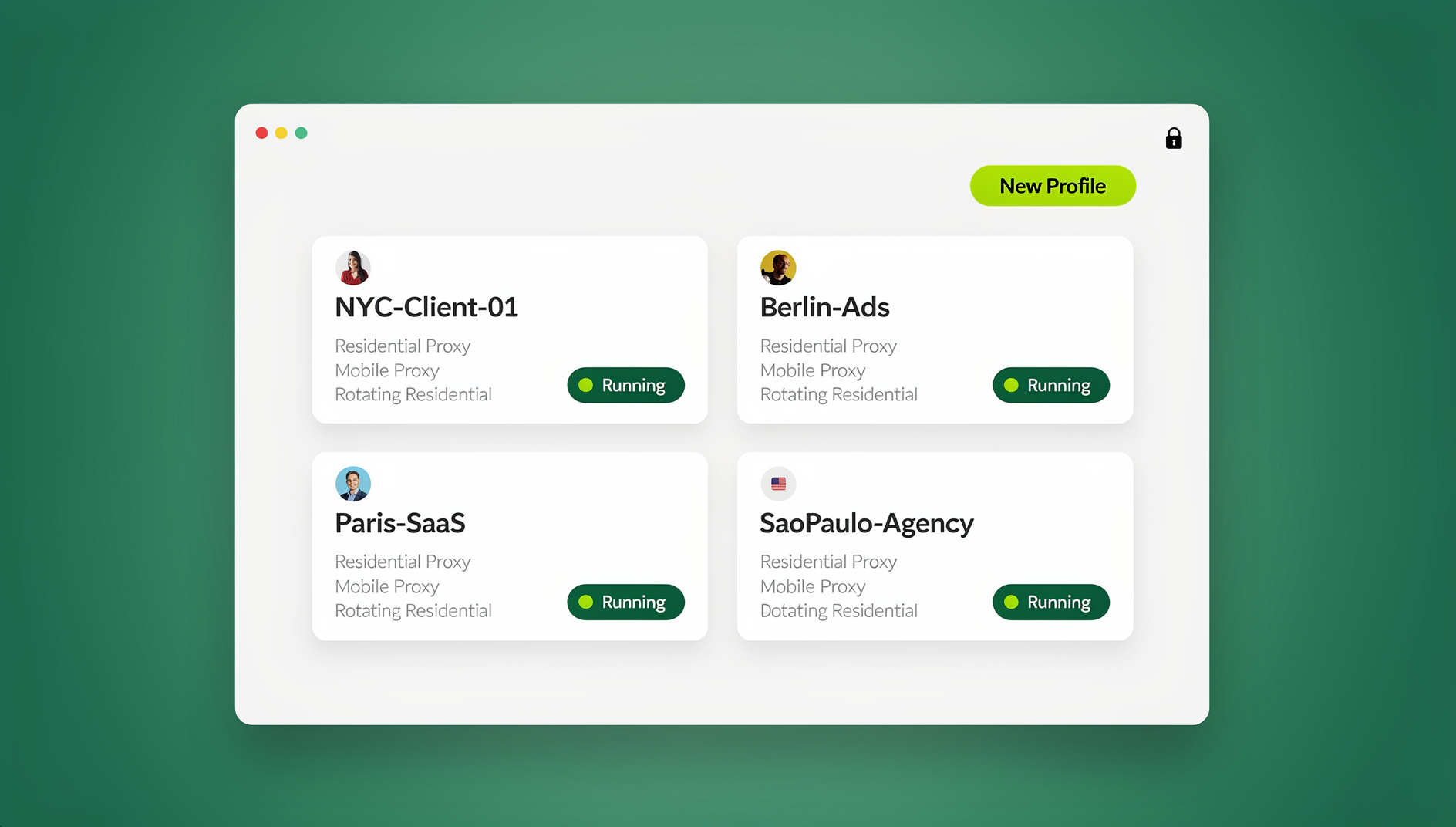
In Sendwin Browser, each profile carries its own cookies, storage and fingerprint. The stealth engine spoofs canvas, WebGL, audio, fonts and hardware at the engine level rather than through script injection, and keeps those values coherent for the whole session. No two profiles share a fingerprint, which removes the device-level bridge Facebook clusters on.
Match the network to the profile
Send.win includes built-in residential proxies on every plan, plus bring-your-own HTTP or SOCKS5. Timezone, locale, WebRTC and geolocation are derived from the proxy’s exit IP automatically, so the profile’s claims and the exit country agree by default. Check the pairing before the first login anyway: a profile reporting US English and Pacific time behind a German IP is the mismatch that starts a review.
Slow the behaviour down
Velocity triggers more disables than any single fingerprint flaw. Log into profiles at human intervals, do not paste the same message into ten conversations, and do not add dozens of friends or join a burst of groups on a fresh account. Give a new profile weeks of ordinary browsing before it carries anything that matters. If you are rebuilding several identities at once, start from a clean structure for how to manage multiple Facebook accounts — the order you create and warm accounts in matters more than anything you do afterwards.
Keep a written map
One row per account: profile name, proxy, email, phone, ID document, and who on the team can open it. When something goes wrong you need that list within the hour, and reconstructing it from memory is when people log into the wrong account from the wrong device — the exact move that caused the original problem.
If you automate, connect to the running profile instead of launching a fresh browser. The local Automation API on the Team plan gives Selenium, Puppeteer and Playwright access to a profile; copy the CDP endpoint from the profile’s automation settings rather than guessing a port.
from playwright.sync_api import sync_playwright

# Copy this value from the profile's automation settings in Sendwin Browser.
CDP_URL = "http://127.0.0.1:PORT"

with sync_playwright() as p:
    browser = p.chromium.connect_over_cdp(CDP_URL)
    context = browser.contexts[0]
    page = context.new_page()
    page.goto("https://www.facebook.com/")
    print(page.title())
    browser.close()
Two habits keep the setup stable afterwards. Sharing: on paid plans you can share a profile with a teammate so it opens already signed in, which removes the “send me the password” step that ends with two people logged in from two countries. Cloud sync: Pro covers 20 profiles and Team 100, so login state follows you between machines instead of being rebuilt by hand. You can also open a profile in the cloud browser — free preview 10 minutes a day, unlimited on Pro and Team — to check an account from an EU or US node without installing anything.
🏆 Send.win Verdict
Most “disabled without appeal” cases are not one bad decision — they are the end of a chain that started with two accounts sharing one fingerprint and one crowded IP. Send.win addresses that chain: every profile gets an engine-level fingerprint that stays coherent for the session, built-in residential proxies drive timezone and locale from the exit IP, and paid plans add profile sharing and cloud sync so a teammate never signs in from another country on your behalf. It will not win an appeal for you, but it removes the linkage that gets accounts disabled in the first place.
Try Send.win free today — 30 days at $0, with 10 isolated profiles and 1 GB of residential proxy traffic included, cancel anytime.
Frequently Asked Questions
Why was my Facebook account disabled without warning?
Meta can disable an account immediately for violations it considers severe or time-sensitive, so there is no guaranteed suspension stage before a ban. Automated checks also flag new accounts, rapid friend requests and repetitive messaging as bot-like. In those cases the disable is the first message you ever see.
Can I appeal if my account was permanently disabled?
Once a disable is marked permanent or an appeal has been denied, there is usually no self-serve route left — a facebook account disabled without appeal at that point is an escalation case, not a form case. Most suspensions do carry a 180-day filing window, though the exact figure varies by region, and a denial inside that window is normally final. What remains is Help Center feedback or paid human support.
How long does a Facebook disabled-account appeal take?
Verification steps run on their own timelines: phone checks resolve in minutes to 24 hours, selfie checks in one to five days, and document uploads in two to seven days. If Meta asks for more documentation after your first appeal, you have 30 days to provide it before the disable becomes permanent.
What if there is no appeal button on my login screen?
Try another surface first — desktop site, mobile app, or a browser you have never used for Facebook — because the prompt appears inconsistently across them. If it never shows up, your case is likely ineligible for self-serve review, and the working routes are the Help Center feedback flow and live support chat through a paid subscription.
Can I create a new Facebook account after being disabled?
Do not create one to appeal the disabled account; using a second account to contest the first can put both at risk. If you genuinely need a new presence, give it its own email, browser profile and network so it is not linked to the disabled account, and use it normally for a while before relying on it.
Does Meta Verified help recover a disabled Facebook account?
Meta Verified includes live human support chat, which is widely treated as the strongest escalation route for wrongly disabled accounts because it puts the case in front of a person rather than another form. It is a paid escalation path, not an official wrongful-ban fix, and no source guarantees recovery. Billing is per asset, so each Page, Instagram account or WhatsApp number is a separate subscription.
Can I recover a disabled Facebook account without ID?
Sometimes. Phone verification and selfie checks resolve plenty of cases without any documents, and those are the steps most people complete successfully. Government ID is requested when the name on the profile needs matching to a real person, so having one document that matches your profile name exactly is the shortest route out.
How Send.win Helps With Facebook Account Disabled Without Appeal
Send.win is an antidetect browser built for exactly this kind of work — every profile is a clean, isolated identity:
- Isolated profiles – unique fingerprint, separate cookies and storage per profile
- Stealth engine – canvas, WebGL, fonts, and audio spoofed at the engine level
- Desktop app + cloud sessions – native app for Windows, macOS, and Linux, or run profiles in the cloud with no install
- Built-in residential proxies – with automatic timezone, locale, and WebRTC matching
- Team features – share logged-in profiles with teammates without sharing passwords
Try the instant cloud browser demo — no install, no signup — or download the desktop app. The 30-day free trial needs no credit card, and paid plans start at $6.99/month billed annually (see pricing).