How to Manage Multiple Google Ads Accounts Without Suspensions
To manage multiple google ads accounts safely, advertisers and agencies must establish strict separation between accounts by using unique IPs, isolated browser environments, distinct payment methods, and clean digital identities. By preventing Google from linking these profiles through browser fingerprinting and cookies, you ensure that a policy violation or suspension on one account doesn’t trigger a devastating chain reaction across your entire advertising portfolio.

The High-Stakes Reality of Google Ads Account Suspensions
In the high-stakes world of digital marketing, pay-per-click (PPC) advertising is a critical revenue driver for countless businesses. At the top of the PPC food chain sits Google Ads. However, Google’s ecosystem is notoriously strict. Google employs some of the most sophisticated fraud detection and tracking algorithms on the internet to maintain the integrity of its ad network. When an agency or affiliate marketer takes on the task of managing multiple accounts, they are often unknowingly stepping into a minefield.
Google’s automated systems are designed to detect and ban bad actors who try to circumvent the system, such as affiliates running prohibited offers, businesses trying to bypass previous suspensions, or scammers. The problem is that innocent agencies often get caught in the crossfire. If Google detects a connection between multiple accounts and one of them is flagged for a policy violation (like “Circumventing Systems” or “Suspicious Payment Activity”), the algorithm will swiftly suspend all linked accounts. This is known as a cascading suspension.
For an agency owner, waking up to find that all client accounts have been suspended simply because one client had a billing issue is a nightmare scenario. This is why learning how to manage multiple Google Ads accounts safely is not just a technical preference; it is a fundamental requirement for business survival.
Understanding How Google Links Accounts Together
To outsmart the algorithm, you first need to understand what it’s looking for. Google does not rely on a single data point to link accounts. Instead, it aggregates dozens of signals to build a comprehensive profile of the user operating the accounts. If these signals overlap across multiple accounts, the accounts are permanently linked in Google’s database.
1. IP Addresses and Network Data
The most obvious link is your IP address. If you log into twenty different Google Ads accounts from the same office Wi-Fi network, Google knows that a single entity controls all of those accounts. While managing client accounts from the same IP isn’t inherently against the rules, it creates a rigid link between them. Furthermore, if you use a standard VPN to hide your IP, Google will easily detect the datacenter IP and flag it as suspicious, drastically increasing your risk of suspension.
2. Browser Cookies and Local Storage
Whenever you log into a Google service, cookies and session tokens are stored in your browser. If you simply log out of Account A and log into Account B in the same browser window, Google reads the leftover cookies. This immediately ties the two accounts together. Standard incognito modes offer limited protection here, as they still share some network-level data and do not completely isolate sessions over the long term.
3. Browser Fingerprinting
This is where things get highly technical. Browser fingerprinting explained simply is the process by which websites collect specific hardware and software configurations of your device to create a unique identifier. Google analyzes your operating system, browser version, screen resolution, installed fonts, Canvas and WebGL rendering, audio APIs, and more. Even if you clear your cookies and change your IP address, your browser fingerprint remains the same, allowing Google to recognize your device across multiple accounts.
4. Payment Methods and Billing Information
Using the same credit card, PayPal account, or bank account across multiple unlinked Google Ads accounts is a massive red flag. Even if the card numbers are different, sharing the same billing address or business name can trigger a linkage. If one account with that billing profile gets suspended for unpaid balances, all other accounts sharing any part of that billing profile are at severe risk.
Google MCC (My Client Center) vs. Separate Accounts
When discussing how to manage multiple Google Ads accounts safely, the first question is usually: “Should I just use an MCC account?” The answer depends heavily on your business model and risk tolerance.
The Benefits of an MCC Account
A Google Ads Manager Account, formerly known as My Client Center (MCC), is Google’s official tool for agencies and large advertisers to manage multiple accounts from a single dashboard.
- Convenience: You use a single login to access dozens or hundreds of client accounts.
- Consolidated Billing: You can set up consolidated billing to receive a single invoice for all managed accounts.
- Reporting: MCC provides cross-account reporting and performance tracking.
- Compliance: It is the Google-approved method for white-hat agencies.
How Send.win Helps With Manage Multiple Google Ads Accounts Safely
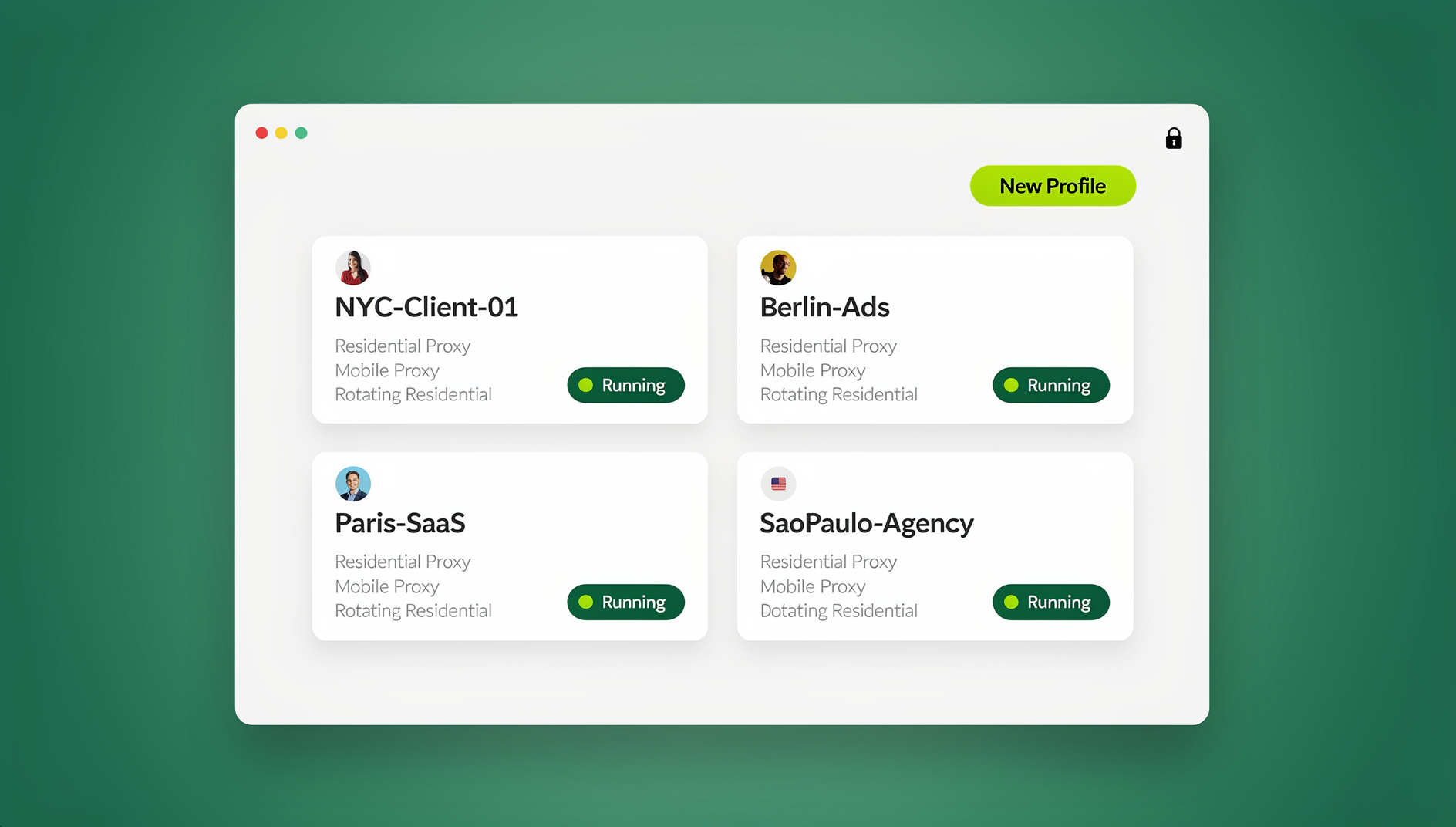
Send.win is an antidetect browser built for exactly this kind of work — every profile is a clean, isolated identity:
- Isolated profiles – unique fingerprint, separate cookies and storage per profile
- Stealth engine – canvas, WebGL, fonts, and audio spoofed at the engine level
- Desktop app + cloud sessions – native app for Windows, macOS, and Linux, or run profiles in the cloud with no install
- Built-in residential proxies – with automatic timezone, locale, and WebRTC matching
- Team features – share logged-in profiles with teammates without sharing passwords
Try the instant cloud browser demo — no install, no signup — or download the desktop app. The 30-day free trial needs no credit card, and paid plans start at $6.99/month billed annually (see pricing).
The Dangers of Using an MCC
While an MCC is convenient, it inherently links all your clients together. If you are a traditional agency running search campaigns for local plumbers and dentists, an MCC is usually fine. However, there are significant risks:
- The Contagion Effect: If one client in your MCC does something that severely violates Google’s policies (e.g., they change their landing page to something deceptive without telling you), their account gets suspended. In severe cases, Google will view the MCC as the common denominator and suspend the entire Manager Account, taking all other innocent clients down with it.
- Affiliate Marketing Risks: If you are an affiliate marketer running aggressive campaigns (nutra, crypto, sweepstakes), using an MCC is a guaranteed way to lose everything at once.
- Client Ownership: Clients may not want their accounts linked to an agency’s central hub, preferring total isolation.
When You Absolutely Need Separate, Unlinked Accounts
If you fall into any of the following categories, relying on an MCC is too risky, and you must adopt strategies to manage multiple Google Ads accounts safely in complete isolation:
- Affiliate Marketers and Media Buyers: Running high-risk verticals requires diversified, unlinked accounts.
- Drop-shippers: E-commerce businesses testing multiple storefronts simultaneously.
- Lead Generation Agencies: Agencies that own the funnels and generate leads for clients, rather than managing the client’s own ad account.
- Arbitrageurs: Traffic arbitrage requires massive scale across independent accounts.
Common Mistakes That Trigger Instant Suspensions
Many advertisers attempt to separate their accounts but fail due to small, overlooked details. Avoid these catastrophic mistakes:
1. Reusing Assets Across Accounts
Do not use the same domain names, landing page templates, or even the same Google Analytics tags across accounts you are trying to keep separate. If Account A and Account B are driving traffic to the same URL or using the same GTM (Google Tag Manager) container, Google links them immediately.
2. Virtual Machines and RDPs
In the past, advertisers used Remote Desktop Protocols (RDPs) or Virtual Machines (VMs) to isolate accounts. While this separates the environment, Google is incredibly adept at detecting VMs. They look for hardware anomalies (e.g., generic graphics drivers, lack of typical background noise) and will flag the account for “Suspicious Activity” before you even launch a campaign.
3. Sloppy Proxy Usage
Using cheap, shared datacenter proxies is a death sentence for a Google Ads account. Datacenter IPs are heavily abused and widely known to Google. You must use high-quality residential proxies or mobile proxies to ensure the IP looks like a genuine, home-based internet user.
4. Copy-Pasting Campaigns
If you export a campaign from Account A and import it exactly as is into Account B via Google Ads Editor, the metadata (including hidden IDs) carries over. You must build campaigns from scratch or thoroughly scrub the data before importing.
Step-by-Step Guide: How to Manage Multiple Google Ads Accounts Safely
To achieve true separation, you must adopt a philosophy of total session isolation. This means treating every account as if it is operated by a completely different human being sitting in a different city on a different computer.
Step 1: Implement Total Browser Isolation
You cannot use standard Chrome, Firefox, or Safari for this. Even with different browser profiles, there is too much data leakage. You need a dedicated multi-login browser that replaces your real browser fingerprint with a unique, randomized, yet consistent fingerprint for every single account.
A multi-login browser containerizes the session, ensuring that cookies, local storage, indexedDB, and cache are strictly isolated. More importantly, it spoofs your hardware details (Canvas, WebGL, Audio, Fonts, User-Agent) so that Google sees a distinct device for every profile.
Step 2: Assign Dedicated Residential Proxies
Once your browser environments are isolated, you must give each profile its own IP address. Purchase high-quality residential proxies. Ensure that the proxy IP matches the geographic location of the Google Ads account’s billing address. If the account is billed to a company in London, the proxy must resolve to London. Never log into that specific profile without that specific proxy active.
Step 3: Completely Isolate Payment Methods
Every isolated Google Ads account needs its own dedicated payment method. You cannot use the same physical credit card twice. Solutions include:
- Virtual Credit Cards (VCCs): Services like Privacy.com, Divvy, or corporate banking platforms allow you to generate unlimited virtual cards with distinct numbers.
- Different Billing Addresses: Ensure the billing address matches the IP location and is distinct from your other accounts.
- Unique Business Entities: For absolute safety at scale, accounts should ideally be linked to different LLCs or business formations.
Step 4: Warm Up the Accounts Naturally
When you create a new, isolated Google Ads account, do not immediately launch a $1,000/day campaign. Google’s trust score for new accounts is zero. You must practice safe browsing to warm up the account:
- Log into the isolated profile and browse the internet normally for a few days (read news, watch YouTube, do standard Google searches) to build up a natural cookie history.
- Create the Google account and let it sit for 24-48 hours.
- Set up the Google Ads account and enter billing details. Wait another 24 hours.
- Launch a very small, low-risk search campaign (e.g., $10/day for brand awareness).
- Gradually scale the spend over several weeks.
Step 5: Segment Your Digital Assets
As mentioned earlier, ensure that everything connected to the account is unique. This means unique domains, unique landing page hosting, separate Google Analytics accounts, separate Google Tag Manager containers, and even different phone numbers if you are using call extensions.
How Send.win Solves the Account Management Puzzle
Executing this level of isolation manually is incredibly tedious. Setting up individual proxy configurations, managing cookies, and avoiding fingerprint leakage is a full-time job. This is why professionals use dedicated platforms like Send.win to automate and secure the process.
Send.win is a premier multi-login browser designed specifically to help agencies and advertisers manage multiple Google Ads accounts safely. Here is how Send.win provides an unfair advantage:
The Send.win Desktop App
Send.win is a native desktop application available for Windows, macOS, and Linux. By running natively, it deeply controls the browser engine, offering superior fingerprint spoofing compared to standard browsers. CRITICAL NOTE: Send.win is a standalone desktop application and cloud platform; it has NO browser extension, ensuring a robust, uncompromised environment free from the vulnerabilities associated with browser add-ons.
Automated Fingerprint Generation
When you create a new profile in Send.win for a client’s Google Ads account, the software automatically generates a highly credible, unique browser fingerprint. It handles the complex masking of WebGL, Canvas, Audio APIs, and hardware concurrency, presenting a mathematically flawless profile to Google’s anti-fraud systems.
Built-in Automation API
Managing dozens of accounts often requires repetitive tasks. Send.win offers a powerful Automation API with full support for Selenium, Puppeteer, and Playwright. This API is available on BOTH the Pro and Team plans. You can write scripts to automate campaign generation, bid adjustments, and reporting across all your isolated profiles without manual intervention.
Cloud Browser Sessions
For ultimate flexibility and security, Send.win offers cloud browser sessions. You can run profiles entirely in the cloud without relying on your local machine’s hardware. This is perfect for distributed teams or when you need to access accounts from a lightweight device, ensuring the digital environment remains perfectly consistent.
With a 30-day free trial (no credit card required), Send.win is accessible to all. The Pro plan at $19/mo (or $6.99/mo billed annually — 63% off) includes 150 profiles, 5GB of proxy bandwidth, and the Automation API. For agencies, the Team plan at $49/mo ($20.99/mo annual — 57% off) expands capacity to 500 profiles, 20GB of bandwidth, the Automation API, and 16 team seats.
🏆 Send.win Verdict
To manage multiple Google Ads accounts safely, you must abandon risky MCC setups and embrace total session isolation. By utilizing distinct IPs, unique virtual credit cards, and robust fingerprint spoofing, you protect your business from devastating cascading suspensions. Success requires meticulous organization and the right technical infrastructure to hide your digital footprints from Google’s aggressive algorithms.
Try Send.win free today — deploy native desktop environments and cloud sessions to scale your Google Ads operations without the fear of bans.
Frequently Asked Questions
Is it illegal to have multiple Google Ads accounts?
It is not illegal in a legal sense, and it is not inherently against Google’s policies for agencies to manage multiple accounts for different clients. However, circumventing a suspension by creating a new account to run the same banned ads is a severe policy violation. Managing multiple accounts safely is about protecting legitimate client assets from cross-contamination, not breaking the law.
Will a standard VPN protect my Google Ads accounts?
No. Standard VPNs use datacenter IPs that are shared among thousands of users, many of whom are engaged in suspicious activities. Google easily detects datacenter IPs and routinely flags them. To manage multiple Google Ads accounts safely, you must use high-quality residential proxies that look like genuine home internet connections.
Can Google detect if I use different Chrome profiles?
Yes. While Chrome profiles separate cookies and basic local storage, they do not mask your hardware or browser fingerprint. Google can easily read your Canvas fingerprint, WebGL data, and underlying OS details to link the Chrome profiles together, putting all accounts at risk.
What should I do if one of my Google Ads accounts gets suspended?
If an account is suspended, never immediately create a new account using the same computer, IP, or payment method. The new account will be instantly banned. You must isolate the suspension. If you were using a platform like Send.win, simply delete the compromised profile and ensure that no assets (domains, VCCs) from the banned account are ever used in your other, safe accounts.
Do I need different domains for each Google Ads account?
If you are trying to keep the accounts completely unlinked, yes. Driving traffic from multiple unlinked Google Ads accounts to the exact same domain name is a massive linkage signal. Each isolated account should have its own unique landing page domain to ensure total separation.
Can my team access these accounts remotely?
Yes, but it must be done carefully. If team members log into the accounts from their personal browsers, they will destroy the isolation. By using a tool like Send.win, you can utilize the Team plan to share isolated profiles. Team members can launch the profiles via the desktop app or cloud sessions, ensuring the fingerprint and proxy remain perfectly consistent regardless of who is operating the account.
Is Send.win a browser extension?
No, Send.win has no browser extension. It is a powerful, standalone desktop application (available for Windows, macOS, and Linux) as well as a cloud platform. This architecture ensures maximum security and prevents the data leaks that are common with lightweight browser extensions.