The sendwin vs incogniton decision comes down to one number. Incogniton’s Professional plan costs $79.99/month for 150 profiles as of this writing; Sendwin’s Pro plan includes the same 150 profiles for $19/month — with residential proxy bandwidth and a full automation API already in the box. Incogniton is still worth considering if you want a free-forever tier or its human-typing simulation, but for anyone paying for real scale, Sendwin delivers roughly eight times the capability per dollar.
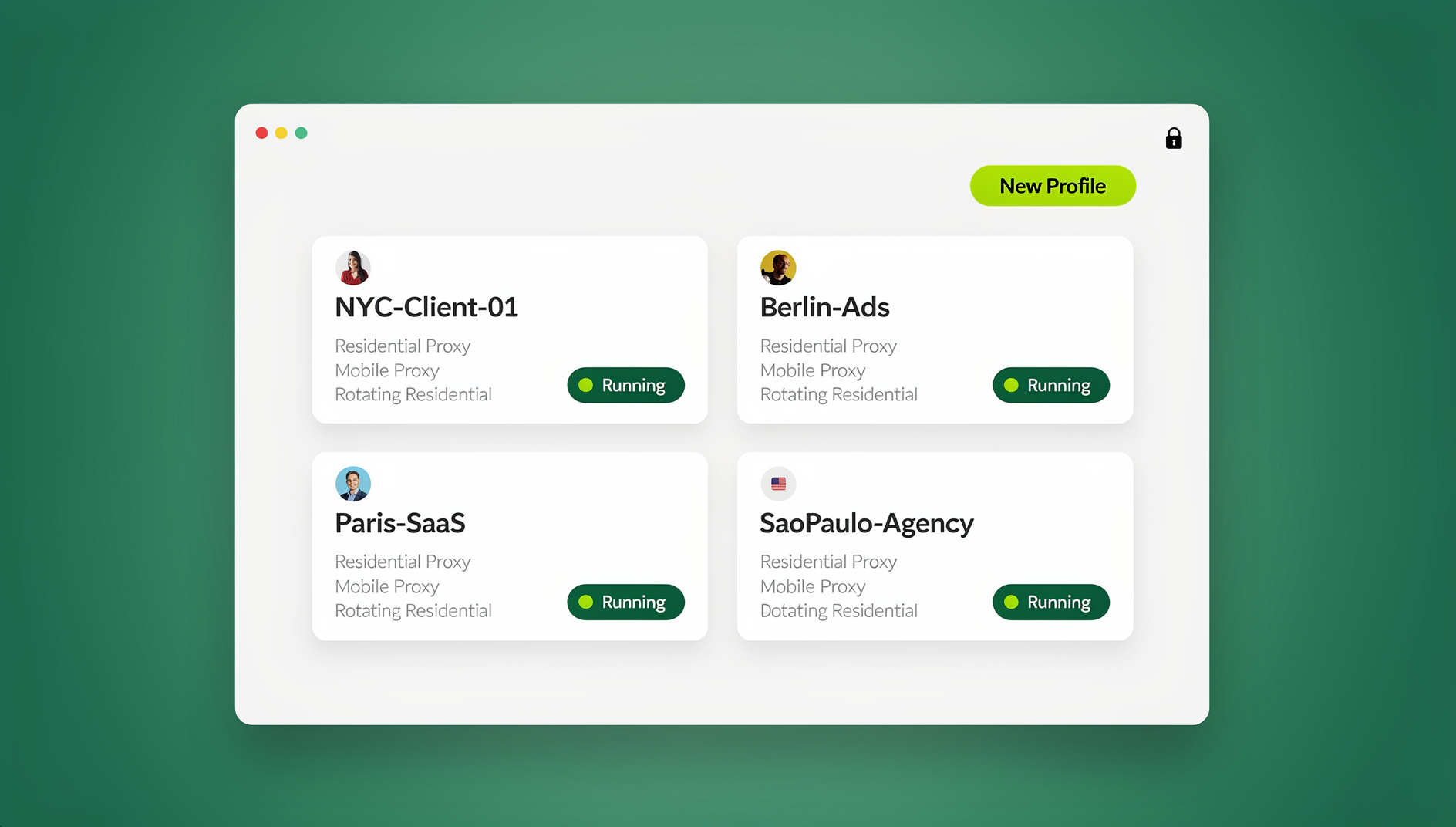

TL;DR: Sendwin vs Incogniton at a Glance
Incogniton built its reputation as the friendly, budget-minded antidetect browser — clean interface, gentle learning curve, and a free tier that let beginners start without commitment. That reputation was earned. But pricing moves and a shrinking free plan have changed the 2026 picture, so here is the head-to-head before we go feature by feature.
| Category | Sendwin | Incogniton |
|---|---|---|
| Best for | Value at scale — profiles, proxies, and automation on one bill | Beginners who want a small free tier and a gentle learning curve |
| Entry price | $19/mo, or $6.99/mo billed annually | ~$13.99–$19.99/mo Starter Plus (as of this writing) |
| Profiles included | 150 on Pro; 500 on Team | 10 on Starter Plus; 50 on Entrepreneur; 150 on Professional |
| Proxies | 5GB residential bandwidth included, auto-configured | Not included — bring your own |
| Automation | Local API on every paid plan (Selenium, Puppeteer, Playwright) | Selenium/Puppeteer API unlocks at the $49/mo Entrepreneur tier |
| Free option | No free-forever tier | Free tier: ~10 profiles for the first 2 months, then drops to ~3 |
| Trial | 30 days, full featured, no credit card | Free tier doubles as the trial |
The one-line verdict: Incogniton remains one of the easiest antidetect browsers to learn, but Sendwin has taken the value crown so decisively that the price gap is now the story.
Fingerprint Quality: Both Pass, One Configures Itself
Under the hood, both tools spin up Chromium-based profiles with distinct canvas, WebGL, font, audio, and hardware fingerprints. If you are new to why that matters, our plain-English guide to the browser fingerprint explains exactly what platforms measure and how antidetect browsers answer.
Incogniton’s fingerprints hold up well on mainstream platforms — marketplaces, social networks, ad dashboards — and its years of steady operation as a budget option earned it a solid reputation. It also adds a clever behavioral touch: the “paste as human typing” feature replays pasted text keystroke by keystroke, which helps on signup flows and platforms that watch input cadence. Its cookie collector can warm fresh profiles by browsing and gathering cookies automatically, so new identities do not look brand new.
Sendwin’s edge is coherence by default. Because residential proxies are built in, every profile’s timezone, locale, and WebRTC behavior is matched automatically to the proxy’s exit location. A profile whose fingerprint says Chicago while its IP says Frankfurt is one of the most common ways multi-account setups die, and Sendwin removes that entire class of mistake. With Incogniton, keeping fingerprint and network consistent is manual work on top of proxies you bought elsewhere.
Both engines pass the checks that matter. Incogniton brings nice behavioral extras; Sendwin brings automatic consistency between fingerprint and network — which, in practice, saves more accounts.
Pricing: The 150-Profile Showdown
This section decides the comparison for most readers, so let us put the plans side by side and then do the math.
| Plan | Profiles | Monthly price (as of this writing) | Notes |
|---|---|---|---|
| Sendwin Pro | 150 | $9.99 ($6.99/mo billed annually) | 5GB residential proxy data + automation API included |
| Sendwin Team | 500 | $29.99 ($20.99/mo billed annually) | 20GB proxy data, 16 seats, automation API |
| Incogniton Free | ~10 for 2 months, then ~3 | $0 | Recently reduced; no automation API |
| Incogniton Starter Plus | 10 | ~$13.99–$19.99 | No automation API |
| Incogniton Entrepreneur | 50 | $49 | Unlocks Selenium/Puppeteer API |
| Incogniton Professional | 150 | $79.99 | 3 team seats |
| Incogniton Custom | 500+ | from ~$149.99 | Custom terms |
As of this writing, Incogniton’s official pricing page confirms these tiers, with discounts of roughly 30% on longer billing terms. Even applying that discount everywhere, the shape of the comparison does not change.
Run the per-profile numbers at equal capacity. Incogniton Professional: $79.99 for 150 profiles is about $0.53 per profile per month. Sendwin Pro: $19 for the same 150 profiles is about $0.07 — under a nickel on annual billing. That is an eight-fold gap before you count what Sendwin bundles in: 5GB of residential proxy data (worth roughly $25–40/month from typical third-party vendors at $5–8/GB) and an automation API that Incogniton reserves for its $29.99+ tiers.
Scale up and the gap widens. Five hundred profiles costs from about $149.99/month on Incogniton Custom versus $29.99 on Sendwin Team — five times more, again before proxies. And Sendwin’s overflow pricing is linear rather than tiered: $0.05 per extra profile and $6/GB for extra bandwidth, so growth never forces a plan jump.
Automation & API: The $9.99 Gate vs the $29.99 Gate
Incogniton does support Selenium and Puppeteer, and its implementation is documented and workable. The catch is placement: the API unlocks at the Entrepreneur tier, $49/month for 50 profiles, as of this writing. Starter Plus users are locked out entirely, and anyone who wants automation across 150 profiles is looking at the $79.99 Professional plan.
Sendwin includes its local Automation API on every paid plan. The $9.99 Pro tier gives you Selenium, Puppeteer, and Playwright control over all 150 profiles, each launching with its fingerprint and included proxy already applied. If you want to see the workflow end to end, our tutorial on driving Puppeteer with an antidetect browser covers connecting a script to a profile in a few lines of code.
Bottom line for builders: automation entry costs $29.99 at Incogniton and $9.99 at Sendwin, and at the 150-profile scale the difference is $79.99 versus $19 per month. There is no version of this category Incogniton wins.
Proxies & Network
Incogniton ships without proxies. You buy residential or mobile IPs from a separate vendor, paste credentials into each profile, and verify the geolocation story yourself. It handles user-supplied proxies fine, but the cost and the configuration burden are entirely yours — and for most real workloads that second bill runs $25 or more per month, often exceeding the Incogniton subscription itself.
Sendwin treats the network as part of the product: 5GB of residential bandwidth on Pro, 20GB on Team, $6/GB beyond, with automatic timezone, locale, and WebRTC alignment to each exit. Normal account-management browsing — dashboards, listings, messaging — sips bandwidth, so most users never buy extra. One vendor, one invoice, and no risk of pairing a pristine fingerprint with a blacklisted IP you bought from the wrong reseller.
Team Features
Incogniton’s collaboration arrives late in its ladder: meaningful team seats appear at the Professional tier — $79.99/month for 3 seats as of this writing — with larger arrangements pushed to Custom plans. For a two-person operation that also wants automation, the required tier climbs quickly.
Sendwin’s Team plan is $49/month ($20.99 annual) for 16 seats and 500 profiles with 20GB of shared bandwidth. Profiles can be shared with teammates without exposing the underlying account passwords — the session travels, the credentials do not — which is exactly what you want when contractors and virtual assistants rotate through. The per-seat arithmetic is stark: under $2 per seat on Sendwin versus roughly $27 per seat on Incogniton Professional.
Cloud Access & Sync
Incogniton offers desktop apps for Windows and macOS, with profile data synced through its cloud so you can move between machines. There is no Linux build as of this writing, which occasionally surprises automation-minded users who deploy on Linux servers.
Sendwin covers Windows, macOS, and Linux with its native Sendwin Browser app, syncs profiles across devices, and adds a second mode Incogniton has no answer to: cloud browser sessions that run a profile in the cloud from any regular browser tab, no installation required. It is the fastest way to hand a VA one account or check a storefront from a machine you do not control. The honest caveat: cloud browsing time is metered monthly, so it complements rather than replaces the desktop app.
Ease of Use
This is Incogniton’s home turf. The interface is clean and unintimidating, profile creation walks you through sensible defaults, and the built-in helpers — paste as human typing, the cookie collector, straightforward proxy fields — flatten the learning curve for first-timers. If you have never touched an antidetect browser and want to poke around indefinitely on a tiny free tier, Incogniton remains one of the gentlest on-ramps in the market.
Sendwin is similarly simple but gets there differently: it automates the steps beginners get wrong rather than teaching them. New profile, automatic residential IP, automatic timezone and locale — you are managing accounts within minutes of signup. That matters for practitioners like the marketplace sellers in our case study on running multiple Etsy shops, where one geolocation slip can cost a storefront. And the 30-day full-featured trial means you evaluate the real product, not a limited free tier.
Pros and Cons
Incogniton pros
- Beginner-friendly, clean interface with a gentle learning curve
- “Paste as human typing” simulates real keystrokes for cadence-sensitive sites
- Cookie collector warms new profiles automatically
- Long-standing reputation as a budget-friendly, stable option
- Free-forever tier still exists, even if reduced
- Solid Windows and macOS desktop apps
How Send.win Helps With Sendwin Vs Incogniton
Send.win is an antidetect browser built for exactly this kind of work — every profile is a clean, isolated identity:
- Isolated profiles – unique fingerprint, separate cookies and storage per profile
- Stealth engine – canvas, WebGL, fonts, and audio spoofed at the engine level
- Desktop app + cloud sessions – native app for Windows, macOS, and Linux, or run profiles in the cloud with no install
- Built-in residential proxies – with automatic timezone, locale, and WebRTC matching
- Team features – share logged-in profiles with teammates without sharing passwords
Try the instant cloud browser demo — no install, no signup — or download the desktop app. The 30-day free trial needs no credit card, and paid plans start at $6.99/month billed annually (see pricing).
Incogniton cons
- Automation API locked behind the $49/mo Entrepreneur tier
- Team seats effectively start at the $79.99/mo Professional tier
- Free tier recently shrank — about 10 profiles for 2 months, then around 3
- No proxies included; separate vendor and separate bill required
- 150 profiles cost $79.99/mo versus Sendwin’s $19/mo
- No Linux app as of this writing
Sendwin pros
- 150 profiles, 5GB residential proxy data, and the automation API for $19/mo
- API included on every paid plan — automation from the cheapest tier
- Team plan: 16 seats and 500 profiles at $49/mo with password-free profile sharing
- Windows, macOS, and Linux apps plus no-install cloud browser sessions
- Automatic timezone, locale, and WebRTC matching to included proxies
- 30-day free trial, no credit card required
Sendwin cons
- No free-forever tier — after the trial you pick a paid plan
- Smaller community and tutorial ecosystem than older incumbents
- Cloud browsing time is metered monthly
- No typing-simulation or cookie-collector equivalents built in
Which Should You Pick?
Pick Incogniton if:
- You want a free-forever tier with zero time pressure, even a small one
- You are brand new and value its gentle UI plus helpers like typing simulation and the cookie collector
- You need ten or fewer profiles, no automation, and prefer a long-established brand
- Your workflow genuinely benefits from paste-as-human-typing on cadence-sensitive platforms
Pick Sendwin if:
- You are paying for scale — the 150-profile tier is one-eighth the price
- You want Selenium, Puppeteer, or Playwright automation without a $29.99 gate
- You do not want a second monthly bill for proxies
- You run a team — 16 seats at $49 versus 3 seats at $79.99
- You use Linux, or want cloud sessions available from any machine
If you are still surveying the whole field before committing, our best antidetect browser ranking puts both of these tools in context against the rest of the 2026 market.
🏆 Send.win Verdict
Incogniton earned its reputation honestly — it is still one of the friendliest antidetect browsers for beginners, and its typing simulation and cookie collector remain genuinely nice touches. But the 2026 sendwin vs incogniton value math is lopsided: $79.99 versus $9.99 for the same 150 profiles, with Sendwin also including residential proxy bandwidth and the automation API that Incogniton gates behind a $29.99 tier. Unless a tiny free tier is all you will ever need, Sendwin is the better buy.
Try Send.win free today — put it head-to-head with Incogniton for a full 30 days, no credit card required.
Frequently Asked Questions
Is Incogniton still worth it in 2026?
For hobbyists who fit inside its small free tier, or beginners who value its clean UI and typing simulation, yes. For anyone paying monthly at scale it is hard to justify: as of this writing, Incogniton charges $79.99/month for 150 profiles while Sendwin charges $19/month for the same count with proxies and an automation API included.
How much cheaper is Sendwin than Incogniton at 150 profiles?
Roughly eight times cheaper on monthly billing — $9.99 versus $79.99 — and the gap widens on annual terms, where Sendwin drops to $6.99/month. Factoring in the included 5GB of residential proxy data, the effective difference is larger still, since Incogniton users buy proxies separately.
Does Incogniton still have a free plan?
Yes, but it shrank recently. As of this writing, new users get about 10 profiles for the first two months, after which the free tier drops to roughly 3 profiles. It remains useful for evaluation and very light use, just no longer for running a real operation.
Does Sendwin have a free plan?
No — that is Sendwin’s most honest weakness in this matchup. It offers a 30-day free trial with no credit card instead, which covers the full product rather than a limited tier, but after 30 days you choose a paid plan starting at $19/month (or $6.99/month billed annually — a 63% savings).
Which plan do I need for Puppeteer or Selenium automation?
On Incogniton, the Entrepreneur tier at $49/month (50 profiles) is the first plan with API access, as of this writing. On Sendwin, every paid plan includes the local Automation API — Selenium, Puppeteer, and Playwright all work from the $9.99 Pro tier across all 150 profiles.
Does Incogniton include proxies?
No. Incogniton supports user-supplied proxies but sells none, so you maintain a separate proxy subscription and configure each profile yourself. Sendwin includes 5GB of residential bandwidth on Pro and 20GB on Team, applied automatically with matched timezone, locale, and WebRTC settings.
Which is better for teams?
Sendwin by a wide margin on price: 16 seats, 500 profiles, and 20GB of shared bandwidth for $49/month, with profile sharing that never exposes account passwords. Incogniton’s meaningful team seats start at the $79.99/month Professional tier and include 3 seats as of this writing.
Can I run Incogniton or Sendwin on Linux?
Incogniton ships Windows and macOS apps only, as of this writing. Sendwin offers native apps for Windows, macOS, and Linux, plus cloud browser sessions that run in any modern browser with nothing installed — an option for locked-down or borrowed machines.