When managing multiple aws accounts, the most secure and efficient method is combining AWS Organizations and AWS IAM Identity Center (SSO) with session-isolated browsers to prevent account cross-contamination. AWS Organizations manages billing and guardrails, SSO handles centralized login portal access, and isolated browser sessions allow cloud architects to maintain separate, simultaneous console sessions for production, staging, and development without cookie leakage or account mix-ups.

The Challenges of Managing Multiple AWS Accounts at Scale
Modern cloud architectures demand strict segregation. Running production systems, testing environments, staging zones, and developer sandboxes inside a single AWS account is a major security and operational risk. Consequently, modern organizations adopt multi-account strategies. However, as the number of accounts grows from a handful to dozens or hundreds, cloud administrators, DevOps teams, and database architects face significant operational friction. The primary challenge lies in balancing security isolation with operational efficiency.
When engineering teams are forced to switch between multiple AWS environments daily, they encounter several operational roadblocks that slow down progress and increase costs:
- Console Fatigue: Constantly logging in and out of different accounts leads to user fatigue and increases the probability of human error. A developer might accidentally deploy a test resource or delete a database in a production account because they lost track of which browser window was active.
- Session Collisions: Standard web browsers share cookie jars across tabs. Logging into one AWS account often terminates the active session of another, or worse, mixes credentials, causing access errors and confusion.
- Blast Radius Control: A misconfiguration in one account should never impact another. While AWS provides structural isolation, the browser remains a common point of failure where a single compromised session could expose multiple environments.
- Credential Exposure: Distributing access keys and long-lived console passwords to a growing team increases the security attack surface exponentially.
This isolation is similar to the strategies used for handling multiple Amazon accounts, where separating shop seller identities is vital to prevent automated linking algorithms from taking down related business units.
The Security Blast Radius of AWS Console Operations
In cloud security, “blast radius” defines the potential scope of damage resulting from a single security incident or operational failure. When managing multiple AWS accounts under a single developer profile on a standard browser, the blast radius is unnecessarily large. If a malicious script, cross-site scripting (XSS) attack, or rogue local tool accesses the browser’s cookie database, it can capture active session tokens for every account the developer has logged into.
By enforcing strict boundary controls, you ensure that a compromise in a development or sandbox account cannot leak credentials to production. Furthermore, standard browsers share the same local storage, cache directories, and temporary files. When developers toggle between production databases and test environments, background processes in the browser can cross-pollinate data, potentially violating compliance standards such as SOC 2, HIPAA, or PCI-DSS. True boundary isolation must extend from the AWS cloud infrastructure down to the physical browser interface used by your team.
The Foundation: AWS Organizations & IAM Identity Center
To establish control over multiple accounts, AWS recommends using AWS Organizations as the administrative core. AWS Organizations enables you to programmatically create accounts, group them hierarchically into Organizational Units (OUs), and apply Service Control Policies (SCPs) to enforce security guardrails. For billing, consolidated billing aggregates charges from all accounts under a single invoice, allowing organizations to benefit from volume discounts.
On top of AWS Organizations, AWS IAM Identity Center (formerly AWS Single Sign-On) provides centralized authentication. Instead of creating local IAM users in every separate account, teams log into a single web portal where they are presented with a list of accounts and role permissions they are authorized to assume. Clicking a role launches an active AWS Management Console tab under that specific security context.
While AWS IAM Identity Center simplifies login mechanics, it does not resolve browser-level limitations. Because standard browsers share active state, opening multiple console tabs from the SSO portal can lead to state collision or forced logouts. Furthermore, session durations are tightly restricted, requiring frequent authentication loops throughout the day, which disrupts developer focus and lowers productivity.
Browser Profiles vs. Session-Isolated Browsers
To handle the day-to-day work of managing multiple AWS accounts, professionals have historically relied on browser-level workarounds. The two most common approaches are standard browser profiles (like Chrome Profiles) and session-isolated browsers. Understanding their differences is key to securing your DevOps workflow.
The Limitations of Standard Browser Profiles
Many system administrators configure separate browser profiles for different environments (e.g., “AWS Prod”, “AWS Dev”, “AWS Client B”). While this isolates cookies, it has major drawbacks at scale:
- Heavy Resource Overhead: Running multiple instances of standard browsers consumes substantial RAM and CPU, slowing down local development machines.
- No Centralized Sharing: DevOps teams cannot easily share active browser environments or pre-configured sessions with colleagues. If a team member needs access to a specific client console, they must log in from scratch.
- Unified Fingerprinting: Standard browser profiles share the same hardware characteristics, operating system details, and IP address. While AWS does not actively ban accounts for sharing a fingerprint, managing external client environments under a single IP without proxy support can trigger security alerts in enterprise monitoring tools.
Operating under separate browser profiles is crucial for safe multi-store operations to prevent automated tracking algorithms from linking separate business units, and the same principle applies to cloud engineers managing strict client account boundaries.
The Session-Isolated Browser Solution
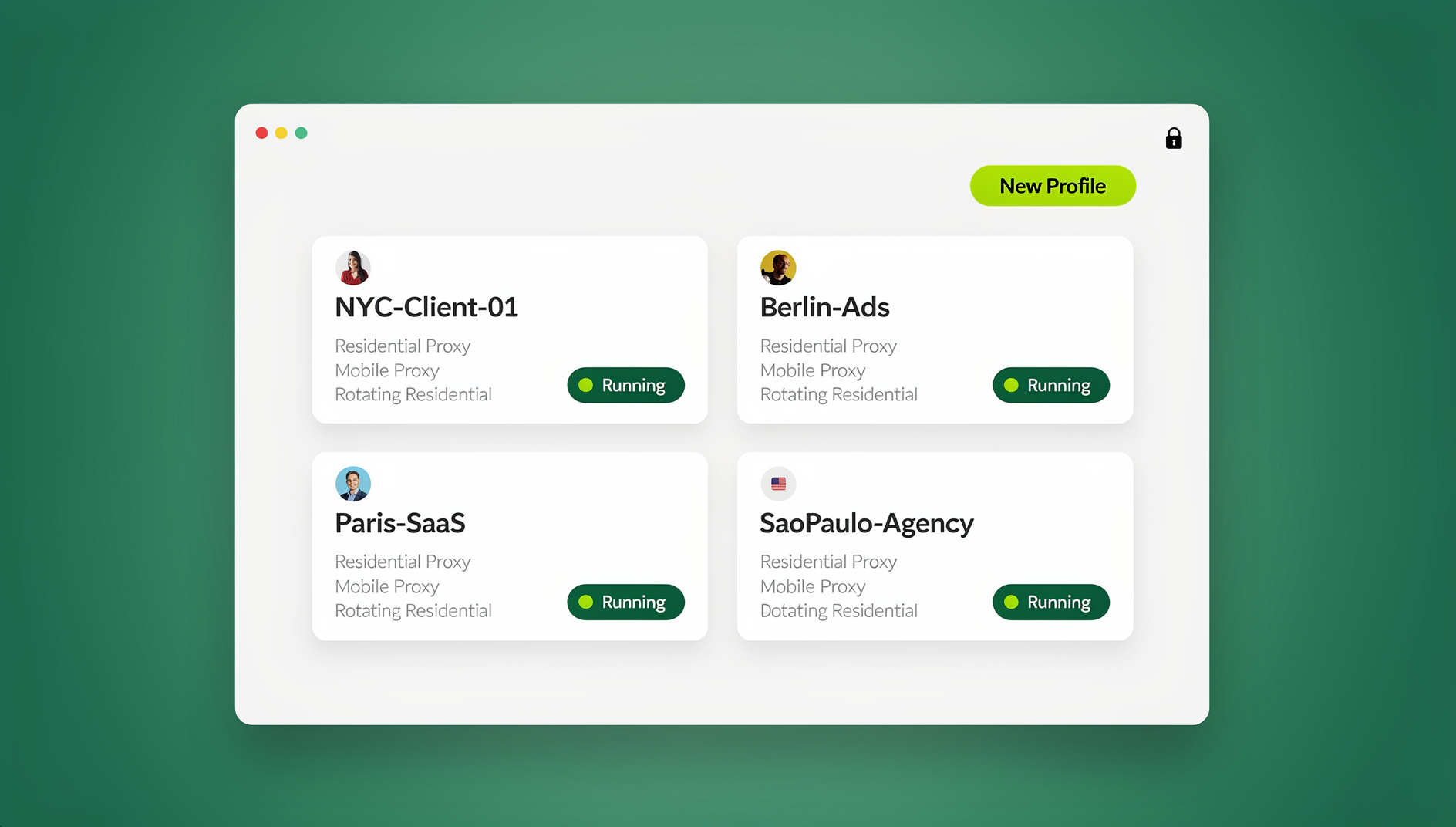
A session-isolated browser like Send.win is built from the ground up to handle multi-account access securely and efficiently. Instead of relying on local profile workarounds, Send.win creates isolated, sandboxed containers for each profile. These profiles run with independent cookie storage, localStorage, and browser fingerprints.
Send.win operates in two primary modes to accommodate different workflows:
- Sendwin Browser (the desktop app): A native Windows, macOS, and Linux desktop client that allows teams to run unlimited profiles locally with minimal system overhead. This is the primary mode of operation for engineers who need maximum performance and local resource access.
- Cloud Browser Sessions: Sandboxed browser instances run entirely in the cloud, allowing teams to access active sessions from any device without installing local software. This is perfect for remote team members or contractors who need quick access.
For more information on coordinating multiple client logins across various platforms, refer to our comprehensive guide on managing multiple accounts. When evaluating options, finding the best browser for multiple accounts will help you select a platform that fits your dev team’s requirements.
Implementing Multi-Region and Multi-Account Isolation
Many AWS architectures are deployed across multiple geographical regions (such as us-east-1, eu-central-1, and ap-southeast-1) to ensure high availability and disaster recovery. When managing these workloads, engineers often need to compare resources across regions and accounts side-by-side. Doing this in a single browser window is highly prone to errors, as the AWS console UI looks identical across regions, making it easy to perform actions in the wrong region.
By using Send.win’s isolated profiles, engineers can dedicate a browser window to a specific region-account combination. For example, you can have one window configured with a proxy in Frankfurt for your European production account, and another window configured with a local connection for your US-based staging account. This geographic and session isolation ensures that administrative requests to the AWS API match the regional source security policies, preventing security alarms and access blocks.
AWS Management Multi-Account Comparison Table
The following table outlines how different browser setups compare when managing multiple AWS accounts:
| Feature | Standard Browser Profiles | Firefox Containers | Send.win Isolated Profiles |
|---|---|---|---|
| Cookie Isolation | Yes (separate profiles) | Yes (separate containers) | Yes (strict sandboxing) |
| Fingerprint Masking | No (shared hardware info) | No (shared fingerprint) | Yes (unique fingerprints per tab) |
| Proxy Support | System-wide (or manual proxy add-on) | Container-specific (manual setup) | Profile-specific proxy matching |
| Cloud Sync & Sharing | No (local profile data only) | No (requires local sync) | Yes (built-in cloud session sharing) |
| System Overhead | High (spawns separate browser instances) | Medium | Low (optimized for parallel sessions) |
| Automation Integration | No | No | Yes (Automation API on Pro/Team plans) |
Step-by-Step Multi-Account Setup Best Practices
To implement an enterprise-ready multi-account architecture, organizations must follow structured security and operational rules. The process can be broken down into five critical phases:
1. Establish the AWS Organizations Hierarchy
Avoid creating accounts in a flat structure. Group accounts into Organizational Units (OUs) to enforce security policies. Create a “Security” OU (containing Log Archive and Security Tooling accounts), an “Infrastructure” OU (containing Network and Shared Services accounts), and a “Workloads” OU split into production and non-production branches. This structure ensures that policies applied at the OU level affect all child accounts automatically, preventing configuration drift.
2. Deploy AWS Control Tower
AWS Control Tower simplifies the setup of a multi-account environment by automating the creation of a “Landing Zone.” It establishes default OUs, configures centralized logging via AWS CloudTrail and AWS Config, and deploys guardrails to enforce compliance. Control Tower’s Account Factory enables teams to provision new AWS accounts with pre-configured networking, IAM roles, and security baselines, ensuring every new environment is secure by default.
3. Centralize Identity with IAM Identity Center
Disable IAM users with long-term credentials in individual accounts. Instead, connect your identity provider (such as Okta, Azure AD, or Google Workspace) to AWS IAM Identity Center. Create permission sets that align with the principle of least privilege. For instance, developers might have full administrator access in sandbox accounts, read-only access in staging, and no direct access to production except through automated CI/CD pipelines.
4. Configure Sendwin Browser Profiles
For operations team members who must manage these accounts, configure distinct profiles in the Sendwin Browser desktop client. Set up one profile per key AWS role or account. For example, create an “AWS-Prod-Admin” profile and an “AWS-Dev-Sandbox” profile. You can open these profiles simultaneously in separate windows. Since the cookies and local storage are isolated, you can stay logged into both accounts at the same time without session timeouts or credential conflicts.
5. Enforce Service Control Policies (SCPs)
SCPs are security guardrails that set the maximum permissions available to accounts within an OU. Even if an IAM user has administrator privileges, an SCP can block specific actions. Implement mandatory SCPs to restrict regions (e.g., deny launching resources outside your primary operating regions), block the deletion of CloudTrail logs, and prevent the creation of public S3 buckets. This ensures that even compromised accounts are restricted in their potential damage.
Designing a Standard Operating Procedure (SOP) for DevOps Teams
Operational security relies heavily on documentation and consistent workflows. An effective multi-account SOP must define how team members access different cloud resources, how session durations are handled, and how access is revoked during offboarding. When onboarding a new engineer, the SOP should require creating their centralized credentials in the corporate directory, which syncs with AWS IAM Identity Center.
Next, the engineer is assigned to specific user groups that define their permission levels. Instead of having them log in using their primary credentials on an unmanaged browser, they are instructed to install the Sendwin Browser desktop client. Pre-configured browser profiles, populated with target URLs, proxies, and session settings, are shared directly with the engineer’s account. This workflow ensures they can begin working immediately, without exposure to raw API keys or passwords, and minimizes configuration errors during environment setups.
Advanced Multi-Account Automation
For organizations looking to scale, manual management of AWS resources and account creation is insufficient. Infrastructure as Code (IaC) tools like Terraform, AWS CDK, and CloudFormation StackSets allow DevOps teams to define infrastructure templates and deploy them across hundreds of AWS accounts simultaneously. StackSets, in particular, integrate with AWS Organizations to automatically deploy resources whenever a new account is added to an OU.
On the browser side, administrative automation often requires interacting with consoles or portals that lack robust public APIs. Send.win provides a powerful Automation API, available on both the Pro and Team plans, which allows developers to run Puppeteer, Playwright, or Selenium scripts directly within isolated browser profiles. This capability enables teams to automate tasks such as routine security audits, multi-account compliance checks, and configuration updates in the AWS Management Console without exposing master credentials or risking account linkage flags.
🏆 Send.win Verdict
AWS console management becomes chaotic when switching profiles or trying to run parallel accounts. Send.win solves this problem by allowing cloud engineers to run separate, isolated, sandboxed browser sessions for each AWS account simultaneously. With support for proxies and persistent sessions, Send.win ensures your staging, production, and sandbox environments remain completely separate without cookie crossover or accidental misconfigurations.
Try Send.win free today — Start your 30-day free trial and experience secure, multi-session cloud browsing.
Frequently Asked Questions
What is the recommended number of AWS accounts for a small startup?
Even for small startups, AWS recommends at least three accounts: a management account (used strictly for billing and organization settings), a production account (holding customer-facing workloads), and a non-production account (for development and testing). This prevents development mistakes from taking down production services.
How does Send.win isolate different AWS console sessions?
Send.win operates using containerized browser environments. Each profile runs in its own sandboxed state with independent cookies, cache, localStorage, and browser fingerprints. This means you can log into two different AWS accounts in parallel without them sharing session data or logging each other out.
What is the difference between the Sendwin Browser app and cloud browser sessions?
The Sendwin Browser desktop app is a native client installed on your computer, running profiles locally for maximum speed. Cloud browser sessions run inside sandboxed environments on Send.win’s servers, allowing you to access your sessions and accounts from any browser without installing local software.
Are there extra AWS costs associated with running multiple accounts?
No, AWS does not charge for creating accounts or maintaining an organization. You only pay for the resources (like EC2 instances, S3 storage, or RDS databases) that are active within those accounts. Consolidated billing aggregates your usage, which can actually lower your costs by qualifying you for higher tier volume discounts.
How does the Send.win Automation API work for AWS management?
The Automation API allows developers to connect automation frameworks like Puppeteer, Playwright, or Selenium to Send.win browser profiles. You can write scripts that launch isolated browser sessions, log into the AWS console, and perform administrative tasks programmatically, ensuring automation scripts run in a safe, fingerprint-protected environment.
Can I share access to an AWS console profile with my team using Send.win?
Yes. Send.win’s Team plan allows you to securely share specific browser profiles with team members. They can launch the profile and access the AWS console without needing to know the master password or re-authenticate, which streamlines operations and enhances credential security.
Can I restrict regional access using AWS Organizations?
Yes, you can use Service Control Policies (SCPs) to restrict region access. By applying an SCP at the root or OU level, you can deny access to all AWS API actions unless they are performed within your allowed geographical regions, protecting your organization from unauthorized deployments.