Why Poshmark Links Your Closets — and What Stops It
Poshmark links closets long before a human ever reviews them: shared IP addresses, identical browser fingerprints, leftover cookies, one verified phone number and one payout account all point to a single operator. The only reliable way to run multiple Poshmark closets without ban risk is to give each closet its own network identity and its own browser profile, then keep sharing behaviour inside conservative limits. Below: the symptoms, the detection mechanics, and the fixes in order of effort.

📌 TL;DR Executive Summary
- Core Takeaway: Poshmark associates closets through IP, canvas/font/user-agent fingerprint, cookies, verified phone number and payout method. Fixing only cookies, or only the IP, leaves the rest of the stack pointing at one person.
- Key Risk/Challenge: The documented suspension trigger through 2025–2026 is not sharing — it is delisting and relisting items within 60 days. Automation also breaches the Terms of Service no matter how well you hide it.
- Recommended Solution: One isolated browser profile per closet, one dedicated ISP or mobile IP bound to it, a separate phone and payout per closet, and sharing under 4,000 self-shares a day with 5–15 second randomized delays.
The Symptoms: How You Find Out Your Closets Are Linked
Linking rarely arrives as a clean ban message. It shows up as friction first, and the friction is a free warning.
- Verification loops. A closet that logged in cleanly yesterday now asks for an SMS code every time, or serves a Cloudflare challenge with a reCAPTCHA warning about unusual activity.
- Chain reactions. One closet is restricted and the others follow within days — including closets that never touched automation.
- Share jail. Your shares still click, but the counter stops moving and your items stop surfacing in the feed.
- New closets flagged on day one. You sign up fresh on the same laptop and get throttled before your first sale.
If two or more of those are happening at once, your listing content is almost never the cause. The platform has already decided your closets belong to one operator.
What Poshmark’s Terms of Service Actually Say
Read the rules before you engineer around them. Poshmark’s Terms of Service, last updated June 3, 2025, prohibit creating multiple accounts to evade punishment or avoid restrictions. The same document bans using any robot, spider, scraper or automated means to access the platform, and bans scraping or harvesting data. Poshmark also reserves the right to suspend or terminate access.
Three practical consequences follow:
- Separate closets are not banned by themselves. Nothing in the terms caps you at one closet, and the economics explain why sellers spread out. Poshmark takes 20% commission on sales of $15 or more and a flat $2.95 below that, calculated on item price only, with no payment-processing, listing or monthly fee on top.
- A closet created to dodge a suspension is explicitly prohibited. If closet A is restricted and closet B pays out to the same bank account, you are in the exact pattern the rule targets.
- Automation technically breaches the terms. Share bots, auto-followers and relisting tools all fall under automated access, even where sellers treat them as routine.
The Poshmark Terms of Service is short enough to read in one sitting. The goal is not to hide from the rules — it is to run each closet as a clean, separate identity, which is the same discipline behind managing multiple Poshmark closets over the long term rather than patching problems monthly.
The Detection Mechanics: What Actually Links Two Closets
Poshmark links closets through a stack of signals, and any single one is enough to associate two accounts. Cookies are the weakest link and the easiest to fix, which is why “clear your cookies” advice keeps circulating and keeps failing. If your goal is to run multiple Poshmark closets without ban risk, you have to neutralise the whole stack — patching the convenient layer changes nothing about the rest.
Shared IP and the Cloudflare bot wall
Poshmark sits behind Cloudflare, which rate-limits and challenges repeated requests from one IP and returns a reCAPTCHA warning about unusual activity. Two logged-in closets behind one home connection look like one operator with two storefronts; five Poshmark tabs sharing at once look like a small farm.
Datacenter and free proxy IPs fare worse than your home connection. They sit on reputation lists, so they get throttled faster, sometimes on the first page load. The durable tier is ISP or static residential: one dedicated IP, held stable and geo-matched to where the closet ships from.
Browser fingerprint
Poshmark is a mobile-first app, so its web detection leans on what a desktop browser cannot help revealing: canvas rendering, installed fonts, user agent and screen size. Two closets opened in the same browser build on the same laptop produce the same canvas hash, the same font list and the same screen metrics. Clearing cookies changes none of it.
Cookies, local storage and session tokens
Log into closet A, sign out, log into closet B in the same browser, and residue remains — a service worker, a cached token, an analytics identifier. The accounts land in the same bucket even though you signed out properly.
Hard identifiers: phone number and payout method
The hardest links are the ones you cannot spoof. A verified phone number and a payout account are unique, durable and tied to real money. Two closets sharing either one are the same operator as far as risk scoring is concerned, and no proxy or fingerprint fix changes that.
Behaviour and timing
Rhythm is a signal. Two closets sharing from 2 a.m. to 4 a.m. in identical bursts, at identical intervals, with identical daily counts behave like software because they are software. Behavioural throttling is separate from IP reputation, so a clean network will not fix your timing.
Quick Wins You Can Ship Today
Start with the cheapest changes and work upward. Each one removes a real linking signal, though none is a complete fix on its own. If you want to run multiple Poshmark closets without ban risk on a tight budget, this is the order to spend your money in.
- Stop crossing sessions. Never log a second closet into a browser profile that has already touched the first.
- Pause auto-relisting. Delisting and relisting inside 60 days is the documented suspension trigger behind the six-day suspensions sellers report.
- Throttle sharing. Randomized 5–15 second delays, under 4,000 self-shares per day, no auto-following, activity confined to normal waking hours.
- Split the hard identifiers. A dedicated phone number and a separate payout method per closet is the highest-value fix that has nothing to do with technology.
- Use Poshmark’s own Bulk Sharing. In-app Bulk Sharing returned in December 2025, which removes most of the reason to run a third-party share bot at all.
- Cap concurrent sessions. Two closets logged in at once on one connection is the fastest route to a Cloudflare challenge.
Quick wins reduce signal; they do not remove it. Fingerprint and IP problems stay unsolved until the browser itself is isolated, and the criteria for choosing that browser matter more than the marketing suggests — here is how to pick the best antidetect browser for marketplace work.
Here is how the fixes rank by effort against what each one genuinely solves:
| Fix | Effort | What it actually fixes |
|---|---|---|
| Never cross sessions between closets | 10 minutes | Cookie, local storage and token linking |
| Stop relisting inside 60 days | 5 minutes | The documented suspension trigger |
| Cap self-shares under 4,000/day with 5–15s delays | 15 minutes | Behavioural and rate-based throttling |
| Separate phone number and payout per closet | Days | Hard-identifier relinking behind clean IPs |
| Isolated browser profile per closet | 1 hour | Canvas, fonts, user agent, screen, storage |
| Dedicated ISP or mobile IP per closet | 1 hour | IP reputation and geo mismatch |
| Keep one stable location per closet | Ongoing | Location trust that mid-month rotation destroys |
The Real Fix: One Isolated Profile Per Closet
Quick wins shrink the signal. Isolation removes it. The setup is a browser profile that owns its own cookies, storage, cache and fingerprint, plus a proxy bound to that profile so timezone, language and geolocation stay aligned to one place.
Each profile should carry its own proxy. That is not a preference — it is what keeps a closet’s timezone, language and geolocation stable enough to read as a single real machine instead of a rotating identity. That stability is what lets you run multiple Poshmark closets without ban risk from one laptop.
Choosing the proxy tier
| Proxy type | Suitability for closets | Notes |
|---|---|---|
| ISP or static residential (dedicated) | Best default | One stable, geo-matched IP held per closet |
| Mobile | Best for already-throttled closets | Highest trust tier, highest cost |
| Rotating residential | Public-page scraping only | Never for a logged-in session — the IP changes mid-visit |
| Datacenter | Poor | Throttled and challenged faster than residential |
| Free proxies | Do not use | Shared, abused and often already blocked |
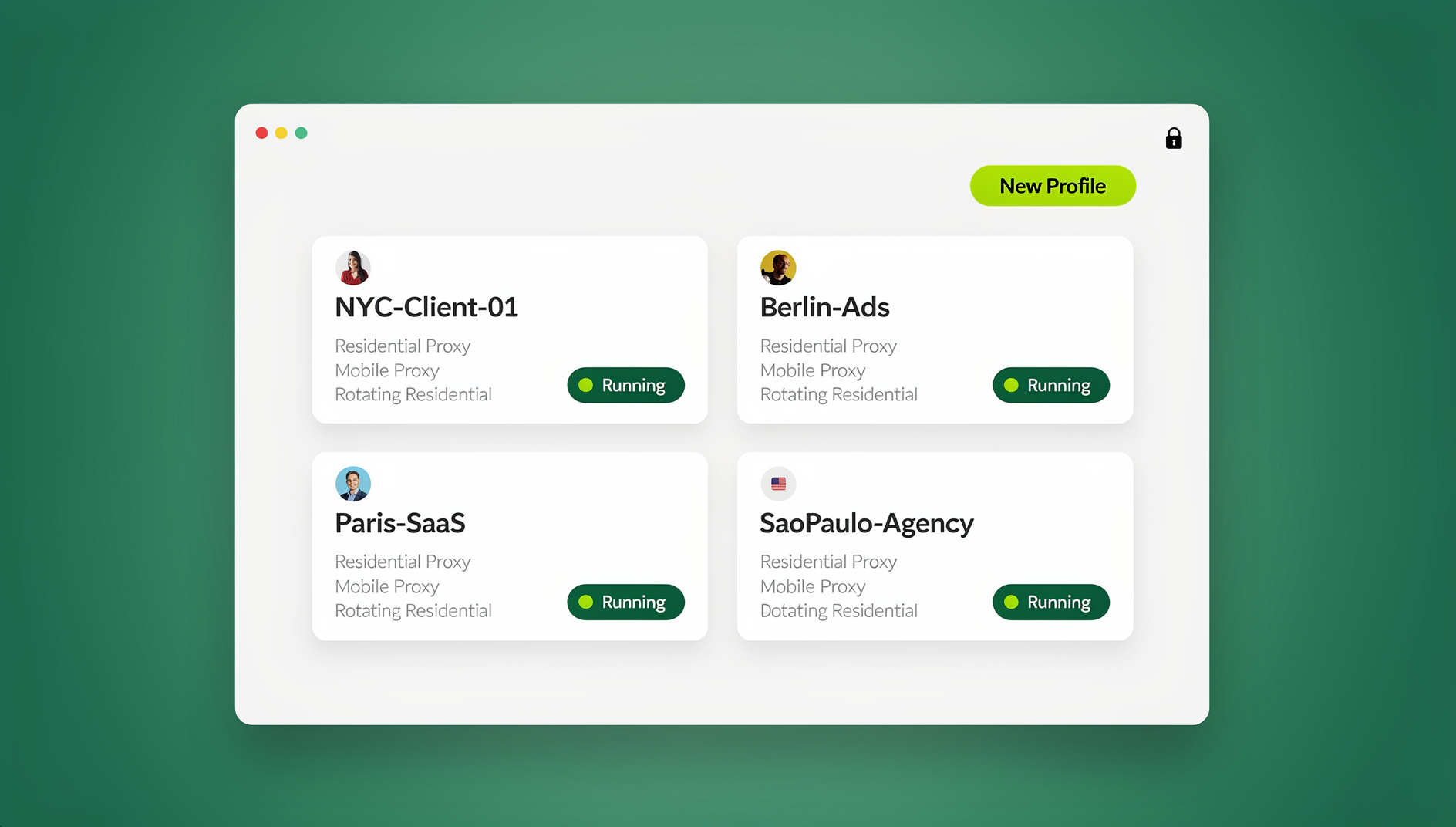
Send.win ships built-in residential proxies on every plan and also accepts your own HTTP or SOCKS5 proxies if you already pay for ISP addresses. Timezone, locale, WebRTC and geolocation follow the proxy’s exit IP automatically, so you are not hand-editing flags and hoping the two stay in sync.
Setting up a closet profile, step by step
- Buy one dedicated IP per closet — ISP or static residential, geolocated near where the closet ships from.
- Create one browser profile per closet and name it after the closet, not after the person running it.
- Attach the proxy inside the profile, then load an IP check and a fingerprint check page. The reported timezone must match the exit IP. Fix any mismatch before you log in.
- Log one closet in per profile, permanently. That profile never sees a second Poshmark account.
- Close the profile instead of logging out. Signing out and switching is the habit that leaks identifiers across accounts.
- Record the mapping — closet email, profile name, proxy, phone number, payout method — in one spreadsheet you actually maintain.
If you want the deeper mechanics — how canvas, WebGL, audio and font spoofing stay coherent across sessions — the walkthrough on how to run a fingerprint browser safely covers the failure modes that break most DIY setups.
Sharing, Relisting and the 2025–2026 Enforcement Timeline
Enforcement on Poshmark has moved in visible steps, and the sequence tells you which behaviours are genuinely dangerous and which are over-hyped.
- May 1, 2025: a blanket suspension wave hit cross-listers who delisted and relisted items within 60 days.
- October 2025: a feed change cut the value of sharing in the feed, reducing the payoff from raw share volume.
- November 16, 2025: the PoshSidekick incident put third-party automation back in the community spotlight.
- December 2025: Poshmark restored in-app Bulk Sharing.
Aggregated community reports show no documented permanent bans for sharing or following alone. Enforcement there is share jail or follow jail — a throttle, not a death sentence. The documented suspension trigger is auto-relisting inside 60 days, which brings six-day suspensions. Treat those as observed seller patterns rather than official Poshmark policy.
Cloud bots running on foreign server IPs carry elevated detection risk compared with tools that operate inside your own browser session.
Tooling, with the caveats attached
| Tool | Type | Poshmark cost | What to watch |
|---|---|---|---|
| In-app Bulk Sharing | Built into Poshmark | Free | Restored December 2025; no third-party risk |
| PosherVA | Chrome or Edge extension | $25/month | Desktop must stay on; no mobile option |
| Nifty | Cloud crosslisting and automation | From $25/month automation, from $39.99/month crosslisting | 7-day trial; 12% saving billed annually |
| Vendoo | Crosslisting | Free up to 5 items, paid from $8.99/month | Bulk delisting and inventory import cost $4.99/month each |
| List Perfectly | Dashboard with Sub-Accounts | Pro Plus tier | Connects two or more closets without password sharing |
Poshmark bot pricing in the 2026 roundups runs from $9.99 to over $39.99 per month, and it changes often. Check each vendor’s own page before you budget, and remember that review sites tend to rank their own product first.
How to Keep Closets From Getting Linked Again
Prevention is mostly about consistency. Detection systems reward stable identity and punish churn, so the boring choice is usually the safe one when you plan to run multiple Poshmark closets without ban risk across several years of selling.
- Pick a location and keep it. Rotating a closet’s IP mid-month is worse than a slightly imperfect location held steady — long-term location trust only accrues over time.
- Match proxy geography to shipping region so buyer questions, shipping estimates and timezone all agree.
- Keep activity human. Variable hours, real gaps, no 3 a.m. sharing marathons, no identical daily counts across closets.
- Heed early warnings. A reCAPTCHA loop or a stalled share counter means pause that closet for 48 hours instead of pushing volume.
- Keep closets out of shared browsers. A closet should never be logged into a profile you also use for personal shopping.
Marketplaces converge on the same linking logic, so the habits transfer. If you also sell elsewhere, the playbook for managing multiple eBay accounts maps almost one-to-one onto Poshmark, with the same phone and payout traps.
Running Closets With a Team Without Password Sharing
Poshmark does not offer multi-user access to a single closet, which pushes teams into password sharing. Every extra person logs in from a new device and a new IP, so re-verification loops are the predictable result.
Send.win handles this differently: share a profile with a paid teammate and it opens already signed in, so no password changes hands and the login never moves. Live cloud sessions share the same way, and cloud sync keeps logins consistent across the devices you work from.
Two team rules are worth writing down. Agree who owns the 2FA phone and recovery email for each closet, because a mid-run password reset drops every shared session at once. And keep profile ownership explicit — two people operating one profile under different habits recreates the behavioural noise you spent the morning removing.
🏆 Send.win Verdict
Poshmark’s linking logic is identity-based, not cookie-based, so the fix has to be a full identity per closet. Send.win covers the two layers that are hardest to build yourself: the Stealth engine spoofs canvas, WebGL, audio, fonts and hardware at the engine level and keeps each profile’s signals coherent, while built-in residential proxies mean timezone, locale, WebRTC and geolocation follow the exit IP instead of contradicting it. The free trial gives you 10 profiles and 10 residential proxies with 1 GB of bandwidth for 30 days — enough to run multiple Poshmark closets without ban risk while you test the workflow before you commit.
Try Send.win free today — 30 days at $0, your profiles stay on your machine, and Pro continues at $19/month, or $6.99/month billed annually, once the trial ends.
Frequently Asked Questions
Is it legal to run multiple Poshmark closets?
Poshmark’s Terms of Service prohibit creating multiple accounts to evade punishment or avoid restrictions, and they ban automated access. Owning several closets for genuinely separate businesses is not what that rule targets. What gets you terminated is opening a new closet to get around a suspension on an old one.
Does Poshmark actually ban you for using a share bot?
Aggregated community reports through 2025 and 2026 show share jail and follow jail rather than permanent bans for sharing or following alone. Automation still breaches the Terms of Service, and the documented suspension trigger is auto-relisting within 60 days. Treat community numbers as observed patterns, not guarantees.
Why do my Poshmark accounts get linked together?
Usually the whole stack rather than one signal: shared IP address, identical browser fingerprint, leftover cookies and storage, the same verified phone number and the same payout method. Poshmark also sits behind Cloudflare, which flags repeated requests from one IP before any human looks at your closets.
Will using a proxy keep my Poshmark closet from being banned?
A proxy fixes one layer — IP reputation and geographic consistency — and it will not save a closet that shares a phone number or payout account with a suspended one. It also does nothing about behaviour, which is a separate detection surface. Run a clean proxy, a clean fingerprint, separate identifiers and conservative timing together.
Can I run several Poshmark closets from one computer?
Yes, provided each closet gets its own isolated browser profile and its own dedicated IP. One browser with five Poshmark tabs is the setup that reliably links accounts, because every tab shares the same canvas hash, fonts, screen metrics and connection.
Should I use residential or datacenter proxies for Poshmark?
Use ISP or static residential IPs, one dedicated address per closet, geo-matched to the closet’s shipping region. Mobile proxies are the most durable tier for closets that have already been throttled. Datacenter and free proxies get challenged faster, and rotating residential IPs should only ever touch public pages, never a logged-in session.
How many self-shares per day is safe on Poshmark?
The conservative profile sellers converge on is under 4,000 self-shares per day with randomized 5–15 second delays, no auto-following, and activity limited to normal waking hours. That is a community-observed pattern rather than official guidance, so start lower than the ceiling and watch whether your share counter keeps counting.
Is relisting items on Poshmark allowed?
Relisting is not prohibited by the terms in itself. The enforcement problem is delisting and relisting inside 60 days, which triggered the May 2025 suspension wave and remains the clearest documented path to a six-day suspension. Space relists well past that window and you remove the single riskiest behaviour in the workflow.
How Send.win Helps With Run Multiple Poshmark Closets Without Ban
Send.win is an antidetect browser built for exactly this kind of work — every profile is a clean, isolated identity:
- Isolated profiles – unique fingerprint, separate cookies and storage per profile
- Stealth engine – canvas, WebGL, fonts, and audio spoofed at the engine level
- Desktop app + cloud sessions – native app for Windows, macOS, and Linux, or run profiles in the cloud with no install
- Built-in residential proxies – with automatic timezone, locale, and WebRTC matching
- Team features – share logged-in profiles with teammates without sharing passwords
Try the instant cloud browser demo — no install, no signup — or download the desktop app. The 30-day free trial needs no credit card, and paid plans start at $6.99/month billed annually (see pricing).