What Is a Cloud Browser and Why Do Remote Workers Need One?
A cloud browser for remote workers is a browser running entirely in the cloud — sessions, cookies, fingerprints, and data never touch your local device. It solves the problems VPNs and browser profiles can’t: true session isolation, zero local data exposure, and access from any machine without installing anything.

The Real Security Challenges Remote Workers Face
Remote work didn’t just change where people work — it fundamentally broke the security models built for office environments. Here are the specific problems that cloud browsers address.
Personal and Work Account Separation
Most remote workers use the same browser for everything — personal Gmail, client dashboards, internal tools, social media management, and banking. Browser profiles in Chrome or Firefox help, but they share the same underlying browser instance, IP address, and often leak data through shared extensions, autofill suggestions, and clipboard history.
The risk isn’t theoretical. Logging into a personal social media account in one tab while managing a client’s ad account in another can trigger platform security flags. Platforms like Meta, Google Ads, and Amazon detect when multiple accounts operate from the same browser environment and may restrict or ban accounts — even if they belong to different people.
Shared Device Risks
Not every remote worker has a dedicated work laptop. Freelancers, contractors, and workers in developing markets often share devices with family members or use public computers at libraries and coworking spaces. Even “logging out” doesn’t fully clean up: cached credentials, saved passwords, browser history, local storage data, and IndexedDB entries can persist across sessions.
A cloud browser eliminates this entirely because nothing is stored locally. When the cloud session ends, the device retains zero trace of the browsing activity.
VPN Limitations for Remote Work
VPNs mask your IP address but introduce their own problems for remote workers:
- Speed reduction — routing through a VPN server adds latency, which compounds when you’re already on a slower home or café connection.
- Split tunneling conflicts — running a company VPN alongside a personal connection creates routing headaches and often forces all traffic through the corporate tunnel.
- IP blacklisting — popular VPN IP ranges are widely flagged by platforms. Running client accounts through a shared VPN IP can trigger CAPTCHA walls or account reviews.
- No session isolation — a VPN changes your IP but doesn’t separate your browser sessions. Cookies, fingerprints, and local storage remain shared across all tabs and windows.
Accessing Geo-Restricted Tools and Content
Remote workers often need to access tools and platforms restricted to specific regions. A social media manager in Europe managing a client’s U.S.-targeted campaigns needs to see what American users see. A QA tester verifying localized pricing needs to browse from multiple countries. A researcher checking regional search results needs authentic local browsing environments.
VPNs can shift your apparent location, but sophisticated platforms detect VPN traffic and serve different results anyway. A cloud browser running in a specific geographic data center with a residential IP provides a genuinely local browsing experience.
How Cloud Browsers Solve Remote Work Problems
Isolated Sessions Per Client or Project
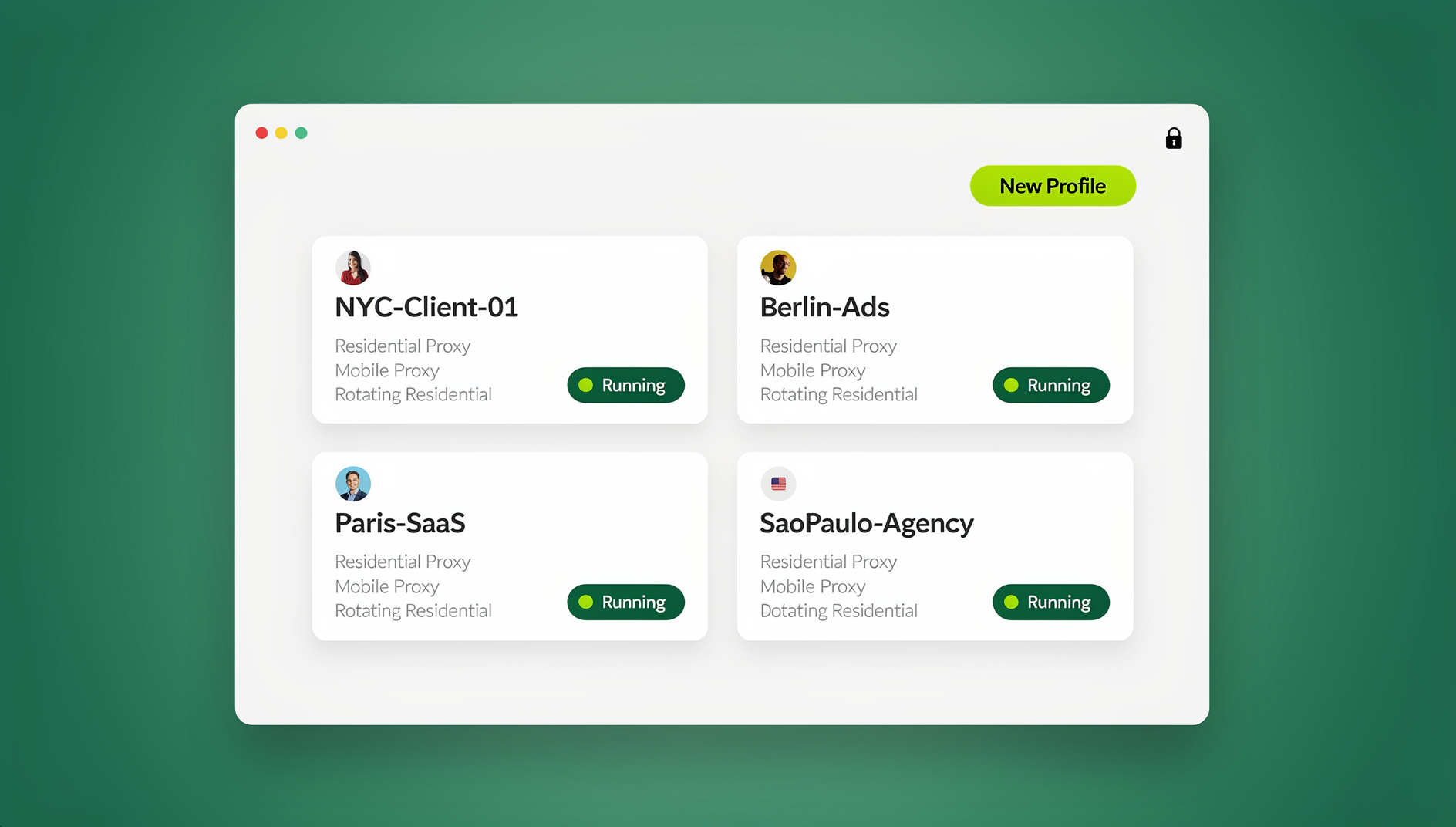
The most powerful feature of a cloud browser for remote workers is session isolation. Each client, project, or account gets its own completely independent browsing environment with:
- Separate cookies and session data — no cross-contamination between clients
- Independent browser fingerprint — each session appears as a unique device
- Dedicated IP address or proxy — each session can exit from a different location
- Isolated local storage, IndexedDB, and cache — no shared state of any kind
This means you can manage Client A’s Google Ads account and Client B’s Google Ads account simultaneously, from the same physical device, without either session knowing the other exists. No account flags. No “unusual activity” warnings. No risk of accidental cross-login.
Zero Local Data Storage
With a cloud browser, all session data lives on remote servers. Your local device — whether it’s your personal laptop, a borrowed machine, or a shared workstation — stores nothing. This provides several advantages:
- No data left behind on shared devices — critical for freelancers using coworking spaces
- No local forensic trail — sensitive client work can’t be recovered from your hard drive
- Simplified compliance — for industries with data handling requirements (healthcare, finance, legal), cloud browsing keeps client data off personal hardware entirely
- No risk of device theft exposure — if your laptop is stolen, your cloud browser sessions and client data are safe behind account authentication on the cloud platform
Access From Any Device, Anywhere
Cloud browser sessions aren’t tied to a specific installation. You can start a session on your desktop at home, continue it on a tablet at a café, and finish it on a different laptop entirely. The session persists in the cloud — your device is just the viewport.
This is transformative for remote workers who travel or work across multiple locations. There’s no “I left my work browser on my other computer” problem. Every device is your work device as long as you can log in.
Key Use Cases for Remote Workers
Managing Multiple Client Accounts
Digital marketing agencies, social media managers, and freelance consultants routinely manage 5, 10, or 50+ client accounts across platforms like Google Ads, Meta Business Suite, LinkedIn, Amazon Seller Central, and Shopify. For practical strategies on handling this at scale, check out our guide to managing multiple accounts safely.
Each platform has its own rules about account sharing and multi-account detection. Running them all in the same browser is a ticking time bomb. Cloud browser sessions let you assign one profile per client account, each with its own session data, fingerprint, and IP — the way platforms expect real users to behave.
Testing in Different Regions
Remote QA testers, localization teams, and market researchers need to verify how websites, apps, and ad campaigns appear in different countries. This goes beyond just changing your IP:
| What You Need to Test | What a VPN Provides | What a Cloud Browser Provides |
|---|---|---|
| Local pricing and currency | Sometimes (detected by many sites) | Authentic local session with matching timezone, language, and locale |
| Localized search results | Partial (Google often detects VPN IPs) | Genuine search results from the target region |
| Geo-restricted content access | Yes, but flagged by many platforms | Access through residential IPs that pass platform checks |
| Ad campaign verification | Unreliable (ad platforms filter VPN traffic) | See real ads as local users see them |
| Compliance checking (GDPR banners, etc.) | IP-level only | Full locale simulation including browser language and timezone |
Secure Browsing on Shared or Public Networks
Coffee shop Wi-Fi, hotel networks, coworking space connections — these are the daily reality for remote workers, and they’re all potential attack surfaces. A cloud browser adds a layer of protection because the actual browsing happens on a remote server. Your local connection only carries the encrypted stream between your device and the cloud browser — not the raw traffic between “your browser” and every website you visit. This provides protection against several common threats that remote workers face on untrusted networks. For more on building a secure browsing setup, see our safe browsing guide.
- Man-in-the-middle attacks — intercepting traffic on the local network only captures the encrypted cloud browser stream, not your actual web activity
- DNS hijacking — DNS resolution happens on the cloud server, not your local machine
- Session hijacking — your cookies and session tokens never transit the local network
Onboarding and Offboarding Contractors
When you bring on a freelancer or contractor, cloud browser sessions let you give them access to specific client accounts without sharing passwords or installing anything on their personal devices. When the engagement ends, you revoke access — the contractor’s device never had the data, so there’s nothing to recover or wipe.
Cloud Browsers vs. Traditional Remote Work Tools
How do cloud browsers compare to the tools remote workers already use?
| Feature | Regular Browser + VPN | Virtual Desktop (VDI) | Cloud Browser |
|---|---|---|---|
| Session isolation | None (all tabs share context) | Full OS-level isolation | Full browser-level isolation per profile |
| Local data exposure | High (cookies, cache, history stored locally) | Low (data stays on virtual machine) | Zero (nothing stored locally) |
| Setup complexity | Low | High (IT provisioning required) | Low (web-based access, no install) |
| Cost | $5-15/mo for VPN | $30-80+/mo per virtual desktop | $9.99-$49/mo (Send.win) |
| Multi-account support | Manual (separate browser profiles) | Separate VM per account (expensive) | Native (unlimited isolated profiles) |
| Performance on low-end devices | Good (runs locally) | Depends on connection quality | Good (server does the heavy lifting) |
| Geo-location flexibility | VPN server locations | Fixed to VM datacenter location | Per-session proxy with location matching |
Virtual desktops (VDI) offer the strongest isolation but are expensive and complex to manage. VPNs are cheap but don’t isolate sessions. Cloud browsers hit the practical sweet spot for most remote workers: genuine isolation, zero local data, easy setup, and affordable pricing.
What to Look for in a Cloud Browser for Remote Work
Not all cloud browsers are built for the same use case. Here’s what matters specifically for remote workers:
- True session isolation — each profile should have independent cookies, fingerprints, and storage. Browser “profiles” that share the same underlying engine don’t count.
- Multi-device access — you should be able to access any session from any device without reinstalling or reconfiguring.
- Team sharing — if you work with a team or manage contractors, you need the ability to share specific profiles or sessions with granular permissions.
- Proxy integration — built-in proxy support with per-profile assignment lets you match each session to the appropriate geographic location.
- No local installation required — the whole point is that the browser runs in the cloud. If you need to install a full application to use it, the “cloud” part is just marketing.
- Automation support — for repetitive tasks like checking ad placements across accounts, automation APIs (Selenium, Puppeteer, Playwright) save hours of manual work.
Run Cloud Browser For Remote Workers in the Cloud With Send.win
Send.win’s cloud browser runs your isolated profiles on remote infrastructure — open a clean, fingerprint-isolated session from any device without installing anything:
- Instant cloud sessions – launch an isolated browser in seconds, no local install
- Isolated profiles – separate fingerprint, cookies, and storage per session
- Cloud sync & profile sharing – pick up the same profiles on the desktop app (Windows, macOS, Linux) or share them with your team
- Built-in residential proxies – with automatic timezone and locale matching
You can try it right now: the Send.win demo browser opens an isolated cloud session directly in this browser tab. The cloud demo is free, and paid plans start at $19/month — see pricing.
Send.win Cloud Browser Sessions for Remote Work
Send.win offers two modes that address different remote work scenarios. The Sendwin Browser is a native desktop app for Windows, macOS, and Linux that creates fully isolated browser profiles locally (requires install) — ideal when you’re working from a dedicated machine and want maximum performance. For the remote browser isolation approach, cloud browser sessions run profiles entirely in the cloud with no local install needed — perfect for shared devices, traveling, or accessing work sessions from any machine.
Both modes provide full session isolation: independent cookies, unique browser fingerprints, separate storage, and per-profile proxy routing. The difference is where the processing happens. Desktop profiles run on your machine. Cloud sessions run on Send.win’s infrastructure and you connect through a browser — your local device is just a window into the session.
How Remote Workers Use Send.win
- Agency account managers create one profile per client, each with the client’s assigned proxy for authentic geographic access. Switch between client accounts instantly without logging in and out.
- Freelancers on shared devices use cloud browser sessions to keep client work completely off personal hardware. End the session, and nothing remains on the device.
- QA and localization teams set up profiles with different region proxies to test localized content, pricing, and ad placements as real local users see them.
- Remote team leads share specific profiles with team members on the Team plan, maintaining access control without sharing raw credentials.
Automating Repetitive Remote Work Tasks
Send.win does not offer an automation interface: there is no API, SDK, headless mode, or Selenium/Puppeteer/Playwright support on any plan. Instead, remote workers use isolated profiles to keep separate cookies, storage, and fingerprints for each account.
- Checking ad placements across multiple client accounts daily
- Monitoring competitor pricing in different regions
- Screenshotting campaign landing pages for client reports
- Testing login flows across multiple environments
🏆 Send.win Verdict
Remote work demands browser isolation that goes beyond VPNs and incognito tabs. Send.win gives remote workers two paths: the Sendwin Browser desktop app (requires install) for dedicated machines, and cloud browser sessions (no local install) for access from any device. Each profile is fully isolated with its own fingerprint, cookies, and proxy. The Pro plan is $19/mo or $83.88/yr and includes 150 profiles and 5GB bandwidth. The Team plan is $49/mo or $251.88/yr for 500 profiles, 20GB bandwidth, and 16 seats. The first card purchase is covered by a 7-day money-back guarantee, and there is a free cloud demo at https://send.win/demo-browser/.
Try the free Send.win cloud demo — a 3-minute preview without signup, or 10 minutes a day with a free account. Start with cloud browser sessions and see why remote teams are switching.
Frequently Asked Questions
What is a cloud browser for remote workers?
A cloud browser is a browser that runs on remote servers instead of your local device. For remote workers, this means your browsing sessions, cookies, login data, and cache are stored in the cloud — not on your laptop or shared device. You access sessions through any web browser, and when you disconnect, nothing remains locally. This solves the core remote work challenge of keeping client data secure across multiple devices and networks.
Is a cloud browser the same as a VPN?
No. A VPN only changes your IP address and encrypts the connection between your device and the VPN server. Your browser still stores cookies, fingerprints, and session data locally, and all tabs share the same identity. A cloud browser runs the entire browsing environment remotely, with full session isolation between profiles, zero local storage, and independent fingerprints per session. They solve different problems — VPNs address IP privacy, cloud browsers address session security and isolation.
Can I use a cloud browser on any device?
Yes. Cloud browser sessions are accessed through a standard web browser, so you can connect from any device with internet access — Windows, macOS, Linux, tablets, even Chromebooks. There’s nothing to install, and sessions persist in the cloud regardless of which device you use to access them.
How does a cloud browser protect client data?
Client data never touches your local device when using cloud browser sessions. All cookies, cached files, login tokens, and browsing history remain on the cloud server. If your device is lost, stolen, or shared, there’s no client data to compromise. When you revoke a contractor’s access, they lose access instantly — there’s no data to recover from their machine.
Are cloud browsers fast enough for daily work?
Modern cloud browsers perform well for typical work tasks: email, web apps, document editing, social media management, and ad platform management. They’re comparable to using a remote desktop. Latency depends on your connection quality and distance to the cloud server. Tasks that require heavy local processing (video editing, 3D rendering) aren’t suitable for cloud browsers, but standard office and marketing work runs smoothly.
How much does a cloud browser for remote work cost?
Costs vary widely. Enterprise virtual desktop solutions run $30-80+/month per user. Cloud browser platforms like Send.win start at $19/mo or $83.88/yr for the Pro plan with 150 isolated profiles and 5GB bandwidth. Team plans are $49/mo or $251.88/yr supporting up to 500 profiles, 20GB bandwidth, and 16 seats. The first card purchase is covered by a 7-day money-back guarantee, and there is a free cloud demo at https://send.win/demo-browser/.
Can I automate tasks in a cloud browser?
No. Send.win does not offer an automation interface — there is no API, SDK, headless mode, or Selenium/Puppeteer/Playwright support on any plan. Instead, you can run routine tasks manually in isolated profiles, so each session keeps its own cookies, storage, and fingerprint.
What’s the difference between a cloud browser and a virtual desktop?
A virtual desktop (VDI) gives you an entire remote operating system — a full Windows or Linux desktop running in the cloud. A cloud browser gives you only an isolated browser environment. Virtual desktops offer more flexibility (you can run any application) but cost significantly more and require IT management. Cloud browsers are lighter, cheaper, faster to set up, and purpose-built for the browsing-centric work that most remote professionals do daily.