Does browser.lol Work on a Phone or Tablet?
Yes — with caveats. browser.lol is a website rather than an app, so Safari on iOS and Chrome on Android can open it and stream a remote Chrome or Firefox session. What you do not get on a phone is control over the proxy or fingerprint, any session persistence, or published guidance on touch behaviour. browser.lol mobile use suits opening a link you do not trust; it is not a phone-based multi-account setup.

📌 TL;DR Executive Summary
- Core Takeaway: browser.lol runs in a mobile browser because it streams a cloud session — but there is no mobile app, no proxy assignment and no fingerprint control.
- Key Risk/Challenge: free sessions are ad-funded and capped at roughly 15 minutes, sessions are disposable with no resume, and the clipboard bridge sends whatever you paste to the remote machine.
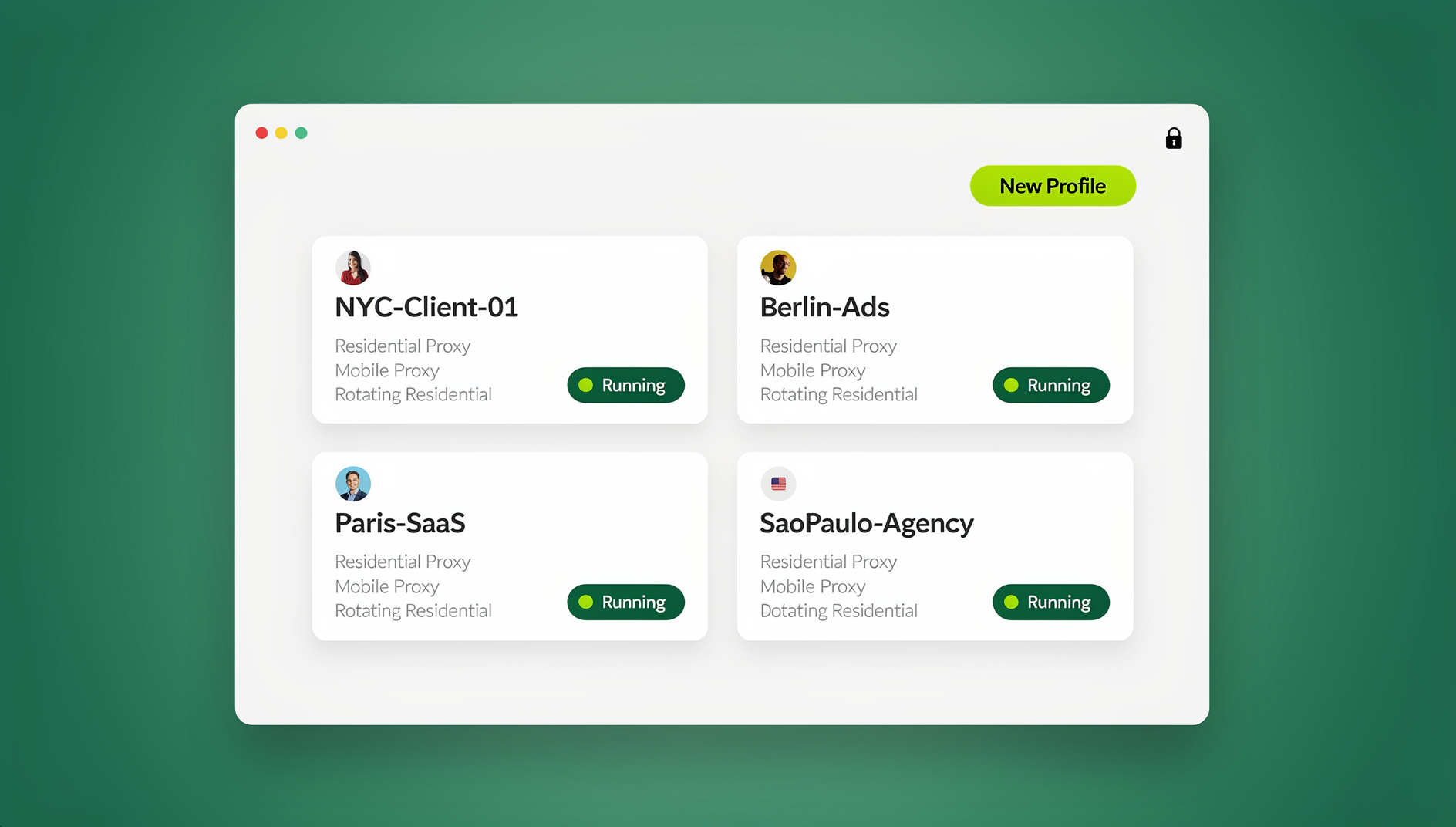
- Recommended Solution: treat it as a malware sandbox on your phone; for real account work, use a cloud profile browser that keeps fingerprints and proxies consistent per account.
What browser.lol Is, and What It Is Not
browser.lol is a cloud-hosted virtual browser. The session runs on a remote server and streams into whatever browser you already have open, with nothing installed locally. Launch, use, close — the same routine on a laptop and on a phone.
Each session is stateless and disposable: cookies, cache and history are wiped when the tab closes, and a closed session cannot be resumed. The service began as BIAB (Browser in a Box) and has offered virtual Chrome and Firefox sessions since at least 2023. It states that its operations follow Swiss data protection rules, that server infrastructure sits in Germany and that data is stored inside the EEA, and it reports handling 20 million API calls and 400,000 active sessions each month.
What it is not is an identity manager. The pitch is risk isolation: pages execute on a server instead of your device, so malicious code stays contained there. Nothing in that setup manages who you appear to be — there is no proxy of your own, no fingerprint control and no separation between accounts.
How a Streamed Session Reaches Your Phone
The mechanics match enterprise remote browser isolation, minus the policy layer. Pages render in an isolated environment on the provider’s machine and stream back as pixels plus an input channel. Vendor documentation describes the same model: JavaScript, modern frameworks, HTML5 and rich media all execute remotely, and remote URLs keep their original addresses with no prefixes added.
Your phone is only a viewer
Page JavaScript, canvas drawing and network requests run on the remote host, so code that would otherwise execute on your handset never reaches it. Enterprise deployments go further, building isolation profiles that restrict what a user can do inside a session — disabling the keyboard to block credential phishing, for instance, and keeping cookies and user data away from the endpoint.
The clipboard bridge is the weak link
The consumer version is looser: a clipboard panel bridges local and remote, so text you paste into the virtual browser is effectively sent to the remote environment. That is convenient for a URL and a bad idea for anything you would not type into a stranger’s laptop. If you are weighing it up for logins, the risks of logging into sensitive accounts through a disposable session deserve a separate read first.
Latency decides how usable it feels
Streaming adds a round trip to every tap, scroll and keystroke. One hands-on write-up reports an anecdotal minimum of about 10 Mb/s for comfortable navigation. RBI vendors argue that added lag is why the model stays confined to a small slice of traffic and is kept away from single-page apps and HTML5 canvas workloads that expect local execution. Cellular networks make it worse: latency swings more than on a fixed line, and hand-offs between cells produce stutter a wired connection rarely shows.
Nobody publishes data-usage or battery figures for streamed sessions, so budget as you would for video. On a metered plan, that matters.
browser.lol Mobile in Practice: What Works, What Breaks
Nothing suggests the service is blocked on mobile browsers. There is no iOS or Android app, which is not the same as failure — it is a browser service, and a mobile browser is a browser. What is missing is documentation for everything below.
- Touch controls. No public documentation covers pinch-zoom, virtual mouse handling, text selection or long-press inside a streamed session. Whether a gesture reaches the remote page as a gesture or as a synthetic click decides whether a mobile layout behaves normally.
- Gesture-heavy pages. Maps you pan, canvas editors, drag-and-drop dashboards and infinite feeds depend on continuous local execution — the workloads streaming handles worst.
- Session length. A published review describes the free tier as ad-supported with roughly a 15-minute cap and limited CPU, RAM and bandwidth. Fifteen minutes is enough to check a link and little more.
- The clipboard between apps. Mobile systems suspend background apps and discard tabs, so the clipboard bridge may not survive a switch to your password manager and back. Keep critical text where you can re-copy it.
- Exit location. The free tier uses the default server location; choosing exit locations sits in the paid Plus tier.
Your choice of mobile browser matters less than you expect here, because rendering happens elsewhere. Chrome remains the compatibility leader on iOS and Android in 2026 comparisons, and a 60-day Android test published in September 2026 found Firefox the strongest of the majors thanks to full desktop extension support. For a streamed session your phone browser is only a viewer — the fingerprint a site evaluates is produced by the remote environment, not by Safari on your handset.
That distinction matters once you move from passive browsing to account work. Understanding what a phone already reveals, starting with touch event fingerprinting on mobile, explains why a streamed session and a managed profile solve two different problems.
How browser.lol Compares With Other Mobile Options
Four approaches get mixed up constantly, and only one of them is about identity.
| Approach | Hides your IP? | Separates identities? | Works on a phone? |
|---|---|---|---|
| browser.lol (virtual browser) | Sites see the service’s server address; no proxy of your own, no geolocation control | No — no proxy assignment, no fingerprint editing, and a 2025 safety explainer rules out anonymous identity and multi-account work | Yes, through the mobile browser; touch behaviour undocumented |
| VPN app | Yes — it changes your exit IP | No — same browser, same canvas, fonts and device signals, so every account still looks like one machine | Yes, native |
| Device cloud (TestMu AI and similar) | Varies by setup | Built for testing real devices, not for managing identities | Yes, by definition |
| Anti-detect profile browser (Send.win) | Residential proxy on every plan; the exit IP drives timezone, locale, WebRTC and geolocation | Yes — canvas, WebGL, audio, fonts and hardware spoofed per profile | Yes, via the cloud browser from any device; the desktop app runs on Windows, macOS and Linux |
If your job is opening a link you do not trust, the first row is enough. If your job is running five seller accounts from a phone, only the last row addresses what gets accounts linked: a consistent per-profile identity with a matching exit IP.
Why the Mobile Gap Hurts Account Work
The people searching for browser.lol mobile are usually sellers checking listings, media buyers verifying creatives, social managers answering DMs, or agency staff uploading assets from a phone. For that group the product is the wrong shape, for three documented reasons.
- No proxy assignment. There is no interface for attaching your own proxy, so traffic exits through the default server IP.
- No fingerprint or geolocation control. Canvas, fonts and headers are whatever the remote environment exposes, and sessions cannot be made deliberately different from each other.
- No persistence. Sign in, close the tab, and the cookies go with the session. A half-finished upload does not survive a call, a network switch or a background tab being discarded.
That last point stings most on a phone, where interruptions are constant. A desktop user can leave a session open through a working block; a phone user cannot, and there is no resume.
A Checklist for Cloud Sessions on a Phone
- Decide what you are isolating. Containing a sketchy download page is a good fit. Running accounts is not.
- Test the stream first. Wi-Fi, heavy page, thirty seconds of scrolling. If it stutters, stop there.
- Assume the session dies. Keep tasks under a few minutes and never leave work only inside the remote browser.
- Keep secrets off the clipboard bridge. Password managers, recovery codes and card numbers stay on your side of the screen.
- Verify the exit before you act. Open a page that prints IP, timezone, language and WebRTC state inside the session, and check they reflect the server rather than your handset.
- Keep account work out of disposable sessions. If an account matters, it needs a persistent profile with a consistent fingerprint and a matching proxy.
- Use a device cloud when the device is the question. TestMu AI, rebranded from LambdaTest on 12 January 2026, lists 3,000+ browser and OS combinations and 10,000+ real devices — the right tool for checking how a page renders on a real iPhone.
Free, Plus and Premium: What Each browser.lol Tier Gives You
| Tier | What it includes | What that means on a phone |
|---|---|---|
| Free (ad-funded) | Virtual sessions, no card required, ads inside the session | Short sessions with capped resources; blocking ads removes the revenue that pays for the servers |
| Plus | Full browser list, no ads, exit locations, disposable tempmail inbox, residential data | More comfortable, but still no proxy assignment, no fingerprint editing and no session persistence |
| Premium (announced, coming soon) | Saved profiles, an MCP endpoint an AI assistant can drive, a larger monthly data allowance, a second session | Saved profiles would be the first feature resembling account persistence — it is not available today |
Billing details are worth reading before you upgrade from a phone, where small print is easy to miss. Cards are processed by Mollie in USD, EUR or CHF depending on your location, and annual billing charges ten months for twelve — an effective 17% saving over monthly. Cancelling leaves your plan active until the paid period ends, with no further charge. Upgrades to Premium bill the pro-rated difference immediately, but moving back down does not refund the remaining period. Existing lifetime licences keep the Plus browsing features permanently, while saved profiles, MCP access, the larger data allowance and the second session sit behind the Premium subscription.
If you want a feature-by-feature browser.lol alternative comparison that separates what is shipping from what is announced, that breakdown covers how these tiers stack up against profile-based browsers.
What Running Accounts From a Phone Actually Requires
Strip the problem back and phone-based account work needs four things a disposable stream does not provide: a session that survives an interruption, a fingerprint that stays consistent between visits, an exit IP that matches the account’s region, and a way to open the same profile from a different device.
How Send.win Helps With Browser Lol Mobile
Send.win is an antidetect browser built for exactly this kind of work — every profile is a clean, isolated identity:
- Isolated profiles – unique fingerprint, separate cookies and storage per profile
- Stealth engine – canvas, WebGL, fonts, and audio spoofed at the engine level
- Desktop app + cloud sessions – native app for Windows, macOS, and Linux, or run profiles in the cloud with no install
- Built-in residential proxies – with automatic timezone, locale, and WebRTC matching
- Team features – share logged-in profiles with teammates without sharing passwords
Try the instant cloud browser demo — no install, no signup — or download the desktop app. The 30-day free trial needs no credit card, and paid plans start at $6.99/month billed annually (see pricing).
Send.win covers those through two routes. Cloud profiles run on EU and US cloud nodes and open from any device with nothing to install — the route that matters on a phone, with a free preview of 10 minutes a day and unlimited cloud browsing on Pro and Team. The Sendwin Browser desktop app, for Windows 10/11, macOS 12+ and Linux, runs profiles locally with the Sendwin Stealth engine inside a patched-Chromium engine.
Two differences matter for account work. Sessions persist, so a cloud profile keeps its cookies and logins and syncs them across devices — the account you signed into on your phone is the account you open on your laptop. And identity is per profile rather than per service: canvas, WebGL, audio, fonts and hardware are spoofed at the engine level and kept coherent, so no two profiles share a fingerprint, while timezone, locale, WebRTC and geolocation follow the proxy’s exit IP automatically. Residential proxies ship on every plan, and you can bring your own HTTP or SOCKS5 proxy.
Sometimes a throwaway session really is the right answer, and there are plenty of disposable cloud browsing tools built for exactly that. Use them for links you distrust; use a managed profile for anything with a login attached.
Automation, when you get there, sits on the Team plan: a local API for Selenium, Puppeteer and Playwright. Each profile exposes a local CDP address you copy from its automation settings and drive from your own scripts. A phone-sized viewport is one line in the script:
from playwright.sync_api import sync_playwright

CDP_URL = "http://127.0.0.1:PORT"  # copy it from the profile's automation settings

with sync_playwright() as p:
    browser = p.chromium.connect_over_cdp(CDP_URL)
    context = browser.contexts[0]
    page = context.new_page()
    page.set_viewport_size({"width": 390, "height": 844})  # phone-sized viewport
    page.goto("https://example.com")
    print(page.title())
    browser.close()
Keep the limits in view: the automation API is Team-only, and the desktop app does not run on iOS or Android. On a phone you are opening a cloud profile, not installing the browser.
🏆 Send.win Verdict
browser.lol answers a narrow question well: it runs a virtual browser on a remote server and streams it to your phone, so a hostile page never executes locally. It gives you no proxy of your own, no fingerprint you control and no session you can return to, which is why it struggles the moment the goal shifts from containing a page to running accounts. Send.win is built for that second job — each profile carries its own consistent fingerprint and its own residential exit IP, and the cloud browser lets you open that profile from a phone without installing anything.
Try Send.win free today — run isolated profiles in the cloud from any device, with 10 free minutes of cloud browsing a day and a 30-day desktop trial that keeps your profiles on your machine.
Frequently Asked Questions
Does browser.lol work on iPhone or Android?
Yes, as far as the platform goes. It is a web service, so Safari on iOS and Chrome on Android can open a session, and nothing published confirms it is blocked on mobile. The absence of a mobile app is not evidence of failure, but touch behaviour and gesture handling remain undocumented.
Can you use browser.lol on a phone without an app?
That is the only way to use it. There is no iOS or Android app; the service streams a remote Chrome or Firefox session into your existing mobile browser, and nothing is installed locally.
Is browser.lol safe to use on mobile data?
The page content runs on the provider’s server rather than your device, which is the isolation benefit. The risks sit elsewhere: your traffic is a continuous stream, and no source has measured how much data or battery a session consumes. On a metered plan, treat it like video streaming.
What is the difference between browser.lol and a VPN?
A VPN changes your exit IP but leaves your browser, fingerprint and cookies exactly as they were, so every account still looks like the same machine. browser.lol changes where the page executes and hides your device from the site, but gives you no proxy choice and no way to make sessions differ from one another.
How long does a free browser.lol session last?
A published review puts the free tier at roughly 15 minutes per session with limited CPU, RAM and bandwidth. Longer, uninterrupted work is a paid-tier expectation, and even then sessions stay disposable.
Can browser.lol be used for multiple accounts?
No. A 2025 safety explainer states the virtual browser is not usable for anonymous identity, multi-account work, automation or fingerprint spoofing, and there is no interface for attaching proxies or editing fingerprints. Each session also wipes its cookies and history on close.
Does browser.lol hide your IP address?
The site you visit sees the service’s server address rather than your home or mobile IP, so your ISP address is hidden. You cannot choose a residential address, control geolocation headers, or keep one exit consistent across sessions — and on the free tier you cannot pick an exit location at all.
What are the best browser.lol alternatives for mobile?
It depends on the job. For disposable risk isolation, similar streaming services work fine from a phone browser. For real device behaviour, a device cloud such as TestMu AI is the better fit. For running accounts from a phone, you want a cloud profile browser with per-profile fingerprints and residential proxies — Send.win opens profiles in the cloud from any device, with a free 10-minute daily preview.