Which Residential Proxy Providers Are Actually Worth Paying?
Ranked by published entry rate: Evomi from $0.49/GB, DataImpulse at $1.00/GB, ProxyLane from $2/GB, Bright Data at $3.50/GB, Decodo at $3.75/GB, SOAX at $5.00/GB, Oxylabs at $6.00/GB and IPRoyal at $7.35/GB. Those are the eight residential proxy providers compared here, cheapest first. Rank is not value — a $3.50/GB rate behind a $499 minimum solves a different problem than a $0.49/GB rate from a small vendor — so every entry lists the terms that change the invoice.
📌 TL;DR Executive Summary
- Core Takeaway: Published entry rates across the eight providers here run from $0.49/GB to $7.35/GB, and the mid-market band of roughly $2.75–$6/GB covers most team workloads.
- Key Risk/Challenge: The headline rate is rarely the invoice — minimum commitments, VAT, top-up minimums, traffic expiry and trial-to-paid rollovers decide what you actually pay.
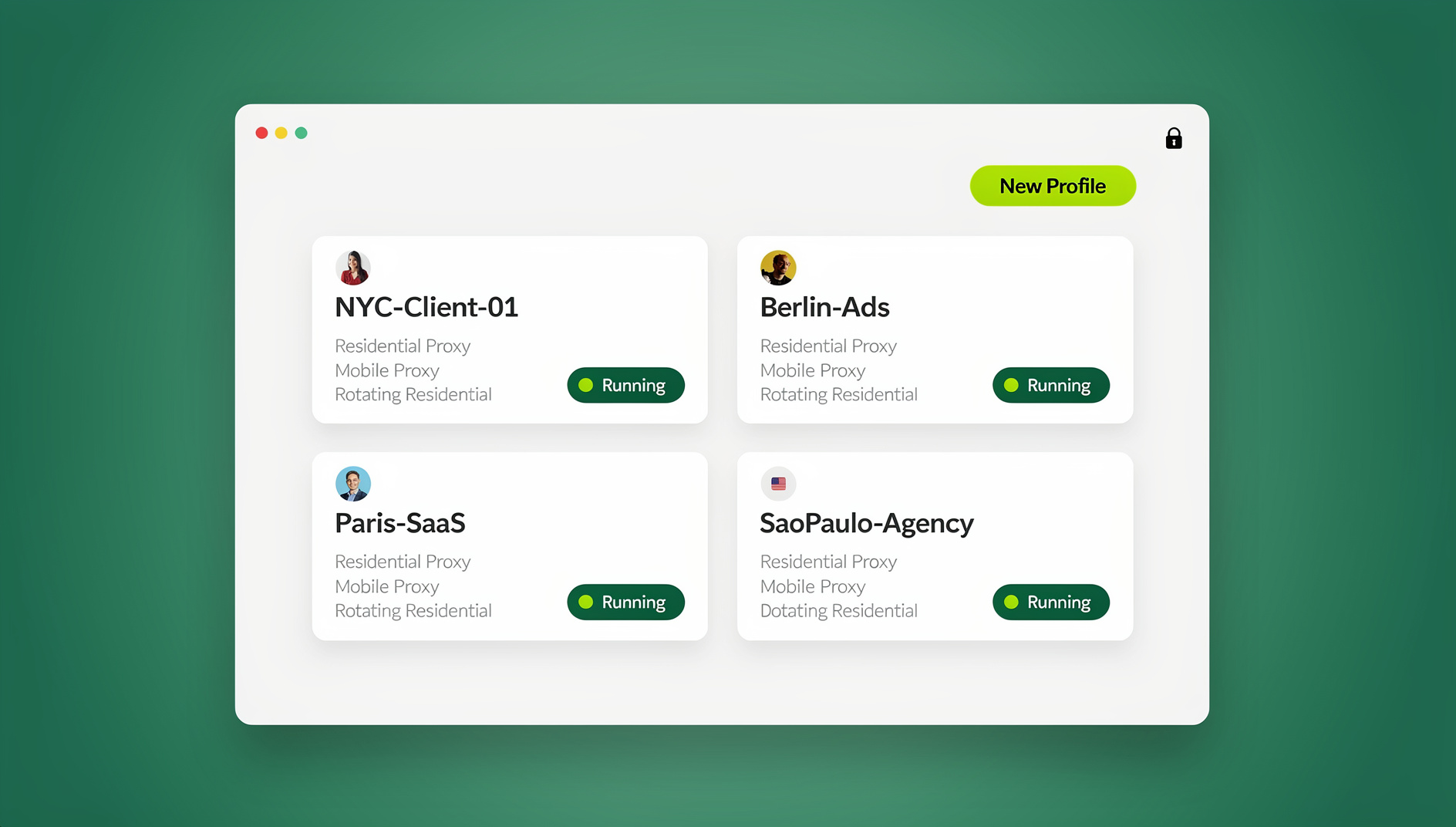
- Recommended Solution: Sort by workload first: rotating residential for many short requests, static ISP for sessions that must survive for days, and a profile manager with bundled proxies when the work is a fixed set of client accounts in a browser.
How This Shortlist Was Ranked
Comparing proxies by marketing is easy and useless. Pool-size claims run from tens of millions to 400M+ IPs, nobody can audit them, and most comparison pages carry affiliate placements. This list sorts by one number you can check — the cheapest published rate at the smallest tier you can actually buy — then flags what moves the total:
- Minimum commitment: the smallest invoice the vendor will issue, not the rate printed beside it.
- Targeting depth: country routing is table stakes; city, ZIP and ASN place a session correctly.
- Sticky-session length: 30 minutes and 72 hours solve different jobs.
- Expiry and rollover: whether unused gigabytes survive, and whether a trial becomes a subscription.
- Verification: KYC and VAT decide whether you can buy today or next week.
- Sourcing: whether the vendor documents how devices join its network.
The prices below come from provider pricing pages fetched between July 17 and August 13, 2026, with trial and refund terms re-checked on September 30, 2026. That is documented pricing, not independent benchmarking, so treat uptime and success-rate figures as claims unless a third party ran the test. If the mechanics are new to you, read what residential proxy software does first.
Eight Residential Proxy Providers, Cheapest Entry Rate First
Each entry gives the published rate and the detail that will surprise you at checkout.
1. Evomi — from $0.49/GB
Evomi publishes residential rates from $0.49/GB with 195+ countries, a 99.9% uptime claim, a single-port endpoint, and country, region, city, ISP and ZIP targeting. The company is Swiss and states that it follows EWDCI sourcing rules — the detail that matters most when you ask where an IP came from.
The catch: the lowest rate on the list belongs to the smallest vendor here. Confirm the quote at your volume and keep a second provider configured before you move client work onto it.
2. DataImpulse — $1.00/GB
Pay-as-you-go is $1.00/GB plus VAT, dropping to $0.80/GB from 1,000 GB, and traffic never expires. Billing is prepaid: a $5 intro block, then a $50 minimum top-up.
The catch: $50 is the real entry price, wasted if you burn 2 GB a month. VAT lands on top of the advertised rate.
3. ProxyLane — from $2/GB
28M+ residential IPs from $2/GB, non-expiring traffic, six targeting levels, HTTP(S) and SOCKS5, and a $1.95 trial for 350 MB. Sticky sessions run up to 72 hours, the longest published window on this list.
The catch: a smaller pool than the enterprise names, and the trial is paid — it proves connectivity, not pool quality at your volume.
4. Bright Data — $3.50/GB, but $499 to start
The entry plan is $499/mo for 141 GB, a $3.50/GB promotional rate against $4.00/GB pay-as-you-go and a claimed pool of 400M+ IPs. Access is gated: Bright Data’s KYC rules accept registered businesses only, need a company domain and a company email, give a decision within 48 hours, and may ask for a driving licence or passport for the named contact plus a short video call. An Immediate Residential Access route skips KYC for some domains, limited to rules that respect the target’s robots.txt. There is no residential access in trial mode.
The catch: the cheapest per-GB rate outside the budget tier carries the largest minimum invoice here, and a solo operator without a company domain cannot buy it at all.
5. Decodo (formerly Smartproxy) — $3.75/GB
Smartproxy rebranded to Decodo in May 2026; accounts, APIs and the network carried over unchanged. Subscriptions run from $3.75/GB at 3 GB ($11.25/mo) to $2.75/GB at 100 GB and $2/GB at 1 TB, with pay-as-you-go at $4/GB from wallet credits — a monthly plan and pay-as-you-go cannot run at the same time. The network is quoted at 115M+ IPs in 195+ locations with continent, country, state, city, ZIP and ASN targeting and sticky sessions up to 30 minutes. Independent Proxyway testing puts average response under 0.5 s with a 99.92% success rate.
The catch: the 3-day, 100 MB trial activates your chosen plan automatically when it ends, and the 14-day money-back option does not apply alongside the trial.
6. SOAX — $5.00/GB
Pay-as-you-go is $5.00/GB plus VAT on the Sandbox plan. A $200/mo plan for 200 credits works out to $3.00/GB on Tier-1 geographies; $0.85/GB at $3,000/mo, with Tier-3 geographies at $0.35/GB.
The catch: geography tiers make your blended rate impossible to predict until you know where the traffic goes, and VAT is added at checkout.
7. Oxylabs — $6.00/GB
Residential starts at $30/mo for 5 GB ($6/GB) and falls to $2.50/GB at 1 TB, with targeting down to ZIP code, coordinates and ASN and sticky sessions up to 24 hours. The ISP line is billed per IP: $15/mo Starter for up to 3 IPs ($1.5/IP), $100/mo Basic for up to 71 IPs ($1.4/IP), $500/mo Flexible for up to 416 IPs ($1.2/IP) and $1.1/IP above 2,270 IPs across 25 locations, with unlimited bandwidth under fair use.
The catch: the highest minimum among the mid-market vendors, self-service purchases are non-refundable, and the free trial is once per client on request. The one-time $5 welcome credit covers verified company registrations.
8. IPRoyal — $7.35/GB
Published pay-as-you-go is $7.35/GB at 1 GB, falling to $5.51/GB at 10 GB. The $1.75/GB figure that circulates is a high-volume marketing claim, not the rate on a small order.
The catch: the most expensive per gigabyte here at low volume, no standard trial, and refunds cover only provider-side failures reported within 24 hours and before 100 MB is used.
One more name worth a quote: Thordata sells prepaid packages only — $2.00 for 1 GB down to $0.65/GB at 5,000 GB ($3,250) — but does not document how it sources IPs, which is worth asking before a $3,250 prepayment.
The same numbers, side by side:
| Provider | Entry rate | Rate at higher volume | Sticky sessions | Terms that change the bill |
|---|---|---|---|---|
| Evomi | From $0.49/GB | Tiers on request | Not published | EWDCI sourcing stated; Swiss company |
| DataImpulse | $1.00/GB plus VAT | $0.80/GB from 1,000 GB | Not published | $5 intro block, then $50 minimum top-up; traffic never expires |
| ProxyLane | From $2/GB | Not published | Up to 72 hours | $1.95 trial for 350 MB; traffic never expires |
| Bright Data | $499/mo for 141 GB ($3.50/GB promo) | $4.00/GB pay-as-you-go | Not published | Business KYC, 48-hour decision; no residential access in trial mode |
| Decodo | $11.25/mo for 3 GB ($3.75/GB) | $2.75/GB at 100 GB; $2/GB at 1 TB; $4/GB pay-as-you-go | Up to 30 minutes | 3-day 100 MB trial rolls into a paid plan; 14-day money-back, not combinable |
| SOAX | $5.00/GB plus VAT | $3.00/GB Tier-1 at $200/mo; $0.85/GB at $3,000/mo | Not published | VAT added at checkout; $0.35/GB on Tier-3 geographies |
| Oxylabs | $30/mo for 5 GB ($6/GB) | $2.50/GB at 1 TB; ISP from $1.1/IP above 2,270 IPs | Up to 24 hours | $5 welcome credit for verified companies; self-service non-refundable; trial on request |
| IPRoyal | $7.35/GB at 1 GB | $5.51/GB at 10 GB | Not published | No standard trial; refunds only for provider-side failures within 24 hours and under 100 MB |
What the Bill Actually Looks Like at 20 GB
Twenty gigabytes is the volume where tier pricing starts to bite and where a $1/GB gap is $20 a month. Run the published numbers: 20 GB at Evomi’s $0.49/GB stays under $10; DataImpulse at $1.00/GB is $20 plus VAT; ProxyLane from $2/GB is about $40; SOAX pay-as-you-go at $5.00/GB is $100 plus VAT. Decodo’s ladder jumps from 3 GB at $11.25 to 100 GB at $275, IPRoyal’s largest published step is 10 GB for $55.10, and Bright Data’s smallest invoice is $499 whether you use 141 GB or 20.
Four lines then move the total, and none of them appear beside the headline rate:
- VAT. DataImpulse and SOAX quote pay-as-you-go plus VAT, so checkout is higher than the advertised rate.
- Minimum top-ups. DataImpulse opens with a $5 block, then $50 a time — fine if you will spend it, wasteful if you will not.
- Expiry. Traffic that expires turns an unused balance into a donation. DataImpulse, ProxyLane and Thordata advertise non-expiring traffic; monthly subscriptions elsewhere do not roll over.
- Rollover and refunds. Decodo’s trial converts to a paid plan unless you cancel, Oxylabs does not refund self-service purchases, and IPRoyal’s refund window closes at 100 MB.
Rotating Residential vs Static ISP for Logged-In Work
Rotating pools change the exit IP between requests. A sticky session holds one IP for a window — 30 minutes at Decodo, up to 24 hours at Oxylabs, up to 72 hours at ProxyLane. That window decides whether a provider suits your workflow far more than any published latency figure, because a 30-minute cap means a new IP every morning for anyone checking the same dashboard daily.
Static ISP proxies — sometimes sold as static residential — run on ISP-registered IPs that do not rotate and are billed per IP with unlimited bandwidth under fair use. Oxylabs prices them at $1.5/IP on Starter (up to 3 IPs), $1.4/IP up to 71 IPs, $1.2/IP up to 416 IPs and $1.1/IP above 2,270 IPs across 25 locations. A monthly per-IP bill is predictable in a way per-GB billing never is, which is why it fits a fixed set of accounts.
The rule of thumb: rotating residential for many short, independent requests; static ISP for anything that has to stay signed in across days. How static ISP IPs work covers the per-IP billing maths.
Matching a Provider to the Work You Actually Do
A scraper and a browser-profile manager want opposite things from a proxy vendor. A scraper wants cheap gigabytes, fast rotation and a pool big enough that failed requests stay a small percentage. Someone managing twenty client accounts wants a handful of stable exits, each tied to one profile so cookies, sessions and network origin all agree.
That second job usually needs 2–5 GB a month, not 200. At $3/GB the proxies cost $6–$15 — less than the time spent re-authenticating. Bundled bandwidth is a reasonable deal for account work and a poor one for data collection.
Send.win is built around that second job rather than around selling gigabytes. Pro is $19/mo (or $83.88/yr, $6.99/mo) with 20 residential proxies, 5 GB a month, 150 saved profiles and 6 seats; Team is $49/mo (or $251.88/yr, $20.99/mo) with 20 GB, 500 profiles and 16 seats. Extra bandwidth is $6/GB on either plan, bring-your-own HTTP/SOCKS5 is supported, and each isolated profile keeps its own cookies, storage, sessions, fingerprint settings and proxy, with timezone, locale, WebRTC and geolocation following the exit IP automatically. Cloud sessions run from Helsinki on any device, up to 50 profiles can be open at once, and a profile shared with a paid teammate opens already signed in. What it does not offer on any plan is an API, SDK or headless mode — keep scraping in a scraping tool.
IP Sourcing and KYC: What to Check Before You Pay
Verification is the least glamorous column and the one that costs the most time. Bright Data’s process is the strictest here: registered businesses only, a company domain and email, a decision within 48 hours, and sometimes a government ID and a video call. For a solo operator that rules the vendor out before price enters the conversation.
Sourcing matters for a different reason. Evomi states that it follows EWDCI sourcing rules; DataImpulse and Thordata do not document how their IPs are obtained. Ask every vendor two questions: are devices opted in, and can you exclude device classes or regions from your traffic?
In November 2026, researchers reported residential proxy traffic leaving the White House network 236 times in 30 days across 28 proxy services, traced to an SDK installed on Windows machines. The mechanism is the lesson: when a pool is assembled by bundling an SDK into free software, a stranger’s device sits on your traffic path and you inherit whatever happens on it.
Pool Size and Success Rates Matter Less Than the Checks a Site Runs
Published pool sizes disagree wildly — tens of millions to 400M+ IPs — and none can be audited from outside. A large pool is a marketing asset. What routes your request is one IP the target has not already burned, and a residential IP from a heavily reused pool can perform worse than a clean static one.
What a site actually evaluates is narrower: whether the exit IP appears on a published proxy list, whether its ASN and country agree with the browser’s timezone and locale, and whether that IP has already served a dozen accounts on the same property. How sites flag a proxy IP breaks those checks down in the order they run.
One constraint applies to every provider here: use it for accounts you own or are authorised to manage, and follow each platform’s terms. Where a platform limits multiple accounts, the answer is its official route — Amazon’s approval process for an additional seller account, or Business Manager roles for agencies on Meta — not a bigger proxy plan.
🏆 Send.win Verdict
Send.win does not win a per-gigabyte fight, because it is not a proxy vendor. It wins the step after you buy: when the work is a fixed set of client accounts in a browser rather than a data pipeline, the residential proxies sit inside the plan — 5 GB a month on Pro, 20 GB on Team, extra at $6/GB — and each isolated profile carries its own cookies, storage, sessions, fingerprint settings and proxy, with timezone, locale, WebRTC and geolocation following the exit IP. Cloud sessions run from Helsinki on any device, up to 50 profiles open at once, and a profile shared with a paid teammate opens already signed in. It has no API, SDK or headless mode on any plan, so keep your data collection in a tool built for it.
See Send.win plans — Pro from $19/mo with 5 GB of residential bandwidth included, backed by a 7-day money-back guarantee on your first card purchase, or start on the free cloud demo at 10 minutes a day.
Frequently Asked Questions
Which residential proxy provider is best for large-scale data collection?
Bright Data and Oxylabs carry the deepest compliance tooling and the highest entry prices, which suits a company with procurement in place. Decodo sits in the middle at $2.75–$3.75/GB with city and ASN targeting, and DataImpulse wins on bursty volume because its traffic never expires. Check the target site’s terms and robots.txt first — no proxy plan grants permission to collect.
How much do residential proxies cost per GB?
Published pay-as-you-go rates among the eight providers here run from $0.49/GB to $7.35/GB. Independent comparisons split the market into roughly $8.50–$12/GB for enterprise tiers, $3–$6/GB mid-market and around $1/GB at the budget end. Your own rate depends on volume and geography, so price the order at 3 GB, 10 GB and 100 GB before you commit.
Is Decodo the same company as Smartproxy?
Yes. Smartproxy rebranded to Decodo in May 2026 and repositioned toward a broader data collection platform. Existing accounts, APIs and the network carried over unchanged, and searches for Smartproxy now lead to Decodo.
Do residential proxy providers offer free trials?
Terms vary more than pricing does. Decodo gives 100 MB for three days but activates a paid plan when it ends unless you cancel; Oxylabs offers a free trial once per client on request; Bright Data has no residential access in trial mode; IPRoyal has no standard trial and refunds only provider-side failures within 24 hours and under 100 MB. ProxyLane charges $1.95 for a 350 MB trial.
Bright Data vs Oxylabs — which should I choose?
Bright Data’s smallest plan is $499/mo for 141 GB and requires business KYC, which suits a company that already has the paperwork. Oxylabs enters at $30/mo for 5 GB and falls to $2.50/GB at 1 TB, and it is the stronger pick if you also need static ISP IPs billed per IP. Neither refunds self-service purchases, so start at the smallest tier that proves the workflow.
What is the difference between residential and ISP proxies?
Residential proxies route through consumer devices and rotate, with sticky sessions that hold one IP for a window — 30 minutes at Decodo, 24 hours at Oxylabs, 72 hours at ProxyLane. ISP proxies, also called static residential, sit on ISP-registered IPs that do not rotate and are billed per IP with unlimited bandwidth under fair use. Use rotating residential for many short requests and static ISP for sessions that must survive for days.
Are cheap residential proxies worth it?
Sometimes. A sub-$1/GB pool such as Evomi at $0.49/GB or DataImpulse at $1.00/GB is fine for low-stakes work, but check three things first: how IPs are sourced, whether traffic expires, and what the minimum top-up is. Cheap turns expensive when requests fail or a balance disappears.
Why do you need proxies for browser profiles?
A profile carries cookies, storage and a session, and the network origin it presents should stay consistent with everything else in it. If the exit IP’s country disagrees with the profile’s timezone and locale, or that IP has already served a dozen other accounts, the site sees a mismatch. Assign one proxy per profile and let timezone, locale, WebRTC and geolocation follow the exit IP.
How Send.win Helps With Residential Proxy Providers
Send.win is a browser profile manager for professionals and teams: every account gets its own isolated browser profile.
- Isolated profiles – separate cookies, storage and sessions per profile
- Fingerprint protection – each profile keeps its own consistent browser fingerprint, so profiles never share one browser identity
- Desktop app + cloud browser – native app for Windows, macOS and Linux, or run profiles in the cloud with no install
- Residential proxies included – on Pro and Team, with timezone and locale matched to the proxy
- Team sharing – share a signed-in profile with a teammate without sharing the password
Try the free cloud demo — no install — or download the desktop app. Paid plans start at $19/month, and your first card purchase is covered by a 7-day money-back guarantee (see pricing).