Sections or a Second Publication: How Substack Handles Several Newsletters
Yes. One Substack login can carry multiple Substack newsletters one person writes, either as sections inside a publication you already run, or as separate publications with their own subdomain, About page and subscriber list. Sections share your homepage, list and billing; separate publications start at zero subscribers but keep their own brand and monetization settings. The account cap is 10 publications, and sections do not count toward it. Most writers only need the section route.

📌 TL;DR Executive Summary
- Core Takeaway: One Substack account holds up to 10 publications, and sections inside a publication do not count toward that cap. One login covers the whole set.
- Key Risk/Challenge: Separate publications start with an empty list, and Substack has no merge tool — the only way back is exporting subscribers and importing them into the publication you keep.
- Recommended Solution: Use a section for a new beat inside your existing brand, create a separate publication only when the audience is genuinely different, and keep each publication’s logins in its own browser profile.
Sections vs Separate Publications: The Real Difference
Two structures, two very different sets of consequences. A section is a sub-newsletter inside a publication you already run: its own URL, but the parent’s homepage, subscriber list and billing. A separate publication is a second publication — different subdomain, different dashboard, subscriber list starting at zero.
| What changes | Section | Separate publication |
|---|---|---|
| URL | your.substack.com/s/newsletter-title | Its own subdomain |
| Homepage | Shared with the parent publication, or hidden from it | Its own |
| Subscriber list | Shared, with per-section email settings | Starts at zero, fully separate |
| Billing and paid tiers | Shared with the parent publication | Its own monetization settings |
| About page and design | The parent publication’s | Its own |
| Counts toward the 10-publication cap | No | Yes |
| Podcast | Supported inside the section | Supported |
Decide on the audience, not the topic. If the same people would plausibly want both newsletters, a section keeps them in one place and one billing relationship. If you are writing for a reader who would never subscribe to the other publication, a separate publication is honest about that — but you are building from an empty list.
One consequence people miss: a section inherits a subscriber count, an archive and a subscribe flow. A separate publication has its own numbers, and a reader who finds both will compare them. Two sections read as one writer with two interests; two publications read as two independent brands, each carrying its own proof. That is the real trade-off behind multiple Substack newsletters one person runs as separate brands: more reach, and two sets of numbers you have to defend.
How a Section Works Inside One Publication
What a section actually creates
A section is a named channel inside your publication, not a brand. Substack gives it a URL that defaults to the newsletter title in the form your.substack.com/s/newsletter-title, so a reader can land on that slice directly and subscribe to it alone. The mechanics are documented on Substack’s help page for sections.
Two details save work later. You can move existing posts into the new section instead of starting with an empty archive, so a topic you have covered for a year does not leave a hole. And a section can carry a podcast, which keeps audio and text behind one subscription rather than two. For multiple Substack newsletters one person publishes under a single name, that shared homepage and archive do most of the growth work for you.
The settings to decide before you publish
Three options shape how the section behaves: whether its posts appear on the publication homepage, whether new subscribers to the publication are added to the section automatically, and whether your existing email list is copied into it. Subscribers keep their own control too — each section has its own email setting, so a reader who wants the main newsletter and not the new one can switch that one off without unsubscribing from you.
Setting up a section, step by step
- Open your publication and go to Settings.
- Click Sections in the left navigation, then choose Add section.
- Name it. That name becomes the label readers see in their email preferences, so make it mean something on its own.
- Check the URL. It defaults to your.substack.com/s/ plus the newsletter title, and you can change the title before publishing.
- Set the three options: homepage visibility, auto-adding new publication subscribers, and copying your existing list.
- Move in the posts that belong there, then announce the section once with a direct link and tell readers how to switch it off.
How Separate Publications Work
Creating a second publication
Open your account Settings — not publication Settings — scroll to the Publications block and click Create another publication. You pick a subdomain and decide whether to import subscribers at that moment. From there the new publication gets its own homepage, About page, design and monetization settings, which is the point: two brands sharing nothing but the login. Substack spells out the path in its multi-publication FAQ.
Switching between publications
The down arrow next to Dashboard in the editor lists every publication on the account, so you move between brands in two clicks. No second account, no second password, no logging out to publish on Tuesday and Thursday.
If the new publication is a second brand, treat its browser session as one too. Running multiple Substack accounts in the same cookie jar is how a personal login ends up one mistaken click away from a client publication.
Why the Choice Matters More Than It Looks
The structure you pick sets your subscriber economics for years. A section grows on the back of the list you already have: the parent publication’s subscribers are all potential readers, and new ones can be added to the section automatically. A separate publication earns every subscriber from a standing start, which is the honest cost of a clean brand split.
It also changes your operational surface. A second publication means a second admin dashboard, a second set of logins, and an audience that may not know the two are connected. Hand a co-writer access and that turns into a password passed around — the same shared-login problem that appears wherever one person runs several accounts.
The 10-Publication Cap, Merging and What You Cannot Undo
Ten publications per account is the hard ceiling. Attempt an eleventh and Substack returns the message “You have created too many publications”. Sections do not count toward that number, which makes them the escape hatch: if you plan to run multiple Substack newsletters one person manages as sections, one publication carries far more channels than the cap suggests.
What you cannot do is merge. Substack has no tool that combines two publications into one, so if you build a second publication, grow it, then decide it belongs with your first, the only route is to export the one you want to retire and import those subscribers into the one you keep. Exporting is a copy operation, not a move: both publications stay live, and readers keep receiving mail from both until you stop publishing on one or they change their preferences.
Understand the export even if you never merge. Open the publication name in the top-left, go to Settings, choose Exports in the sidebar and click Start new export. Substack emails a download link when the ZIP is ready, which takes minutes for a small list. Inside is subscribers.csv:
- email and name — your import keys.
- subscription_type — free, paid or comp, which maps to a tag on most other platforms.
- stripe_subscription_status — spots lapsed paid readers before you import them as free.
- subscriber_since — the age of the relationship, which decides whether you re-confirm.
- email_disabled — filter these rows out and never import them.
- country — useful for timing sends.
How Send.win Helps With Multiple Substack Newsletters One Person
Send.win is an antidetect browser built for exactly this kind of work — every profile is a clean, isolated identity:
- Isolated profiles – unique fingerprint, separate cookies and storage per profile
- Stealth engine – canvas, WebGL, fonts, and audio spoofed at the engine level
- Desktop app + cloud sessions – native app for Windows, macOS, and Linux, or run profiles in the cloud with no install
- Built-in residential proxies – with automatic timezone, locale, and WebRTC matching
- Team features – share logged-in profiles with teammates without sharing passwords
Try the instant cloud browser demo — no install, no signup — or download the desktop app. The 30-day free trial needs no credit card, and paid plans start at $6.99/month billed annually (see pricing).
Two caveats. The export carries no per-subscriber open rates, click history, payment details or comment history, so engagement stays behind. A list older than six to twelve months deserves a re-confirmation campaign rather than a silent import. If you are leaving Substack entirely, subscribers.csv imports cleanly into Beehiiv, Kit and MailerLite, where subscription_type usually becomes a tag that keeps paid and free readers separate.
What Several Newsletters Actually Cost
Publishing, hosting and email delivery cost nothing on Substack however large your list grows, and nothing is deducted until you enable paid subscriptions. Once you do, the fee stack is identical on every publication you run, so multiple Substack newsletters one person accounts for cost the same percentage as a single one.
Substack keeps 10% of every paid subscription. On web checkout, Stripe adds 2.9% plus $0.30 per transaction and a 0.7% recurring billing fee, all taken before payout. The legacy 0.5% billing rate for creators who connected Stripe before 10 July 2024 expired on 30 June 2025, so the current rate is what everyone pays.
| Where the subscription is bought | Price | Fees deducted | You keep | Effective rate |
|---|---|---|---|---|
| Web checkout, monthly | $10/mo | $1.66 | $8.34 | 16.6% |
| Web checkout, annual | $100/yr | $13.90 | $86.10 | 13.9% |
| iOS in-app purchase | $10/mo | $2.50 | $7.50 | 25.0% |
In-app purchases on iOS are the expensive lane. Apple takes 15-30% and Substack’s 10% still applies, with no Stripe fees in the mix. Substack’s default adjusted pricing raises the in-app price so your take-home lands closer to the web figure, but the formula is not published, so do not plan around it.
Because the fee structure is identical everywhere, three newsletters do not stack platform fees — they stack transactions. Three $10 monthly subscriptions cost roughly the same percentage as one. What differs is conversion: the commonly cited free-to-paid benchmark for newsletters sits between 2% and 5%, and a 2026 review of more than 200 Substacks framed launch conversion as often stalling below 2%. Test that number before you commit a second brand to a paid tier.
On price itself, documented models run from freemium migration and paid-only vaults to digital product bundles and hybrid sponsorship. Founders tiers, the highest-priced model, commonly sit between $200 and $500+ a year. Pick the model before the number — the most frequent pricing mistake in that review was choosing a price first. If a publication is one channel in a wider creator business, the same isolation rules apply across the rest of your presence, and the walkthrough on cloud browser for influencer management shows how that scales.
Cross-Promotion: Growing Newsletters Without Splitting Your Audience
Substack’s Recommendations are the built-in growth loop between publications, and they work whether your newsletters are sections or separate publications. You endorse others from the Recommendations tab via Add Recommendation, and those endorsements surface in your subscribe flow, your welcome page, your welcome email and the Substack app.
Add a blurb. A recommendation with a blurb can appear on the recommended publication’s welcome page with a link back to yours; one without a blurb stays buried in a list. A February 2024 update expanded the subscribe-flow screen from a maximum of three recommended publications to the full list, so blurbs do more work now than they did before.
The scale is worth knowing: as of early 2024, Substack’s published figures put Recommendations plus the Substack app at 50% of all new subscriptions and 25% of new paid subscriptions platform-wide. Cross-promoting your own work is not the same as endorsing someone else’s, but it lives in the same system.
Common Mistakes When One Person Runs Several Newsletters
- Creating a publication when a section would do. You inherit an empty list and a second brand to maintain for what may be one extra topic a week.
- Auto-adding the entire list to a new section. Opt-in beats opt-out; let readers choose the new channel.
- Assuming you can merge later. There is no merge function, and export-and-import does not carry engagement data.
- Importing an exported list without filtering. Rows where email_disabled is true will hurt deliverability on whichever platform receives them.
- Sending the same issue twice from two publications. An export is a copy, not a move — readers get both until you stop one.
- Reusing one browser profile for every publication and login. Shared cookies, saved passwords and an open session on a shared laptop blur the line between your brands.
- Pricing a second paid tier before testing conversion. With free-to-paid benchmarks in the 2-5% range, a second paid newsletter can take months to justify itself.
Keeping Publication Logins Separate
Inside Substack, everything is one account, and that part is fine. The separation problem starts around the platform: a personal login, a client publication, a research account, an assistant who needs access to exactly one of them, and a second brand you do not want connected to the first. That is the messy part of running multiple Substack newsletters one person is responsible for, and it is a browser problem, not a Substack problem.
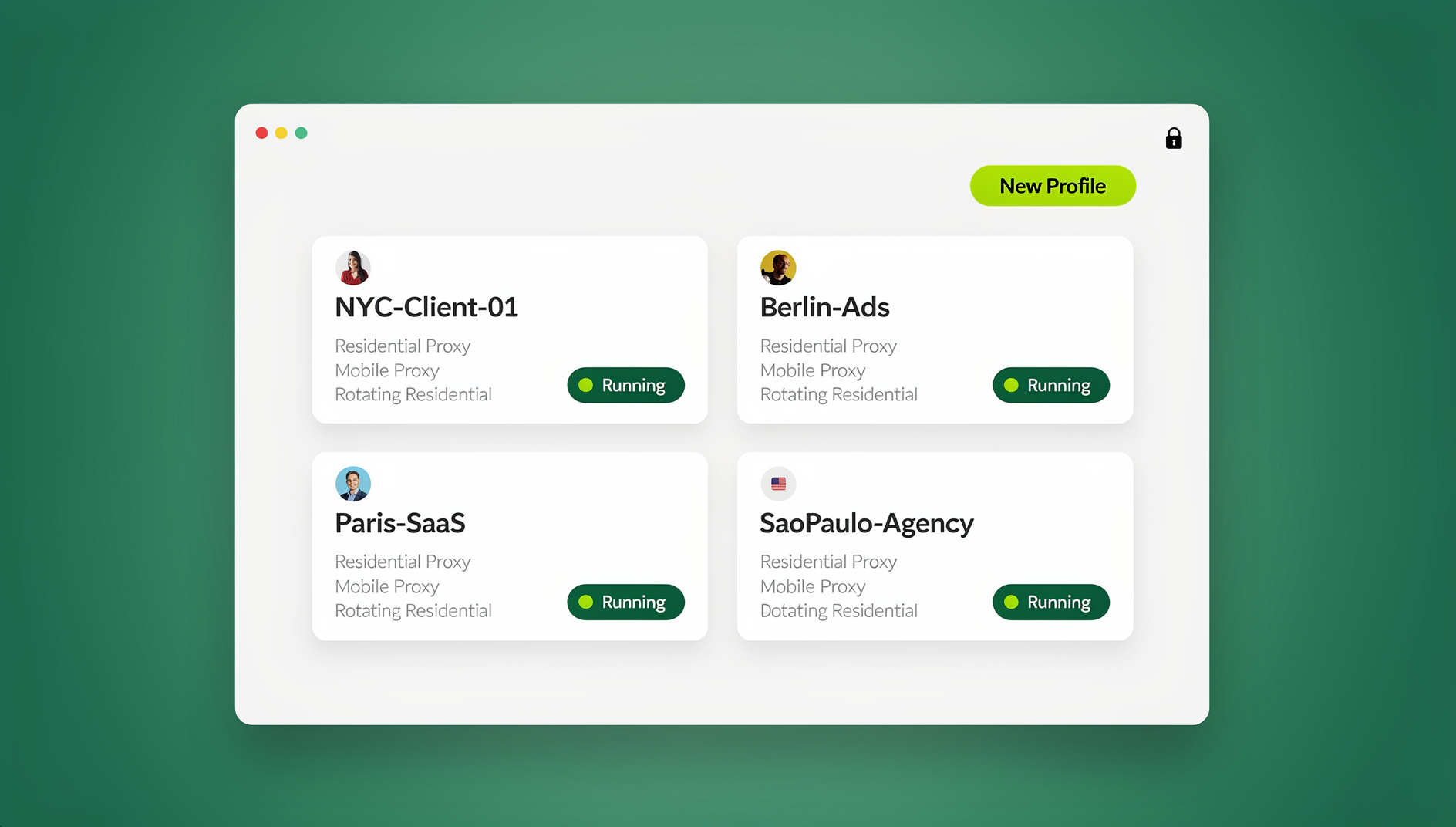
Sendwin Browser gives each of those its own isolated profile. It is a desktop app for Windows, macOS and Linux that runs a patched-Chromium engine with the Sendwin Stealth engine built in — canvas, WebGL, audio, fonts and hardware are spoofed at the engine level and kept coherent, so each profile reads like a separate machine rather than one laptop with a shuffled user agent. Every plan includes built-in residential proxies, and timezone, locale, WebRTC and geolocation follow the proxy’s exit IP automatically, which matters when a publication’s admin panel expects a stable country.
If you would rather not install anything, the cloud browser runs the same profiles on Send.win’s EU and US cloud nodes from any device, with a free 10-minute daily preview and unlimited cloud browsing time on Pro and Team. Sharing is the feature worth knowing here: share a profile with a paid teammate and it opens already signed in, so a co-writer reaches one publication’s dashboard without ever holding your Substack password. Cloud sync, available on paid plans, carries that login across your own devices.
For a portfolio of publications, that gives you a clean boundary: one profile per publication brand, one for personal, one shared profile for whoever helps you publish. Setting it up on a fresh machine is straightforward, and setting up antidetect browsers on Windows covers the profile, proxy and fingerprint basics.
On the Team plan, the local Automation API for Selenium, Puppeteer and Playwright can attach to a running profile, which is useful if you ever script a publishing or reporting check that spans publications:
from playwright.sync_api import sync_playwright

CDP_URL = "http://127.0.0.1:PORT"  # copy it from the profile's automation settings

with sync_playwright() as p:
    browser = p.chromium.connect_over_cdp(CDP_URL)
    context = browser.contexts[0]
    page = context.new_page()
    page.goto("https://substack.com")
    print(page.title())
CDP_URL is a placeholder — each profile exposes its own port, and you copy the real value from that profile’s automation settings in the app.
🏆 Send.win Verdict
Substack answers the structural half of this question: sections for a new beat inside your existing brand, separate publications for a genuinely different audience, and a hard cap of 10 publications per account with no merge path. What Substack does not manage is the browser all of it runs in. If you operate several publications, or one publication plus client work, separate Sendwin Browser profiles keep each brand’s sessions, cookies and logins apart, and profile sharing hands a teammate access to one dashboard without giving away your password.
Try Send.win free today — 30 days of the desktop browser with 10 isolated profiles, built-in residential proxies and the Stealth engine, $0 today and cancel anytime.
Frequently Asked Questions
Can one person run multiple Substack newsletters at once?
Yes. Substack allows you to create and manage multiple publications on one account, and a single login switches between them using the down arrow next to Dashboard. You can also run several newsletters as sections inside one publication, which keeps them on one subscriber list and one billing setup.
Should I add a section or create a second publication?
Use a section when the same reader would plausibly want both newsletters — it shares your homepage, subscriber list and billing, and readers can switch that section’s emails off on their own. Create a separate publication when the audience and brand are genuinely different, and accept that its list starts from zero.
How many Substack publications can one account have?
Ten. Sections do not count toward that limit; publications do. Once you reach it, Substack returns the message “You have created too many publications” the next time you try to create one.
Do sections and separate publications share the same subscriber list?
Sections share the parent publication’s list and billing, and subscribers simply control which sections email them. Separate publications each have their own subscriber list, homepage, About page and monetization settings, and they start with nobody subscribed.
How do I switch between my Substack publications?
Use the down arrow next to Dashboard in the editor. It lists the publications on the account, so you can move between brands in two clicks without logging out or keeping separate sets of credentials.
Can I merge two Substacks into one if I change my mind?
No — Substack has no merge function. The workaround is to export the publication you want to retire and import those subscribers into the one you keep. The export is a copy, not a move, so the original stays live and keeps mailing until you stop publishing on it.
Will starting a second newsletter split my existing audience?
Only if you force the same people to choose. A section lets a reader keep the main newsletter and skip the new one with a single email toggle. A separate publication starts from zero subscribers, so nothing is split — but nothing carries over either.
How do subscribers opt out of just one section?
Each section has its own email setting, so a reader can switch that section off without unsubscribing from the publication. Plan for it: a clean section toggle is how people leave one topic without leaving you entirely.