Do You Need a Cloud Browser to Run Influencer Accounts Safely?
Yes — as soon as more than one client or creator login passes through the same machine. A cloud browser for influencer management runs each brand or creator account inside its own isolated browser on a remote node, with its own fingerprint, cookies and proxy exit IP. You open a tab from any laptop, and the platform sees a separate, consistent device rather than twelve accounts typing from one fingerprint.

📌 TL;DR Executive Summary
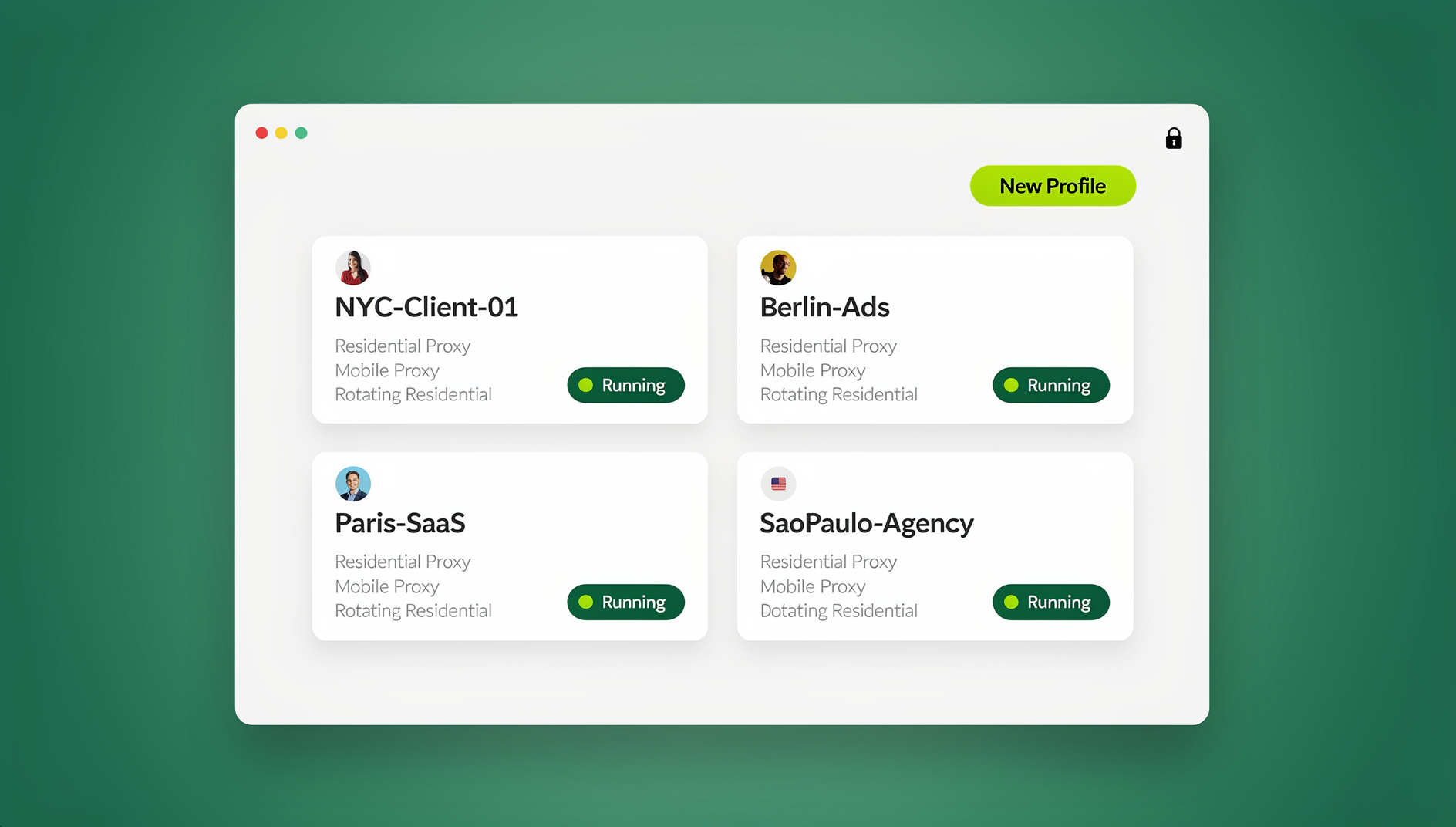
- Core Takeaway: A cloud browser gives every brand, creator and client account its own persistent profile — fingerprint, storage and proxy exit IP — so one laptop can host dozens of logins without tying them together.
- Key Risk/Challenge: Platforms link accounts through overlapping signals, so a shared desktop browser, a cloned virtual machine or a rotating proxy undoes the isolation you thought you had.
- Recommended Solution: One profile per account, one stable residential proxy matched to its locale, and access shared as a profile instead of a password. Send.win ships residential proxies and the stealth engine on every plan.
What a Cloud Browser for Influencer Management Actually Is
Influencer work splits into two layers, and people mix them up constantly. The first is the management platform: SaaS or a marketplace that digitalizes discovery, outreach, contracts, content approval, post tracking and payments. Kolsquare indexes more than 3 million creator profiles across Instagram, TikTok, YouTube, Facebook and Twitter. Influence4You keeps a vetted database of 160,000 registered influencers. Modash reports 350+ million creator profiles with filters for engagement rate, fake followers and hashtags. Those figures describe a search index, not a browser.
The second layer is where the work happens: logging in. Someone on your team opens Instagram, TikTok, YouTube Studio, a client’s Facebook Page and a Shopify admin in the same afternoon, and every one of those logins carries identity signals. A cloud browser covers that layer. It runs the browser itself on a remote node and streams the view to your device, so each account opens inside its own isolated profile with its own fingerprint, cookie jar and proxy exit IP.
The distinction is easy to miss, because roundups of influencer platforms note that most are cloud-based and work from any modern browser. The platform decides which creator to book and how the contract gets signed. The browser decides whether the platform believes you are one person running one account.
Cloud browser, desktop antidetect browser, phone farm
Three categories get used for this work, and they are not interchangeable. A desktop antidetect browser runs locally with unique per-profile canvases, WebGL, audio and fonts, and suits accounts that behave like desktop users. A cloud phone or phone farm produces native mobile fingerprints with per-device proxy clients — the right call when the platform’s typical user is on mobile, as with TikTok, Reels and Shorts. A cloud browser keeps the same isolation as the desktop tools but moves the machine off your desk, so a profile survives a laptop change and can be handed to a teammate.
How a Profile Stays Isolated: Fingerprint, Storage and Network
Isolation sounds abstract until you know what a site actually reads. In a cloud browser for influencer management, a profile only holds together when three layers — fingerprint, storage and network — move as one unit.
The fingerprint layer
A modern device fingerprint combines canvas hash, WebGL renderer and extensions, screen resolution and pixel ratio, font list and language, audio context, user agent and HTTP header order. Platforms hash those values and compare them across accounts. Practitioner guides published in 2026 describe Meta’s multi-account detection as running on five overlapping signals: IP reputation and ASN, the TCP/IP fingerprint, whether the verification number is VoIP or a real carrier, the device and browser fingerprint, and cross-session behavior. Miss one, and the other four still hold the accounts together.
The matching is fuzzy, which is what catches people. Two accounts sharing a canvas hash, a WebGL renderer, a font list and a timezone land in the same cluster even when they use different user agents and different IPs. Clearing cookies does nothing to that cluster. The EFF’s Panopticlick project found 94 percent of tested browsers were uniquely identifiable from fingerprint traits alone, and the 2024 Cover Your Tracks update recorded only a modest decline in uniqueness. Uniqueness is not the problem — collision is. Identical is worse than unusual.
The storage layer
Cookies, localStorage and IndexedDB are the account’s memory. A profile that wipes them at every launch looks like a device that has never visited the site, which is exactly how session-hijack detection reads a fresh login from a known handle. Virtual browser profiles solve this by giving each identity its own persistent Chromium user data directory, so the session survives between logins instead of being rebuilt from nothing. The browser isolation guide breaks down what each layer contains.
The network layer
Timezone, locale, WebRTC and geolocation have to follow the proxy’s exit IP, not your laptop’s operating-system settings. A profile with en-US fonts, an Asia/Singapore clock and a residential IP in Ohio is a contradiction any risk engine can read in one pass. Device fingerprinting also counts as personal data under GDPR — France’s CNIL fined ad tech companies in 2023 for fingerprinting without consent, and Germany and Canada opened similar probes — which is one reason platforms treat fingerprint anomalies as a fraud signal rather than a curiosity.
Why Accounts Get Linked — and What the Damage Looks Like
Agencies, in-house social teams, affiliate managers and freelance account managers share one failure pattern: several accounts, one laptop, one fingerprint. The first symptom is rarely a ban. It is a verification loop, a password reset you did not request, a suspicious-login notice, or an ad account placed under review the day a campaign goes live.
The trouble compounds when a fingerprint does more than identify you — it sorts you. Platforms do not need proof that two accounts share an owner. A shared subset of signals is enough to group them, and grouped accounts inherit each other’s enforcement history. One suspended creator account can drag down a brand account that was never touched.
| Approach | What it isolates | Fingerprint realism | Shareable | Best for |
|---|---|---|---|---|
| One desktop browser, many tabs | Nothing — same canvas, fonts and IP for every login | One fingerprint for all accounts | Only by sharing passwords | Single-account work |
| Virtual machine per client | The operating system, not the browser | Cloned guests often present identical canvas, WebGL and font signals; renderer strings like VMware SVGA 3D announce virtualization | Heavy — snapshots and files | Test environments, not account work |
| Cloud phone or phone farm | A real mobile device identity | Native mobile fingerprints, per-device proxy clients | Limited, device-bound | TikTok, Reels, Shorts |
| Cloud browser profile | Fingerprint, storage state and network path together | Unique and coherent per profile, persistent across sessions | Yes — the profile opens already signed in | Client accounts, multi-brand portfolios |
| Desktop antidetect profile | The same three browser layers, locally | Unique and coherent per profile | Yes, but tied to one machine | Desktop-behaving accounts, one operator |
Each of the five detection signals has a matching fix, and the fix is never a better proxy on its own.
| Detection signal | What the platform reads | What breaks the link |
|---|---|---|
| IP reputation and ASN | Residential versus datacenter ranges, shared subnets, ASN reuse across accounts | One stable residential exit IP per profile, never recycled |
| TCP/IP fingerprint | Stack-level behavior compared with the claimed user agent and OS | A profile whose OS, user agent and headers agree |
| Verification number | VoIP versus real-carrier classification | A real carrier number per account, not a shared SMS service |
| Device and browser fingerprint | Canvas, WebGL, fonts, audio, resolution, header order — hashed and compared | Unique coherent values, kept stable between sessions |
| Cross-session behavior | Timing, action order, accounts that reference each other | Separate profiles with separate storage, paced like a human |
Setting Up: A Profile-Per-Account Checklist
Numbers matter more than tools here. Ten profiles built carefully outperform fifty built quickly, because one sloppy profile can cluster the other nine. The same checklist applies whether you run a desktop antidetect app or a cloud browser for influencer management.
- Map accounts to profiles before you log in. One profile per handle, not per client — a brand with three regional handles needs three profiles, because those accounts will link if they share a machine.
- Assign one proxy per profile and keep it. Reusing an exit IP across two profiles is the fastest way to merge them.
- Match locale, timezone, language and currency to the exit IP. A US proxy with a German system locale is a flag, not a detail.
- Keep storage and fingerprint persistent. A new fingerprint every morning reads as a new device every morning, which is its own pattern.
- Verify with a real carrier number. VoIP classification sticks to the account from signup and never washes out.
- Warm up new accounts. A day or two of scrolling, searching and following before you publish, run ads or send outreach.
- Document the mapping. Profile name, handle, proxy country, owner, client — so a departure tells you exactly what to revoke.
If Instagram is the platform you juggle most, this workflow for managing multiple Instagram accounts walks through the same profile-and-proxy mapping in platform-specific detail.
Sharing Client and Creator Access Without Sending Passwords
Most agencies still hand over credentials, and that one habit creates three problems at once: the client’s password lives in a chat thread, the login lands on a new fingerprint from a new city, and every departure becomes a password-reset project across a dozen platforms.
Profile sharing takes the password out of the loop. A teammate opens an isolated profile they have been granted, and it is already signed in — the session lives in the profile’s own storage, not in a message. Removing the shared password is the single reason most teams move to a cloud browser for influencer management in the first place. The client keeps their credentials, your team keeps working, and when someone leaves you revoke the share instead of chasing resets.
Freelancers hit the same wall from the other side, since every client brings a different locale, platform mix and working hours. The patterns in this breakdown of how freelancers use cloud browsers map straight onto small agency teams.
Automating Bulk Profile Checks
At thirty profiles, “log into each one and confirm it is alive” becomes a job nobody wants. Automation helps, but only where the browser exposes a real debugging interface — scripting a login form with a bare headless driver usually produces a fingerprint no human browser would ever emit.
With a profile open and its automation port available, Playwright can attach to the live session instead of launching a fresh one. The snippet below uses only documented Playwright APIs:
from playwright.sync_api import sync_playwright

# Copy the CDP URL from the profile's automation settings — the port differs per profile.
CDP_URL = "http://127.0.0.1:PORT"

with sync_playwright() as p:
    browser = p.chromium.connect_over_cdp(CDP_URL)
    context = browser.contexts[0]        # the profile's existing, already-authenticated context
    page = context.new_page()
    page.goto("https://www.instagram.com/")
    print(page.title())
    page.close()
    browser.close()
Attaching to an existing context matters more than the code: the profile keeps its own cookies, its own fingerprint and its own proxy, so the automated visit looks like the same session a human would produce. Send.win’s local Automation API for Selenium, Puppeteer and Playwright ships with the Team plan and attaches the same way to a running profile. Running many profiles in parallel is covered in this walkthrough of browser session management.
Common Mistakes That Re-link Your Accounts
Most multi-account failures are not caused by the platform getting smarter. They are caused by an isolation step that stopped working weeks earlier.
- Cloning one profile into many. Duplicating a profile duplicates the canvas, WebGL and font values with it. Build each from its own template or let the tool generate coherent values.
- Rebuilding the profile after a prompt. Deleting and recreating is a panic reaction that changes the device identity. Fix the mismatch — locale, IP, headers — and keep the profile.
- One personal login to “check something”. Logging into a client account once from your everyday browser profile links that account to your personal fingerprint permanently.
- Letting a teammate reply from their own browser. A shared password plus a personal machine reintroduces exactly the collision you removed.
- Swapping proxies mid-campaign. A handle that jumps from Berlin to Dallas to Manila in a week looks like a compromised session, and platforms react accordingly.
Choosing a Cloud Browser for Influencer Management
Once you know where accounts get linked, the evaluation list gets short. Score any tool on these six points:
- Where the spoofing happens. Engine-level fingerprint control beats scripts injected into the page, which detection systems learn to recognize.
- Persistence. Fingerprint and storage must survive between sessions, not regenerate at every launch.
- Proxy match. Does timezone, locale, WebRTC and geolocation follow the exit IP automatically, or do you set it by hand and hope?
- Sharing model. A profile you can hand over already signed in is auditable; a password pasted into chat is not.
- Portability. A cloud option for devices you do not control, plus a local desktop app for accounts that behave like desktop users.
- Automation path. The API should attach to a live, fingerprinted profile — not launch a bare headless browser.
Send.win answers those six directly. Profiles spoof canvas, WebGL, audio, fonts and hardware inside the engine and stay coherent, so each one reads as a separate real machine and no two share a fingerprint. Residential proxies come with every plan, with bring-your-own HTTP/SOCKS5 alongside, and timezone, locale, WebRTC and geolocation follow the proxy’s exit IP automatically. Sendwin Browser installs locally on Windows, macOS and Linux; the cloud browser runs profiles on EU and US nodes with nothing to install. Profiles can be shared with a paid teammate who opens them already signed in, cloud sync carries logins across devices on paid plans, and the local Automation API for Selenium, Puppeteer and Playwright is part of the Team plan.
🏆 Send.win Verdict
Influencer platforms handle the campaign — discovery, contracts, approvals, payments. None of them handle the browser your team logs in from, and that is the layer where accounts get linked. If you run brand handles, creator accounts or client portfolios from one machine, the working setup is one persistent profile per account with its own residential exit IP, shared as a profile rather than a password. Send.win covers exactly that layer, with the stealth engine and residential proxies on every plan, a cloud option for distributed teams, and a local automation API on Team for bulk checks.
Try Send.win free today — 30 days for $0, cancel anytime, and your local profiles stay on your machine.
Frequently Asked Questions
What is a cloud browser and how does it work?
A cloud browser runs the browser itself on a remote server and streams the rendered view to your device. Each profile keeps its own fingerprint, cookies, localStorage and proxy on that node, so closing your laptop does not end the session. You get full isolation without installing anything on the machine you are working from.
Can I manage several Instagram accounts from one computer safely?
Yes, provided every account has its own isolated profile, its own stable residential exit IP and its own persistent storage. The risk is not the number of accounts but the overlap between them. Two handles sharing a canvas hash, a font list and a timezone get grouped no matter how many IPs you rotate through.
Do influencer marketing platforms replace a browser tool?
No. Platforms such as Kolsquare, Modash or HypeAuditor cover discovery, audience-quality checks, contracts, approvals and payments, and some flag fake followers and inflated engagement before you pay a creator. None of them control the fingerprint, cookies or IP your team logs in with.
How many accounts can I run from one device?
As many as you have isolated profiles for — the constraint is discipline, not hardware. Send.win’s plans scale from 10 profiles on the free trial to 150 on Pro and 500 on Team, with unlimited local concurrency. The practical limit is how many you can warm up, pace and review properly.
Do virtual machines hide my fingerprint better than browser profiles?
Usually worse. A virtual machine isolates the operating system, not the browser, so cloned guests often present identical canvas, WebGL and font signals. WebGL renderer strings that name a virtual graphics adapter announce virtualization outright. Virtual browser profiles isolate the identity the site observes, which is the layer detection actually reads.
Why do fake or randomized fingerprints get flagged?
Because inconsistency is easier to detect than uniqueness. A profile claiming macOS with Windows fonts, or a European locale on a US residential IP, contradicts itself. Randomizing values at every launch adds a second signal: a device that is never the same device twice, which is not how real hardware behaves.
What causes suspicious login alerts in Instagram and TikTok?
New device fingerprints, new countries, new ASNs and VoIP verification numbers are the usual triggers. Alerts often fire on behavior too — several accounts signing in within minutes, from the same subnet, with similar action timing. Keeping a profile stable once it works avoids most of these prompts.
Is it safe to log into brand accounts while traveling?
Only if the login happens inside a profile that already holds the account’s fingerprint, cookies and proxy. Logging in from a hotel network on your everyday browser changes the device and the network path at the same time, which is the classic trigger for a verification loop. A cloud profile looks identical from any location.
Run Cloud Browser For Influencer Management in the Cloud With Send.win
Send.win’s cloud browser runs your isolated profiles on remote infrastructure — open a clean, fingerprint-isolated session from any device without installing anything:
- Instant cloud sessions – launch an isolated browser in seconds, no local install
- Isolated profiles – separate fingerprint, cookies, and storage per session
- Cloud sync & profile sharing – pick up the same profiles on the desktop app (Windows, macOS, Linux) or share them with your team
- Built-in residential proxies – with automatic timezone and locale matching
You can try it right now: the Send.win demo browser opens an isolated cloud session directly in this browser tab. The 30-day free trial needs no credit card, and paid plans start at $6.99/month billed annually — see pricing.