Can One Person Legally Run Multiple Etsy Shops?
Short answer to multiple etsy shops same person how to: yes, it is allowed. Etsy publishes no cap on how many shops one seller may run, but each shop needs its own Etsy account and its own email address, and you must list every shop you own in the Public Profile of every account. Running them all from one computer is fine. The failure mode is entanglement: Etsy links accounts owned by the same person, so a permanent suspension in one shop usually takes the others down.

📌 TL;DR Executive Summary
- Core Takeaway: One person can run several Etsy shops. Each shop needs its own Etsy account and email, you may reuse the same card, bank account, tax ID and address, and you must disclose every shop in each account’s Public Profile.
- Key Risk/Challenge: Etsy links accounts owned by the same person, so enforcement cascades. The fastest way to look like one coordinated operation is a shared browser session, a shared fingerprint and near-identical listings.
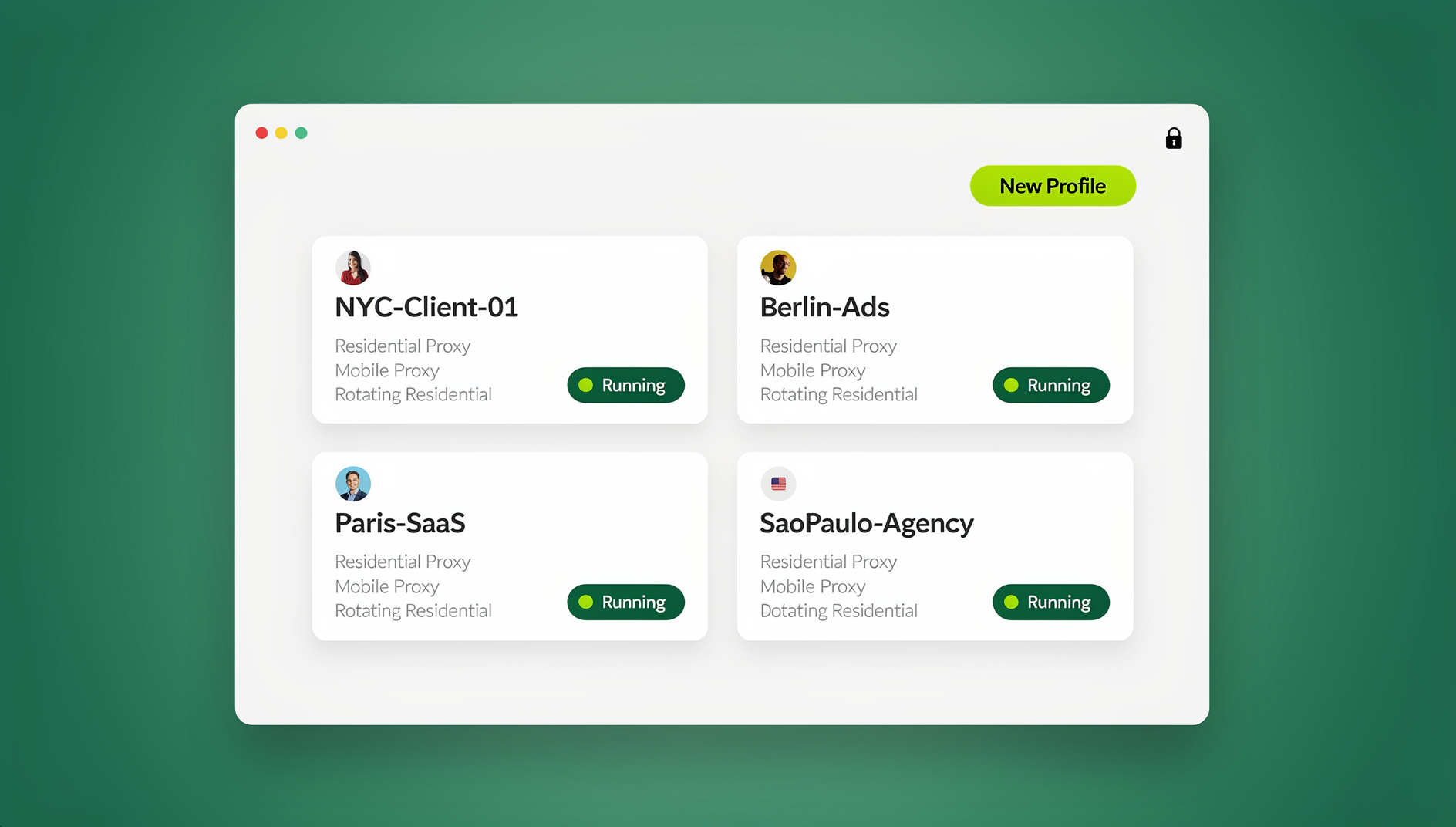
- Recommended Solution: Give each shop its own account, its own email, its own browser profile and its own proxy exit, disclose everything, and keep bookkeeping separate before the first sale.
What Etsy Actually Requires From a Multi-Shop Seller
The rule is structural, not numerical. One Etsy account holds one shop and one email address, so opening a second shop always means creating a second account with a separate login. Etsy does not publish a limit on how many of those accounts a seller may hold, and multi-shop sellers commonly run two, three or five storefronts. Nothing in the policy tells you multiple etsy shops same person how to keep those accounts from reading as one coordinated operation — that part is your setup, not Etsy’s rulebook.
What surprises people is how little else has to change. You can reuse the same credit card, the same bank account, the same taxpayer ID and the same address across every shop. You do not need a second legal identity, a second company or a nominee owner. One limited liability company can own several Etsy shops, as long as two shops never carry the same name.
Two obligations are non-negotiable. First, disclosure: list all your shops in the Public Profile of every account you operate. Second, compliance: each account is measured against the Seller Policy on its own, and you cannot average a clean shop against a messy one. If one storefront breaks a rule, the others do not dilute the blame.
Etsy also cannot merge shops or transfer listings, order history or reviews between accounts. Whatever reputation shop one built stays with shop one. Shop two starts from zero, which is exactly the point if you are testing a new niche or a different price tier.
| Item | Allowed | Not allowed |
|---|---|---|
| Same credit card and bank account across shops | Yes | — |
| Same taxpayer ID and business address | Yes | — |
| Separate email address per shop | Required | Reusing one email for two accounts |
| Two shops with the same name | — | Blocked |
| Duplicate or near-identical listings across shops | — | Prohibited |
| Running several shops from one computer and IP | Yes | Coordinated behaviour that reads as search gaming |
| Merging shops or moving sales history | — | Not possible |
| Listing all shops in every Public Profile | Required | Selective disclosure |
How Etsy Links Your Accounts Under the Hood
Etsy’s own help documentation suggests using a different browser for each account. That is shorthand for “use a different cookie jar.” A normal browser holds one Etsy sign-in at a time, so two shops in the same profile means logging in and out all day — or leaving two tabs open where one quietly inherits the other’s session.
Cookies are the cheap linking signal, and they are the one you can see and clear. The persistent signal is the device fingerprint: canvas rendering, WebGL output, installed fonts, audio stack, screen resolution, timezone, language and hardware characteristics, all read fresh on every page load. Clearing cookies changes one input. The fingerprint and the locally stored data stay exactly where they were.
Above that sit the identifiers you cannot spoof and should never try to: email addresses, recovery phone numbers, payment instruments, tax IDs, billing and shipping addresses. Enforcement works on the aggregate, so when one account is actioned, the linked set becomes visible and a permanent suspension cascades through it.
That is why “just use a VPN” fails as a separation strategy. A VPN changes your IP address and nothing else — same browser build, same fonts, same canvas output, same stored sessions on disk. If your goal is genuine separation between shops you own and disclose, each shop needs its own environment rather than the same environment behind a different exit IP. The mechanics get a fuller treatment in this walkthrough on how to manage multiple Etsy accounts.
Who This Affects and Where the Money Goes
Three situations bring sellers here. Splitting a catalogue into distinct audiences or price tiers. Testing a new line you do not want polluting the conversion rate and review score of a main shop. And managing storefronts for other owners, where the accounts belong to someone else and your job is to keep their sessions apart.
That last case matters because the goal is separation of session data, not concealment of ownership. Etsy’s disclosure requirement means isolation tools are not a way to run undisclosed shops — that is a policy problem no browser can solve. What isolation actually fixes is the practical problem: two shops sharing one cookie jar, one fingerprint and one pile of local storage, so a single flagged session contaminates everything downstream.
The money side is real too. Every extra storefront carries its own listing fees, renewals, transaction fees, payment processing and advertising spend. In June 2026 Etsy expanded Purchase Protection to cover up to $250 USD per eligible order even when the order total is higher, which is a per-order safety net rather than a per-seller one. And if you ship into the US from outside it, the rules changed: from July 9, 2026 non-US sellers must build duties and import fees into their pricing and ship US-bound orders Delivery Duty Paid, because orders without duties prepaid no longer qualify for Purchase Protection.
Opening a Second Shop: The Step-by-Step Checklist
Work through this in order. Skipping step four is the single most common reason second shops get actioned. It is also the practical answer to multiple etsy shops same person how to stay compliant from day one, because every step closes a link Etsy could use to connect the accounts.
- Register a dedicated email address that you control and that is not a shared inbox. Do not reuse your main shop’s address or an alias that forwards into it.
- Create the second Etsy account and finish verification before you publish anything. An unverified account that suddenly lists products looks worse than an empty one.
- Name and brand the shop distinctly. Two shops cannot share a name, and near-identical banners, logos and About text invite a duplicate-shop review.
- Add every shop to the Public Profile of every account. Do this on day one, not after a warning email.
- Read the Seller Policy for that shop separately. Some categories carry their own compliance requirements, so a shop selling them lives under stricter rules than your main one.
- Set up bookkeeping before the first sale — a separate ledger, a separate profit-and-loss tag, or a spreadsheet tab per shop. Retrofitting this at tax time is miserable.
- Build a dedicated browser profile for the shop with its own fingerprint, its own proxy exit and its own cookie store. Never log into a second shop inside it.
- Keep a written map of shop name, account email, profile name, proxy region and recovery method. Store it in a password manager.
- Decide who else touches the shop — messages, order processing, returns — and give them their own access rather than sharing your credentials.
- Run it like a business from day one. The shops that survive are the ones treated as real, not as side experiments.
If you want the full sequence with screen-level detail, this multiple Etsy seller accounts setup guide walks through the same steps with the account and profile configuration included.
Keeping Each Shop in Its Own Session
This is where most multi-shop setups quietly fall apart. The question of multiple etsy shops same person how to divide sessions comes down to four things: cookies, fingerprint, proxy exit and local storage. Here is what each commonly recommended option actually separates.
| Method | What it actually separates | Where it breaks down |
|---|---|---|
| Different browser per shop | Cookies and local storage | Still one machine fingerprint per browser, and no proxy control; workable at two shops, tiring at four |
| Chrome profiles | Per-profile cookies and some storage | Switching closes tabs and windows; fine for about two shops, painful at three or more |
| Incognito or private window | A fresh session each time | Every window needs a fresh Etsy login, so each switch costs friction |
| VPN | IP address only | Fingerprint, fonts, canvas output and stored data are unchanged |
| Anti-detect browser profiles | Fingerprint, cookies, storage, proxy exit and timezone per shop | Needs setup discipline; profiles must stay one-shop-per-profile forever |
Sendwin Browser takes the last approach. It is a desktop app for Windows 10/11, macOS 12 and newer, and Linux, with the stealth engine built in. Each profile renders its own coherent fingerprint — canvas, WebGL, audio, fonts and hardware spoofed at the engine level rather than patched in with scripts. No two profiles share a fingerprint, and timezone, locale, WebRTC and geolocation follow the profile’s proxy exit automatically.
Every plan includes built-in residential proxies, with extra bandwidth at $6 per GB, so you are not stitching a browser and a proxy service together by hand. Profiles run side by side with no local concurrency cap, which means shop one, shop two and shop three can all be open in separate windows without one inheriting another’s session. If you would rather not install anything, the cloud browser runs profiles on EU and US cloud nodes from any device, with a free 10-minute daily preview and unlimited browsing time on Pro and Team. Sharing a profile with a paid teammate opens it already signed in, so an assistant never needs a password.
If you script repetitive work across shops, the local Automation API on the Team plan attaches Selenium, Puppeteer or Playwright to a running profile so the session, cookies, fingerprint and proxy stay intact.
from playwright.sync_api import sync_playwright

# One Send.win profile per Etsy shop. Copy each port from that profile's
# automation settings in the app - the port differs for every profile.
SHOP_PROFILES = {
    "shop_one": "http://127.0.0.1:PORT_ONE",
    "shop_two": "http://127.0.0.1:PORT_TWO",
}

with sync_playwright() as p:
    for shop, cdp_url in SHOP_PROFILES.items():
        browser = p.chromium.connect_over_cdp(cdp_url)
        context = browser.contexts[0]   # the profile's real, already-warm session
        page = context.new_page()
        page.goto("https://www.etsy.com/")
        print(shop, page.title())
        page.close()   # leave the browser running for the next task
The pattern is worth copying even if you never write a script: attach to an environment that already holds the right session rather than building one from scratch. A run-through of that approach across five storefronts is documented in this piece on how to run 5 Etsy shops from one machine.
What Each Extra Shop Costs in Fees, Tariffs and Time
Adding a shop multiplies fixed costs faster than most sellers expect. Listing fees, renewals, transaction fees, payment processing and ad spend are charged per storefront, and none of them scale down because the shops share an owner. Budget the second shop as a separate business line, not as an incremental feature of the first.
If you ship into the US from outside it, reprice before you open shop two. Delivery Duty Paid is now the condition for Purchase Protection on US-bound orders, and the tariffs estimator inside the listing form’s Price and inventory section lets you compare shipping options and review possible HS codes before a listing goes live. Getting this wrong on two shops doubles the exposure.
Bookkeeping is the quiet killer. Keep a separate ledger or accounting tag per shop so you can produce a profit-and-loss statement for each one. Craftybase handles inventory for Etsy sellers, and a shared spreadsheet with one tab per shop is a legitimate starting point. The point is that at filing time you can show which revenue belongs to which storefront, which is also what you will need if a shop is ever actioned. Sellers running multiple storefronts off Etsy, including multiple Shopify stores, need the same discipline for the same reason.
Do the workload maths before shop number three
Time does not consolidate the way files do. Each storefront has its own message queue, order queue, review replies, listing maintenance and ad monitoring, and none of those shrink because you own both shops. Two shops is usually one person’s realistic ceiling before quality drops somewhere visible; a third only makes sense once you can name who handles messages, who handles fulfilment and who handles returns.
If you cannot answer those three questions with names, the honest move is to fix shop one first. A neglected second shop is exactly the profile that gets actioned, and a neglected second shop is what drags the first one down with it.
Mistakes That Get Multi-Shop Sellers Suspended
Almost none of these are about owning too many shops. They are about looking like one operation. The whole answer to multiple etsy shops same person how to stay out of trouble fits in one line: separate sessions, distinct listings, full disclosure.
- Sharing one browser session across shops. Shop two gets treated as a casual add-on, runs in the same profile, and goes down with shop one.
- Copy-pasting listings. Identical titles, descriptions and photos across storefronts are duplicate shops in all but name, and both get suspended.
- Reusing an email or recovery phone. One shared identifier is enough to link two accounts during enforcement.
- Skipping the Public Profile disclosure. Etsy expects every shop listed on every account. Selective disclosure turns a policy question into a trust question.
- Treating a VPN as isolation. It changes the IP and leaves the fingerprint, fonts and stored data identical.
- Launching shop two while shop one has an open violation or overdue balance. Fix the first account before you add a second surface.
- Running shop two on the same keyword set with near-identical pricing. That reads as coordinated search gaming rather than a distinct audience or price tier.
- Assuming an appeal is a reset button. One appeal, a six-month window and no guarantee of reinstatement.
When One Shop Is Suspended: Cascade and the 6-Month Appeal
Etsy links accounts that belong to the same person, and enforcement normally cascades: a permanent suspension in one shop takes the others with it. That is the argument for keeping each shop’s records, listings and login environment separate — not to hide from Etsy, but so that when something goes wrong you can see exactly which shop triggered it and what evidence belongs to which appeal.
Temporary suspensions are handled differently from permanent ones. You resolve them by replying to Etsy’s email, paying overdue balances and closing open cases, after which Etsy may reinstate the account automatically. There is no appeal form for a temporary suspension.
Permanent suspensions go through the Etsy Appeals Center, where you can file one appeal within six months of the suspension date. Miss that window and the account stays permanently suspended with no further appeal. A strong submission shows that the issue is resolved and states which practices will change, with supporting documents. A specialist can take up to two weeks to reply with a final decision, and filing does not guarantee reinstatement.
Practically, that means you should prepare the record before you need it: screenshots of the resolved issue, any correspondence, the listing changes you made, and a per-shop paper trail. If you run several shops, the appeal you file covers one account’s facts. Sloppy shared records make that impossible to reconstruct under time pressure.
🏆 Send.win Verdict
Etsy already lets one person own several shops, so the hard part is not permission — it is keeping those shops from bleeding into each other in the browser. Sendwin Browser gives each shop its own profile with a coherent fingerprint and its own residential proxy, so you can run shop one, shop two and shop three side by side without a shared cookie jar, and without a VPN doing half a job. This is a separation tool, not a loophole: you still list every shop in every Public Profile, because disclosure is a policy requirement that no browser can substitute for.
Try Send.win free today — the 30-day trial costs $0 today and every plan includes residential proxies, then Pro runs $19/mo or $6.99/mo billed annually.
Frequently Asked Questions
How many Etsy shops can one person have?
Etsy does not publish a cap on the number of shops a single seller may operate. Each shop must sit on its own Etsy account with its own email address, and you must list all of your shops in the Public Profile of every account. In practice, multi-shop sellers commonly run two, three or five storefronts.
Do I need a separate email address for each Etsy shop?
Yes. One Etsy account holds one shop and one email address, so a second shop requires a second account and a second email. Use an address you actually control rather than an alias forwarding into your main inbox, since a shared inbox creates an avoidable link between the accounts.
Can I use the same bank account and credit card for two Etsy shops?
You can. Etsy allows the same credit card, bank account, taxpayer ID and address across multiple shops, so a second legal identity or entity is not required. What you cannot do is run two shops under the same name, or treat compliance as something you can average across the accounts.
Can I run two Etsy shops from the same computer and IP address?
Yes, that is permitted. The risk is not owning several shops from one machine — it is looking coordinated, such as identical listings, shared sessions or matched pricing across storefronts. Keep each shop in its own browser profile so cookies, storage and fingerprints never overlap.
Do I have to tell Etsy about all my shops?
Etsy requires you to list every shop you own in the Public Profile of each account. Each account is also judged separately against the Seller Policy, so a clean record in one shop does not offset a violation in another. Selective disclosure is one of the quickest ways to turn a routine review into a suspension.
Can I copy listings from one Etsy shop to another?
No. Duplicate shops and near-identical listings across shops are prohibited, and enforcement can suspend every shop an owner runs. If two storefronts sell similar products, rewrite the titles, descriptions and photography so each reads as a distinct brand aimed at a distinct buyer.
If one of my Etsy shops is suspended, do the others go too?
They often do. Etsy links accounts belonging to the same person, and enforcement cascades, so a permanent suspension in one shop normally takes down the others. That is why separating login environments and keeping per-shop records matters more than simply limiting how many shops you own.
How long do I have to appeal a permanently suspended Etsy shop?
You can file one appeal within six months of the suspension date through the Etsy Appeals Center. Miss the window and the account stays permanently suspended with no further appeal. A specialist may take up to two weeks to respond with a final decision, and submitting does not guarantee reinstatement.
How Send.win Helps With Multiple Etsy Shops Same Person How To
Send.win is an antidetect browser built for exactly this kind of work — every profile is a clean, isolated identity:
- Isolated profiles – unique fingerprint, separate cookies and storage per profile
- Stealth engine – canvas, WebGL, fonts, and audio spoofed at the engine level
- Desktop app + cloud sessions – native app for Windows, macOS, and Linux, or run profiles in the cloud with no install
- Built-in residential proxies – with automatic timezone, locale, and WebRTC matching
- Team features – share logged-in profiles with teammates without sharing passwords
Try the instant cloud browser demo — no install, no signup — or download the desktop app. The 30-day free trial needs no credit card, and paid plans start at $6.99/month billed annually (see pricing).