Traders can interactive brokers manage multiple accounts by utilizing account linking for simple switching, opening a Financial Advisor master account to execute automated trade allocations, setting up institutional multi-trading portfolios, or running isolated browser profiles using Send.win’s native desktop tool and cloud browser sessions. Choosing the right architecture prevents credential fatigue, login locks, and regulatory compliance flags while ensuring execution speed across distinct portfolios.

The Multi-Account Conundrum for Modern Interactive Brokers Traders
Interactive Brokers (IBKR) is renowned as one of the most powerful trading platforms globally, offering access to dozens of international markets, advanced algorithmic tools, and highly competitive margin rates. However, as trading businesses grow, the need to manage several distinct portfolios simultaneously becomes a critical operational requirement. Professional fund managers, registered investment advisors (RIAs), proprietary trading firms, and active retail traders often find that running a single account is insufficient for their complex trading needs.
For instance, a retail trader might want to separate their long-term retirement portfolio from their short-term daily options trading strategy to simplify tax reporting and performance tracking. Proprietary trading groups need to allocate capital to different traders while maintaining centralized risk control. Wealth managers must execute trades across dozens of client accounts without manually logging in and out of each one. In all these cases, choosing the correct method to interactive brokers manage multiple accounts is crucial for efficiency, risk management, and regulatory compliance.
Failing to implement a robust multi-account management system can lead to severe operational issues. Traders face the constant hassle of managing multiple sets of login credentials, risking account lockouts due to security flags when logging in from different devices. More importantly, manual order entry across separate accounts can lead to execution delays, mismatched fill prices, and costly errors. Understanding the native options provided by Interactive Brokers, as well as external solutions, is the first step toward building a scalable trading operation.
An Overview of Interactive Brokers Account Types and Structures
Interactive Brokers offers a variety of account types designed to accommodate different levels of trading complexity and regulatory requirements. Choosing the right account structure determines how you access the platform, how trades are allocated, and how fees are managed. At the basic level, IBKR provides individual and joint accounts for retail traders. These accounts are simple to set up but lack the advanced multi-account management tools required by professionals.
For professional managers, IBKR offers specialized structures like the Financial Advisor (FA) account. An FA master account allows a single manager to control unlimited client sub-accounts from one login. This structure supports automated trade allocation and consolidated reporting, making it the industry standard for registered wealth managers. Similarly, the Friends and Family Advisor account offers a simplified version of this structure for non-professional managers who handle portfolios for close contacts.
Institutional users, such as hedge funds and corporate entities, utilize the Multiple Trading Agreement (MTA) or Separate Trading Limit (STL) structures. These options allow institutions to divide their trading capital among multiple sub-accounts, each managed by a different trader or running a distinct automated strategy. By understanding these structures, you can select the method that best aligns with your regulatory status and operational scale.
Method 1: Linking Multiple Individual Accounts Under a Single Login
For retail traders who own multiple individual accounts (such as a standard margin account, an IRA, and a trust account), Interactive Brokers provides a convenient feature known as account linking. This process allows you to associate multiple separate accounts with a single set of login credentials. Once linked, you can easily switch between your different portfolios using a dropdown menu in the Client Portal or Trader Workstation (TWS) without having to log out and log back in.
To link your accounts, you must log into the Client Portal of your primary account, navigate to the Account Settings menu, and select the option to link an existing account. You will need to enter the account number and login credentials of the account you wish to link. After verifying ownership, the accounts will be linked. While this method eliminates credential fatigue, it is important to understand its limitations. Linked accounts remain completely independent entities with separate margin calculations, distinct buying power, and independent tax reporting.
The primary drawback of linked accounts is that they do not support automated trade allocation. If you want to place the same trade across three linked accounts, you must enter three separate orders manually. This makes account linking unsuitable for professional money managers or anyone running high-frequency strategies across multiple portfolios. For a broader overview of how to manage various digital profiles safely, refer to our comprehensive chrome multi account guide to profile setup.
Method 2: Financial Advisor (FA) Master Accounts for Professional Managers
The Financial Advisor (FA) account is Interactive Brokers’ flagship solution for professional money managers who need to interactive brokers manage multiple accounts on behalf of clients. This structure features a master account used by the advisor to execute trades, view reports, and manage settings, along with individual client sub-accounts that hold the actual funds and positions. The advisor logs in once to the master account and can trade for all client accounts simultaneously.
To set up an FA account, you must complete a specialized application with Interactive Brokers and provide proof of regulatory registration, such as a Registered Investment Advisor (RIA) license or an equivalent certification in your jurisdiction. Once approved, you can create new client sub-accounts or invite existing IBKR clients to link their accounts to your advisor master. The FA portal provides powerful tools for fee administration, allowing you to configure automatic fee calculations (such as percentage of Assets Under Management or performance-based fees) that are billed directly to client accounts.
One of the most significant benefits of the FA structure is consolidated reporting. Advisors can generate performance reports, tax statements, and activity logs that cover all client sub-accounts or group them by specific investment strategies. This eliminates the need to compile reports manually from separate accounts, saving hours of administrative work. However, the regulatory compliance requirements and licensing costs mean that the FA account type is generally reserved for active professional wealth management firms.
Automated Trade Allocation Methods for Advisor Accounts
A key advantage of the FA account structure is the ability to place a single block order and automatically distribute the shares across multiple client sub-accounts. IBKR supports several pre-defined allocation methods that advisors can apply to their orders in Trader Workstation (TWS). Below is a summary of these methods:
| Allocation Method | How It Works | Best Suited For |
|---|---|---|
| Net Liquidation Value | Allocates shares proportionally based on each sub-account’s total net asset value. | Applying a single strategy across accounts of vastly different sizes. |
| Available Equity | Allocates shares proportionally based on the available buying power in each sub-account. | Leveraging accounts with active margin setups while avoiding over-leverage. |
| Equal Quantity | Distributes the total order size equally among all selected sub-accounts. | Trading for a group of clients with identical account sizes and goals. |
| Percentage | Allocates shares based on a user-defined percentage distribution for each sub-account. | Customized portfolio strategies that require precise weightings. |
| Model Portfolio | Allocates shares to match the target weightings of a pre-configured model portfolio. | Managing standardized, thematic fund strategies across multiple clients. |
Method 3: Friends and Family Advisor Setup for Non-Professional Managers
For experienced traders who manage money for a small group of friends or relatives but do not have formal RIA registration, Interactive Brokers offers the Friends and Family advisor account. This account type provides most of the multi-account trading and allocation features of a professional FA account without the strict licensing requirements. It allows a master account to manage up to 15 sub-accounts with a total combined value of under $2 million.
Because this structure is intended for non-commercial use, Friends and Family advisors cannot charge performance fees or advertise their services to the public. However, they can use TWS allocation profiles, model portfolios, and consolidated reporting tools. This makes it an ideal solution for family offices or experienced traders who want to help their immediate circle invest without navigating the complex regulatory landscape of professional fund management.
While the Friends and Family option is highly accessible, it still requires administrative diligence. The master account holder is responsible for ensuring they do not exceed the 15-account or $2 million limits, as doing so will trigger an account freeze until professional registration credentials are provided. Additionally, because the sub-accounts are owned by separate individuals, the master trader must maintain clear communication and set expectation levels regarding risk and strategy.
Method 4: Institutional MTA and STL Structures for Proprietary Trading
Hedge funds, prop trading groups, and corporate entities require institutional-grade solutions to interactive brokers manage multiple accounts. IBKR supports these organizations through Multiple Trading Agreement (MTA) and Separate Trading Limit (STL) accounts. These setups are designed for companies that employ multiple traders who need to operate independently within a single corporate entity.
Under an MTA structure, a firm can link multiple trading sub-accounts to a master account. Each sub-account is assigned to a specific trader who has their own login credentials and trading permissions. The master account holder retains full oversight and can allocate capital, set risk parameters, and monitor trading activity in real time. The STL structure takes this a step further by enforcing hard trading limits on individual sub-accounts, preventing any single trader from risking more capital than they are authorized to use.
Institutional structures also support clearing and prime brokerage integrations, allowing firms to clear trades through third-party institutions while executing them on IBKR. This flexibility is essential for large-scale trading operations that must coordinate across multiple clearing houses and execute sophisticated multi-asset strategies. However, the setup process for institutional accounts is complex, requiring extensive corporate documentation and compliance reviews.
Method 5: Running Parallel Trading Sessions Safely with Send.win
Many traders do not qualify for a Financial Advisor account and do not want the administrative overhead of institutional structures, yet they still need to monitor and trade in multiple independent IBKR accounts simultaneously. Natively, Interactive Brokers prevents you from logging into multiple sessions of Trader Workstation (TWS) using the same credentials on a single computer. Even if you use different logins, running multiple TWS instances locally requires significant system resources and often causes software conflicts.
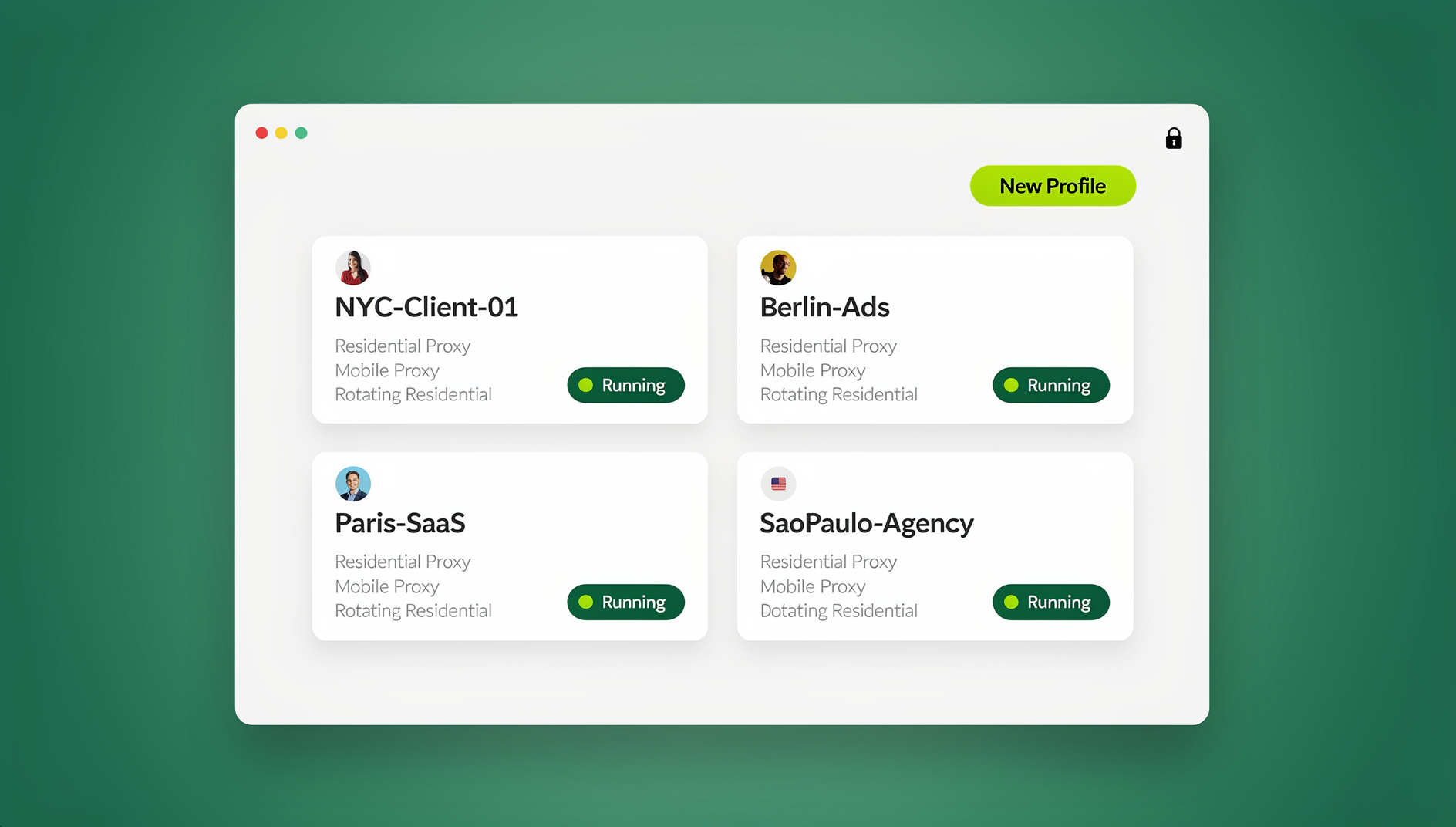
A highly efficient alternative is to access the IBKR Client Portal (the web-based trading interface) through separate, isolated browser profiles. Traditional browsers share cookies and local storage across tabs, meaning that logging into one IBKR account will automatically log you out of any others open in the same browser. To solve this, professional traders use Send.win. Send.win provides persistent, isolated browser environments that run side-by-side, allowing you to log into different IBKR accounts simultaneously without any session cross-contamination.
Send.win operates in two ways: through the native Sendwin Browser desktop client (available for Windows, macOS, and Linux) or via cloud browser sessions that run entirely on Sendwin’s remote infrastructure without requiring any local installation. By using a secure cookie management tool, Send.win isolates the cookies, cache, and local storage of each tab, preventing Interactive Brokers from linking your sessions or flagging your accounts for suspicious login activity. This is particularly valuable for traders managing international portfolios who need to associate different proxy IPs with each trading profile. If you are managing multiple digital assets, you can read our browser for ads management guide to learn more about sandbox configurations.
Method 6: Programmatic Execution and Automation via IBKR APIs
For algorithmic traders and quantitative developers, programmatic multi-account management is the ultimate goal. Interactive Brokers provides two main APIs for this purpose: the Trader Workstation (TWS) API and the Client Portal (REST) API. These interfaces allow you to write custom scripts to monitor positions, receive market data, and execute trades across multiple sub-accounts automatically.
The TWS API requires running TWS or the IB Gateway software locally. Your scripts connect to this gateway via network sockets. The API supports multi-account trading, allowing you to specify target account numbers and allocation codes directly in your order placement functions. The Client Portal API, on the other hand, is a RESTful web service that does not require running TWS locally. You can interact with it using standard HTTP requests, making it ideal for cloud-deployed trading bots and web dashboards.
To take automation a step further, Send.win offers a local Automation API on its Pro and Team plans. This API allows developers to drive isolated browser sessions programmatically using popular libraries like Selenium, Puppeteer, and Playwright. This means you can automate tasks within the Client Portal interface directly, such as exporting daily statements or checking margin status across dozens of separate accounts, without having to build complex API integrations from scratch. For instance, developers running multiple online campaigns or managing multiple amazon accounts use similar automation tools to unify their operations under a single programmatic script.
Best Practices for Risk and Compliance in Multi-Account Trading
Managing multiple trading accounts introduces unique operational risks that can quickly lead to financial loss or regulatory scrutiny if not managed carefully. The foremost best practice is establishing a clear account naming convention. Interactive Brokers assigns alphanumeric account numbers (e.g., U1234567) that are easy to confuse during fast-paced trading sessions. Always set up custom descriptive aliases in your account management dashboard, such as ‘IRA_Growth’ or ‘Trust_Income’, to prevent executing trades in the wrong portfolio.
Another critical practice is implementing daily reconciliation workflows. At the end of every trading day, compile account statements and verify that all executed trades, current positions, cash balances, and margin requirements match your internal records. Using IBKR’s Flex Queries allows you to automate the extraction of this data into CSV or XML formats, which can then be imported into portfolio accounting software or custom spreadsheets for rapid checking.
Finally, ensure that you maintain strict security standards. Multi-account managers handle significant sums of capital and sensitive client information. Never share master login credentials or password files. Use secure team sharing tools that allow authorized users to access specific accounts without revealing the underlying passwords. Ensure two-factor authentication (2FA) is active on all profiles, and restrict API access to trusted IP addresses to prevent unauthorized order execution.
🏆 Send.win Verdict
Juggling multiple Interactive Brokers accounts natively often leads to credential fatigue, IP-related security locks, and system lag from running multiple Trader Workstation instances. Send.win provides a clean, secure solution, allowing you to access and trade across multiple Client Portal sessions concurrently via its native Sendwin Browser desktop client or cloud browser sessions. This gives you professional-grade isolation without the compliance overhead of a Financial Advisor account.
Try Send.win free today — run all your trading profiles in parallel with a 30-day free trial.
Frequently Asked Questions
Can I open multiple individual accounts at Interactive Brokers?
Yes. Interactive Brokers allows you to open multiple individual accounts for different purposes, such as a cash account, a margin account, and an IRA. You can then link them under a single login for easy switching via the Client Portal or TWS selector.
What is the difference between linked accounts and advisor accounts?
Linked accounts are independent retail portfolios grouped under a single login for convenience; they do not support automated trade allocations. Advisor accounts (Financial Advisor and Friends & Family) are master-sub structures designed for professional money managers to execute block orders and distribute them across multiple sub-accounts instantly.
Does Interactive Brokers charge fees for multi-account structures?
There are no direct fees for setting up linked accounts or advisor master accounts. However, market data subscription fees and minimum commission requirements may apply to individual sub-accounts depending on their activity levels and asset values.
Can I trade in multiple IBKR accounts simultaneously on TWS?
Trader Workstation (TWS) restricts users to one active login session per machine. To trade on multiple independent accounts simultaneously without advisor access, you must use separate computers, configure virtual machines, or access the Client Portal using isolated browser environments like Send.win.
How does Send.win prevent login bans when switching accounts?
Send.win isolates the cookies, cache, local storage, and browser fingerprints of each profile. This prevents websites from identifying that multiple logins are coming from the same local browser profile, reducing the risk of security locks or automatic sign-outs when managing multiple portfolios.
What are the pricing options for Send.win?
Send.win offers a 30-day free trial with no credit card required. Paid plans include the Pro plan at $19/month ($6.99/month billed annually — 63% savings) supporting up to 150 profiles, and the Team plan at $49/month ($20.99/month billed annually — 57% savings) which includes 500 profiles and team collaboration seats.
Is the Automation API available on the Pro plan?
Yes. Send.win’s local Automation API, which supports Puppeteer, Playwright, and Selenium to control isolated profiles programmatically, is available starting on the Pro plan as well as the Team plan, making automation accessible to solo developers and quantitative traders.
{
“@context”: “https://schema.org”,
“@type”: “FAQPage”,
“mainEntity”: [
{
“@type”: “Question”,
“name”: “Can I open multiple individual accounts at Interactive Brokers?”,
“acceptedAnswer”: {
“@type”: “Answer”,
“text”: “Yes. Interactive Brokers allows you to open multiple individual accounts for different purposes, such as a cash account, a margin account, and an IRA. You can then link them under a single login for easy switching via the Client Portal or TWS selector.”
}
},
{
“@type”: “Question”,
“name”: “What is the difference between linked accounts and advisor accounts?”,
“acceptedAnswer”: {
“@type”: “Answer”,
“text”: “Linked accounts are independent retail portfolios grouped under a single login for convenience; they do not support automated trade allocations. Advisor accounts (Financial Advisor and Friends & Family) are master-sub structures designed for professional money managers to execute block orders and distribute them across multiple sub-accounts instantly.”
}
},
{
“@type”: “Question”,
“name”: “Does Interactive Brokers charge fees for multi-account structures?”,
“acceptedAnswer”: {
“@type”: “Answer”,
“text”: “There are no direct fees for setting up linked accounts or advisor master accounts. However, market data subscription fees and minimum commission requirements may apply to individual sub-accounts depending on their activity levels and asset values.”
}
},
{
“@type”: “Question”,
“name”: “Can I trade in multiple IBKR accounts simultaneously on TWS?”,
“acceptedAnswer”: {
“@type”: “Answer”,
“text”: “Trader Workstation (TWS) restricts users to one active login session per machine. To trade on multiple independent accounts simultaneously without advisor access, you must use separate computers, configure virtual machines, or access the Client Portal using isolated browser environments like Send.win.”
}
},
{
“@type”: “Question”,
“name”: “How does Send.win prevent login bans when switching accounts?”,
“acceptedAnswer”: {
“@type”: “Answer”,
“text”: “Send.win isolates the cookies, cache, local storage, and browser fingerprints of each profile. This prevents websites from identifying that multiple logins are coming from the same local browser profile, reducing the risk of security locks or automatic sign-outs when managing multiple portfolios.”
}
},
{
“@type”: “Question”,
“name”: “What are the pricing options for Send.win?”,
“acceptedAnswer”: {
“@type”: “Answer”,
“text”: “Send.win offers a 30-day free trial with no credit card required. Paid plans include the Pro plan at $19/month ($6.99/month billed annually — 63% savings) supporting up to 150 profiles, and the Team plan at $49/month ($20.99/month billed annually — 57% savings) which includes 500 profiles and team collaboration seats.”
}
},
{
“@type”: “Question”,
“name”: “Is the Automation API available on the Pro plan?”,
“acceptedAnswer”: {
“@type”: “Answer”,
“text”: “Yes. Send.win’s local Automation API, which supports Puppeteer, Playwright, and Selenium to control isolated profiles programmatically, is available starting on the Pro plan as well as the Team plan, making automation accessible to solo developers and quantitative traders.”
}
}
]
}