To manage multiple Google Calendar accounts without scheduling conflicts, professionals and teams must use native calendar sharing, separate browser profiles, or dedicated multi-profile browsers like Sendwin. While native sharing allows simple view-only access and calendar tools help block external bookings, utilizing the Sendwin Browser desktop client or isolated cloud browser sessions ensures persistent logins and complete write-access across all Google accounts simultaneously without security challenges.

Why You Might Need Multiple Google Calendar Accounts
Google Calendar is the scheduling backbone for millions of professionals, but it was built with a single-account mindset. When you need to manage multiple Google Calendar accounts — for personal life, a full-time job, a side business, freelance clients, or volunteer commitments — the complexity multiplies rapidly. Double bookings, missed appointments, and scheduling confusion become daily risks. If you are a consultant juggling five clients, each giving you a corporate Google Workspace account, checking your calendar requires logging in and out of multiple panels, making it easy to overlook a key meeting.
Maintaining work-life separation is another major driver. Many people maintain separate Google accounts for work and personal use. Your employer might provide a Google Workspace account with its own calendar, while your personal Gmail has a different calendar entirely. Seeing both calendars in one view — without merging the accounts — is essential for avoiding scheduling conflicts. Entrepreneurs running multiple businesses typically have separate Google Workspace accounts for each venture. Each business has its own meeting schedules, project timelines, and team availability — all needing unified visibility. Finally, managing family members’ calendars — kids’ school events, partner’s work schedule, shared family appointments — often means accessing calendars across multiple Google accounts.
Without a clean multi-account setup, double bookings are inevitable. If a client schedules a meeting on your freelance calendar while your corporate job has a critical presentation at the same time, you are forced to reschedule and explain the conflict. This looks unprofessional and drains your productivity. Having an aggregated, real-time view where you can also make updates instantly is the only way to manage a busy schedule across different entities successfully.
Additionally, modern remote workers often face the challenge of time zone differences. Managing multiple calendars manually can lead to scheduling mistakes, especially when accounts are set to different default time zones. A unified viewing environment allows you to see time slots adjusted to your local environment, ensuring that you never miss a client call because of a timezone translation error. It also allows you to plan breaks and buffer times more accurately, protecting your health and productivity.
Method 1: Google’s Native Multi-Calendar Features
Google Calendar allows some basic integration between accounts. While these native features are suitable for casual users, they have significant drawbacks for power users who need complete edit access and quick workflows across several independent profiles.
Adding Other Calendars Within Google Calendar
Google Calendar allows you to view calendars from other Google accounts without logging into them. This is the simplest way to aggregate multiple calendars. To do this, open Google Calendar in your primary Google account, click the “+” icon under “Other calendars”, select “Subscribe to calendar”, enter the Gmail address of your other account, and accept the sharing invite in that second account. Once shared, the calendar appears in your primary view with a distinct color. While this displays all events together, it only grants view access; if you want to reschedule an event on the shared calendar, you must log out and log into that specific account.
Google Calendar Delegate Access
Google Workspace accounts support calendar delegation, which is more powerful than simple sharing. With delegate access, you can view all event details (including private events), create, edit, and delete events on behalf of the owner, respond to meeting invitations, and manage scheduling settings. Delegation is configured in Google Calendar settings under “Share with specific people” by selecting the “Make changes and manage sharing” permission level. This is ideal for executive assistants managing a boss’s calendar, but it still requires manual configuration for every single profile, which is tedious for a freelancer managing many client accounts.
Google Calendar Mobile App Multi-Account Support
The Google Calendar mobile app supports multiple logged-in Google accounts simultaneously. You can toggle individual calendars on and off, see all events in a unified view, and create events on any logged-in account’s calendar. This is one area where mobile actually outperforms the desktop experience. On desktop, standard browsers restrict you to one active Google account login per session, meaning you cannot natively edit multiple calendars side-by-side in separate tabs without encountering session override errors.
Method 2: Browser Profiles for Simultaneous Calendar Editing
Because the Google Calendar desktop site restricts you to a single login session per browser instance, using browser profiles is a popular workaround for desktop users. This allows you to open separate windows for each account.
Setting Up Chrome Profiles for Google Workspace
To set up profiles, click your user icon in Chrome, select “Add” to create a new profile, name it after the calendar (e.g., “Calendar – Personal”, “Calendar – Client A”), and log into the respective Google account. Each profile stores its own cookies separately, meaning you can stay logged into all calendars at once. To understand the deep technical details of cookie isolation and session persistence across separate profiles, you can read our Cookie Management Tool Complete Guide 2026. While this solves the basic session conflicts, managing ten browser windows takes up a lot of screen space and memory. If you want a complete tutorial on profile organization in Chrome, view our Chrome Multi Account Multi Account Management Guide 2026.
The Friction and Security Pitfalls of Web Browser Profiles
Web browser profiles are heavy on CPU and memory. Running several Chrome profiles simultaneously can quickly overload your computer, causing browser tabs to freeze or crash. Furthermore, web browser profiles share the same IP address and system fingerprint. Google tracks the hardware configuration and IP location of logins to prevent unauthorized access. If you are logging into ten client Workspace accounts from the same machine with identical browser fingerprints, Google’s security systems may flag these as suspicious, triggering frequent verification codes or temporarily locking the accounts, disrupting your client relations.
Method 3: Managing Calendars with Sendwin Browser and Cloud Sessions
To bypass the heavy memory usage of standard web profiles and avoid security blocks, specialized multi-profile tools are the ideal solution. Sendwin offers a highly optimized ecosystem designed specifically for simultaneous, safe multi-account access.
The Sendwin Browser Desktop Client
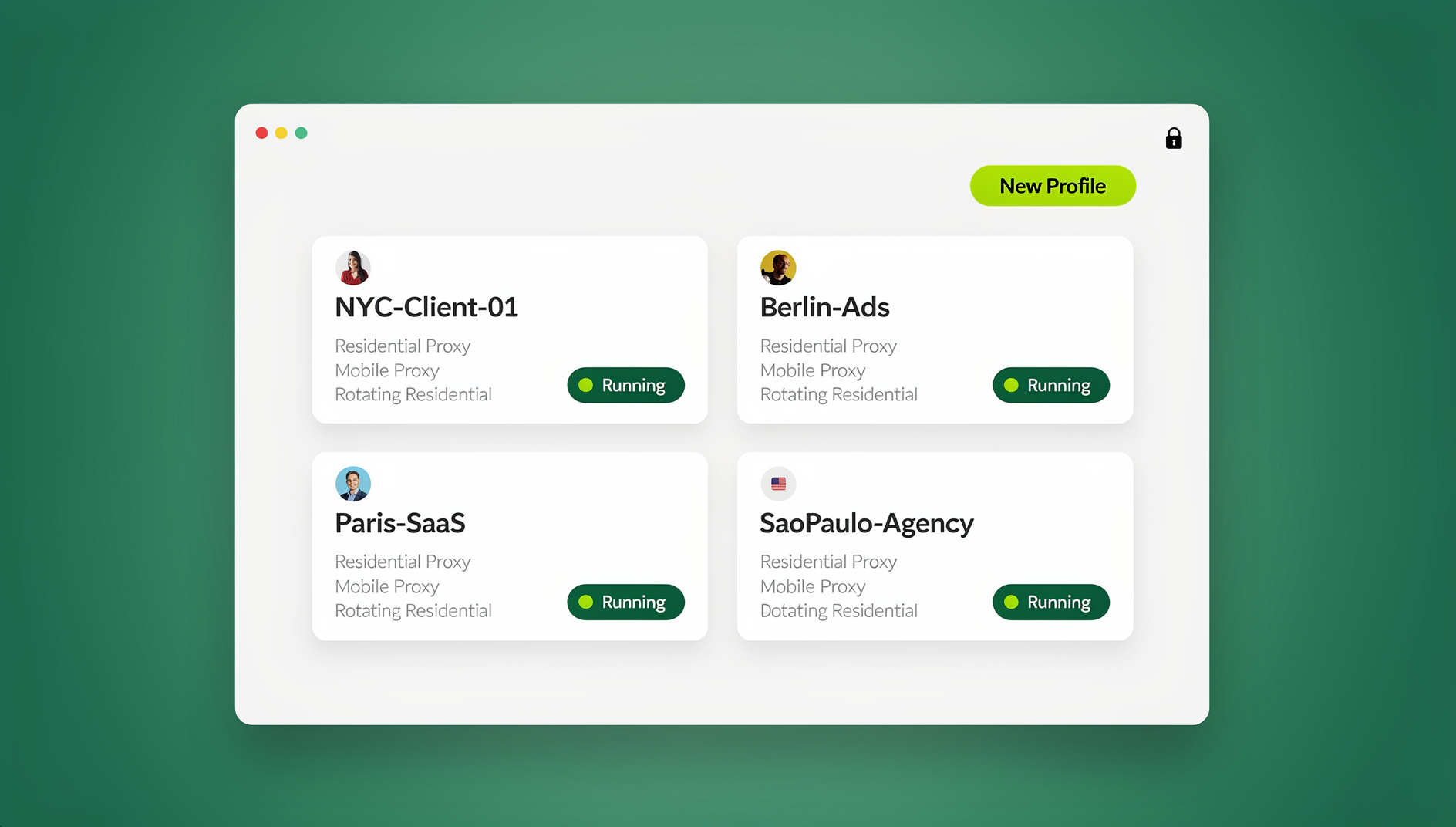
The Sendwin Browser is a native desktop client for Windows, macOS, and Linux. It allows you to run multiple Google Calendar accounts simultaneously in isolated tabs. Unlike standard web browsers, Sendwin modifies the digital fingerprint of each profile (including user-agent, canvas data, and system fonts). This means Google sees each login session as coming from a completely different device, minimizing security challenges and eliminating account suspension risks. You can keep all your client calendars open in a single window, switching between them with simple sidebar tabs, which saves system memory.
Cloud Browser Sessions for Easy Access
Sendwin also features cloud browser sessions. In this mode, your browser profiles run on secure cloud servers and are streamed directly to your device. This allows you to manage all your Google Calendars from any device without installing any software locally. For teams, this means a project manager can share a client’s calendar session with an assistant without sharing the raw login credentials. The session remains active in the cloud, so the assistant can make updates immediately. This is highly secure and prevents the risk of login credentials being leaked or lost during team transitions.
IP and Fingerprint Isolation: Protecting Your Client Accounts
Digital security is a major consideration when handling corporate calendars. Google tracks various network parameters to ensure account safety, and failing to manage these can lead to locks.
Browser Fingerprinting Danger
Google employs advanced algorithms to detect suspicious login patterns. A browser fingerprint consists of unique hardware and software markers, such as your graphics driver, screen size, and system language. When you access multiple client calendars from the same device, Google’s algorithms can link them together. If one client’s workspace faces security issues, your device fingerprint could be marked as untrusted, affecting all other accounts you manage. To understand how browser isolation protects your digital footprint and keeps your profiles secure, check out our Browser For Ads Management Browser Isolation Guide 2026.
Multi-Account Safety on Other Platforms
The need for digital isolation is well established across various online business sectors. For instance, online merchants must run separate profiles with distinct IPs to prevent account linkage, as outlined in our Multiple Amazon Accounts Multi Account Management Guide 2026. The same security standards apply to Google Calendar. By integrating proxies with Sendwin, you can assign a unique IP address to each calendar profile. This makes Google believe you are logging in from different locations, completely separating your business entities and ensuring uninterrupted scheduling operations.
Pricing and Plans: Which Sendwin Tier Fits Your Workflow?
Sendwin offers clear, transparent pricing designed to scale with your business. Every new user receives a 30-day free trial that requires no credit card, letting you test all multi-profile features risk-free. Once the trial ends, you can select from two main plans. The Pro plan costs $19 per month (or $6.99 per month when billed annually) and includes 150 profiles, 5GB of proxy bandwidth, and the local Automation API. The Team plan costs $49 per month (or $20.99 per month when billed annually) and includes 500 profiles, 20GB of proxy bandwidth, the local Automation API, and 16 team seats. The Automation API on the Pro plan is highly beneficial for users looking to sync their calendars programmatically using custom scripts.
For larger teams with higher resource requirements, Sendwin offers modular add-ons. You can buy extra proxy bandwidth for $6 per GB, or add additional profiles to your account for just $0.05 per profile. For a consultant managing a dozen client calendars, the annual Pro plan at $6.99 per month is an affordable solution that saves hours of login friction and protects your scheduling workflows from security disruptions.
🏆 Send.win Verdict
Managing multiple Google Calendar accounts natively leads to constant session override errors and security blocks on desktop. Sendwin offers a secure alternative by isolating cookie containers and masking fingerprints across all profiles.
Try Send.win free today — Streamline your calendar coordination with isolated, secure multi-profile sessions.
Frequently Asked Questions
Can I manage multiple Google Calendar accounts in one view?
Yes. You can subscribe to other calendars natively within Google Calendar (view-only), use the Google Calendar mobile app which displays multiple accounts together, or use the Sendwin desktop client to edit all accounts side-by-side in isolated profiles.
How do I sync two Google Calendar accounts?
You can sync them by sharing your calendar natively with write permissions, using third-party sync utilities like Reclaim.ai, or writing a custom Google Apps Script. For a secure, manual approach, keeping both accounts open in Sendwin is the safest way.
Can I merge two Google Calendar accounts?
No, Google does not allow merging accounts. You can export events from one account as an .ics file and import them into another, but this is a one-time copy. For ongoing sync, you must use sharing settings or third-party tools.
How do I avoid double-booking across Google Calendar accounts?
You can share calendars with “Free/Busy” visibility between your accounts so you can see conflicts. Alternatively, booking platforms like Calendly can check availability across multiple connected accounts before offering slots to clients.
Is there an add-on or helper to manage multiple Google Calendar accounts?
No, Sendwin does not offer a browser add-on or helper. Instead, it provides a standalone desktop client and secure cloud browser sessions, which keep your accounts isolated and active without the risks of browser add-ons.
Will Google block me for logging into multiple calendar accounts?
Google does not ban multiple accounts, but logging into many accounts from the same IP address and hardware setup can trigger security verification codes. Using Sendwin with proxies prevents these flags by separating your footprints.
What is the price of Sendwin for managing multiple accounts?
Sendwin provides a 30-day free trial. The Pro plan is $19 per month ($6.99/mo annual) for 150 profiles. The Team plan is $49 per month ($20.99/mo annual) for 500 profiles and 16 team seats.