How Websites Decide Your Residential Proxy Is a Proxy
Yes. If you are asking can residential proxy be detected, the honest answer is that it can — no proxy is truly invisible. Detection is not one check but a weighted score built from weak signals: the exit IP’s reputation history, the ASN behind it, how your TCP and TLS stacks look, whether your timezone, DNS and WebRTC match that IP, and how your session behaves. A residential proxy usually fails two or three of those checks at once, not one.

📌 TL;DR Executive Summary
- Core Takeaway: Residential proxies are detectable, but detection is a risk score assembled from several noisy signals. Clean IP reputation plus a coherent fingerprint and human pacing keeps that score low.
- Key Risk/Challenge: Mismatches give you away faster than the proxy itself — a US exit IP with an EU timezone, a TCP fingerprint that contradicts the User-Agent, or one TLS client signature reused across hundreds of rotating IPs.
- Recommended Solution: Treat the proxy as one field in a long form, not a disguise. Keep exit IP, timezone, locale, WebRTC, DNS and session length consistent, and pick the right session type for the task.
What a Residential Proxy Changes — And What It Leaves Untouched
A residential proxy routes your traffic through an IP that a consumer ISP assigned to a household connection. What changes is the visible IP, its ASN and the geolocation attached to it. What does not change is your browser fingerprint, TLS handshake, DNS resolver, WebRTC candidates, request pacing and account history. The proxy edits one field in a long form while every other field keeps saying the same thing. So can residential proxy be detected? Yes, but rarely because of the address itself — the untouched fields decide it.
Proxies and VPNs solve different problems. A VPN usually pushes all device traffic through one fixed exit; a proxy works per application or per browser profile, so it can be pinned to a single session or rotated between requests. For the trade-offs between exit types, see residential versus datacenter proxies.
| Proxy type | Where the exit IP comes from | How it reads to a detection stack | Best fit |
|---|---|---|---|
| Datacenter | Cloud and hosting ASNs such as AWS, Google Cloud, Azure, DigitalOcean or Vultr | Classified by ASN alone, so it is the easiest to flag | High-volume, low-sensitivity reads |
| Rotating residential | Real ISP-assigned household IPs, changed on a timer or per request | Reputable IPs, but weak when one fingerprint and pacing pattern spans hundreds of them | Stateless scraping and price or ranking checks |
| Sticky residential | One household IP held for the length of a session window | Fine for logged-in flows when the window matches the task | Checkouts, form submissions, short logged-in tasks |
| Static residential / ISP | A dedicated IP attributed to an ISP, held for days or longer | The most stable identity when an account needs a permanent address | Accounts you keep for months |
How Residential Proxy Detection Works Under the Hood
Detection vendors work in four layers: provider intelligence, network-level signals, client-side fingerprints and live session behaviour. Each layer is noisy on its own. Together they are accurate enough to act on, which is why the question can residential proxy be detected rarely has a clean yes-or-no answer.
Provider datasets and shared exits
Vendors keep lists of IPs observed routing proxy traffic. IPinfo’s residential proxy dataset tags each flagged address with the proxy service it belongs to, a last-seen date and a percent-days-seen confidence value, refreshed every 24 hours, with per-request API scoring in roughly 50-200 ms. IPGeolocation.io tracks 20 million residential proxy ranges in a local dataset with provider names and last-seen dates.
Those lists decay. Exit nodes open and close as apps are installed and uninstalled, providers resell the same devices, and ISPs reassign addresses. Carrier-grade NAT compounds the problem: hundreds or thousands of subscribers share one public IP, so one device running a proxy SDK damages the reputation of the whole neighbourhood. Across major residential proxy providers, 44.1% of IPs appear in more than one provider’s pool, which means your exit may be shared with strangers running completely unrelated traffic.
TCP/IP stack, latency and TLS
Datacenter ASNs — AWS, Google Cloud, Azure, DigitalOcean, Vultr — are trivial to classify, which is why datacenter proxies get blocked faster. On residential IPs the checks move lower in the stack. Passive OS fingerprinting tools such as p0f compare the TCP handshake against the claimed User-Agent: headers that say Windows while the initial sequence number, window size and option ordering match a Linux kernel expose the tunnel. Scanners such as Nmap and Masscan also probe residential addresses out of the request path for open proxy ports like 1080, 3128, 8080 and 8291, though legitimate hosts produce false positives. Latency triangulation adds another signal — a handshake to a New York IP that consistently takes over 300 ms suggests the traffic is tunnelled from somewhere else.
TLS is the next layer. In HTTPS tunnelling the proxy only forwards the CONNECT request, so your JA3/JA4 client fingerprint comes from the browser or automation stack and stays identical while the IP changes. Many distinct residential IPs sharing one rare client fingerprint get clustered into a single operator, which is exactly the pattern that catches fast-rotating setups.
Browser fingerprint, WebRTC and DNS
Sites also read canvas, WebGL, audio, font and hardware signals, and a mismatch between GPU, installed fonts and platform makes a profile look synthetic. WebRTC exposes your real local and public addresses whenever non-proxied UDP is allowed. DNS is the quiet one: a resolver answering from a different country than the exit IP breaks the geolocation story before the page finishes rendering.
Session and behaviour analysis
Last comes behaviour — request rate, click paths, time between actions, session length, and whether a brand-new IP suddenly signs into an account only ever seen from another continent. One odd request is noise; a repeating pattern is a decision.
Why Detection Matters for Scraping, Ads and Multiple Accounts
For scraping, detection shows up as 403s, 429s and CAPTCHA walls that quietly ruin coverage — you end up with partial data and no way to tell which pages were blocked. For e-commerce sellers and ad buyers the cost is verification loops, restricted ad accounts and declined payments. For social media managers it is phone checks and throttled reach, which is why preventing multiple-account flags takes more than swapping IPs. For agencies, one flagged profile can put a client portfolio at risk.
There is a supply-side story worth knowing too. In March 2026 the FBI published a PSA on residential proxy networks documenting five ways devices end up as exit nodes — SDK partnerships, free VPNs with buried terms, compromised IoT devices, malware and passive-income apps — alongside eleven criminal uses. In May 2025 the DOJ dismantled Anyproxy and 5socks, which had advertised more than 7,000 proxies at $9.95 to $110 per month. DNS queries to proxy-related domains rose from roughly 300 billion per month in early 2025 to over 500 billion by April 2026, and Infoblox found more than 65% of its cloud customers connecting to residential proxy services. The defenders are well funded, and the exit IP you rent may be a device its owner never meant to share.
Detection Is a Weighted Score, Not a Switch
No single check proves a proxy, so can residential proxy be detected from one signal? No. Vendors stack independent, noisy signals into a risk score and act when several agree. That is why a residential IP with a mediocre reputation can still work when fingerprints, timezone and pacing are coherent — and why a pristine IP fails the moment three smaller details contradict each other.
| Signal | What is measured | How a careless setup fails |
|---|---|---|
| IP reputation | Provider datasets with service tags, last-seen dates and confidence values | The exit IP already appears in a proxy dataset |
| ASN and routing | Whether the address belongs to a cloud provider or a consumer ISP | A hosting ASN behind a claim of household traffic |
| TCP/IP stack | Handshake signature compared with the claimed operating system | User-Agent says Windows, TCP options say Linux |
| TLS fingerprint | JA3/JA4 client hello signature | One rare fingerprint reused across hundreds of rotating IPs |
| Latency | Round-trip time against the IP’s claimed location | A New York IP with handshakes over 300 ms |
| WebRTC and DNS | STUN candidates and resolver location | Real IP leak, or a resolver in the wrong country |
| Behaviour | Request rate, click paths, timing, session length | Robotic cadence, or a fresh IP signing into an old account |
Two consequences follow. A clean IP on one platform may still be flagged on another, because scoring models and datasets differ behind closed doors. And blanket blocking is expensive: Cloudflare measured that four out of five requests coming from residential proxy IPs were legitimate direct traffic from the household itself. Treat that as directional rather than universal, but it explains why platforms prefer step-up verification over hard blocks.
Sticky Sessions vs Rotation: Duration and Session-ID Hygiene
Sticky sessions are configured with a session identifier, usually embedded in the proxy username or passed as a parameter. The same identifier reuses the same exit for its window; a new identifier gets a new exit. That is the entire mechanism, and it is where most people make their first mistake: they stretch one identifier for hours because the login held.
Match the window to the task plus a small buffer. If you genuinely need the same IP for much longer than 30 minutes, a static residential or ISP proxy is usually a better fit than an over-long sticky session — dedicated ISP addresses are sold across 30+ countries, held for up to 90 days, from around $0.12 per IP per day. For stateless work, residential proxy rotation for web scraping covers how to set intervals without creating a new tell.
Rotation is not invisibility. Rotating on every request means hundreds of IPs carry one TLS fingerprint and one behaviour pattern, which is precisely the clustering signal JA3 analysis looks for. Rotate for reads that carry no identity; pin for anything logged in.
Checking Exit IP and Browser Coherence
You cannot inspect a vendor’s risk score, but you can verify the layers you control. Ask the profile what it believes about itself, then compare that with the exit IP’s region. A quick Playwright check catches the most common mismatch before it costs you an account.
from playwright.sync_api import sync_playwright

PROXY = {
    "server": "http://gate.yourprovider.net:8000",  # your proxy endpoint
    "username": "your-username-session-ab12",       # session id usually lives in the username
    "password": "your-password",
}

with sync_playwright() as p:
    browser = p.chromium.launch(proxy=PROXY, headless=True)
    context = browser.new_context(
        timezone_id="America/New_York",  # must match the exit IP's region
        locale="en-US",
    )
    page = context.new_page()
    page.goto("https://example.com")

    print(page.evaluate("Intl.DateTimeFormat().resolvedOptions().timeZone"))
    print(page.evaluate("navigator.language"))
    print(page.evaluate("navigator.hardwareConcurrency"))

    context.close()
    browser.close()
If the timezone or language returned does not match the exit IP’s country, you have found a flag before a platform did. The same check applies to WebRTC candidates and to the DNS resolver the session actually uses.
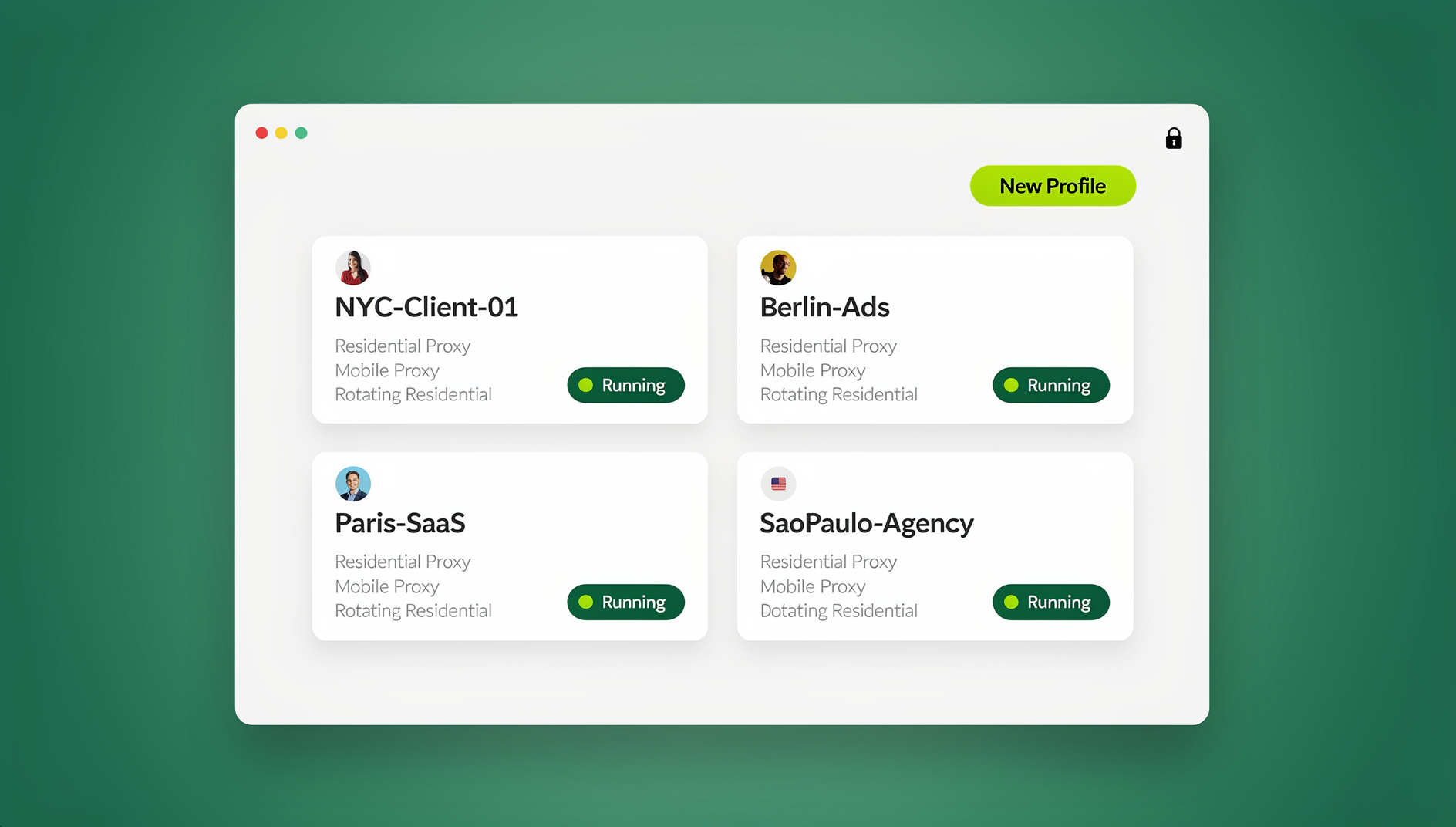
When you drive a Sendwin Browser profile instead, the proxy, timezone, locale, WebRTC and geolocation are already derived from the exit IP, so this becomes a confirmation step rather than a repair job. Send.win’s local Automation API for Selenium, Puppeteer and Playwright is listed on the Team plan, and a profile is reachable over CDP like this:
from playwright.sync_api import sync_playwright

CDP_URL = "http://127.0.0.1:PORT"  # copy it from the profile's automation settings

with sync_playwright() as p:
    browser = p.chromium.connect_over_cdp(CDP_URL)
    context = browser.contexts[0]
    page = context.new_page()
    page.goto("https://example.com")
    print(page.title())
Practical Checklist to Lower Residential Proxy Detection Risk
The question can residential proxy be detected comes down to a handful of details you control. Every item below maps to one of the layers above, and none of them requires access to a vendor’s scoring model.
- Vet the exit IP before first use. Check the ASN type, test it against two proxy-detection datasets, and note whether it appears under more than one provider name.
- Match timezone, locale and Accept-Language to the exit IP. City-level where possible, country-level at minimum.
- Close WebRTC leaks. Allow only proxied UDP, or disable non-proxied UDP entirely so STUN cannot expose your real address.
- Keep DNS in the exit IP’s region. Resolve through the tunnel, or through a resolver in the exit country.
- One identity per profile. Never mix proxies or accounts inside a single profile, and never reuse one profile across two client identities.
- Pick the session type for the job. Rotating for stateless reads, sticky for logged-in flows, static ISP for accounts you keep for months — compare ISP proxies versus residential proxies before you commit.
- Cap volume and pace requests. Think times, scrolls and pauses are cheaper than a CAPTCHA wall.
- Check fingerprint coherence, not just uniqueness. A unique profile whose GPU cannot exist on its stated platform is still a flag.
- Log what you change. Record the exit IP, ASN, timezone, locale and session window per profile, so a failed account tells you which version it ran.
Common Mistakes That Trigger a Flag
- Buying on pool size. A large pool of shared or tainted addresses performs worse than a small, clean one. Ask how many users sit behind your exit, not how many million IPs the provider claims.
- Stretching sticky sessions for hours. A login that holds is not proof the session is healthy — long windows are exactly what IP-quality checks look for.
- Ignoring the TCP and TLS layers. People tune User-Agent strings for hours while the handshake still says Linux.
- Rotating IPs in the middle of a logged-in flow. Checkout, form submission and 2FA steps should complete on the same exit.
- One fingerprint across a whole fleet. Hundreds of IPs with one client signature is a cluster, not diversity.
- Signing into an old account from a new country. Account history is itself a signal, and a geography jump triggers re-verification.
How Send.win Helps With Can Residential Proxy Be Detected
Send.win is an antidetect browser built for exactly this kind of work — every profile is a clean, isolated identity:
- Isolated profiles – unique fingerprint, separate cookies and storage per profile
- Stealth engine – canvas, WebGL, fonts, and audio spoofed at the engine level
- Desktop app + cloud sessions – native app for Windows, macOS, and Linux, or run profiles in the cloud with no install
- Built-in residential proxies – with automatic timezone, locale, and WebRTC matching
- Team features – share logged-in profiles with teammates without sharing passwords
Try the instant cloud browser demo — no install, no signup — or download the desktop app. The 30-day free trial needs no credit card, and paid plans start at $6.99/month billed annually (see pricing).
Where Send.win Fits
Send.win is an anti-detect browser with built-in residential proxies, which puts the two halves of this problem in one place. Instead of bolting a proxy onto a normal browser and then patching timezone, locale and WebRTC by hand, each profile is a patched-Chromium environment with the Sendwin Stealth engine built in. Canvas, WebGL, audio, fonts and hardware are spoofed at the engine level rather than by script injection, and they are kept coherent, so a profile reads like a separate real machine and no two profiles share a fingerprint.
Timezone, locale, WebRTC and geolocation follow the proxy’s exit IP automatically, which removes the single most common source of the mismatches described above. You can also bring your own HTTP or SOCKS5 proxy where you already trust a pool, and the two approaches can coexist across different profiles. Sendwin Browser runs locally on Windows 10/11, macOS 12+ and Linux, and the same profiles can run on Send.win’s EU and US cloud nodes from any device with nothing to install. On paid plans, cloud sync carries logins across machines, and sharing a profile with a paid teammate opens it already signed in.
🏆 Send.win Verdict
Since residential proxy detection is mostly a mismatch problem, the fix is an environment where the pieces cannot drift apart. Send.win pairs built-in residential proxies with engine-level fingerprint spoofing and resolves timezone, locale, WebRTC and geolocation from the exit IP automatically, which removes the two failure classes that catch most setups: an inconsistent browser identity and geo settings that contradict the IP.
Try Send.win free today — 30 days at $0 with 10 isolated profiles, 10 built-in residential proxies and 1 GB of bandwidth, and your local profiles stay on your machine.
Frequently Asked Questions
Can residential proxies be detected by websites?
Yes. No proxy is completely undetectable, so can residential proxy be detected is really a question of how strongly. Sites combine IP reputation datasets, ASN and routing data, TCP and TLS fingerprints, browser fingerprinting, WebRTC and DNS checks, and behaviour analysis into a weighted risk score. A well-configured residential proxy lowers that score rather than zeroing it.
Why do residential proxies get blocked?
Usually because several signals agree at once: the IP already appears in a proxy dataset, neighbours behind the same carrier-grade NAT address have damaged its reputation, the browser fingerprint contradicts the claimed machine, or the request rate looks nothing like a human. One weak signal rarely triggers a block on its own.
Is a residential proxy the same as a VPN?
No. A VPN typically routes all device traffic through one fixed exit, while a proxy applies per application or per browser profile and can be pinned to a session or rotated between requests. Running a residential proxy inside a browser profile is how most multi-account setups work.
Do residential proxies protect me from fingerprinting?
No. A proxy changes your visible IP and its geolocation, nothing more. Canvas, WebGL, audio, fonts, hardware, screen metrics and WebRTC candidates still come from your browser, which is why an IP swap alone fails on platforms that fingerprint aggressively.
How long should a sticky session last?
Roughly the length of the task plus a small buffer, reassessed per workflow. If you need the same IP for much longer than 30 minutes, a static residential or ISP proxy with a dedicated address is usually the better fit than stretching a rotating sticky session.
Are free residential proxies safe to use?
Generally not. Free services tend to recycle IPs that have already been blocked, and many lack encryption, exposing your traffic to interception. You also rarely learn how many other users share the same exit or when it was last flagged.
How do I know whether my residential IP is shared?
Run the address through more than one reputation dataset and compare the provider names and last-seen dates. Across major providers, 44.1% of IPs appear in more than one provider’s pool, so overlap is common. If an address shows up under several services, treat it as shared and plan accordingly.
Does rotating IPs hide a proxy or expose it?
Both, depending on how you rotate. Rotation improves the IP-reputation layer, but if hundreds of addresses carry one TLS client fingerprint and one behaviour pattern, they get clustered into a single operator. Rotate for stateless reads and keep identities pinned for anything logged in.