To understand **what is fingerprint browser anti detect browser explained** simply: it is a specialized web browser that lets you run multiple isolated profiles, each with its own digital footprint (like canvas, WebGL, user-agent, and hardware features). By presenting unique, consistent parameters to target websites, these browsers help keep your accounts and sessions separate. This guide explains how fingerprinting works and reviews the best tools like Send.win, Multilogin, and GoLogin.

The Core Mechanics of Browser Fingerprinting
For many years, web tracking relied primarily on cookie files. Websites stored small text files on your hard drive to track your logins, shopping carts, and browsing history. If you cleared your cookies or used incognito mode, you were treated as a new visitor. Today, cookie tracking has been eclipsed by browser fingerprinting. Websites no longer need to write files to your device. Instead, they collect hundreds of distinct data points that your browser naturally transmits during standard interactions.
When you visit a website, the server requests technical information to render the page correctly. This includes your operating system type, user-agent string, preferred language settings, screen resolution, and time zone. However, advanced scripts also inspect lower-level properties, such as your graphics card specifications, the exact way your CPU renders 3D shapes, the list of installed system fonts, and the behavior of your system’s audio processing chip. Combined, these attributes create a highly detailed, unique identifier. This digital signature is so specific that it allows platforms to identify your device with over 99% accuracy, even if you change your IP address or delete your cookies. This is why tracking has become so difficult to avoid without specialized tools.
To make matters more complex, modern fingerprinting algorithms examine browser navigator objects in detail. They query variables like navigator.language, navigator.languages, navigator.platform, navigator.hardwareConcurrency, and navigator.deviceMemory. If any of these values are inconsistent—for example, if a script detects eight CPU cores but your user-agent says you are running a lightweight mobile phone—the website’s security systems will immediately flag the browser profile as suspicious and lock it out. This highlights the absolute necessity of absolute consistency when spoofing browser parameters.
How an Anti-Detect Browser Spoofs Fingerprints
An anti-detect browser is a specialized application designed to combat browser fingerprinting. Instead of blocking tracking scripts—which actually makes your browser look more suspicious and unique—an anti-detect browser modifies the data those scripts collect. By altering the JavaScript environment at a low level, it allows you to create multiple, completely isolated browser profiles on a single machine. To websites, each profile appears to be running on a completely different physical device.
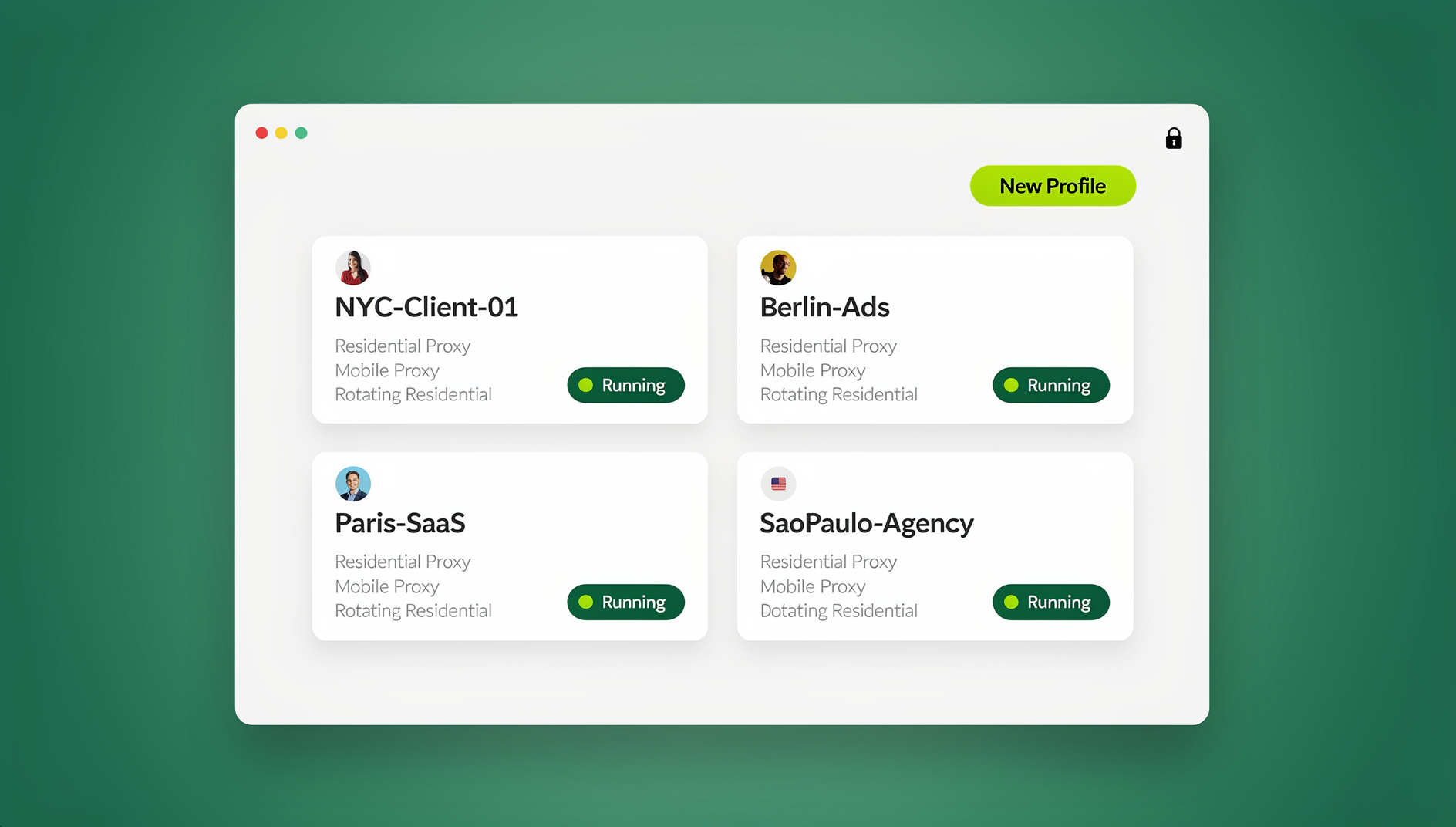
For example, you can configure Profile 1 to appear as a Windows 10 workstation running a Chromium-based browser with an NVIDIA graphics card, located in Chicago. Simultaneously, you can run Profile 2 to look like a macOS laptop running a Safari-like engine with an Intel GPU, located in London. Each profile manages its own isolated cookies, local storage, cache, and history. Combined with a dedicated proxy, it provides complete identity separation, allowing you to operate multiple accounts on the same platform without triggering fraud prevention systems.
To achieve this level of security, anti-detect browsers intercept Javascript function calls at runtime. They use native browser bindings to inject custom scripts before any page assets or tracking scripts can load. This ensures that when a website queries properties like canvas rendering or WebGL capabilities, the browser returns altered, realistic values instead of the real hardware details. This low-level modification is the primary defense against advanced tracking algorithms in 2026.
Understanding WebRTC and Network-Level Isolation
Even if your hardware fingerprint is perfectly masked, your network configuration can still compromise your accounts. Many users rely on Virtual Private Networks (VPNs) or simple proxy tools to change their IP addresses. However, modern websites use WebRTC (Web Real-Time Communication) to query local network interfaces. WebRTC is a browser technology that allows direct peer-to-peer communication, which is useful for video calls and streaming. Unfortunately, it also allows scripts to bypass your proxy or VPN and discover your real local IP address.
This leak is fatal for multi-account management. If Facebook or Amazon detects that ten different profiles, all claiming to run from different countries, are exposing the same local IP address via WebRTC, they will link the accounts instantly. Anti-detect browsers prevent this vulnerability by blocking WebRTC leaks or spoofing the WebRTC media device list. They return virtualized, consistent network paths to ensure your true IP remains hidden, completing the isolation of your digital footprint.
7 Crucial Insights About Anti-Detect Browsers
1. Deep Profile Isolation Prevents Cookie Leakage
The foundation of any anti-detect browser is profile isolation. In a standard browser, all tabs share the same local storage, cookies, and cache memory. If you log into two separate accounts on the same platform in different tabs, the platform will immediately link them. Anti-detect tools run each profile in an isolated sandbox, ensuring that session cookies and local data never cross-contaminate. This level of segregation is essential for secure account management. It separates not only cookies but also IndexedDB, LocalStorage, cache storage, and Service Workers, preventing any cross-contamination. If you want to configure your network footprint properly, you can read our guide on proxy browser setup to see how to pair proxies with isolated profiles.
2. Coherent Hardware Spoofing is Key to Credibility
Many basic privacy tools attempt to protect anonymity by randomizing browser values on every page load. However, modern fraud detection algorithms easily identify this pattern. If your user-agent claims you are running a Mac, but your graphics card renderer is a Windows DirectX driver, the platform will flag the profile as fake. Anti-detect browsers generate coherent fingerprints where every parameter—operating system, user-agent, GPU, canvas rendering, and audio signature—aligns perfectly. The fingerprint remains stable and consistent over time, mimicking a real user’s device. Statistical coherence is what keeps profiles from being flagged by fraud detection scanners.
3. Seamless Proxy Integration Isolates Network Footprints
A unique hardware fingerprint is useless if all your profiles share the same IP address. Anti-detect browsers allow you to assign a dedicated proxy to each profile. When you open a profile, the browser routes all traffic through that specific proxy IP. This prevents platforms from linking your accounts through shared IP networks. Professional tools automatically synchronize your profile’s timezone, language settings, and WebRTC parameters to match the proxy’s geographical location, preventing configuration mismatches that trigger security alerts. Standardizing on high-quality residential proxies is the best practice for maintaining access.
4. Automation APIs Enable Scale and Efficiency
For businesses managing dozens of accounts, manual operation becomes a major bottleneck. Anti-detect browsers resolve this by integrating with popular web automation frameworks like Selenium, Puppeteer, and Playwright. This allows developers to script repetitive tasks—such as creating accounts, publishing listings, or parsing data—while maintaining full fingerprint isolation. Send.win does not offer an automation interface: there is no API, SDK, headless mode or Selenium/Puppeteer/Playwright support on any plan.
5. Collaborative Workspaces Support Team Workflows
In digital agencies and e-commerce teams, multiple employees often need to manage the same set of accounts. Sharing raw passwords or passing multi-factor authentication (MFA) codes back and forth is insecure and inefficient. Anti-detect browsers allow team members to share active browser profiles securely. When you share a profile with a coworker, they can open it instantly with the active login session intact, without ever knowing the account password. If you want to understand how this fits into broader network security, you can explore our guide on browser isolation technology to see how containerized sessions scale. Teammates can manage profiles securely without sending raw login details.
6. Cloud-Based Session Deployment vs. Native Clients
Traditionally, anti-detect browsers required downloading heavy local applications. Running multiple profiles concurrently puts a heavy strain on your computer’s RAM and CPU, often causing slowdowns. Modern solutions like Send.win offer both the Sendwin Browser desktop client for local execution and cloud browser sessions that run entirely on remote servers. Cloud sessions stream the browser window to your screen, offloading the processing power and allowing you to access profiles from any device, including Chromebooks, tablets, or phones, without local installation. If you are interested in self-hosted cloud alternatives, you can check out our guide on docker browser configurations for containerized setups. Remote execution provides the ultimate layer of hardware decoupling.
7. Cost-Effectiveness and Pricing Models
Evaluating the cost of anti-detect tools is crucial for calculating your business overhead. Send.win offers a highly competitive pricing structure designed for accessibility. There is no free trial; the first card purchase is covered by a 7-day money-back guarantee, and the only free option is the cloud demo at https://send.win/demo-browser/. When you decide to upgrade, two primary plans are available:
- Pro Plan: $19 per month (or $83.88 per year), supporting 150 profiles and 5GB of proxy bandwidth.
- Team Plan: $49 per month (or $20.99 per month billed annually), supporting 500 profiles, 20GB of proxy bandwidth, and 16 user seats.
This model ensures that even small businesses can access advanced anti-detection tools without the high costs typical of legacy software providers. Investing in isolated profiles is highly cost-effective compared to the massive losses incurred from suspended seller storefronts or ad accounts.
How to Select the Right Tool for Your Workflow
Choosing the right anti-detect browser depends heavily on your specific operational goals. If your primary focus is digital marketing and running social campaigns, you need a browser that integrates well with ad managers. If you are managing e-commerce storefronts, profile stability and proxy consistency are your top priorities. If your operation requires running heavy scrapers, you should look for containerized setups. For a deeper look at separating application layers for security, you can read our resource on application isolation techniques. Testing profiles before scaling up is highly recommended.
Send.win is highly recommended for teams that require flexible, portable access due to its hybrid model of native desktop apps and cloud-hosted browser sessions. Users who prefer premium local customizability often look at Multilogin, while those operating on tight budgets find GoLogin or AdsPower to be suitable alternatives. Testing tools using free trials is the best way to verify compatibility with your target platforms.
🏆 Send.win Verdict
For professionals seeking to understand what is fingerprint browser anti detect browser explained, Send.win delivers an outstanding, modern solution. By supporting both the native Sendwin Browser desktop client and zero-install cloud browser sessions, it caters to all workflow styles. The cloud browser mode allows you to access isolated profiles from any device without local hardware strain, while the Pro plan ($19/month, or $83.88/year) keeps pricing accessible to solo users. It is an excellent, secure platform for managing multiple business accounts.
Try Send.win today — plans start at $19/mo, and your first card purchase is covered by a 7-day money-back guarantee.
Frequently Asked Questions
What is the difference between a fingerprint browser and an anti-detect browser?
They are the same thing. Both terms refer to specialized web browsers designed to manage, spoof, or mask your browser fingerprints (such as user-agent, canvas, and WebGL specs) to let you run multiple accounts securely without linking them.
Does Send.win require me to install a desktop application?
It depends on your workflow. Send.win offers both the native Sendwin Browser desktop client (which you install on Windows, macOS, or Linux) and cloud browser sessions, which run entirely on remote servers and can be used directly in any standard web browser tab.
Can I automate tasks in my anti-detect browser profiles?
No. Send.win has no automation interface: there is no API, SDK, headless mode or Selenium/Puppeteer/Playwright support on any plan.
How do anti-detect browsers prevent account linkage?
They isolate profile data (cookies, storage, and history) and spoof hardware parameters (canvas rendering, WebGL hashes, system fonts, and audio profiles). To websites, each profile behaves like a completely separate physical computer with its own network connection.
What is the starting price for Send.win plans?
Send.win has no free trial; the first card purchase is covered by a 7-day money-back guarantee, and the only free option is the cloud demo at https://send.win/demo-browser/. The Pro plan costs $19 per month ($83.88 per year) for 150 profiles, and the Team plan costs $49 per month ($251.88 per year) for 500 profiles.
Is using an anti-detect browser legal?
Yes. Operating an anti-detect browser is completely legal. It is a tool for managing privacy, testing web layouts, and running multiple business profiles. However, the legality of your activities depends on how you use it and whether you comply with local laws.
Can I run anti-detect browser profiles on my phone?
Yes, if you use a cloud-based solution. Send.win’s cloud browser sessions run remote browser instances and stream the visual interface to your screen. This allows you to launch and control your profiles using a standard web browser on your iOS or Android device.
Conclusion
Understanding fingerprint management is essential for operating multiple accounts online in 2026. Websites have moved far beyond cookie tracking, making advanced fingerprint browsers a necessity for digital marketers, e-commerce sellers, and privacy-focused professionals. By utilizing tools like Send.win, you can keep your profiles separate, organise your workflows, and collaborate with your team safely. Try the free cloud demo to experience the power of modern profile isolation firsthand.