What a cloud browser actually changes for a small non-profit
A cloud browser for non-profits runs each account inside its own isolated browser on a remote host, so staff, volunteers and contractors sign in to the same tools from any device with nothing installed on the endpoint. Access is granted per browser profile instead of per password, so offboarding a volunteer means removing a share rather than rotating a password that six other people depend on.
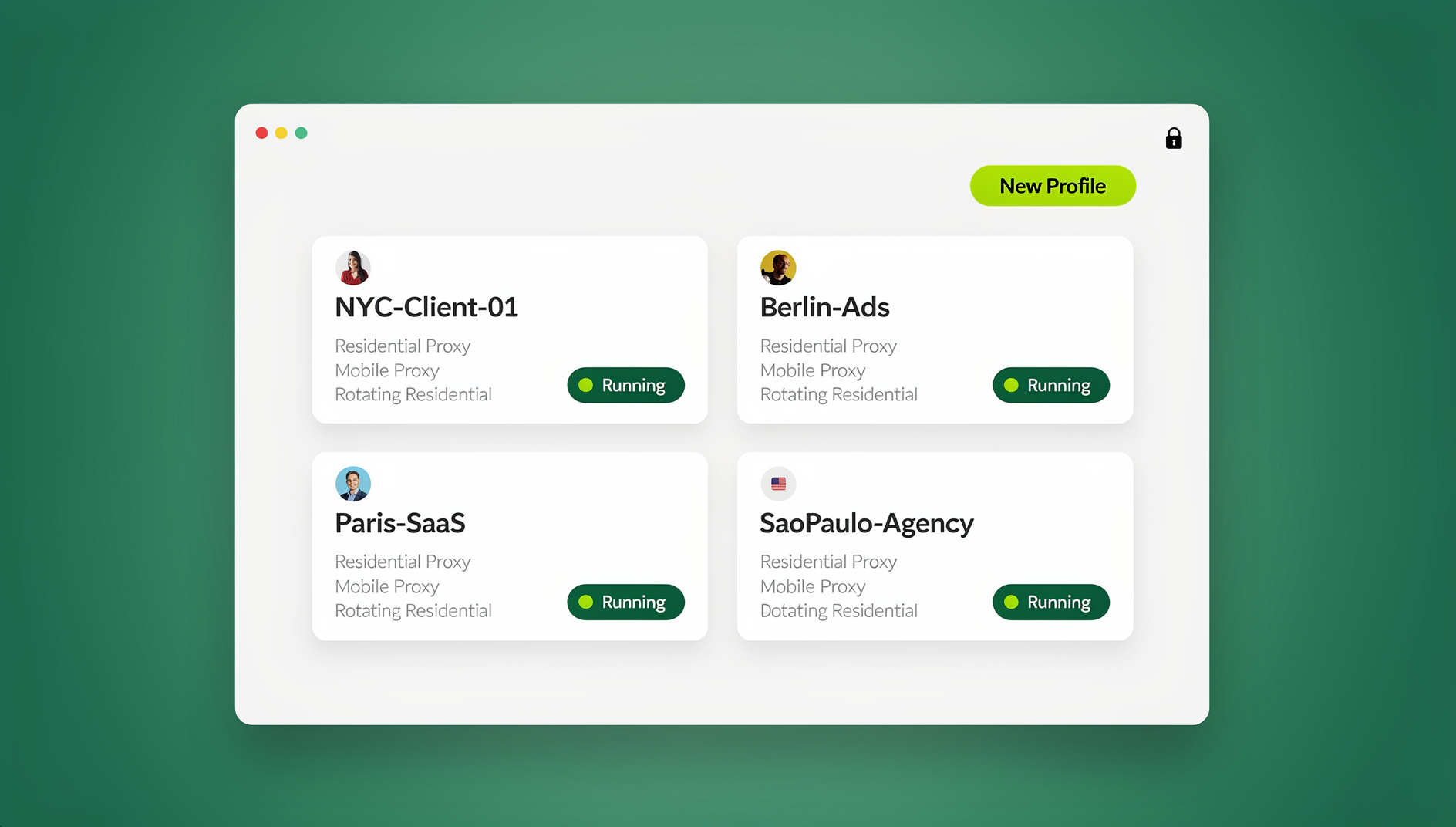
📌 TL;DR Executive Summary
- Core Takeaway: Each role — grants, donor CRM, ad account, social — gets its own isolated profile with a saved login, openable from a Chromebook, tablet or library PC with nothing installed.
- Key Risk/Challenge: Shared passwords and mixed identities. Sign a personal Gmail into the same browser as your grant-funded ad account and a suspension on the personal account can take the organisation’s campaigns with it.
- Recommended Solution: Send.win runs profiles on EU cloud nodes with built-in residential proxies and lets you share a profile with paid teammates so it opens already signed in; Pro is $19/mo or $83.88/yr, and the first card purchase is covered by a 7-day money-back guarantee.
A cloud browser is not Chrome with a privacy extension, and it is not the same job as Brave, Opera, Vivaldi or Tor. Those protect one person’s session on one machine. A remote browser keeps the session on the provider’s host and streams it to whoever you authorise, which moves the control point from the device to the profile.
One day, four handoffs
Here is how the same Tuesday looks once the browser lives on a host instead of on four laptops — and why a cloud browser for non-profits is as much a scheduling decision as a security one.
8:40 a.m. — the grants coordinator, working from a Chromebook
She opens the grants profile and the foundation portal is already signed in. Timezone, locale and geolocation follow the profile’s proxy exit IP, so the session reads as the office city rather than the hotel Wi-Fi she used last week. Nothing was installed on the Chromebook her household also uses for schoolwork.
11:00 a.m. — the development director and the Ad Grants account
She exports the monthly search terms report from the Google Ads profile, then checks the donor CRM in a second profile. Two profiles, two identities, no crossover: her personal Gmail never shares a browser session with the organisational account, so the ad account keeps one consistent device and location history. That is the same discipline remote teams use for cloud browser for remote work, and it is why logins stop triggering verification prompts.
2:00 p.m. — onboarding a volunteer who has no work email
The volunteer coordinator shares the social scheduling profile with a new starter. It opens already signed in, so no password is texted, no shared inbox is created for a three-month commitment, and no credential lands in a personal notes app. When the placement ends, the share is removed and the account keeps working for everyone else.
4:30 p.m. — the contractor handoff
A contract designer abroad opens the same shared profile, publishes two posts and closes the session. If the contract ends abruptly on Friday, access ends with it. No password rotation runs across a committee, which is the most common reason small non-profits delay offboarding in the first place.
The four risks that actually bite non-profits
“Use strong passwords and turn on MFA” is correct and incomplete. These are the failure modes specific to browser-based non-profit work.
Shared logins with no off switch
One password for a role inbox, stored in a document or a single password-manager entry, known by five people. It works until someone leaves, and then rotation breaks calendar invites, saved sessions and two-factor prompts on other people’s phones. You also lose the per-person record a funder may ask for when they want to know who approved a payment.
Profile-level sharing fixes the mechanics: the credential stays inside the profile, each paid teammate is granted access to that profile, and revocation is instant. Send.win shares profiles paid-to-paid, so nobody handles the underlying password. A cloud browser for non-profits lives or dies on this one mechanic, because a share you can revoke is what makes a three-month volunteer placement safe to run.
Account linking: how a personal Gmail endangers an ad grant
Platforms connect accounts using what they can observe on the device: cookies, local storage, canvas and WebGL rendering, installed fonts, screen and hardware details. Sign your personal Gmail into the same browser as the Google Ad Grants account behind up to $10,000 a month in in-kind search advertising, and you have created a link between them. If the personal account is suspended for unrelated activity, the organisational account carries that risk. The same pairing happens between a personal Facebook profile and a Page, or a personal Google account and a Workspace admin console.
Engine-level isolation is what makes the fix practical. Send.win keeps each profile’s own consistent browser fingerprint, so profiles do not share one browser identity and no two profiles share a fingerprint.
Donor data, the platform layer and the browser layer
Donor records carry names, addresses, giving history and sometimes health or immigration details. Microsoft 365 and Google Workspace both provide encryption at rest and in transit, MFA, threat detection and certifications such as SOC 2 and ISO 27001, so the platform layer is usually fine. The gap is the browser layer: unreviewed extensions, work files living in personal Gmail, donor exports copied to personal drives.
The basics still do the heavy lifting. MFA stops roughly 80% of unauthorised access attempts, and regular phishing drills reduce risk further. Then add browser-level policy: an approved-app list before anyone installs anything, one profile per role, and no donor exports on unmanaged devices. More of that playbook sits in these cloud browser security best practices.
Devices you cannot install anything on
Volunteers arrive with a Chromebook, an eight-year-old laptop, an iPad or a library terminal. You cannot install a desktop app on any of those, and your own policy may forbid it. Cloud profiles need no endpoint install at all: the profile runs on the provider’s nodes and streams to the browser already on the device. That is the argument that usually decides the purchase for a cloud browser for non-profits — you stop buying hardware just to manufacture clean machines. Send.win’s free tier includes a 10-minute-a-day cloud preview for exactly this kind of testing, and Pro and Team remove the time limit.
Cloud browser vs VPN vs loaner laptop
Non-profits often reach for a VPN first. A VPN does one job well — authentication, integrity and confidentiality for traffic in transit — but it adds little once your applications are cloud-native and your users only need specific published apps rather than the whole internal network. The question a cloud browser for non-profits answers is a different one: not whether the traffic can be trusted on its way to the office, but which identity is sitting in front of the account.
| Approach | What it actually protects | What the user installs | Best fit |
|---|---|---|---|
| VPN | Traffic in transit to the office network | A client, per device | Reaching on-prem servers and file shares |
| HTML5 remote app portal | One published Windows app; data stays on the host | Nothing | Legacy line-of-business software on unmanaged devices |
| Cloud browser profile | Identity, cookies, storage and fingerprint, per profile | Nothing | Distributed teams sharing cloud tools and ad accounts |
| Shared password manager | Credential storage | An extension or app | Small teams that never share a browser identity |
| Loaner laptop | One known device image | Nothing, but you ship hardware | Short-term staff with a fixed desk |
Read that as a stack, not a contest. If a grant portal still runs on a Windows box in the office, an HTML5 portal keeps the data on the host. If your tools are already cloud-native, the profile does the identity work and the VPN becomes optional — the longer side-by-side is in this cloud browser vs VPN comparison, if you need to justify dropping a line item to your board.
Setting up a shared profile stack
Plan the identities before you touch any settings — the step a cloud browser for non-profits rollout most often skips. A five-person team usually needs four to six profiles, not five.
Run Cloud Browser For Non Profits in the Cloud With Send.win
Send.win’s cloud browser runs your isolated profiles on remote infrastructure — open a clean, fingerprint-isolated session from any device without installing anything:
- Instant cloud sessions – launch an isolated browser in seconds, no local install
- Isolated profiles – separate fingerprint, cookies, and storage per session
- Cloud sync & profile sharing – pick up the same profiles on the desktop app (Windows, macOS, Linux) or share them with your team
- Built-in residential proxies – with automatic timezone and locale matching
You can try it right now: the Send.win demo browser opens an isolated cloud session directly in this browser tab. The free cloud demo gives a 3-minute preview without signup, or 10 minutes a day with a free account; paid plans start at $19/month, and the first card purchase is covered by a 7-day money-back guarantee — see pricing.
- Start with the free cloud demo. The cloud demo at https://send.win/demo-browser/ is a 3-minute preview without signup, or 10 minutes a day with a free account. There is no free trial; paid plans start at Pro $19/mo or $83.88/yr, and the first card purchase is covered by a 7-day money-back guarantee.
- List your identities. Write down every account with a login: grants portal, donor CRM, Google Ads, social scheduler, role inbox, admin console. Never group two accounts into one profile just because the same person uses both.
- Create one profile per identity, named by function — “Grants portal”, “Ad Grants”, “Social – FB/IG” — so a new coordinator understands the map without a briefing.
- Attach a proxy to each profile. Every plan ships with built-in residential proxies and accepts your own HTTP or SOCKS5. Timezone, locale, WebRTC and geolocation follow the exit IP, so a US-based org keeps a consistent US footprint.
- Sign in once, inside the profile. Complete the two-factor prompt and let the session save. You are building the profile’s history, not repeating it.
- Turn on cloud sync on a paid plan so logins follow team members across devices without a re-login dance.
- Share the profile with paid teammates. It opens already signed in, and no credential is ever typed into a chat message.
- Set the guardrails. On Team you can block or redirect pages inside a shared session, which keeps a volunteer out of the billing section of an ad account while still letting them publish posts.
- Write offboarding into your handbook as one line on the volunteer exit checklist: remove the share.
What stays local instead
Not everything belongs in a shared cloud profile. Payroll, HR files and any document holding a staff member’s home address should stay in a personal account on a managed device. Cloud profiles are for shared and role-based identities, where the value is consistent access rather than secrecy. Teams that need a local install for staff get one through the Sendwin Browser desktop app on Windows, macOS and Linux, while volunteers stay in the cloud.
What the browser layer costs next to the rest of your stack
Non-profit budgets are tight in a specific way: the big platforms are heavily discounted, so the small line items are the ones that get scrutinised.
| Line item | Typical cost | Notes |
|---|---|---|
| Google Workspace Business Starter (verified 501(c)(3)) | $0 for up to 2,000 users | 30 GB pooled storage per user, Meet, Calendar, Gemini; normally $6–$18 per user per month |
| Microsoft 365 Business Basic for non-profits | Free up to 10 licences, then about $3 per user | Validation runs through independent partners, typically within 3 days |
| Donor CRM | About $99–$119 per month | Bloomerang starts around $119 for up to 1,000 donor records with unlimited users; DonorPerfect around $99 |
| Salesforce Nonprofit Cloud | 10 free licences; implementation $10,000–$30,000+ | Via the Power of Us programme |
| Backup for the cloud stack | $2–$5 per user per month | On top of the productivity platform |
| Cloud browser profiles | Pro $19/mo or $6.99/mo billed annually; Team $49/mo or $20.99/mo billed annually | 7-day money-back guarantee on the first card purchase, cancel in two clicks; $6 per extra GB of proxy bandwidth, $0.05 per extra profile |
| Full stack benchmark | $500–$1,500 per month for 10–75 staff | Before the browser layer is added |
Set against that stack, a cloud browser for non-profits is not the expensive line. It is also cheaper than the alternative many non-profits default to: buying and managing spare laptops so every volunteer has a “clean” machine. On-premises servers used to cost $5,000–$15,000 a year for capability that Microsoft and Google now give away, and the browser layer is the same trade — a small monthly line replacing hardware and manual password rotation.
Scaling from five people to fifty
Standardise by role, not by person
Profiles named after people break the moment someone leaves. Profiles named after functions survive turnover and let you add a second grants coordinator without rebuilding anything. When a role splits, the profile is shared with both people and both open the same saved session.
Match the plan to seats, not to profile count
Free covers 10 profiles, 10 residential proxies, 1 GB of bandwidth a month, one concurrent cloud session and no cap on running local profiles at once — enough to prove the workflow on your own machine. Pro adds 150 profiles, 20 proxies, cloud sync for 20 profiles, 6 team seats, three concurrent cloud sessions and sharing with up to 20 paid members. Team goes to 500 profiles, 20 GB of bandwidth, 16 seats, nine concurrent cloud sessions and sharing with up to 50 paid members. Seat count, not profile count, is usually what pushes a growing non-profit upward; the mechanics are covered in this guide to a cloud browser for teams.
Automate only what repeats every month
Watch the bandwidth line, not the profile line
Proxy bandwidth is the meter that moves first when a team starts streaming video or pulling large exports through a profile. Extra bandwidth is $6 per GB and extra profiles are $0.05 each, so you can top up mid-cycle without changing plans. Keep heavy downloads — annual reports, video assets — on the local connection instead of inside a profile.
🏆 Send.win Verdict
For a non-profit, the browser is where donor data, grant accounts and shared logins all collide, and it is usually the least managed layer of the stack. Send.win fits because isolation is per profile rather than per person: each profile keeps its own cookies, storage and consistent fingerprint, built-in residential proxies make timezone and geolocation follow the exit IP, and sharing a profile with a paid teammate opens it already signed in. It does not replace MFA, an approved-app policy or a backup routine — it is the layer those policies need in order to land.
Try Send.win free today — run a shared profile in the cloud for 30 days at $0, keep your local profiles on your own machine, and see whether your offboarding checklist gets shorter.
Frequently Asked Questions
Is a cloud browser free for non-profits?
There is no separate non-profit tier and no free trial, but the first card purchase is covered by a 7-day money-back guarantee. Pro is $19 a month, or $83.88 a year, and Team is $49 a month, or $251.88 a year. The free cloud browser preview is capped at 10 minutes a day, which is enough to evaluate and not enough for daily work.
Can volunteers access our tools without installing software?
Yes, and that is the main reason non-profits pick this over a desktop setup. Cloud profiles run on Send.win’s EU and US nodes and stream to the browser already on the device, so a Chromebook, tablet or library terminal works with no installation and no admin rights. The Sendwin Browser desktop app exists for staff who want a local install on Windows, macOS or Linux, but volunteers rarely need it.
Are cloud browsers secure enough for donor data?
Only as secure as the policies around them. Profiles live in encrypted cloud storage, sessions are authenticated, and on Team you can block or redirect pages inside a shared session. The remaining risks are human: a donor export saved to a personal drive, or a personal account signed into a work profile. MFA stops roughly 80% of unauthorised access attempts, so use it alongside the browser layer rather than instead of it.
How do we stop staff using personal Google accounts for work files?
Make the work identity easier to reach than the personal one. A profile that is one click away and already signed in removes most of the temptation. Keep the role inbox and shared drives in their own profiles, and state in the handbook that work documents live in the organisational account only. Shared Drives also let you close an ex-employee’s account immediately while the documents stay accessible to the team.
Do we still need a VPN if we use cloud apps?
Usually not for cloud-only work. A VPN authenticates and encrypts traffic in transit, but it adds little when your provider already offers zero-trust access controls and your team only needs specific published applications. If you still reach an on-premises donor server or a legacy Windows application, keep browser-based remote access for that one app instead of tunnelling the whole network.
How do we handle staff turnover in shared cloud accounts?
Offboard the share, not the password. Removing a teammate from a profile leaves the credential intact for everyone else, so you avoid the rotation cascade that breaks saved sessions and two-factor prompts across the team. Keep a named owner on every profile, review the list quarterly, and remember that revocation takes seconds when someone leaves abruptly.
What browser policy should a non-profit handbook include?
Four clauses cover most of the risk. One: an approved-app list, including browser extensions, reviewed before installation. Two: one profile per identity, with no personal accounts inside work profiles. Three: donor data stays in the organisational tenant and never moves to a personal device. Four: access is removed within one business day of a role ending. Add a review date so the policy does not quietly expire.
How long does non-profit verification take for Microsoft and Google?
Microsoft validates through independent partners and typically completes within about 3 days; you need a legal name, a public-facing website domain, a phone number that is not VoIP or call-forwarding, and a legal identifier such as a US EIN, as set out in Microsoft’s validation requirements. Google verifies through TechSoup, with a typical turnaround of 2 to 14 business days. Note that Google’s rules exclude government bodies, hospitals and academic institutions even when they operate as non-profits, and Microsoft’s free tier stops at 10 licences while Google’s covers up to 2,000 users.