What Is Browser Compartmentalization and Why Does It Matter?
Browser compartmentalization means splitting your browsing activities into separate, isolated contexts so that one activity can never leak data into another. This browser compartmentalization guide covers every practical method — from built-in browser profiles and Firefox containers to virtual machines and antidetect browsers — ranked by the isolation strength each provides. The core idea is simple: your default browser treats everything you do as one continuous identity. Compartmentalization breaks that single identity into purpose-built silos, each with its own cookies, storage, fingerprint, and optionally its own IP address.
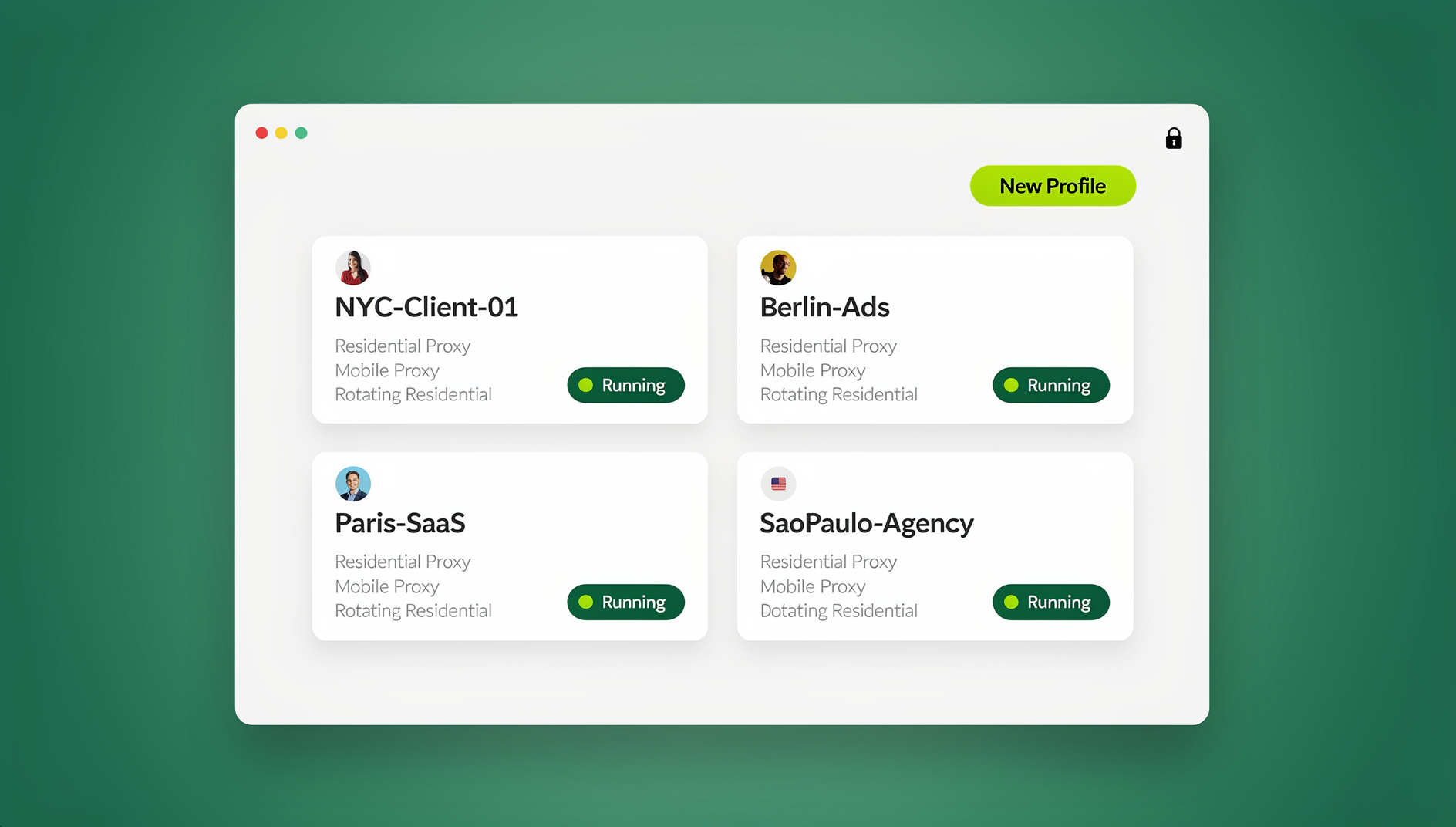
Why Your Browser Is a Single Point of Failure
Every mainstream browser — Chrome, Firefox, Edge, Safari — stores cookies, localStorage, IndexedDB, cached resources, autofill data, and browsing history in one shared profile by default. That means:
- Cross-site tracking is trivial. A tracking pixel on a news site reads the same cookies a retailer dropped yesterday. Federated Login buttons (Sign in with Google) stitch identities across dozens of services.
- Session leakage exposes accounts. If you manage a client’s Facebook Ads in one tab and your personal Facebook in another, both share the same cookie jar. One logout or policy flag can cascade.
- Fingerprinting ties everything together. Canvas hashes, WebGL renderer strings, installed fonts, screen resolution, timezone, and language headers create a near-unique device fingerprint. Every tab in the same browser instance shares that fingerprint.
- One compromise poisons everything. A malicious browser extension, a phishing page that steals session tokens, or a drive-by exploit affects every account logged into that browser simultaneously.
The threat model here isn’t hypothetical. Ad networks, social platforms, e-commerce fraud teams, and threat actors all exploit the fact that most people browse from a single, undifferentiated context. Compartmentalization is the countermeasure.
The Compartmentalization Spectrum: Weakest to Strongest
Not every threat requires the same level of isolation. The methods below are ordered from easiest (but weakest) to most robust, so you can match your approach to your actual risk.
1. Multiple Browser Profiles (Built-In)
Chrome, Edge, and Firefox all support creating multiple user profiles. Each profile gets its own cookie store, history, extensions, and bookmarks. You can sign into Google Workspace in Profile A, run personal browsing in Profile B, and manage a client account in Profile C.
Strengths:
- Free and built into every major browser.
- Fully separate cookie jars — no cross-profile session leakage.
- Each profile can have its own extensions, so you can run an ad-blocker in one profile and leave it off in another for ad testing.
Weaknesses:
- All profiles share the same browser fingerprint (canvas, WebGL, fonts, screen size). Any site doing browser fingerprinting will link them.
- All profiles share the same IP address unless you manually configure a per-profile proxy.
- No automation API — you can’t script profile creation or session management at scale.
For a deeper walkthrough of Chrome’s multi-profile system, see our Chrome multi-account management guide.
2. Firefox Multi-Account Containers
Firefox Containers are tab-level isolation units. Each container (Personal, Work, Banking, Shopping) gets its own cookie jar, and you can assign specific sites to always open in a specific container. Tabs are color-coded so you can see which context you’re in at a glance.
Strengths:
- Runs inside a single Firefox window — no juggling separate browser windows.
- Granular: you can isolate individual sites, not just broad “profiles.”
- The Mozilla-backed Multi-Account Containers extension is free and well-maintained.
Weaknesses:
- Containers share the browser fingerprint. Firefox’s built-in fingerprinting resistance (resist.fingerprinting) applies globally, not per-container.
- Same IP address across all containers.
- No container-level proxy support without third-party extensions.
- Doesn’t scale well past 10-15 containers — the UI becomes hard to manage.
We cover Firefox’s container system in detail in our Firefox Multi-Account Containers guide.
3. Separate Browsers per Activity
A step up from profiles: use entirely different browsers for different purposes. For example, Firefox for personal browsing, Chrome for work, Brave for crypto, and Tor Browser for anything requiring anonymity.
Strengths:
- Each browser has its own cookie store, cache, extension ecosystem, and (partially) different fingerprint.
- A compromise in one browser (malicious extension, zero-day) doesn’t automatically affect the others.
- Different browsers have different privacy defaults — you can lean on Brave’s built-in ad blocking and Tor’s circuit-based routing without configuring anything.
Weaknesses:
- Same IP address across all browsers unless you manually configure per-browser proxies or VPNs.
- Fingerprints are different but not randomized — if a tracker knows both your Chrome and Firefox fingerprints, they can potentially link them via your IP or behavioral patterns.
- Managing extensions, bookmarks, and passwords across four browsers is a UX nightmare.
- No scalability. You can’t create 50 separate browsers for 50 accounts.
4. Virtual Machines (Maximum Traditional Isolation)
Running each browsing context inside its own VM (VirtualBox, VMware, or QEMU/KVM) provides OS-level isolation. Each VM has its own filesystem, network stack, MAC address, and set of hardware identifiers that the browser reports.
Strengths:
- Complete isolation. A VM compromise doesn’t leak to the host or other VMs (barring hypervisor exploits, which are extremely rare).
- Different OS-level fingerprints: timezone, screen resolution, installed fonts, language packs — all controllable per VM.
- You can snapshot and restore clean states.
Weaknesses:
- Resource-heavy. Each VM needs 2-4 GB of RAM and 20+ GB of disk. Running five VMs simultaneously requires a beefy machine.
- Slow to spin up and switch between.
- Still shares the host’s IP unless you configure per-VM network routing through different VPN endpoints or proxies.
- Completely impractical at scale (20+ contexts).
- No built-in team collaboration — you can’t share a VM “profile” with a colleague without exporting the entire disk image.
5. Antidetect Browsers (Purpose-Built Compartmentalization)
Antidetect browsers are designed specifically for browser compartmentalization at scale. They create isolated browser profiles, each with a unique, configurable fingerprint (canvas noise, WebGL hash, font list, screen dimensions, user-agent, timezone, language, WebRTC leak protection). Each profile can be assigned a different proxy, so IP isolation is built-in rather than bolted on.
Strengths:
- Full fingerprint isolation per profile — not just cookie separation.
- Per-profile proxy binding: each browsing context gets its own IP.
- Scalable to hundreds or thousands of profiles.
- Team features: share profiles with collaborators without sharing passwords or exposing session tokens.
- Automation APIs (Selenium, Puppeteer, Playwright) for programmatic control.
Weaknesses:
- Paid software — typically $10-100/month depending on the provider and profile count.
- Learning curve for fingerprint configuration if you want to go beyond defaults.
Choosing Your Method: A Threat-Model-Based Approach
The right compartmentalization strategy depends on what you’re defending against. Here’s a decision framework:
| Threat | Minimum Effective Method | Why |
|---|---|---|
| Cross-site cookie tracking (ads, retargeting) | Browser profiles or Firefox Containers | Cookie-jar separation is sufficient; fingerprinting isn’t the primary vector here |
| Account linkage by a single platform (Google, Facebook) | Separate browsers or browser profiles with different logins | Platform correlation is mostly cookie and login-based |
| Fingerprint-based tracking (ad fraud detection, anti-bot systems) | Antidetect browser | Only antidetect browsers randomize/spoof the full fingerprint surface |
| IP-based correlation | Any method + per-context proxy/VPN | No browser-level solution fixes this alone — you need separate exit IPs |
| Managing 10+ accounts on the same platform safely | Antidetect browser | Profiles + containers don’t scale, and shared fingerprints get you banned |
| OS-level malware isolation | Virtual machines | Only VMs isolate at the OS/kernel level |
| Team-based multi-account management | Antidetect browser with team features | VMs and profiles can’t share sessions across team members |
Most people overestimate their threat model or underestimate it. If you’re a privacy-conscious individual who just wants to keep work and personal browsing separate, browser profiles are fine. If you’re running an agency managing 50 client ad accounts, you need antidetect-level isolation with per-profile proxies and team sharing.
Best Practices for Browser Compartmentalization
Regardless of which method you choose, these principles make compartmentalization actually work:
Define Clear Boundaries
Label each compartment by purpose: “Work,” “Personal Finance,” “Social Media Management,” “Client: Acme Corp.” Never mix activities across compartments. The moment you log into a personal account inside a work profile, the boundary is broken.
Assign One Identity per Compartment
Each compartment should correspond to exactly one identity or account cluster. If you manage three Amazon storefronts, each one gets its own compartment — not three tabs in the same profile.
Use Different IPs Where It Matters
Cookie and fingerprint isolation are necessary but not sufficient when the platform you’re using checks IP addresses. Platforms like Amazon, Facebook, and Google correlate account activity by source IP. If five “separate” profiles all share the same residential IP, the platform can still link them. Residential or mobile proxies — one per compartment — close this gap.
Don’t Skip DNS Isolation
An overlooked detail: if all your compartments use the same DNS resolver (e.g., 8.8.8.8), DNS query patterns can correlate them. Use the proxy’s DNS resolution (SOCKS5 with remote DNS, or the proxy provider’s DNS) rather than your system DNS. For more on maintaining full anonymous browsing hygiene, including DNS and WebRTC considerations, see our dedicated guide.
Automate What You Can
Manual compartmentalization breaks down at scale because humans forget. They open the wrong profile, paste a link from a personal chat into a work browser, or forget to switch proxies. Automation — whether through scripted profile launches, proxy auto-assignment, or session management APIs — reduces human error to near zero.
Audit Regularly
Run periodic checks: Are all profiles still using the correct proxy? Have cookies leaked between contexts? Are fingerprints still unique? Tools like browserleaks.com, creepjs, and coveryourtracks.eff.org let you verify that each compartment presents a distinct identity.
When You Need Send.win-Level Isolation
Browser profiles and Firefox Containers solve the basics — cookie separation and a bit of organizational hygiene. But they hit a hard ceiling once your requirements include any of the following:
- Fingerprint uniqueness per context. Profiles don’t touch the fingerprint. If a platform checks canvas, WebGL, or font enumeration, all your profiles look like the same device.
- Per-profile proxy binding. Built-in profiles have no proxy awareness. You’d need to run each profile through a different system-level proxy or VPN split tunnel — fragile and manual.
- Scale beyond 10-20 contexts. Managing 50+ browser profiles or VMs is operationally painful. You need a purpose-built management layer.
- Team collaboration. You can’t hand a Chrome profile to a colleague without exporting it, shipping the entire user data directory, and importing it on their machine. Session sharing needs to be cloud-native.
- Automation. If you need to script session creation, cookie injection, or browser actions across dozens of profiles, you need a Selenium/Puppeteer/Playwright-compatible API — not manual clicking. Send.win does not offer this.
This is the problem space that Send.win’s Sendwin Browser occupies. Each profile in Sendwin Browser is a fully isolated browsing environment with its own fingerprint configuration, proxy assignment, and cookie store. The Sendwin Browser desktop app (Windows, macOS, Linux) lets you manage profiles locally, while cloud browser sessions let you run profiles from any device without installing anything. Understanding session isolation principles is key to appreciating why this architecture matters — it’s the difference between cosmetic separation and genuine compartmentalization.
Step-by-Step: Setting Up Compartmentalized Browsing
Here’s a practical setup guide, from beginner to advanced:
Level 1: Quick Wins (Free, 15 Minutes)
- Create 3-4 browser profiles in Chrome or Firefox: Personal, Work, Finance, Shopping.
- Install uBlock Origin in all profiles.
- Assign each profile a distinct avatar/color so you can visually distinguish them.
- Set each profile’s homepage to something context-appropriate (work email, personal dashboard, etc.).
- Discipline yourself to never cross profiles — no “just quickly” logging into a personal account in the work profile.
Level 2: Container-Based Isolation (Free, 30 Minutes)
- Install Firefox with the Multi-Account Containers extension.
- Create containers for each category: Personal, Work, Banking, Social Media, Shopping.
- Use the “Always Open In” feature to assign sites to containers (e.g., bank.com always opens in Banking).
- Install the Temporary Containers extension for throwaway browsing — each new tab gets a fresh, disposable container.
- Enable Enhanced Tracking Protection in Strict mode for an additional layer.
Level 3: Full Compartmentalization with Antidetect Profiles
- Sign up for a browser profile manager (Send.win offers paid plans starting at $19/month, with the first card purchase covered by a 7-day money-back guarantee, or try the free cloud demo).
- Create a profile for each activity or account. Configure the fingerprint to match the target platform’s expected user demographics (timezone, language, screen resolution).
- Assign a dedicated proxy to each profile — residential proxies for platforms that flag datacenter IPs, mobile proxies for social media.
- For team workflows, use profile sharing so colleagues can access client accounts without passing credentials.
Common Compartmentalization Mistakes
Even experienced users make these errors:
- Copy-pasting between compartments. The clipboard is shared across browser profiles and even across browsers. If you copy a URL or tracking code from one context and paste it into another, you may inadvertently transfer tracking parameters (UTM codes, session IDs, referrer tokens).
- Using the same password manager across all compartments. A cloud-synced password manager that autofills across compartments can leak identity signals. Consider using separate vaults or a local-only manager for sensitive compartments.
- Ignoring WebRTC leaks. WebRTC can expose your real local IP even behind a proxy. Ensure your compartmentalization tool blocks or spoofs WebRTC, or disable it manually in browser settings.
- Assuming private/incognito mode is compartmentalization. It isn’t. Incognito mode discards cookies after the session but doesn’t isolate the fingerprint, doesn’t change your IP, and doesn’t prevent cross-tab tracking during the session.
- Sharing bookmarks across contexts. Bookmarks with tracking parameters or auto-login tokens can inadvertently link compartments.
Compartmentalization for Specific Use Cases
For Privacy-Conscious Individuals
Use Firefox Containers as your baseline. Create containers for banking, shopping, social media, and general browsing. Enable Enhanced Tracking Protection in strict mode. Use a VPN if you want IP-level compartmentalization. This setup costs nothing and blocks 90% of casual cross-site tracking.
For Freelancers and Agencies
You manage multiple client accounts on the same platforms. Browser profiles won’t cut it because fingerprint linkage can get accounts flagged. Use an antidetect browser with per-client profiles, each bound to a different residential proxy. Send.win’s profile sharing lets team members access client profiles without credential handoff, and cloud browser sessions mean you can work from any device.
For E-Commerce Sellers
Platforms like Amazon, eBay, and Etsy actively hunt for sellers running multiple storefronts. They correlate browser fingerprints, IP addresses, payment methods, and shipping addresses. Compartmentalization here requires antidetect-level fingerprint isolation, per-store proxies (residential, matching the store’s registered country), and strict separation of payment and business details. No amount of Chrome profiles will survive an Amazon linkage audit.
For Developers and QA Teams
Testing across different user contexts, locales, and device configurations requires compartmentalization. Send.win’s browser profile manager lets you create profiles with specific fingerprint configurations, each with its own cookies, storage and proxy, so you can test across separate browser identities without maintaining a fleet of VMs or physical devices.
🏆 Send.win Verdict
Browser compartmentalization is a spectrum, and most methods only solve part of the problem. Built-in profiles separate cookies but share fingerprints. Firefox Containers are convenient but can’t scale or mask device identity. VMs are overkill for most use cases and impractical for teams. Send.win’s Sendwin Browser gives you the full stack: isolated fingerprints, per-profile proxies, cloud sessions without local installs, and team sharing — starting at $19/month on the Pro plan, with the first card purchase covered by a 7-day money-back guarantee, or try the free cloud demo.
Try Send.win free today — compartmentalize your browser the way it should have been built from day one.
Frequently Asked Questions
What is browser compartmentalization?
Browser compartmentalization is the practice of separating your online activities into isolated browsing contexts — each with its own cookies, storage, and ideally its own fingerprint and IP address. The goal is to prevent data, tracking, and identity leakage between different activities or accounts.
Is using multiple Chrome profiles enough for compartmentalization?
Multiple Chrome profiles separate cookies and browsing history, which stops basic cross-site tracking. However, all profiles share the same browser fingerprint (canvas hash, WebGL renderer, fonts, screen resolution) and the same IP address. For casual privacy, profiles are adequate. For managing multiple accounts on platforms that check fingerprints, they are not enough.
How are Firefox Containers different from separate browser profiles?
Firefox Containers operate within a single browser window, isolating cookies and storage at the tab level rather than the window level. You can have a Work container tab and a Personal container tab side by side. This is more convenient than switching between full browser profiles, but the isolation is limited to cookies and storage — fingerprints and IP addresses are shared across all containers.
Do I need a VPN or proxy for effective compartmentalization?
If your threat model includes IP-based correlation (platforms linking accounts because they share the same IP address), then yes — you need a different exit IP for each compartment. A single VPN helps hide your real IP but gives every compartment the same VPN IP, which is no better for correlation. Per-compartment proxies (residential or mobile) are the correct solution for IP-level isolation.
Can websites still track me if I use compartmentalization?
It depends on your method. Cookie-level compartmentalization (profiles, containers) stops cookie-based tracking but not fingerprinting. Fingerprint-level compartmentalization (antidetect browsers) stops both, but you also need IP-level isolation to prevent correlation through shared network addresses. No single method blocks all vectors — effective compartmentalization layers cookie, fingerprint, and IP isolation together.
What is the difference between browser compartmentalization and using incognito mode?
Incognito mode discards cookies and browsing history when you close the window, but during the session, all tabs share the same fingerprint and IP. It provides no isolation between tabs, no persistent separation of identities, and no fingerprint masking. Compartmentalization is a persistent architectural separation; incognito mode is a temporary cleanup tool.
How many compartments should I create?
Start with the minimum that covers your actual use cases. Most individuals need 3-5 (personal, work, finance, shopping, sensitive research). Agencies and e-commerce sellers may need one per client or storefront — anywhere from 10 to 200+. The key is that each compartment maps to one clear purpose or identity. If you find yourself needing more than 10-15, you should use a tool designed for scale, like an antidetect browser.
Is browser compartmentalization legal?
Yes. Separating your browsing activities into isolated contexts is perfectly legal. It’s a privacy and security practice, not a circumvention tool. However, some platforms’ terms of service prohibit operating multiple accounts — compartmentalization makes it technically possible but doesn’t change the ToS. Always review the rules of any platform where you plan to manage multiple accounts.
How Send.win Helps With Browser Compartmentalization Guide
Send.win is a browser profile manager built for exactly this kind of work — every profile is a clean, isolated identity:
- Isolated profiles – unique fingerprint, separate cookies and storage per profile
- Fingerprint protection – each profile keeps its own consistent browser fingerprint, so profiles do not share one browser identity
- Desktop app + cloud sessions – native app for Windows, macOS, and Linux, or run profiles in the cloud with no install
- Built-in residential proxies – with automatic timezone, locale, and WebRTC matching
- Team features – share logged-in profiles with teammates without sharing passwords
Try the instant cloud browser demo — no install, no signup — or download the desktop app. There is no free trial; paid plans start at $19/month on Pro ($83.88/year), and the first card purchase is covered by a 7-day money-back guarantee (see pricing).