What Is an Antidetect Browser for PC?
An antidetect browser for PC is a desktop application that runs every account in its own profile with a separate, internally consistent device fingerprint. Instead of one machine holding many logins, it presents many machines: different canvas output, WebGL renderer, fonts, screen size, timezone and network origin per profile. Each profile keeps its own cookies and sessions, so a platform sees a distinct device with its own history rather than a repeated visitor.
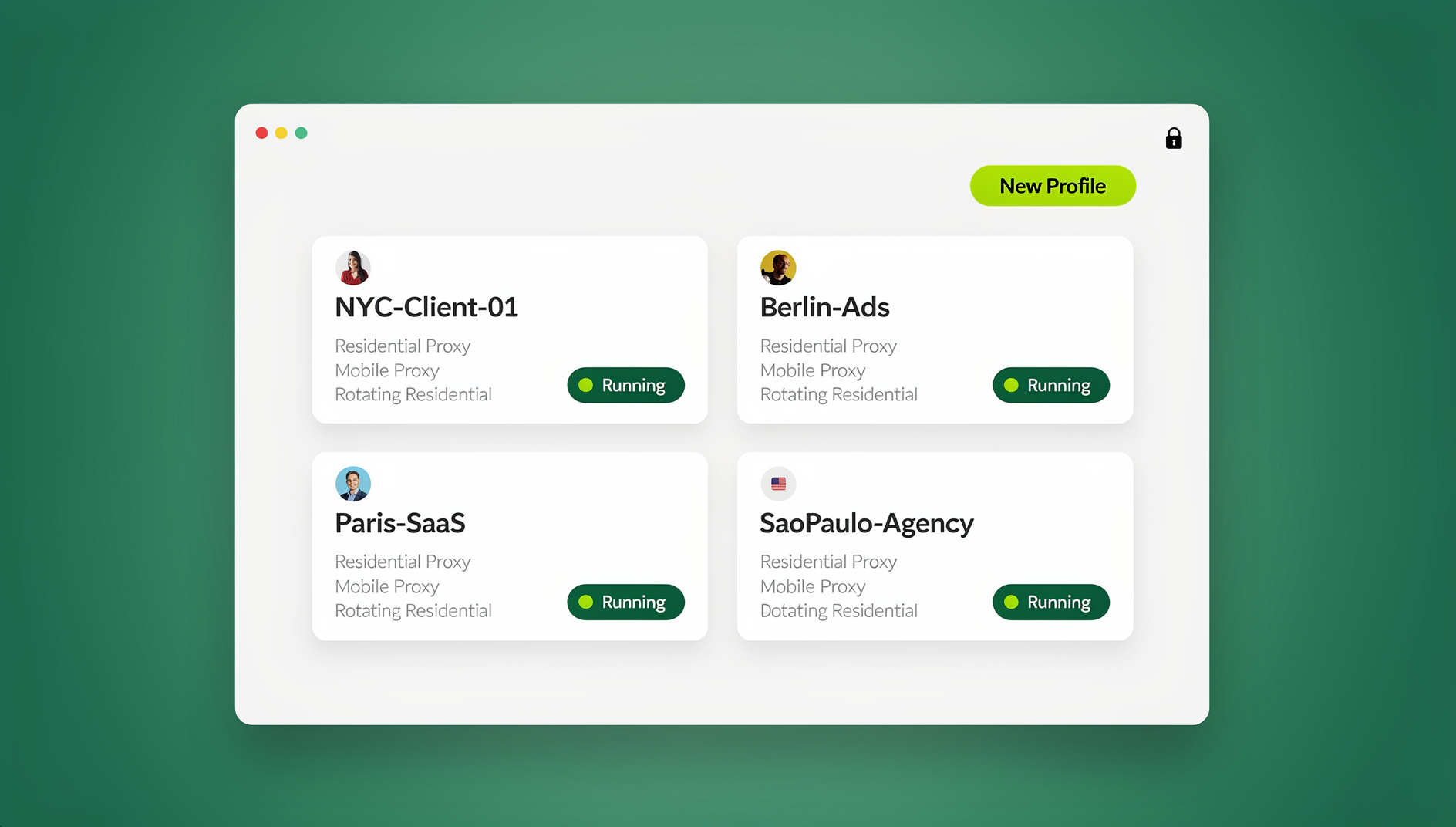
📌 TL;DR Executive Summary
- Core Takeaway: A real antidetect browser answers fingerprint probes with plausible values taken from real hardware instead of blocking them, and pairs each profile with its own proxy, because blocked APIs and rotating IPs both leave obvious traces.
- Key Risk/Challenge: Fingerprints are only the top layer. TLS/JA3-JA4 handshakes, HTTP/2 frame ordering and behaviour carry the same identifying power, and no tool stays undetectable forever.
- Recommended Solution: Work in order — install the desktop build, create one profile per account, attach and verify the proxy, test the fingerprint, then log in and warm the profile up slowly.
How Fingerprint Spoofing Works Under the Hood
Detection is a scoring problem, not a single yes-or-no check. A site collects dozens of signals, hashes them into one fingerprint, then compares that hash with everything it has already seen. When two logins produce the same hash, the platform groups them together. One ban or one trust downgrade then lands on every account in that group.
The signals a page reads first
Page scripts can read your screen resolution, installed font list, GPU vendor and renderer strings exposed through WebGL, AudioContext output, canvas rendering results, and navigator properties such as platform, language and device memory. Timezone and locale come along too. None of these identifies a machine alone. Hashed together, they narrow you to a device class, and often to one physical PC, even after you clear cookies.
That is the target set an antidetect browser has to manage: canvas, WebGL vendor, audio, fonts, screen resolution, timezone, locale, user agent and device memory. Miss one and the spoofed values stop agreeing with each other.
Spoof the values, never block the API
Amateur setups block fingerprint probes: null returns from canvas, refused WebGL contexts, blanked-out hardware details. Blocking is a red flag in itself, because a normal browser answers every probe. A working stealth layer answers with values drawn from real hardware and keeps the whole set coherent. A Windows user agent showing macOS-only fonts, or a US timezone on a German exit IP, is easy to catch.
Send.win takes the engine-level route. Each profile keeps its own consistent browser fingerprint, with canvas, WebGL, audio, fonts and hardware settings handled inside the browser rather than injecting patches through page scripts, so values stay consistent across frames, workers and third-party scripts, and no two profiles share a fingerprint. The Sendwin Browser installs locally on Windows 10/11 (64-bit), macOS 12+ on Apple Silicon and Intel, and Linux via AppImage or .deb, with residential proxies included on every plan.
TLS fingerprints: the layer most checkers never see
The TLS handshake runs before any page script, which puts it outside JavaScript fingerprinting. Cloudflare describes JA3 and JA4 as fingerprints of the TLS client itself, built from the ClientHello the browser sends. JA4 sorts the extension list, cutting duplicate fingerprints across modern browsers.
Two properties matter for your setup. A TLS fingerprint stays stable across destination IPs, ports and certificates, so switching proxy does not change it. It is also calculated only during a full handshake, so plain HTTP carries no JA3 and a resumed session does not recompute one. Mobile app traffic often shares a single JA3 fingerprint across many users, which is why platforms sometimes allow or block it as a group. Cloudflare’s JA3 and JA4 documentation covers the mechanics.
Behaviour, frame ordering and a moving engine
ScrapingBee’s July 2026 update puts it plainly: desktop antidetect browsers are now judged on TLS handshakes, HTTP/2 frame ordering and behavioural checks, not fingerprint consistency alone. Mouse paths, typing cadence, navigator.webdriver and how long a profile keeps its clearance sit outside the fingerprint entirely. This breakdown of how websites detect antidetect browsers walks the layers in order.
The surface moves as well. Chrome’s desktop release calendar lists Early Stable, Stable, Extended Stable and LTS builds shipping on a rolling schedule, so fingerprint-relevant engine changes land continuously. A browser frozen on one build drifts toward a fingerprint nobody else has.
A claim worth keeping in perspective
In August 2026 a developer accused a large marketplace of running hidden audio processes in the browser that could feed PC audio fingerprinting. The company has not confirmed it, so treat it as an unverified allegation rather than established practice. It is still a reminder that audio output belongs on the spoof list, and that one unmanaged signal can matter as much as thirty correct ones.
Why It Matters: Who Gets Linked and Who Doesn’t
Multi-account work breaks in two predictable ways: the platform links your accounts to each other, or it links each account to a machine it already distrusts. Both are fingerprint problems before they become account problems.
Incognito is not isolation
Two incognito tabs on one PC share the same fingerprint. Clearing cookies resets storage, not the device signature, so a match still connects the private session to the account you used in a normal window. The same trap catches a second Chrome profile and a second Windows user account on one laptop — the hardware and engine strings did not change, so the hash did not either.
Proxies complement the browser, they don’t replace it
The browser controls device identity; the proxy controls network origin. Rotate IPs without spoofing and you look like one machine teleporting between cities. Spoof dozens of devices behind one IP and you look like a farm. Both halves have to tell the same story, which is where hand-set timezone and locale values usually undo a decent setup. This antidetect browser privacy guide covers the account-hygiene side of the same problem.
Who this affects
- E-commerce sellers running several storefronts on one marketplace or across marketplaces.
- Ad buyers and affiliates managing multiple ad accounts and pixel histories.
- Agencies holding client logins that must never touch each other’s sessions.
- Social media managers and support teams splitting work across accounts.
- Developers who need rendered pages or logged-in sessions instead of raw HTML.
Not everyone needs this stack. Geekflare’s June 2026 guide notes that if you only extract public data, you may not need a browser profile system at all, because scraping APIs handle proxy rotation and rendering server-side. Profile isolation earns its keep when logins and account history are the point.
Legal and platform risk
Owning the software is legal. What you do with it sits in a grey area, and violating a platform’s terms of service can end in permanent bans even when no law was broken. There is also a hard limit worth accepting up front: no antidetect browser is 100% undetectable forever, because detection teams keep updating. Plan for a stack you can adjust, not a permanent shield.
What Actually Runs on Windows, macOS and Linux
Desktop options widened over the past few years. A July 2026 roundup tested ten antidetect browsers with starting prices from roughly $3.99/mo to about $64/mo, and Multilogin published a full subscription comparison in September 2026. Prices and free tiers move fast, so treat this table as a map and confirm at checkout.
| Tool | Starting price | What stands out |
|---|---|---|
| Donut Browser | Free | Open source under AGPL-3.0, unlimited profiles, no account and no telemetry; profiles stay on-device with an optional self-hosted Docker sync server |
| ixBrowser | $3.99/mo | Free tier reported as unlimited profiles but capped at 10 new profiles and 100 launches per day |
| GeeLark | ~$5/mo plus usage | Real cloud Android phones rather than emulation; free trial of 2 phones for 30 minutes |
| GoLogin | $9/mo ($4.50 annual) | Free plan with 3 profiles; Windows, macOS, Linux and a native Android app on its own Orbita engine |
| AdsPower | $9/mo ($7.20 annual) | Free plan with 2 profiles; built-in no-code automation |
| Dolphin Anty | $10/mo | Free plan with 5 profiles; tuned for media buying and affiliate work |
| Multilogin | $11/mo (Pro 10) | Plans to $89/mo (Business 300); profiles and Android cloud phones billed separately; proxy network across 150+ countries; unlimited seats from Business 100 up |
| Octo Browser | ~$11/mo (€10) | No free plan; kernel-level spoofing and an iOS app |
| Incogniton | $13.99/mo | Free plan starts at 10 profiles then drops to 3; Windows and macOS only |
| Kameleo | ~$64/mo (€59) | Free tier of 2 browsers, 100 profiles and 300 minutes; multi-engine spoofing including genuine Safari and mobile emulation |
Three caveats before you compare numbers. Some prices are quoted in EUR or priced by usage and converted approximately to USD, so they shift with exchange rates. Vendors also publish comparison content that ranks their own product first, so treat pass-rate claims and detection scores as marketing. Annual discounts come with end dates that move: Multilogin, for one, was promoting 40% off annual billing with a promotion ending 18 September 2026. For more side-by-side detail, see this best antidetect browser roundup.
PC Setup Checklist, in Order
Order matters more than settings here. Most early bans come from logging in before the profile was ever verified, not from a weak spoof.
- Install the desktop build. Confirm the download matches your platform and comes from the vendor’s own site; a repackaged build gives your work away before you start. Send.win, for example, ships Windows 10/11 (64-bit), macOS 12+ for Apple Silicon and Intel, and Linux as AppImage or .deb.
- Create one profile per account before logging in anywhere. Name it after the account, not just the platform. Never run two accounts in one profile, and avoid cloning a profile to save time: a clone inherits derived identity data instead of building a fresh one.
- Attach the proxy to the profile first. Residential IPs in the account’s usual country beat datacenter ranges. Verify the exit IP, then confirm that timezone, locale, WebRTC and geolocation follow it. If the browser derives those values, leave them alone — on Send.win the built-in residential proxies are assigned per profile and track the exit IP automatically. Bringing your own HTTP/SOCKS5 endpoint? Test it outside the browser first so a dead proxy does not burn the profile’s first login.
- Test the fingerprint before the first login. Open a checker on the assigned proxy, read the result, fix mismatches, and only then sign in.
- Warm the profile up. Browse normally for the first few sessions, scroll feed pages, open a listing or two, and leave the settings alone. A profile that logs in and immediately mass-edits looks nothing like a returning user.
- Watch local resources. Every Chromium profile carries its own renderer processes, so RAM and disk use scale with how many you run at once. If your machine starts swapping at twenty profiles, move long-running ones to a cloud session instead of buying more RAM.
- Decide where the login lives. Local-only keeps everything on your disk; cloud sync lets the same profile follow you to another machine. Choose per client or per team, not per mood.
Reading checker results properly
Pixelscan, Iphey and CreepJS are the common trio, and all three should run on a clean residential proxy rather than your home connection. CreepJS is the pickiest: it flags thread disagreements between execution contexts, an unfrozen macOS user agent, and local API servers listening on the machine. Those flags usually mean a value was set by hand instead of derived from the exit IP.
Just as important is what checkers cannot see. A clean result says nothing about the TLS handshake, HTTP/2 frame ordering, mouse and typing behaviour, navigator.webdriver, or whether a platform still trusts the profile two weeks later. Passing is a floor you clear, not a finish line.
Driving a profile from Playwright
Send.win has no automation interface: no API, SDK, headless mode or Selenium/Puppeteer/Playwright support on any plan.
Connecting over CDP keeps the profile’s cookies and session state alive across script crashes and restarts. The same pattern works from Puppeteer and Selenium. Tooling is widening in that direction too: Donut Browser ships a local REST API and an MCP server so scripts and AI agents can drive profiles without a cloud dashboard, and MCP support arrived in other antidetect tools in early 2026, letting LLM clients create profiles and open real sessions.
Local Profiles vs Cloud Profiles: Backup and Migration
Where a profile lives decides how it survives a dead laptop. Local profiles are files on your disk: they load fast, need no connection, and behave predictably until your RAM runs out. The trade-off is that a lost machine takes the sessions with it, so you need an export routine. Donut Browser, for example, stores profiles on-device by default and offers an optional self-hosted Docker sync server for cross-device access without a vendor account.
Cloud profiles flip the trade-offs. You reach the same profile from any device, nothing installs, and the PC you sit at stops mattering. In exchange you depend on the provider’s nodes, and the fingerprint you tested belongs to the node image rather than your machine. Send.win splits the difference: profiles run locally in the desktop app, cloud sync on paid plans moves logins between devices, and the cloud browser runs profiles on EU and US nodes with a free 10-minute daily preview and unlimited cloud browsing time on Pro and Team.
Decide the backup rule before you need it. Export or sync every profile that took more than a week to warm up, keep the proxy list next to it, and note which client it belongs to. Migration goes wrong when the fingerprint survives but the network identity does not.
Common Mistakes That Burn New Profiles
- Logging into several accounts within the first hour. Fresh profiles that immediately behave like ten-year-old users are the easiest pattern to spot.
- Hand-editing timezone, locale or WebRTC. If the browser derives these from the exit IP, leave them. Manual values drift out of sync the moment you switch proxy.
- Sharing one proxy across many profiles. That rebuilds the farm signature you were avoiding. One exit IP per profile on any platform that scores risk.
- Copying cookies between profiles. You move session state into a fingerprint that never earned it, and both accounts now share a session trail.
- Treating a fingerprint checker as the final exam. It says nothing about TLS, frame ordering or behaviour.
- Running a stale engine. If your browser build stops tracking upstream Chrome releases, its fingerprint slowly becomes unique.
- Assuming “free” means permanent. Multilogin’s free plan has no time limit but requires opening at least one profile every 7 days — after that, profiles are deleted automatically. ixBrowser’s free tier is reported as unlimited profiles but capped at 10 new profiles and 100 launches per day. Check what a free tier actually enforces before you build on it; this roundup of the best free antidetect browser options covers the trade-offs.
How Send.win Helps With Browser Profile Management for PC
Send.win is a browser profile manager built for exactly this kind of work — every profile is a clean, isolated identity:
- Isolated profiles – unique fingerprint, separate cookies and storage per profile
- Fingerprint settings – canvas, WebGL, fonts, and audio configured per profile
- Desktop app + cloud sessions – native app for Windows, macOS, and Linux, or run profiles in the cloud with no install
- Built-in residential proxies – with automatic timezone, locale, and WebRTC matching
- Team features – share logged-in profiles with teammates without sharing passwords
Try the instant cloud browser demo — no install, no signup — or download the desktop app. There is no free trial; paid plans start at $19/month on Pro ($83.88/year), and the first card purchase is covered by a 7-day money-back guarantee (see pricing).
🏆 Send.win Verdict
Two things decide whether PC profiles stay organised: fingerprint coherence and a network identity that matches it. Send.win handles both at the engine and profile level — canvas, WebGL, audio, fonts and hardware are configured inside the browser rather than patched in through scripts, and timezone, locale, WebRTC and geolocation follow the profile’s residential exit IP automatically, which removes the hand-tuning mistake that complicates most DIY setups. Send.win has no automation interface, so treat automation as something it does not offer. It is not permanent invisibility, and no honest tool claims to be, but it is a testable starting point with proxies included on every plan.
Try the Send.win cloud demo — a 3-minute preview without signup, or 10 minutes a day with a free account. Paid plans start at Pro $19/mo or $83.88/yr, and the first card purchase is covered by a 7-day money-back guarantee.
Frequently Asked Questions
What is an antidetect browser for PC and how does it work?
It is a desktop application that runs each account in its own profile with its own device fingerprint. Rather than blocking fingerprint APIs, it feeds each profile values taken from a real hardware setup — canvas, WebGL, audio, fonts, screen size, timezone and locale — so every profile looks like a different physical machine to the sites you visit.
Do I still need a proxy with an antidetect browser?
Yes, for anything involving multiple accounts on one platform. The browser controls device identity and the proxy controls network origin, and both have to agree. Rotating IPs without spoofing still shows one device, and spoofing without per-profile IPs still shows one location hosting many machines.
Can websites detect antidetect browsers?
They can detect inconsistency, and they keep getting better at it. Beyond JavaScript fingerprints, platforms look at TLS/JA3-JA4 handshakes, HTTP/2 frame ordering, mouse and typing behaviour, navigator.webdriver and long-term account history. No antidetect browser is undetectable forever, so aim to stay coherent with real devices instead of chasing a permanent pass.
Is a free antidetect browser for PC good enough?
It can be, if you know the limits. Open-source options such as Donut Browser give unlimited local profiles for free, while other free tiers cap profile counts, daily launches or inactivity windows. Free plans rarely include proxies, so budget for residential bandwidth separately and check whether your profiles get deleted after a quiet period.
What are JA3 and JA4 fingerprints, and do they affect me?
They are fingerprints of your TLS client, calculated from the ClientHello your browser sends during the handshake, before any page script runs. JA4 sorts the extension list, which reduces duplicate fingerprints across modern browsers. They stay the same across different IPs, ports and certificates, so changing proxy does not change them — which is why they matter even though fingerprint checkers cannot see them.
How many browser profiles do I need per account?
One profile per account, without exceptions. Reusing a profile for two accounts, or cloning one to spin up a second, links them through shared fingerprint or session data. If you manage different clients, keep a separate profile per client account too, so a handover never mixes histories.
Is using an antidetect browser legal?
The tool itself is legal to buy and run. The grey area is what you do with it: violating a platform’s terms of service can get accounts permanently banned even when no law was broken. Treat platform rules as the binding constraint, and keep the legitimate reason for multi-account work documented.
Do free plans delete inactive profiles?
Some do, and it is rarely obvious on the pricing page. Multilogin’s free plan has no time limit but deletes profiles automatically after 7 days of complete inactivity. Before you build a workflow on a free tier, find the inactivity rule, the daily launch cap and whether proxies are included at all.