What Does a Cloud Browser Actually Do for a Government Agency?
A cloud browser for government agencies runs each web session on a remote node instead of on the workstation, so cookies, session tokens and page content stay off the endpoint while staff still work in an ordinary browser window. That matters because more than 96% of U.S. government line-of-business applications are browser-based, according to Coconut’s 2026 public-sector whitepaper, and many are opened by contractors and hybrid staff on machines the agency does not fully manage.
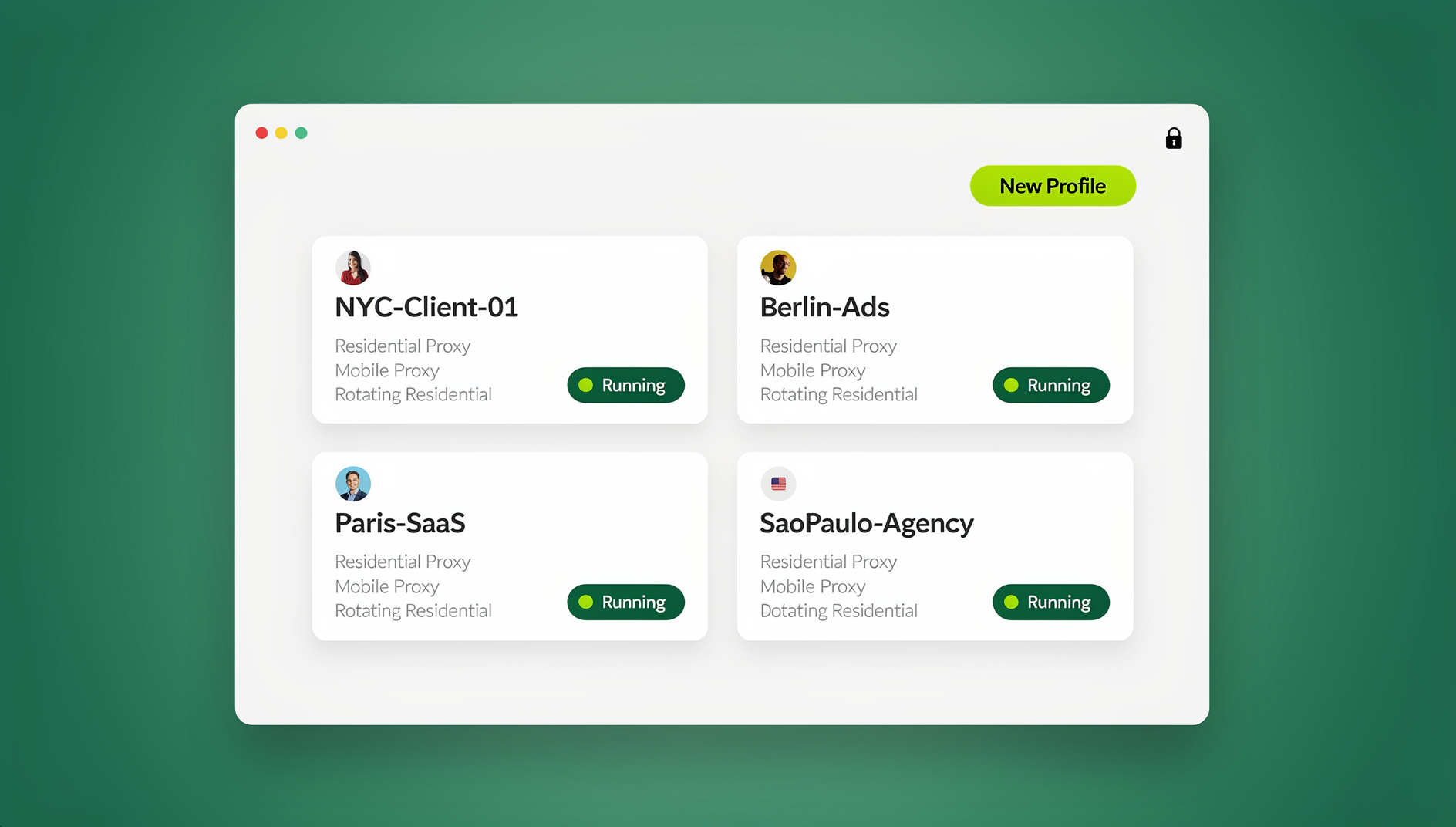
📌 TL;DR Executive Summary
- Core Takeaway: Cloud-run sessions keep cookies, tokens and page data off the device, which is what makes unmanaged contractor laptops, BYOD phones and short-term staff supportable at all.
- Key Risk/Challenge: FedRAMP scope is decided per agency use case, and the practical failure points are compliance evidence, account linking across tenants, and credentials passed between people.
- Recommended Solution: One isolated profile per identity on a defined proxy exit, credentials that never leave the profile, and a written scope determination naming the data a session may touch.
A Day in the Workflow: Cloud Browsing on a Public-Sector Desk
Government browser work is not one job. It is a program analyst in a regional office, a contractor on a personal laptop, a comms officer running several public accounts, and a records officer pulling documents from third-party portals. Each hits the same constraint from a different angle: many identities, one or two devices, and an audit trail that has to survive review.
07:45 — The contractor shift starts
A contractor signs in from a home network on a laptop the agency does not image or patch. Under a device-trust model that machine is a problem. Under a cloud-session model the browser executes on the provider’s node and the laptop only renders it, so case files, tokens and downloads never reside locally. A lost or stolen device stops being a data-loss event.
09:30 — Multi-tenant case portals
Grants, benefits, licensing and supplier registration often run on the same underlying platform. Sign into two tenants from one browser profile and the platform sees shared cookies, a shared canvas fingerprint, a shared exit IP and a shared WebRTC stack; it then treats the two tenants as one actor. Separate profiles with separate fingerprints and separate exits are the fix.
If you are still weighing approaches, the trade-offs between hosted session isolation and per-profile local isolation are covered in this guide to browser isolation for government.
13:00 — Public communications accounts
A comms team may hold a dozen accounts across platforms for programs, regions and languages. Each platform watches login geography, device consistency and timing. When three officers sign into four accounts from one desk, the pattern reads as automated. Isolated profiles with stable, matched proxies let each account keep a consistent identity without moving devices around the office.
15:30 — FOIA and third-party research
Records requests, dockets, procurement portals and vendor registries get reached at whatever speed a script allows. Repeated requests from a single client fingerprint end in a block, and a blocked session during an active request is a schedule problem, not an inconvenience.
The Regulatory Layer: What FedRAMP, FISMA and NIST 800-53 Actually Ask
Most confusion about public-sector cloud tooling comes from treating FedRAMP as a product label. It is not. FedRAMP applies to cloud services that create, collect, process, store or maintain federal information on behalf of an agency, and the scope call belongs to the agency, not the vendor. The same service can be in scope for one use case and out of scope for another — a distinction that decides whether a cloud browser for government agencies is even the right layer to buy.
FedRAMP’s consolidated scope guidance, which quotes OMB Memorandum M-24-15, lists the exclusion categories: single-agency systems, search engines, social media and communications platforms, information providers that do not collect sensitive federal information, and ancillary services whose compromise poses negligible risk. Indicators pulling the other way include work under 44 U.S.C. § 3506, an agency-specific tenant, integration into enterprise IAM, SIEM, SSO or SASE, and availability to multiple agencies. Read the primary source at FedRAMP scope guidance before a vendor slide deck makes the decision for you.
Behind the scope call sits NIST SP 800-53 Revision 5, the control catalog most agencies assess against. It organizes controls into families including Access Control, Audit and Accountability, Identification and Authentication, System and Communications Protection, Incident Response and Supply Chain Risk Management, and publishes them in OSCAL JSON, XML and YAML. NIST issued Release 5.2.0 on August 27, 2025, a minor release with a patch list in the supplemental material, documented at NIST SP 800-53 Rev. 5.
Evidence you can point at, family by family
A browser layer is not a control set, but it produces artifacts an assessor can use. Structure a narrative with them; do not claim equivalence, because NIST warns that crosswalks between frameworks are not one-to-one.
| SP 800-53 Rev. 5 family | What a cloud browser layer contributes |
|---|---|
| Access Control (AC) | One isolated profile per role or tenant, with no shared cookie jar or fingerprint between them |
| Identification and Authentication (IA) | Credentials stay inside the profile and are never handed to another person |
| Audit and Accountability (AU) | A named inventory of saved cloud sessions and active shares you can attach to the assessment narrative |
| System and Communications Protection (SC) | Traffic exits through a defined proxy, with timezone, locale, WebRTC and geolocation following that exit IP |
| Supply Chain Risk Management (SR) | The browser engine is patched centrally rather than per endpoint, shrinking the fleet you must inventory |
The Three Risks That Bite Public-Sector Browser Work
1. Compliance drift between the scope call and reality
An agency determines a use case is out of FedRAMP scope, then quietly expands the same deployment to a second program that is in scope. Nothing breaks until an assessment or a records request surfaces it. Write the boundary down: which systems, which data classes, which staff and contractors, and who signs off on changes.
2. Account linking across tenants and platforms
Linking is rarely deliberate and always detectable. The receiving platform reads cookies, canvas and WebGL rendering, installed fonts, audio behavior, hardware concurrency, timezone and exit IP. Two separate users that match on all of those get merged into one risk score, and both accounts inherit the consequences. Fingerprint isolation has to stay coherent — a spoofed canvas next to a real GPU string is a stronger signal than no spoofing at all.
3. Shared logins and credential handoff
Password sharing breaks non-repudiation, MFA enrollment and offboarding at the same time, and it frustrates the people doing the work enough that they route around the process. Sharing a profile that opens already authenticated avoids the handoff entirely: the second person never sees the password, and revocation is one action.
Cloud Browser vs VPN vs VDI for Agency Work
These three get compared constantly and they solve different problems. A VPN extends the network, VDI moves the desktop, a cloud browser moves the session. When you weigh a cloud browser for government agencies against these two, the session is usually the cheaper unit to move.
| Dimension | VPN | VDI | Cloud browser |
|---|---|---|---|
| Where execution happens | On the local device | On a hosted desktop | On a hosted browser node |
| What sits on the endpoint | Cookies, cache and tokens | A thin client | Rendered pixels and input only |
| Separating multiple identities | Manual and error-prone | One desktop each, expensive | One isolated profile each |
| Patch burden | Every endpoint | The whole desktop image | The browser engine, centrally |
| Scaling unit | Concurrent tunnels | Hosted desktops | Profiles and concurrent sessions |
| Best fit | Network reach to internal systems | Heavy local desktop applications | Portals, SaaS, official accounts, research |
If you are replacing remote-access plumbing, the control and cost differences are worth a side-by-side read: cloud browser vs VPN.
Step-by-Step: Setting Up a Cloud Browser for Government Agencies
Work through this in order. The first two steps are paperwork and usually take longer than the technical setup, which is normal.
- Write the scope determination first. Name the program, the systems, the data classes and the roles, record whether the use case falls inside FedRAMP scope, and say who owns that call.
- Build the identity map. One profile per person, role or tenant — never one profile shared by three people. Mark which identities may be automated and which stay manual.
- Choose the runtime. Sendwin Browser is a desktop app for Windows 10/11 (64-bit), macOS 12+ and Linux, installed locally, with per-profile fingerprint settings built in. The cloud browser runs the same profiles on EU nodes from any device with nothing installed. For contractors on unmanaged hardware, the cloud path avoids shipping software to machines you do not control.
- Attach the network. Every plan includes built-in residential proxies, and you can bring your own HTTP or SOCKS5. Timezone, locale, WebRTC and geolocation follow the proxy’s exit IP automatically, because coherence matters more than any single value.
- Verify the fingerprint surface. Canvas, WebGL, audio, fonts and hardware are spoofed at the engine level rather than injected by script and kept consistent, so no two profiles present the same machine. Open a fingerprint test page in two profiles side by side and confirm they differ on the categories your portal actually reads.
- Turn on sharing and sync. Sharing a profile with a paid teammate opens it already signed in, so no password changes hands, and cloud sync makes logins follow you across devices.
- Block dormant profiles. Profiles that are not in use should not be reachable between campaigns, reviews or seasonal programs.
- Document offboarding. When a contractor leaves, revoke the share, rotate the credential inside the profile and archive the session notes.
The cloud-versus-local split, session limits and storage tiers are laid out in the Sendwin cloud features walkthrough.
Automating a portal check without breaking the profile
Keep the script boring: read a page, log the result, exit. Automation that navigates aggressively or re-authenticates on every run is the fastest way to get a known profile flagged.
Scaling from One Team to a Directorate
Scaling a cloud browser for government agencies breaks in predictable places: seats, concurrent cloud sessions, saved sessions, sync coverage and proxy bandwidth. Size those before you size the profile count.
| Limit | Free trial | Pro | Team |
|---|---|---|---|
| Saved browser profiles | 10 | 150 | 500 |
| Concurrent cloud sessions | 1 | 3 | 9 |
| Saved cloud sessions | 1 | 20 | 100 |
| Cloud sync coverage | — | 20 profiles | 100 profiles |
| Share with paid members | — | up to 20 | up to 50 |
| Team seats | 1 | 6 | 16 |
| Automation API (local) | — | — | No |
Bandwidth is the line item that surprises people. Residential proxy bandwidth is metered, and extras cost $6 per GB, so a team that leaves image-heavy portals open all day burns through the included 5 GB or 20 GB faster than expected. Extra profiles cost $0.05 each when you need a few more identities without changing tier.
For multi-team rollouts, session sharing and concurrency planning decide whether a directorate fits on one tenant, which is what this guide on cloud browser for teams works through.
Procurement routes that actually exist
Federal IT buying runs through GSA vehicles. The Multiple Award Schedule is organized into 12 large categories, subcategories and Special Item Numbers. Governmentwide Acquisition Contracts such as 8(a) STARS III — a five-year base with one three-year option and a $50 billion program ceiling — and Alliant 2 cover services-based solutions. Cloud.gov shows the other pattern: a FedRAMP Authorized (Moderate) platform where agencies can reuse the existing compliance package, plus a free sandbox for federal staff and contractors.
Two habits make procurement survivable. Put service-level agreements and continuous monitoring expectations in the contract language rather than an appendix, since that is the step the GAO findings show getting skipped. And ask vendors for a scope determination worksheet and a control mapping, with the caveat that mappings are not equivalence evidence. Anyone who answers with a logo instead of a document is telling you something.
A short scaling checklist
- One profile per identity, named by role and tenant, with the owner recorded.
- Concurrent session limits mapped to peak simultaneous users, not headcount.
- Proxy bandwidth budgeted per team, with a monthly alert before the cap.
- Sharing limited to paid members, so a departing contractor loses access in one action.
- Automation parked on the tier that includes the API, with scripts kept read-only where possible.
- Scope determination re-reviewed whenever a new program joins the environment.
Run Cloud Browser For Government Agencies in the Cloud With Send.win
Send.win’s cloud browser runs your isolated profiles on remote infrastructure — open a clean, fingerprint-isolated session from any device without installing anything:
- Instant cloud sessions – launch an isolated browser in seconds, no local install
- Isolated profiles – separate fingerprint, cookies, and storage per session
- Cloud sync & profile sharing – pick up the same profiles on the desktop app (Windows, macOS, Linux) or share them with your team
- Built-in residential proxies – with automatic timezone and locale matching
You can try it right now: the Send.win demo browser opens an isolated cloud session directly in this browser tab. The free cloud demo gives a 3-minute preview without signup, or 10 minutes a day with a free account; paid plans start at $19/month, and the first card purchase is covered by a 7-day money-back guarantee — see pricing.
🏆 Send.win Verdict
Send.win makes no FedRAMP authorization claim, so it is not a shortcut through an in-scope assessment and the scope call stays with your agency. What it does handle is the layer public-sector browser teams actually struggle with: many identities on few devices. Each profile keeps its own consistent browser fingerprint, so profiles do not share one browser identity, every plan ships built-in residential proxies, and the same profiles run either in the installed desktop app or on EU and US cloud nodes with nothing on the endpoint. Sharing opens a profile already signed in, so credentials stop circulating, and the saved cloud session inventory gives you something concrete to describe in an assessment narrative.
Try the Send.win cloud demo — a 3-minute preview without signup, or 10 minutes a day with a free account, so you can test your real portal before you write the scope determination.
Frequently Asked Questions
What is a cloud browser and how does it work in government?
A cloud browser for government agencies runs the session on a remote node and streams the rendered page to the user’s device, so cookies, tokens and page content never land on the endpoint. Agencies use it for portals, SaaS applications, official accounts and research where the device is not fully managed. The experience is an ordinary browser window; only the location of the session changes.
Is a cloud browser FedRAMP authorized or compliant?
It depends on the service and the use case. Some cloud browsing products hold a FedRAMP authorization and many do not, and no vendor can decide scope for your agency. Treat compliance language as a claim that needs a document behind it: an authorization package, or your agency’s own scope determination.
How does FedRAMP scope apply to browser-based cloud services?
FedRAMP applies to cloud services that create, collect, process, store or maintain federal information on behalf of an agency, and the agency decides whether a given use case is in scope. Exclusions cover single-agency systems, search engines, social platforms, information providers without sensitive federal data, and negligible-risk ancillary services. Agency-specific tenants and enterprise IAM or SIEM integration indicate scope.
Can cloud browsers replace VPNs for remote government work?
Not universally. A VPN extends network reach to internal systems; a cloud browser isolates the web session itself. If most of your work happens in browser-based portals and SaaS, moving the session is often simpler than moving the network path. If you need internal servers and thick clients, you still need the network layer.
How do cloud browsers help with FISMA and NIST 800-53 compliance?
They contribute evidence rather than certification. Isolated profiles support access control and identification narratives, the session inventory supports audit and accountability descriptions, and a defined proxy exit supports communications protection. NIST warns that mappings between frameworks are not one-to-one, so use them to structure a narrative, not as proof of equivalence.
Do cloud browsers work for contractors on unmanaged devices?
This is the strongest fit. When the session executes on a hosted node, a personal laptop or BYOD phone renders pixels instead of storing case data, so a lost or infected device stops being a data-loss event. You still need identity verification, session policy and an offboarding step that revokes access the day a contract ends.
How do you buy a cloud browser through GSA schedules or GWACs?
Federal IT buying runs through the Multiple Award Schedule, organized into categories and Special Item Numbers, and through Governmentwide Acquisition Contracts such as 8(a) STARS III and Alliant 2. Agencies can also reuse an existing compliance package; Cloud.gov, for instance, is FedRAMP Authorized at the Moderate level. Put SLAs and monitoring requirements in the contract itself.
How do you audit sessions in a cloud browser?
Combine the browser layer’s records with your existing monitoring pipeline. Saved cloud sessions give you a named inventory of what ran where, sharing records show who held access to which identity, and your SIEM or identity provider covers the authentication side. The GAO finding that agencies fully implemented continuous monitoring on only three of eight selected systems is the reminder here.