What Browser Security Actually Means for a Financial Advisor’s Workday
browser security for financial advisors means keeping each client’s custodial, planning and CRM session in its own isolated container — separate cookies, storage, device fingerprint and proxy exit — so one phished page or stolen session token cannot reach the rest of your book. In practice, that is one browser profile per custodian or client relationship, no unnecessary extensions, and a browser whose sessions your firm can document and revoke on demand.
📌 TL;DR Executive Summary
- Core Takeaway: Effective browser security for financial advisors means one isolated profile per custodian or client relationship, each with its own fingerprint and routed through its own proxy exit, so a single compromised login cannot expose every portal you use.
- Key Risk/Challenge: Adversary-in-the-middle phishing kits steal live session cookies and walk straight past MFA, while shared logins and stacked extensions widen the blast radius across your whole book.
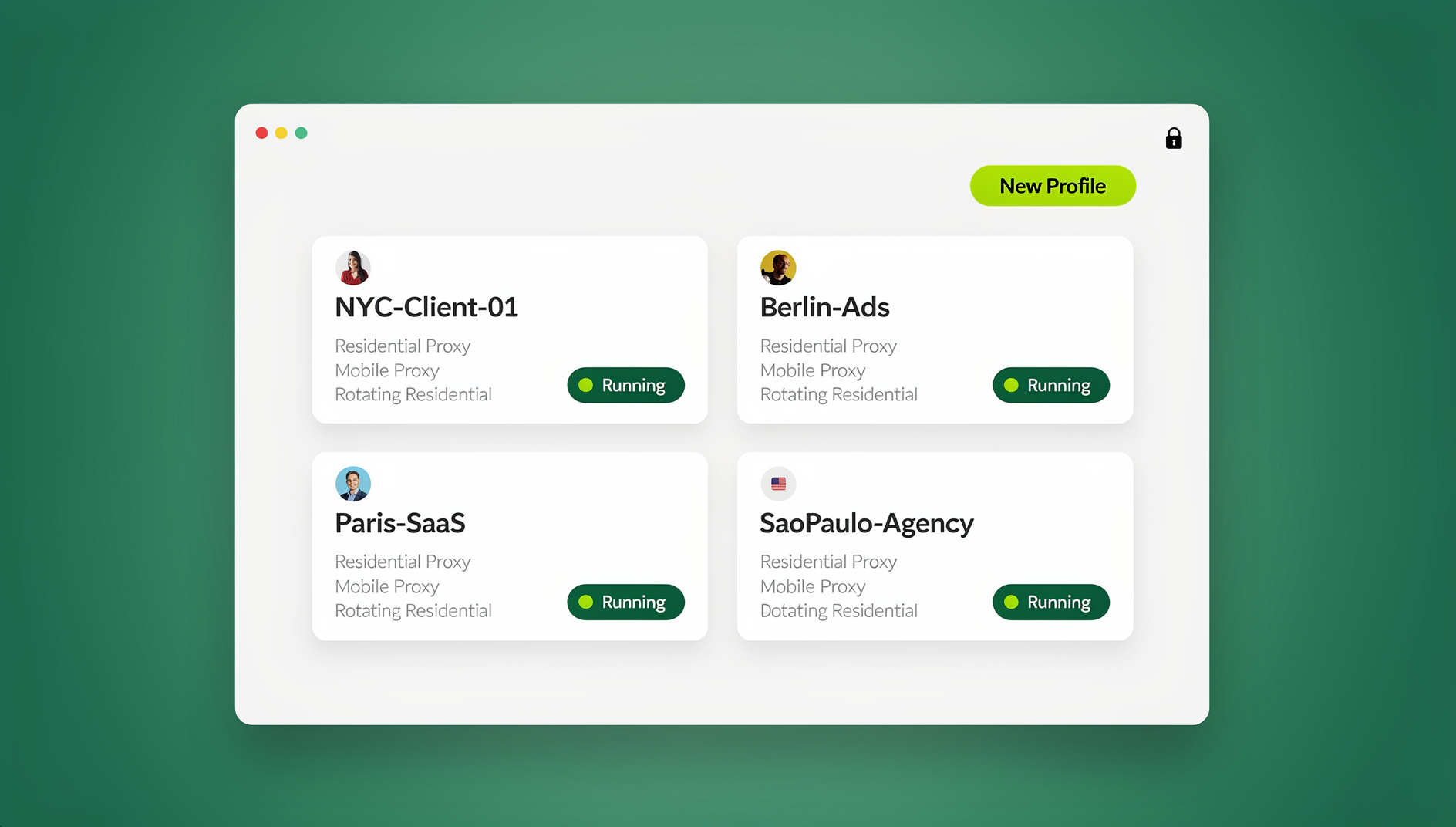
- Recommended Solution: Run custodial, planning and vendor portals in separate Send.win profiles — each profile keeps its own cookies, storage, sessions and fingerprint settings, with cloud sync and profile sharing available.
A Day in the Advisory Workflow: Where Client Data Actually Leaks
Your browser is where nearly every client-data action happens — the account check, the planning projection, the carrier illustration, the signed document. Run all of it through one signed-in profile and a single bad click reaches the whole book.
Morning: custodial and portfolio portals
Schwab Advisor Center, Fidelity Institutional, Orion and most other platforms you log into are cloud apps built and tested against Chromium first. By 9am you may hold live sessions in three or four of them at once, each a cookie and a session token sharing a process with your personal email tab.
Advisors handling charitable vehicles on top of client accounts have an even longer list; the practical patterns for splitting those logins are in this guide to managing multiple DAF accounts.
Midday: planning software, CRM and client conversations
eMoney, MoneyGuidePro and Redtail pull net-worth statements, tax returns and beneficiary details into the same rendering engine. Then come the conversations — email, text, WhatsApp, LinkedIn — that FINRA Rule 3110 requires you to review wherever they happen. Blend those surfaces with your personal inbox and the review gets harder, not easier.
Afternoon: vendor and carrier portals
Insurance carriers, TAMPs, reporting tools and e-signature platforms each want their own credentials. This is the layer regulators flag hardest: FINRA reports rising numbers of cyberattacks and outages originating at third-party vendors, which is why its 2026 oversight report devotes a dedicated section to third-party risk.
Evening: the same laptop, a different life
Home office, personal banking, streaming, a child’s school portal. Every one of those tabs shares the cookie store and the extension permissions with your custodial sessions, so a malicious ad or a typosquatted login page on the personal side can reach what the business side has open.
The Three Risks That Hit Advisory Firms First
1. Adversary-in-the-middle phishing that steals the session, not the password
An AiTM kit sits as a reverse proxy between you and the real portal. You see the genuine login page, your password manager autofills on the correct domain, your MFA push arrives and you approve it. The kit captures the resulting session cookie and walks into the portal as you, no password needed.
Push Security, which runs a detection extension across roughly 3 million browsers, reported detecting and blocking 6 ClickFix attacks and 10 AiTM attempts during a 30-day proof of value at a financial services organization of about 4,500 employees. Phishing remains the opening move in over 90% of successful attacks on financial firms in the 2021–2023 figures still widely cited.
Isolation limits the damage, and containment is the core of browser security for financial advisors. If the stolen cookie belongs to a profile that only ever sees one custodian, with no shared storage, the attacker gets that portal — not your planning software, your CRM and your email in the same sweep.
2. Session and fingerprint blending across custodial logins
Portal fraud systems score login risk. When a dozen unrelated logins arrive from one device fingerprint, one address and one cookie jar, those signals blur together, and trouble in one session can drag the confidence score of the others down. That can surface as extra verification steps or a temporary hold at the worst possible moment.
The quieter cost is exposure. Cookies, localStorage and cached tokens from every portal sit beside each other inside a single profile, so one browser-level compromise reaches every relationship at once. Separate profiles keep each custodian’s data in its own jar.
3. Shared logins and orphaned vendor access
Most small practices keep a vault entry named something like “Custodian — main” that staff, a virtual assistant and a departing associate all use. Nobody can say who signed in last Tuesday. FINRA’s effective practices for vendor risk point the other way: due diligence scaled to how mission-critical the vendor is, an inventory that includes product versions, contracts that keep client data out of vendors’ open-source GenAI tools, vendors taking part in incident-response testing, and access revoked the moment a relationship ends.
Extension sprawl makes this worse. Every add-on can read the page you are on, and one over-permissioned or abandoned extension is enough to exfiltrate a live session — see why the browser extensions security hole is where most firms should start their audit.
What the Rules Require Right Now
The regulatory picture moved twice in two years, and plenty of advisor-facing content still describes the old version.
The 2022 SEC cyber proposal is dead. The SEC formally withdrew its proposed cybersecurity risk management rule for investment advisers on June 12, 2025 (Release 33-11377), part of a rollback of 14 proposed rulemakings. That removed a proposal, not an obligation — the withdrawn rule’s five elements remain a useful benchmark for sizing your program, but you cannot cite it as a requirement.
Amended Regulation S-P is not a proposal. Adopted in May 2024, it requires a written incident response program, notice to affected individuals within 30 days of a breach, and a 72-hour notification path from third-party service providers. Large entities had to comply by December 3, 2025 and smaller ones by June 3, 2026, so both deadlines have passed. If your incident response plan is still a paragraph in a policy binder, you are exposed today.
FINRA supervision still runs on Rule 3110: written supervisory procedures, qualified designated supervisors, a ban on supervising your own activities, review of business communications wherever they happen, an annual firm review, and branch inspections at least every three years. Documentation is mandatory — unarchived reviews, red-flag investigations and supervisory actions cannot evidence compliance. The outsourcing and vendor expectations sit in FINRA’s third-party risk report, and the CORE initiative, launched in 2025, now shares cyber and technology risk intelligence with firms it believes may be affected.
| Obligation | What it asks for | What it looks like in your browser |
|---|---|---|
| Amended Regulation S-P | Written incident response program; 30-day notice to affected individuals; 72-hour notice from service providers | Know which profile touched which client account, and revoke one profile and its stored cookies without disturbing the others |
| FINRA Rule 3110 | Written procedures, designated supervisors, review of communications wherever they occur, archived documentation | Keep client messaging inside dedicated business profiles so review and archiving are complete and provable |
| FINRA vendor-risk practices | Vendor inventory with versions, due diligence, no client data into vendor GenAI tools, vendors in IR testing, access revoked at exit | One profile per vendor; delete it when the contract ends instead of leaving a signed-in session behind |
| Client portal baselines | TLS 1.3 in transit, AES-256 at rest, role-based access, inactivity logout, limited concurrent sessions | Never leave portal profiles signed in on a shared machine; block them when they are not in use |
How to Set Up Isolated Advisor Profiles Step by Step
You can put browser security for financial advisors in place on one laptop in about half an hour. Map profiles to real relationships, not to moods or tabs.
- Install the desktop app. Sendwin Browser runs natively on Windows 10/11 (64-bit), macOS 12+ (Apple Silicon and Intel) and Linux as an AppImage or .deb. On a machine you do not control, skip the install and use a cloud profile instead.
- Create one profile per relationship. A profile for each custodian, each planning tool, the CRM, each vendor portal, and one for personal browsing that touches nothing else. No catch-all profile.
- Assign a proxy to every client-facing profile. Every plan includes built-in residential proxies, and you can bring your own HTTP/SOCKS5. Residential addresses draw less scrutiny from portal fraud systems than datacenter ranges.
- Check the exit before you sign in. Timezone, locale, WebRTC and geolocation follow the proxy’s exit IP automatically, so the profile reports a coherent location instead of a clock and an address that disagree.
- Log in once and let the profile keep the session. Cookies and tokens stay inside that profile, so a portal you use daily is ready without a fresh MFA dance every morning.
- Turn on cloud sync. Pro syncs 20 profiles and Team syncs 100, so your logins follow you between the office desktop and the laptop at home.
- Block profiles you are not using. Keep each one out of reach while you work in another.
- Share instead of handing over passwords. A profile shared with a paid teammate opens already signed in, and revoking access is a single action when someone moves on.
If you are still weighing isolation models — per-tab, per-container, per-profile or fully streamed — this breakdown of browser isolation for financial services maps each one to the threat it actually stops.
Profile and IP Hygiene: Matching Fingerprint, Proxy and Custodian
Isolation only holds if the network layer agrees with it. For browser security for financial advisors, three habits carry most of the weight.
- One profile, one exit IP, for the life of the session. Rotating addresses mid-session is the most common self-inflicted red flag. Pick a residential exit near the client’s or firm’s region and leave it alone while you are logged in.
- Do not route portal access through a VPN. A VPN tunnels all traffic through one shared address, so every user on that node looks like the same visitor. The difference between the two approaches is covered in this comparison of proxy vs VPN for IP masking.
- Keep fingerprint elements coherent. Send.win keeps each profile’s fingerprint settings consistent within that profile, so profiles do not share one browser identity.
Browser Options Compared for Advisory Practices
There is no single most-secure browser, and any vendor claiming otherwise is selling something. What matters is which threats each model removes. The enterprise end has also consolidated fast: CrowdStrike acquired Seraphic, Akamai announced its intent to acquire LayerX, and Zscaler absorbed SquareX during 2026, so confirm the current owner before you commit to a multi-year contract.
| Approach | How isolation works | Best fit | Watch-outs |
|---|---|---|---|
| Chrome profiles / Chrome Enterprise | Separate cookie jars per signed-in profile; fleet policy and compliance reporting from Chrome Enterprise Core, which is free | Solo advisors already standardized on Chrome | Profiles share one device fingerprint and one IP; deeper controls sit behind paid Enterprise Premium |
| Firefox Multi-Account Containers | Containers separate cookies inside a single window | Advisors who want client separation without new software | Containers still share the fingerprint, the IP and the extension set |
| Edge for Business | Entra-based work and personal profile separation, Purview DLP, Conditional Access | Firms standardized on Microsoft 365 | The strongest protections lean on E5 or Purview licensing |
| Purpose-built enterprise browsers (Island, Prisma Access Browser) | Hardened Chromium with last-mile DLP, watermarking, copy and download restrictions, device posture checks | Regulated firms with a security team and a per-user budget | Per-user enterprise pricing and a procurement cycle; confirm current rates with the vendor |
| Extension-based security (LayerX) | Central policy, DLP and SaaS/GenAI governance layered on the browsers you already run | Firms that cannot migrate browsers | Depends on browser extension APIs and adds one more extension to the surface you are trying to shrink |
| Streamed sessions (Kasm) | Containerized, disposable browser sessions streamed from private infrastructure or cloud | Task-level isolation for contractors and one-off research | Streaming feels different from native browsing, and heavy portals show it |
| Send.win profiles | One engine-level fingerprint per profile, traffic through built-in residential proxies or your own HTTP/SOCKS5, on desktop or in the cloud | Advisors juggling custodial, planning, vendor and personal logins | Requires discipline: one role per profile, not one profile for everything |
Scaling From One Advisor to a Multi-State Practice
Two to five people: shared access without shared passwords
Share the profile instead of passing credentials around. With Send.win, a profile shared with a paid teammate opens already signed in, so nothing sensitive moves through a text message, and a live cloud session can be handed over mid-task when you want a second set of eyes on a statement. Pro covers up to 20 paid members, Team up to 50, and Team includes 16 team seats against 6 on Pro.
Six to twenty people: inventory and evidence
Your profile list becomes your system and vendor inventory. Keep it current, note which custodian or tool each profile serves, and delete profiles when a contract or relationship ends — the same discipline FINRA expects of vendor access generally. Cloud sync keeps one consistent set of logins on every approved device instead of a patchwork of local profiles.
Automation for reporting chores
The session lives in the profile, so the script never touches a password or a one-time code. Keep scripts read-only unless a written procedure covers what they are allowed to change.
Cloud profiles for travel and BYOD
On a hotel laptop or any machine you do not administer, run the session in a cloud profile from Send.win’s EU and US nodes instead of signing in locally. Nothing is installed and nothing stays on the endpoint. The free preview gives you 10 minutes a day, while Pro and Team include unlimited cloud browsing time.
Add-ons stay simple as you grow: extra proxy bandwidth at $6 per GB and extra profiles at $0.05 each, so scaling up does not force a plan change.
🏆 Send.win Verdict
Send.win fits a problem general enterprise browsers were not built for: one advisor, many custodial and planning relationships, each needing its own identity rather than a single hardened window. Engine-level fingerprint spoofing plus a residential proxy exit per profile gives each portal a coherent, separate machine, while cloud sync and profile sharing replace shared vault entries with revocable access. It does not replace an incident response program, a written Reg S-P policy or your MFA — it is the layer those controls run on.
Try the Send.win cloud demo — a 3-minute preview without signup, or 10 minutes a day with a free account.
Frequently Asked Questions
What is the most secure browser for financial advisors?
There is no single winner, and any vendor claiming otherwise is selling something. The practical answer is the browser you can isolate per relationship and audit afterwards. Chrome, Edge and Firefox separate cookies between profiles, but all of them share the device fingerprint, the IP address and the extension set across those profiles.
How do I keep client logins separate in one browser?
Use one profile per custodian or client relationship instead of one profile holding a dozen tabs. Firefox Multi-Account Containers do this at the cookie level; Send.win does it at the engine level, so each profile also carries its own fingerprint and its own assigned proxy exit. Block or close profiles when you are not working in them.
Is Chrome safe for handling client financial data?
Chrome patches quickly and custodial portals are tested against Chromium first, so it is a reasonable base. What it does not do is separate fingerprint, IP or extensions across profiles, and the free Chrome Enterprise Core controls stop short of last-mile data loss prevention. Treat it as the floor, not the ceiling.
What does amended Regulation S-P require of my RIA?
It requires a written incident response program, notice to affected individuals within 30 days of a breach, and a 72-hour notification path from third-party service providers. Deadlines passed on December 3, 2025 for large entities and June 3, 2026 for smaller ones. In practice, that means knowing which system or profile touched which client account.
Do I still need a cybersecurity program now that the SEC withdrew its 2022 rule?
Yes. The withdrawal on June 12, 2025 (Release 33-11377) removed a proposal, not an obligation. Amended Regulation S-P, FINRA Rules 3110 and 4370 and state rules still apply, and the withdrawn proposal’s five elements remain a useful benchmark for how large your program should be.
Should advisory firms use browser extensions for security?
Extensions can deliver real value — DLP, phishing detection, SaaS and GenAI governance — but each one can also read the portal pages you have open. Give every extension the same vendor due diligence you would give a custodian or planning tool, keep the list short, and remove anything without a named owner.
How do I supervise third-party vendors under FINRA Rule 3110?
Start with a current inventory that includes product versions, then apply due diligence scaled to how mission-critical the vendor is. Contracts should keep client data out of vendors’ open-source GenAI tools, vendors should take part in incident-response testing, and access should be revoked as soon as the relationship ends.
Can I access custodial portals from a cloud browser?
Yes. Cloud profiles run from Send.win’s EU and US nodes, so the browsing happens off your device while the session and its fingerprint stay inside the profile. The free preview allows 10 minutes a day, and Pro and Team include unlimited cloud browsing time. It is the safer option on a laptop you do not administer.
How Send.win Helps With Browser Security For Financial Advisors
Send.win is a browser profile manager built for exactly this kind of work — every profile is a clean, isolated identity:
- Isolated profiles – unique fingerprint, separate cookies and storage per profile
- Fingerprint settings – each profile keeps its own consistent browser fingerprint, including canvas, WebGL, fonts, and audio
- Desktop app + cloud sessions – native app for Windows, macOS, and Linux, or run profiles in the cloud with no install
- Built-in residential proxies – with automatic timezone, locale, and WebRTC matching
- Team features – share logged-in profiles with teammates without sharing passwords
Try the instant cloud browser demo — no install, no signup — or download the desktop app. There is no free trial; paid plans start at $19/month on Pro ($83.88/year), and the first card purchase is covered by a 7-day money-back guarantee (see pricing).