What Is the Difference Between a Linked Account and an Amazon Profile?
When you compare linked account vs profile amazon, the distinction is simple: a profile is a public page and a linked account is an enforcement finding. A profile shows your reviews, ratings, wish lists and bio; it is not your Seller Central identity. A linked account means Amazon has connected two or more seller accounts through shared IPs, devices, cookies, bank details, tax IDs or addresses. Multiple seller accounts are allowed only with a legitimate business need and accounts in good standing.
📌 TL;DR Executive Summary
- Core Takeaway: An Amazon profile is a public page for reviews, ratings, lists and bio. A linked account is Amazon’s finding that two or more accounts are connected through shared identifiers.
- Key Risk/Challenge: A violation on one seller account can deactivate related accounts, and funds can be held for up to 90 days. Tax IDs, bank accounts and document metadata are the hardest links to undo after the fact.
- Recommended Solution: Confirm Amazon permits the second account, separate the legal entity, tax ID, bank account, contact details and credentials, then keep browser data apart with one profile per authorised account.
Amazon Profile vs Amazon Household vs Linked Seller Account
Three different things get called “linked” or “profile” in the same conversation. That overlap is where most linked account vs profile amazon confusion starts, and the three behave nothing alike, so separate them before you act on any advice.
| Dimension | Amazon public profile | Amazon Household | Linked seller account |
|---|---|---|---|
| What it is | Public page with your reviews, ratings, wish lists and bio | Official Prime-sharing feature for families | Amazon’s finding that two or more seller accounts are connected |
| Who it involves | Any Amazon customer | One additional adult plus up to four children | Seller accounts, including ones that have been dormant for years |
| What is shared | Reviews, ratings, lists and bio | Prime benefits only; order history stays private per member | Whatever matches: IP, device, cookies, bank, tax ID, address or documents |
| What it is not | Not your Seller Central identity | Not a seller linking flag | Not a setting you can turn on or off |
| What you do about it | Edit it in your account settings | Add or remove members in Household settings | Confirm eligibility, separate the records, appeal if already deactivated |
What an Amazon Linked Account Actually Means
“Linked” is not a switch. It is a conclusion Amazon reaches after matching accounts, and Section 3 of the Business Solutions Agreement is the clause Amazon cites when it deactivates linked or multiple seller accounts. The practical effect is that one policy violation can deactivate every related account, not just the one that caused the problem.
Amazon Household borrows the same word for something benign: an official feature that lets one additional adult and up to four children share Prime benefits, each with their own login and separate order history. That is not a seller linking flag, and it does not give a family member access to your Seller Central account.
Why linking is a seller problem, not a buyer problem
Buyers normally run one Amazon account, so there is little to match. Sellers run one account per region by default, and the risk sits exactly where payouts, inventory and tax records sit. Once Amazon calls a seller account linked, the burden shifts to you to show the accounts are genuinely separate businesses.
Regional linking is a different, older feature
Amazon ended regional account linking around 2016. You now set one preferred store across marketplaces instead of linking separate regional accounts. If an old guide describes “linked” regional accounts, that is not a related-account deactivation. For the seller-side mechanics, this guide to manage multiple Amazon seller accounts covers day-to-day operations.
What an Amazon Profile Is — and What It Is Not
Your Amazon profile is the public page attached to your customer activity: reviews, ratings, wish lists and bio. It sits apart from the private account data Amazon uses for orders and payments, and its feature set has changed over the years. Treat it as a reputation page, not a compliance record.
A profile is not Seller Central
The public page does not say who owns a seller account, which bank receives disbursements or which tax ID is on file. Rewriting the bio changes none of that, and it will not resolve a linked-account notice.
A profile is not a second account
Editing it creates neither a new buyer account nor a new seller account. If you need another seller account, the question is whether Amazon permits it for your business — not whether the public page looks different.
How Amazon Detects Linked Seller Accounts in 2026
Amazon does not publish a scoring formula. What the current enforcement picture shows is a wide set of cross-account checks: IP addresses, device fingerprints, shared cookies, browser fingerprints, bank accounts, credit cards, phone numbers and addresses are compared across Seller Central accounts, alongside document review.
Hard identifiers versus browser identifiers
A matched EIN or SSN is one of the strongest signals, and it does not weaken with time — a dormant account still links if the tax ID matches. Document metadata behaves the same way: PDFs produced from the same software, template or accountant have served as linking signals. Browser-level evidence such as cookies and fingerprints is one input among many, which is why a clean browser window alone never separates two accounts.
Innocent triggers that still create a link
A spouse’s seller account on the same home WiFi, a former employee opening a new account, an uncleared cookie from a previous employer’s Seller Central session. Recent 2026 guidance names these as common accidental triggers, and they are ordinary shared-device and shared-network situations rather than exotic edge cases.
What changed in 2026
Earlier in 2026, Amazon removed the requirement to obtain advance permission before opening a second seller account, while keeping the good-standing and operational-separation requirements. Reporting since then describes related-account suspensions rising sharply as linking detection grew more aggressive. The lesson is not that a second account is free to open; it is that separation evidence matters more than before. Confirm the current wording in Seller Central before you rely on it.
If the account is already deactivated
A linked-account appeal needs three things: the specific trigger identified, evidence of separation or full disclosure, and a Plan of Action tied to the related-account policy. Appeal the responsible account first, then each related account. Funds can be held for up to 90 days while the case is open, and preparation commonly takes 2–4 hours plus 3–10 business days of Amazon review. A new browser profile is not an appeal.
Legitimate vs Rejected Reasons for a Second Seller Account
Amazon’s standard is a legitimate business need, not a wish for more shelf space. Accepted justifications include separate registered companies, distinct brands, manufacturing or 3PL work for unrelated clients, and different regions that require separate tax entities. Rejected scenarios include backup accounts, starting fresh after a suspension, and duplicate stores selling the same catalog.
| Accepted in principle | Usually rejected |
|---|---|
| Separate registered companies | A backup account in case the main one fails |
| Distinct brands under separate operational ownership | Starting fresh after a suspension |
| Manufacturing or 3PL work for unrelated clients | Duplicate stores selling the same catalog |
| Different regions requiring separate tax entities | Same legal entity, different product lines or markets |
That last rejected row causes most of the damage. Running two accounts for separate product lines or markets under the same legal entity does not meet the legitimate business purpose standard. A new brand name on the same company, bank account and tax ID is still the same seller in Amazon’s view.
Separating Authorised Accounts: Records First, Browser Second
If Amazon permits your second account, the separation has to show up in dull records before it shows up in any tool. Once the linked account vs profile amazon distinction is settled, that means each seller account needs its own bank account, tax ID, contact details and login credentials; sharing or cloning those is a common cause of related-account suspensions.
Identity and money first
- A separate legal entity, tax ID and bank account per account.
- A separate business address, phone number and contact email.
- Distinct credentials — never reuse a password or a recovery email.
- Verification documents that match that entity, and no recycled PDF template across accounts.
How Send.win Helps With Linked Account Vs Profile Amazon
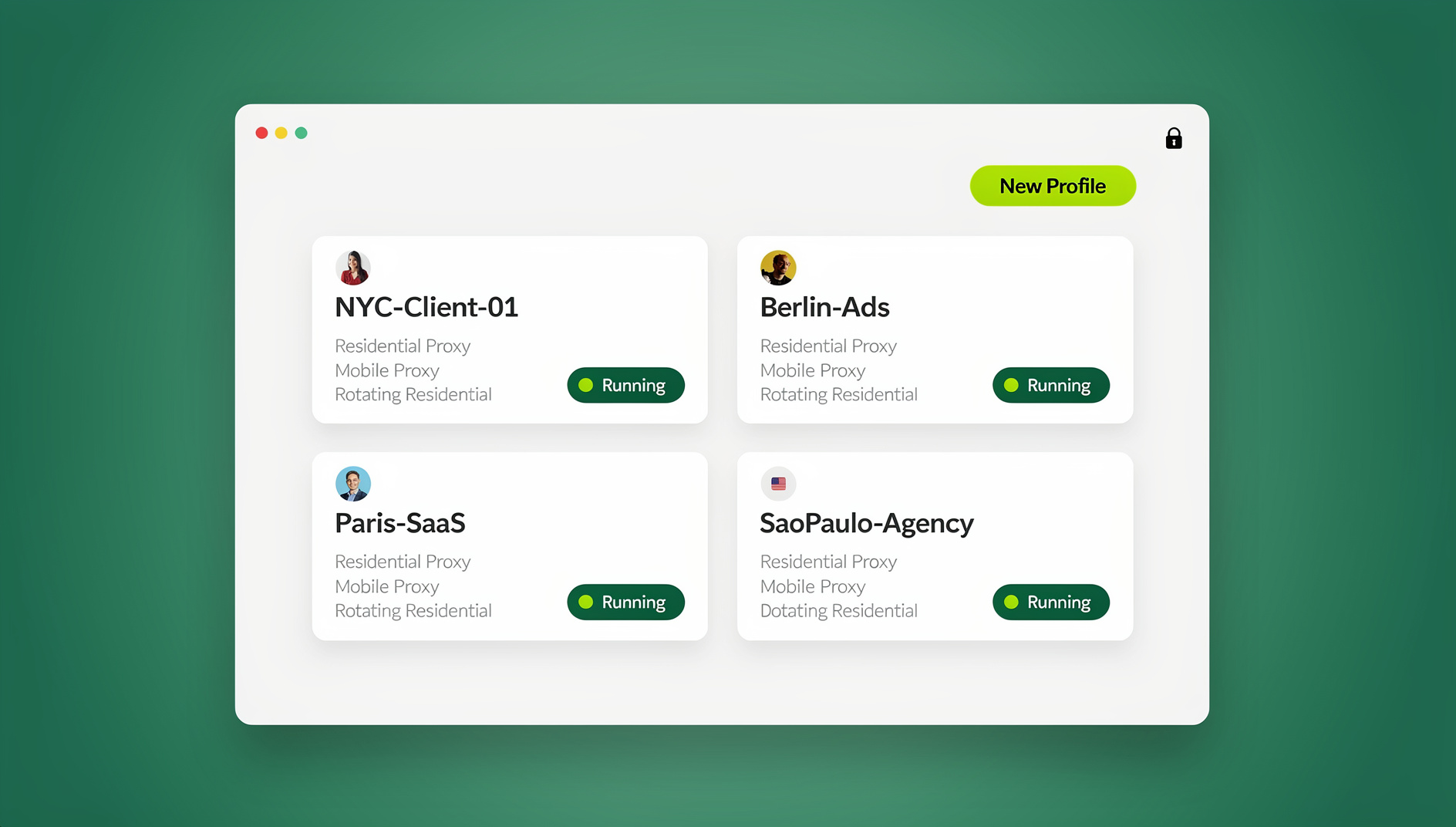
Send.win is a browser profile manager for professionals and teams: every account gets its own isolated browser profile.
- Isolated profiles – separate cookies, storage and sessions per profile
- Fingerprint protection – each profile keeps its own consistent browser fingerprint, so profiles never share one browser identity
- Desktop app + cloud browser – native app for Windows, macOS and Linux, or run profiles in the cloud with no install
- Residential proxies included – on Pro and Team, with timezone and locale matched to the proxy
- Team sharing – share a signed-in profile with a teammate without sharing the password
Try the free cloud demo — no install — or download the desktop app. Paid plans start at $19/month, and your first card purchase is covered by a 7-day money-back guarantee (see pricing).
Then the browser and network layer
On the technical side, run one browser profile per account, each with its own cookies, storage, sessions, fingerprint settings and proxy. Sendwin Browser is a Chromium-based desktop app for Windows, macOS and Linux, and each profile keeps its own browser data instead of sharing a single browser identity. Attach a proxy and timezone, locale, WebRTC and geolocation follow the exit IP automatically; Pro and Team include residential proxies with metered bandwidth, and you can bring your own HTTP/SOCKS5 proxy.
Write the proxy-to-profile map down before you open anything. This walkthrough on one profile per account shows how assignments drift when nobody owns that list.
Team access without password sharing
Agencies and virtual assistants often work inside a client’s Seller Central account. Send.win lets you share a profile with a paid teammate and it opens already signed in, so no password changes hands; live cloud sessions can be shared the same way. That covers authorised client work only — it does not replace the client’s written authorisation or Amazon’s rules for that account.
The cloud browser runs profiles on Send.win’s server in Helsinki, so a teammate can work from any device without installing anything. The desktop app is the other mode: installed locally, with your profiles on your own machine.
Route by Route: Cost, Strengths, Weaknesses
The linked account vs profile amazon question is not a subscription choice, because Amazon does not sell either one as a separate product. What varies is money, time and exposure.
| Route | What it costs | Strength | Weakness |
|---|---|---|---|
| Amazon public profile | Nothing | Free public identity for reviews and lists, separate from private order data | Changes nothing about seller identity or ownership |
| Amazon Household | Nothing | Official way to share Prime benefits with one adult and up to four children | Family sharing only; irrelevant to a seller linking review |
| Second seller account, properly separated | A second entity, bank account, tax filing and bookkeeping | Lets you sell under a business Amazon actually permits | Any shared record — tax ID, bank, address, document template — can relink the accounts |
| Send.win browser profiles | Paid plans; free cloud demo, 10 minutes a day | One profile per account with its own cookies, storage, fingerprint settings and proxy, on desktop or in the cloud | Fixes the browser layer only; cannot separate a tax ID, bank account or document trail |
Notice where the risk sits: every weakness on the seller row is a record, not a browser. Software separates cookies and storage; it cannot separate an EIN. For the account-level risks behind that distinction, read this guide to multiple Amazon accounts.
Which Option Fits Your Situation?
Start with the rule Amazon applies, not the tool you would like to use.
- Family sharing Prime: Amazon Household — one extra adult and up to four children, separate logins, private order history.
- A public review identity: your Amazon profile. Free, separate from private account data, and not a seller tool.
- An authorised second seller account: separate entity, tax ID, bank and contact records first, then one isolated browser profile per account with its own proxy.
- An agency running client Seller Central accounts: Send.win profiles per client, shared with paid teammates, backed by written authorisation from each client.
- QA or support testing by region: the cloud browser or a desktop profile with a matching proxy, so timezone, locale and geolocation follow the exit IP.
- Backup account, fresh start after a suspension, duplicate catalog: none of these routes works. Use Amazon’s appeal or verification process for the account that was actioned.
If you are weighing browser-level tools rather than Amazon features, this browser profile manager comparison covers where isolation stops and account separation starts.
🏆 Send.win Verdict
Send.win is relevant only where the browser layer is the part you can control: one isolated profile per authorised Amazon account or client, each with its own cookies, storage, sessions, fingerprint settings and proxy, on desktop or in the cloud. It is not a fix for a linked-account suspension, a shared EIN or a missing business licence. Use it after the legal and tax separation is real, never instead of it.
See Send.win plans — Pro is $19/mo ($83.88/yr billed annually), Team is $49/mo ($251.88/yr), with a 7-day money-back guarantee on your first card purchase; the free cloud demo gives you 10 minutes a day.
Frequently Asked Questions
What is the difference between an Amazon profile and a linked account?
An Amazon profile is a public page showing reviews, ratings, wish lists and bio, separate from your private account data. A linked account is an enforcement finding that two or more accounts are connected through shared identifiers. One is a page; the other is a risk status.
Can I have multiple Amazon seller accounts in 2026?
Amazon’s default is one seller account per region, with exceptions for a legitimate business need and accounts in good standing. Separate registered companies, distinct brands, unrelated client work and different tax entities are the kinds of reasons Amazon accepts. The linked account vs profile amazon difference does not change that rule — a public profile is not a second account. Check Seller Central for the current requirements before you open anything.
What triggers an Amazon linked account suspension?
Shared IPs, devices, cookies, browser data, bank accounts, credit cards, phone numbers, addresses, tax IDs and document metadata all serve as matching signals. A matched EIN or SSN is among the strongest. Accidental cases happen too, such as a spouse’s account on the same home WiFi or an old Seller Central cookie on a shared laptop.
How do I appeal a linked account suspension on Amazon?
Identify the specific trigger, gather evidence of separation or disclose the relationship, and write a Plan of Action tied to the related-account policy. Appeal the responsible account first, then each related account. Preparation commonly takes 2–4 hours, review can take 3–10 business days, and funds may be held for up to 90 days.
Does Amazon Household link my account to family members?
Yes, in the Household sense: one additional adult and up to four children can share Prime benefits, each with a separate login and private order history. That is not the same as a seller account being flagged as related.
Can family members see each other’s orders on linked accounts?
No. Amazon Household is built so each member keeps a separate login and private order history; the shared part is the Prime benefit. A seller linked-account flag is a different matter and exposes the account to deactivation and review.
Do I still need Amazon’s permission to open a second seller account?
Earlier in 2026 Amazon removed the advance-permission step while keeping the legitimate business need and operational-separation requirements. Reporting and appeal guidance still assume accounts are in good standing and genuinely separate. Verify the current process in Seller Central before you act on it.
Can I open a new account after my old one was suspended?
Not as a workaround. Starting fresh after a suspension is a rejected scenario, and Amazon can link the new account to the old one. Use the appeal or verification process for the account that was actioned, and disclose a genuinely separate business if you have one.