Residential Proxy vs VPN: Two Tools, Two Jobs
A residential proxy routes only the app you configure through a real household ISP IP, while a VPN tunnels your whole device through a datacenter IP. That single difference decides most outcomes: scraping success, multi-account survival and geo-access depend on the exit IP’s ASN reputation, not on encryption. Compare residential proxy vs VPN on routing scope, IP type, rotation and cost per gigabyte instead of privacy slogans, and the choice gets obvious fast.
📌 TL;DR Executive Summary
- Core Takeaway: A VPN encrypts a whole device behind a datacenter IP; a residential proxy gives one app a household ISP IP that anti-bot systems score as trustworthy. Different tools, different jobs.
- Key Risk/Challenge: Neither one hides your browser fingerprint or cookies. Accounts sharing one exit IP stay linkable, and datacenter ranges start pre-scored low by WAFs like Cloudflare.
- Recommended Solution: Use a VPN for device-wide encryption on untrusted networks. For scraping, ad verification and many accounts, pair a residential proxy with an antidetect browser so each profile owns one IP and one device identity.
How Send.win Helps With Residential Proxy Vs Vpn
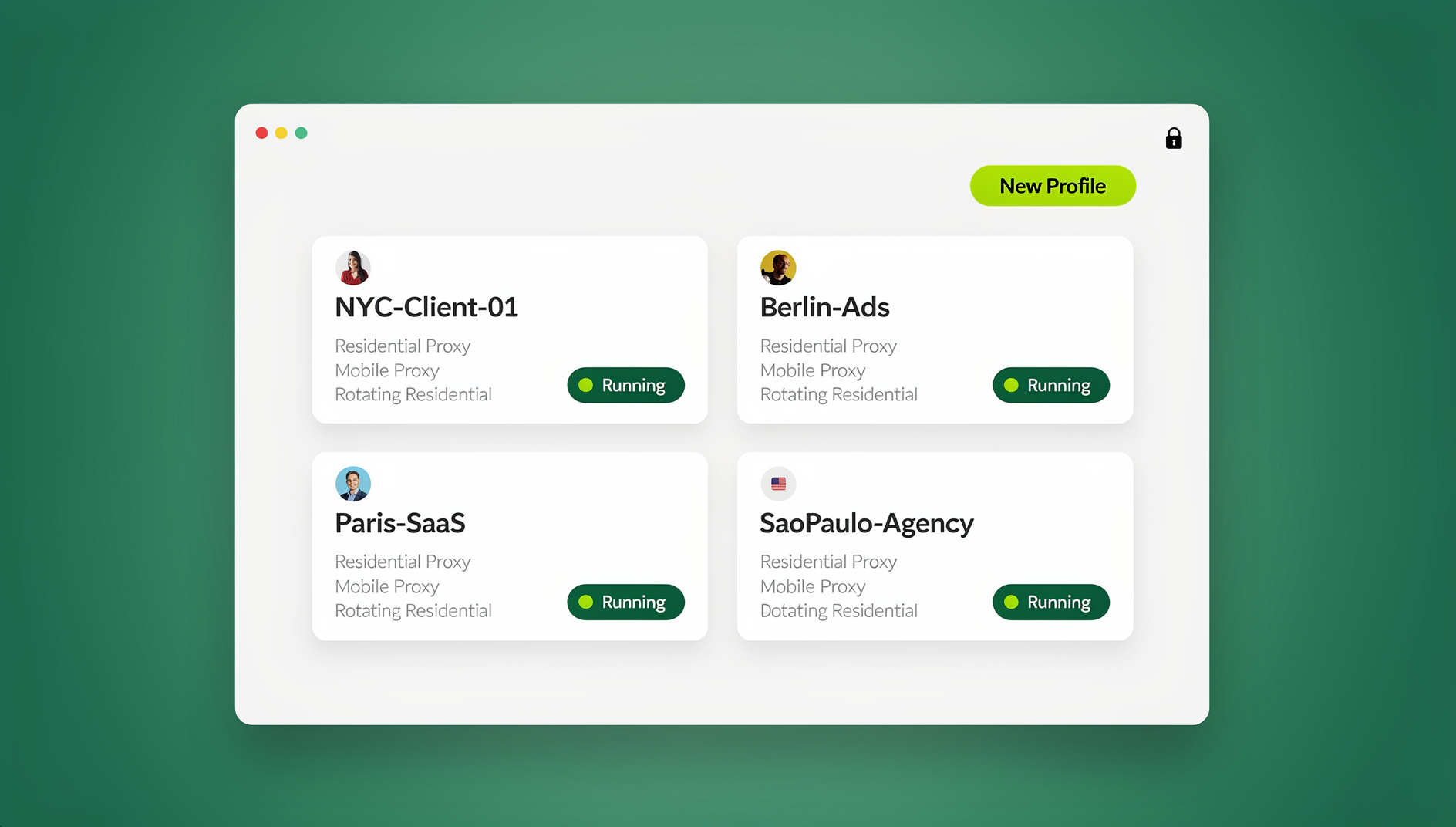
Send.win is an antidetect browser built for exactly this kind of work — every profile is a clean, isolated identity:
- Isolated profiles – unique fingerprint, separate cookies and storage per profile
- Stealth engine – canvas, WebGL, fonts, and audio spoofed at the engine level
- Desktop app + cloud sessions – native app for Windows, macOS, and Linux, or run profiles in the cloud with no install
- Built-in residential proxies – with automatic timezone, locale, and WebRTC matching
- Team features – share logged-in profiles with teammates without sharing passwords
Try the instant cloud browser demo — no install, no signup — or download the desktop app. The 30-day free trial needs no credit card, and paid plans start at $6.99/month billed annually (see pricing).
The Difference at a Glance
| Dimension | Residential proxy | VPN | Send.win |
|---|---|---|---|
| Routing scope | Only the browser, app or script you point at it | Every packet from the device | Per browser profile, local or in the cloud |
| Exit IP type | ISP-assigned household IPs | Datacenter ASNs (M247, DataCamp, Choopa and similar) | Built-in residential pool, plus your own HTTP/SOCKS5 |
| Encryption | None at the proxy hop; HTTPS still protects the request | OpenVPN or WireGuard tunnel for the whole device | None added; standard HTTPS |
| Rotation | Per request or sticky, roughly 10 minutes to 24 hours | One IP per session until you reconnect | Follows the proxy you attach per profile |
| Fingerprint handling | Unchanged | Unchanged | Canvas, WebGL, audio, fonts and hardware spoofed per profile |
| Multiple accounts | One identity per session config | All accounts share one exit IP | One isolated profile per account |
| Pricing model | Per GB, roughly $1–$10+ by tier | Flat subscription, commonly $3–$13/month | 30-day free trial, then Pro from $6.99/mo billed annually |
How Each Tool Routes Your Traffic
What a residential proxy actually does
A residential proxy is a forward proxy placed between one application and the internet. You enter the host, port and credentials in the browser, scraper or desktop app, and every request that app makes leaves through an IP an ISP issued to a real household. Nothing else on the machine changes: your email client, chat apps and background system traffic keep their normal route.
That narrow scope is the feature, not a limitation. You can run a market-research script through a US residential IP while the laptop stays on the office network. A plain HTTP proxy does not encrypt the hop — it just forwards the request — but HTTPS still protects the payload end to end, and SOCKS5 covers non-browser clients that need raw TCP.
What a VPN actually does
A VPN builds an encrypted tunnel from your device to the provider’s server using OpenVPN or WireGuard, then pushes every packet through it. Your ISP sees one encrypted stream, and every app on the machine shares the same exit IP. That is why a VPN is the right answer for public Wi-Fi, remote work and sensitive browsing.
The catch is where that IP comes from. VPN exits live in datacenter ranges such as M247, DataCamp and Choopa, and you get a single exit IP per session until you manually reconnect or switch servers. For a human browse session that is fine. For forty logged-in seller accounts, it is a shared address that ties them together.
Where residential VPNs fit
A residential VPN combines the tunnel with residential exit IPs. You keep the encryption and lose the datacenter tell, but most providers hand you one IP at a time with limited rotation, which solves a geo-block for a single session rather than giving you pool depth. If you want the three-way view from the server’s side, this breakdown of IP masking and security covers how each route looks to the site.
Why IP Type Decides Whether You Get Blocked
Cloudflare Bot Management scores requests on a 1–99 scale: 1 means automated, 2–29 likely automated, 30–99 likely human, and 0 means no score was computed. Its model blends IP reputation, JavaScript and fingerprint signals, TLS and HTTP/2 handshake characteristics, and behaviour. Any single weak layer can drag the whole request below the WAF threshold.
IP reputation is keyed by ASN and evaluated before any JavaScript runs. Datacenter ranges are pre-scored low because so much abuse originates there; residential IPs are treated as far more trustworthy, and mobile carrier CGNAT addresses carry the highest baseline trust. No amount of user-agent tuning rescues a flagged network.
Handshake fingerprints matter too. TLS JA3/JA4 and HTTP/2 characteristics often betray an automation client before headers are read, which is why a request that looks correct in DevTools can still return error 1020, error 1015, a Turnstile managed challenge or a silent 403 carrying a cf-ray header. Cloudflare’s bot score documentation (updated August 2026) also notes a __cf_bm cookie that smooths scores across a session, so one bad first request keeps costing you. To see which layer flagged you, this breakdown of proxy detection signals separates network, TLS and fingerprint evidence.
Speed, Bandwidth and What You Actually Pay
VPNs usually win the raw speed comparison. A datacenter server sits on high-capacity links and the tunnel overhead is predictable, with unlimited bandwidth on a flat plan. Residential proxies route through real consumer connections, so latency varies by peer, city and time of day. Sticky sessions are typically faster than per-request rotation because you skip the reconnect cost.
Cost runs the other way. VPN subscriptions are quoted at roughly $3–$13 per month for unlimited traffic, so volume barely moves the bill. Residential bandwidth is metered, with 2026 vendor list prices around $1–$3/GB at the budget pay-as-you-go end, $3–$8/GB mid-market and $5–$10+/GB for premium or low-volume plans. Ten gigabytes of monthly scraping traffic therefore lands somewhere between roughly $10 and $100 depending on tier.
The number that decides your budget is cost per successful request: price divided by success rate. A $2/GB pool that answers every second request costs $4 per usable gigabyte; a $6/GB pool with a 95% success rate costs about $6.32. Cheap proxy traffic that gets challenged is the most expensive traffic you can buy.
| Option | What you pay | Unit | Bandwidth |
|---|---|---|---|
| Residential proxy, budget pay-as-you-go | About $1–$3 | Per GB | Metered, often with expiry |
| Residential proxy, mid-market | About $3–$8 | Per GB | Metered, targeting included |
| Residential proxy, premium/low-volume | About $5–$10+ | Per GB | Metered, city/ASN targeting often extra |
| VPN subscription | About $3–$13 | Per month | Typically unlimited |
| Send.win Pro | $19/mo, or $6.99/mo billed annually ($83.88/yr) | Per month | 150 profiles, 20 residential proxies, 5 GB/mo |
| Send.win Team | $49/mo, or $20.99/mo billed annually ($251.88/yr) | Per month | 500 profiles, 20 proxies, 20 GB/mo, local automation API |
| Send.win add-ons | $6 per GB, $0.05 per extra profile | Per unit | Top up on Pro or Team without changing plan |
Benchmark providers on effective rate, not sticker price. Minimum top-ups, traffic that expires at month end and paid city or ASN targeting all push the real number above the headline, which is why the method for how to compare residential proxy prices is worth five minutes before you commit to a plan.
Session Design: Sticky, Rotating or One Exit IP
Rotating residential proxies assign a new IP per request, which spreads load across a pool and frustrates per-IP rate limits on read-only work. Sticky sessions hold one IP for a set window — providers typically describe 10 minutes to 24 hours — which is what logged-in accounts need, because a marketplace that sees your session IP jump mid-checkout will flag the account.
A VPN gives you the opposite of rotation: one exit IP for every app and every session until you reconnect. Stable, but shared. If your target counts requests per IP, you exhaust the quota immediately, and if you run several accounts, the shared address is the link between them. Choosing the session type before the proxy plan saves money and bans; the guide to residential proxy rotation covers sticky windows and retry logic in detail.
| Job | Session type that fits | Why |
|---|---|---|
| Read-only scraping of public pages | Rotating per request | Spreads load, avoids per-IP rate limits |
| Logged-in account work | Sticky, one IP per profile | Session continuity matches a real user |
| Price and ad checks by city | Sticky with geo targeting | The IP must match the market you are verifying |
| Whole-device privacy on hotel Wi-Fi | VPN tunnel | Every app is covered, encryption included |
Use Cases: Scraping, Ad Verification and Rank Tracking
Residential proxies are the standard pick for web scraping, price monitoring, ad verification, SEO rank tracking and multi-account management — workloads where the IP has to look like a normal shopper or reader in a specific country. VPNs are best suited to protecting a whole device on untrusted networks, remote work and sensitive browsing, where encryption matters more than IP diversity.
Automation stacks need a separate endpoint per browser instance, not one global tunnel. Playwright, Puppeteer and Selenium all accept a per-browser proxy, and the launch pattern is short:
from playwright.sync_api import sync_playwright

PROXY = {
    "server": "http://HOST:PORT",          # your residential gateway
    "username": "USERNAME",
    "password": "PASSWORD",
}

with sync_playwright() as p:
    browser = p.chromium.launch(
        proxy=PROXY,
        headless=False,
    )
    context = browser.new_context(
        locale="en-US",
        timezone_id="America/New_York",
    )
    page = context.new_page()
    page.goto("https://example.com/pricing")
    print(page.title())
    browser.close()
When the profile lives inside an antidetect browser, you stop passing proxy credentials in code at all. You attach the automation client to the profile’s local debugging endpoint and work inside the fingerprint that profile already owns:
from playwright.sync_api import sync_playwright

CDP_URL = "http://127.0.0.1:PORT"  # copy it from the profile's automation settings

with sync_playwright() as p:
    browser = p.chromium.connect_over_cdp(CDP_URL)
    context = browser.contexts[0]
    page = context.pages[0] if context.pages else context.new_page()
    page.goto("https://example.com/pricing")
    print(page.title())
    browser.close()
That is the pattern Send.win exposes for Selenium, Puppeteer and Playwright on the Team plan. Every plan also ships with a residential pool out of the box — 10 proxies and 1 GB of bandwidth during the 30-day free trial, 20 proxies on Pro and Team — plus bring-your-own HTTP/SOCKS5 if you already pay another provider.
Multi-Account Management: Where a VPN Falls Short
Run five seller accounts through one VPN and the marketplace sees one address logging into five stores. One API call links them, and the shared exit IP is the evidence. Cookies and local storage make it worse, because every account’s session data sits in the same browser profile behind the same canvas and WebGL signature.
The working setup is a one-to-one mapping: one isolated profile per account, one proxy endpoint per profile, one coherent fingerprint per profile. Isolation has to happen at the engine level, with canvas, WebGL, audio, fonts and hardware spoofed consistently, not through script injection a page can detect. Sendwin Browser does this per profile, so cookies, cache and storage never mix and no two profiles share a fingerprint.
When a VPN Is the Better Buy
For personal privacy, a VPN is cheaper and simpler. It encrypts everything on the device, including DNS lookups and background sync traffic, and you configure nothing per app. If your threat model is a hostile local network — hotel Wi-Fi, a shared rental router, a conference hotspot — the VPN is the tool that answers it, and no proxy replaces that.
The honest split is device privacy versus per-app identity. Buy the VPN for the tunnel, and stop expecting it to deliver IP diversity, rotation or account separation.
Can You Chain a VPN and a Residential Proxy?
Yes, and it is a legitimate layered setup. Route the device through the VPN tunnel, then point the proxy-aware app at a residential gateway. The target site sees only the residential exit IP, while the VPN provider sees encrypted traffic heading for the proxy, so you keep device-level encryption and gain a residential identity for the app that needs one.
Two things to plan for: latency stacks from both hops, and the proxy provider now sees requests originating from your VPN’s datacenter range, which can trip its abuse rules even though nothing leaks to the target site. For most multi-account work, a residential pool plus real profile isolation does the job without the double hop.
Which Should You Pick?
Match the tool to the workload, and stop expecting one to cover both:
- Personal privacy on any network: a VPN. Device-wide encryption for a few dollars a month is the right buy, and no proxy replaces it.
- Scraping, price monitoring, ad verification, rank tracking: residential proxies, rotating for public pages and sticky for anything with a session.
- Multiple marketplace, ad or social accounts: residential proxies plus real profile isolation — one IP, one fingerprint, one account. A VPN cannot do this, because the shared exit IP defeats the setup.
- Agency work with cookies, logins and teammates: an antidetect browser with built-in residential proxies and cloud sync, so a colleague can open a client profile already authenticated without a password changing hands.
- Both privacy and account work: chain them. VPN for the device, residential proxy and an isolated profile for the app.
If your honest answer is “all of the above”, keep the VPN subscription for travel and run account work through isolated profiles.
🏆 Send.win Verdict
The residential proxy vs VPN question usually hides a second one: which tool keeps my accounts separate? A VPN answers the first half and loses the second, because every session shares one datacenter exit IP and every account shares one fingerprint. Send.win answers both — each profile carries its own coherent device identity and its own proxy endpoint, from the built-in residential pool on every plan or your own HTTP/SOCKS5. Profiles open already signed in when a paid teammate opens a shared one, cloud sessions run on EU and US nodes, and the cloud preview is free for 10 minutes a day. It is not a replacement for a VPN on hostile Wi-Fi, and it will not encrypt your whole machine. For scraping at scale, ad verification and running many accounts at once, it is the layer that makes the proxy actually work.
Try Send.win free today — 30 days free, $0 today, cancel anytime; after day 30 your plan continues on Pro at $19/mo, or $6.99/mo billed annually. Every plan ships with free residential proxies and the Sendwin Stealth engine.
Frequently Asked Questions
Is a VPN the same as a proxy?
No. A VPN creates an encrypted tunnel for the whole device and sends all traffic through one server, while a proxy forwards traffic for only the app you configure and does not encrypt the connection. A VPN changes your IP and your transport; a proxy mainly changes your IP at the application level.
Do residential proxies encrypt my traffic?
Not at the proxy hop. A standard HTTP or SOCKS5 proxy forwards your request without adding encryption, so plain HTTP traffic stays readable to the proxy operator. HTTPS still protects the content of the request itself, and a VPN is the tool to add if you need the whole connection encrypted.
Can I use a VPN for web scraping?
You can, and it works for small, low-volume jobs against tolerant sites. It breaks down as you scale: every request exits from one datacenter IP, datacenter ASNs are pre-scored as low-trust by anti-bot systems, and you have no rotation when a rate limit hits. Rotating residential proxies exist precisely because scraping needs IP diversity.
Which is faster, a residential proxy or a VPN?
A VPN is usually faster and more consistent, because datacenter servers sit on high-capacity links and the tunnel overhead is predictable. Residential proxies route through real consumer connections, so speed depends on the peer, the city and the time of day. Sticky sessions are typically faster than per-request rotation.
Is a residential proxy better for multiple accounts?
Yes, as long as you separate the profiles too. One residential IP per account prevents the accounts from being linked by network address, which a VPN cannot do because all sessions share one exit IP. You still need an isolated browser profile per account so cookies, storage and fingerprint signals do not overlap.
Can I use a VPN and a proxy at the same time?
Yes. Running the device through a VPN and pointing a proxy-aware app at a residential gateway gives you layered identity: the target site sees the residential IP, and the VPN provider only sees encrypted traffic heading to the proxy. Expect some added latency, and check that your proxy provider allows VPN-originated connections.
Are free residential proxies safe to use?
Treat them as unusable for anything that matters. Free pools are usually shared by many users at once, so the IP’s reputation reflects everyone else’s traffic as well as yours, addresses disappear without notice, and you have no way to audit who else is on the same IP.
Which option is cheaper for large data collection?
Compare cost per successful request rather than cost per gigabyte. A VPN is far cheaper per unit of traffic but produces more blocked requests on protected sites, so the cheap traffic is wasted. Residential proxies cost more per GB and often cost less per usable page, because you pay for results rather than retries.