What Is Digital Identity Management — and Why Should You Care?
A digital identity management guide covers every trace you leave online — accounts, browser fingerprints, cookies, IP addresses, and metadata — and shows you how to control who sees what. Poor identity management leads to account takeovers, doxxing, and cross-site tracking that links your “separate” personas together. The defenses stack in layers: password managers, two-factor authentication, email aliases, VPNs, and browser isolation. When those layers aren’t enough, antidetect browsers like Send.win create fully compartmentalized digital identities that websites cannot correlate.
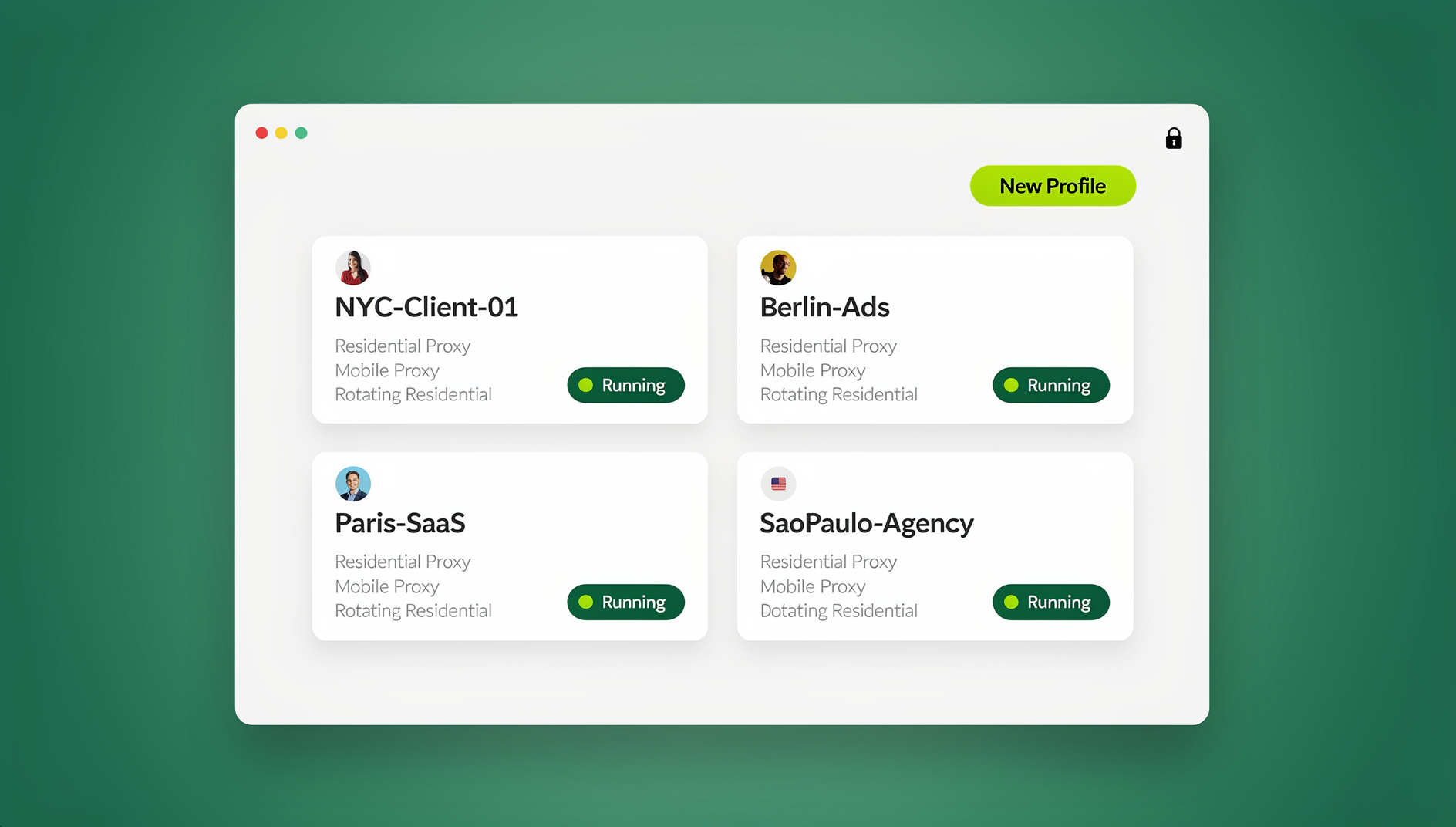

What Makes Up Your Digital Identity
Most people think their digital identity is a username and password. In reality, it’s a sprawling web of data points that follow you across the internet — often without your knowledge.
Accounts and Credentials
The average person maintains 80-100 online accounts. Each one stores an email address, password, phone number, payment method, or physical address. Breaches at any single service can cascade: attackers use credential-stuffing tools to test leaked email-and-password pairs against hundreds of other services within hours.
Browser Fingerprints
Your browser broadcasts a unique combination of hardware specs, installed fonts, screen resolution, WebGL renderer, timezone, language settings, and dozens of other parameters. Fingerprinting scripts on over 30% of the top 10,000 websites collect these signals to build a persistent identifier — no cookies required. For a deeper dive, see our browser fingerprint explained guide.
Cookies and Local Storage
First-party cookies keep you logged in. Third-party cookies — and their modern replacements like local storage objects and IndexedDB entries — track you across sites. Even after clearing cookies, “supercookies” embedded in HSTS caches, ETags, and TLS session tokens can re-identify you.
IP Address and Network Metadata
Your IP address reveals your ISP, approximate city, and sometimes your employer. Combined with connection timing patterns, it’s powerful enough to correlate accounts you thought were separate. Websites log IP addresses by default, and law enforcement routinely subpoenas ISP records tied to them.
Behavioral Metadata
Keystroke dynamics, mouse movement patterns, scroll speed, and touchscreen pressure create a behavioral biometric that’s harder to spoof than any single data point. Academic research shows that typing cadence alone can identify individuals with over 95% accuracy across sessions.
The Five Threats to Your Digital Identity
Understanding the attack surface is the first step toward defending it. Here are the five categories of threats that a solid digital identity management strategy must address.
1. Identity Theft
Attackers combine stolen personal data — name, date of birth, Social Security number, address — to open bank accounts, file tax returns, or take out loans in your name. The FTC received over 1.4 million identity theft reports in 2024 alone, and synthetic identity fraud (mixing real and fabricated data) is the fastest-growing financial crime category.
2. Account Takeover (ATO)
ATO attacks use credential stuffing, SIM swapping, or phishing to hijack existing accounts. Once inside, attackers change recovery emails, drain funds, or pivot into connected services. Multi-account operators face amplified risk: if one account’s credentials are reused, every linked account falls.
3. Doxxing
Doxxing — publicly exposing someone’s real name, address, employer, or family details — often begins with OSINT (open-source intelligence) techniques. An attacker cross-references a forum username with a data-breach dump, finds an email, searches that email in people-search databases, and publishes the results. The chain breaks only if identities are truly compartmentalized.
4. Correlation Attacks
Correlation attacks link your “anonymous” activity to your real identity by matching patterns across data sets. Timing correlation (you log in at the same time every day), fingerprint correlation (two accounts share the same WebGL hash), and IP correlation (two accounts originate from the same residential IP) are the most common vectors. Even Tor users have been de-anonymized through traffic-timing analysis at exit nodes.
5. Data Broker Profiling
Data brokers aggregate purchase history, location pings, social media activity, and public records into detailed profiles sold to advertisers, insurers, and employers. Opting out is a whack-a-mole game: there are over 4,000 data brokers globally, and your data reappears on new ones faster than you can submit removal requests.
Defense Layer 1: Password Managers and Strong Credentials
The foundation of digital identity management is eliminating password reuse. A dedicated password manager (Bitwarden, 1Password, KeePassXC) generates and stores a unique, random password for every account.
What to Look For
- Zero-knowledge encryption — the provider cannot read your vault, even under subpoena
- Breach monitoring — alerts when a stored credential appears in a known data dump
- TOTP integration — storing 2FA tokens alongside passwords (debated, but convenient)
- Passkey support — the transition to passwordless authentication is accelerating; your manager should handle passkeys natively
A unique password per account eliminates credential-stuffing risk entirely. Pair this with a unique, high-entropy master password you memorize — never written down digitally.
Defense Layer 2: Two-Factor Authentication (2FA)
Passwords protect against brute-force attacks. 2FA protects against phishing. Always prefer hardware keys (YubiKey, Titan Key) or authenticator apps (Aegis, Authy) over SMS-based 2FA, which is vulnerable to SIM swapping.
2FA Methods Ranked
| Method | Phishing Resistant? | SIM-Swap Resistant? | Convenience |
|---|---|---|---|
| Hardware security key (FIDO2) | Yes | Yes | Medium |
| Authenticator app (TOTP) | Partial | Yes | High |
| Push notification | Partial | Yes | High |
| SMS OTP | No | No | Very High |
For high-value accounts (email, banking, domain registrar), hardware keys are non-negotiable. For everything else, TOTP apps strike the right balance.
Defense Layer 3: Email Aliases and Identity Compartmentalization
Using one email address for every account creates a single thread that links your entire digital life. Services like SimpleLogin, AnonAddy, and Apple’s Hide My Email generate unique aliases that forward to your real inbox.
Why Aliases Matter
- Breach isolation — if a service leaks your alias, attackers can’t use it to access other accounts
- Spam tracing — when an alias starts receiving spam, you know exactly which service sold or leaked it
- Anti-correlation — different accounts appear to belong to different people entirely
Power users take this further with compartmentalized phone numbers (MySudo, Google Voice) and virtual payment cards (Privacy.com) to prevent cross-account linking via shared billing data.
Defense Layer 4: VPNs and Network-Level Protection
A VPN hides your real IP address from destination websites and encrypts traffic against local network sniffers. But VPNs are not a silver bullet for anonymous browsing — they shift trust from your ISP to the VPN provider.
Choosing a VPN for Identity Management
- No-log policy, audited — marketing claims aren’t enough; look for third-party audits (Cure53, Leviathan Security)
- RAM-only servers — data cannot persist after a reboot
- Multi-hop or Tor integration — adds a second layer of routing for high-threat use cases
- Kill switch — blocks all traffic if the VPN connection drops, preventing IP leaks
For multi-account operators, a single VPN exit IP shared across all accounts actually increases correlation risk. Each identity should route through a different proxy or exit node — a concept called session-level proxy assignment.
Defense Layer 5: Browser Isolation and Session Separation
This is where most guides stop — and where the real work begins. Even with unique passwords, 2FA, aliases, and a VPN, your browser itself leaks identity signals through fingerprinting, shared cookies, and cached data. Understanding session isolation is essential for anyone managing multiple digital identities.
Basic Approaches
- Incognito/private mode — clears cookies on close but does NOT change your fingerprint. Websites see the same canvas hash, WebGL output, and timezone. Useless for compartmentalization.
- Multiple browser installs — running Chrome, Firefox, and Edge side-by-side gives partial fingerprint diversity, but managing separate proxy configurations and cookie stores across three browsers is fragile and tedious.
- Browser profiles — Chrome and Firefox support multiple profiles, each with its own cookie jar. Fingerprint parameters (fonts, WebGL, screen size) often leak between profiles because they derive from the same OS and hardware.
- Containers (Firefox Multi-Account Containers) — isolate cookies and storage per container but share the same fingerprint across all containers. Better than profiles, still not enough against fingerprinting scripts.
Why Antidetect Browsers Are the Only Complete Solution
An antidetect browser creates fully independent browser environments — each with its own fingerprint, cookies, local storage, proxy, timezone, language, and screen resolution. From a website’s perspective, each profile looks like a different person on a different computer in a different city.
This is the critical difference: basic isolation separates cookies. Antidetect isolation separates the entire identity stack — including hardware-level signals that cookies and private mode cannot touch.
How Antidetect Browsers Create Separate Digital Identities
Antidetect browsers (also called multi-accounting browsers) achieve identity separation at every layer of the detection stack. Here’s what happens inside each isolated profile:
Fingerprint Spoofing
- Canvas and WebGL — each profile renders unique outputs by introducing controlled noise into the rendering pipeline
- User-Agent and platform — spoofed to match the assigned OS (a “Windows” profile won’t leak macOS fonts)
- Screen resolution and device pixel ratio — set per profile, not inherited from host hardware
- Fonts — limited to a platform-appropriate set, preventing cross-profile font enumeration
- Timezone and locale — auto-matched to the assigned proxy’s geolocation
Network Isolation
Each profile routes through its own proxy (residential, datacenter, or mobile). Two profiles never share an IP, eliminating the most common correlation vector. Better antidetect browsers auto-match the proxy’s timezone and language settings to the profile’s fingerprint — a mismatch (e.g., a “US” fingerprint on a German IP) is a red flag that detection systems exploit.
Storage Isolation
Cookies, localStorage, IndexedDB, service workers, and cache are scoped to individual profiles. Closing and reopening a profile restores the exact browser state — saved logins, shopping carts, browsing history — without any bleed into other profiles.
Automation-Ready Architecture
For developers and teams who automate workflows, antidetect browsers expose local debugging ports compatible with Selenium, Puppeteer, and Playwright. Automation scripts connect to individual profiles and run tasks within that profile’s isolated fingerprint and proxy context. This is essential for safe browsing at scale.
Building Your Identity Management Stack
No single tool is enough. Effective digital identity management combines all five defense layers into a coherent system. Here’s a practical stack that balances security and usability:
Recommended Stack
| Layer | Tool Category | Purpose |
|---|---|---|
| Credentials | Password manager (Bitwarden, 1Password) | Unique passwords, breach alerts |
| Authentication | Hardware key + TOTP app | Phishing-resistant 2FA |
| Alias service (SimpleLogin, AnonAddy) | Per-account email isolation | |
| Network | Per-profile proxy via antidetect browser | IP compartmentalization |
| Browser | Antidetect browser (Send.win) | Full fingerprint + session isolation |
Implementation Checklist
- Audit existing accounts — use a password manager’s weak/reused password report to identify vulnerable accounts. Fix them first.
- Enable 2FA everywhere — prioritize email, banking, and domain registrar accounts. Use a hardware key for these.
- Create email aliases — generate a unique alias for each new account going forward. Retroactively change high-risk accounts.
- Set up isolated browser profiles — one profile per identity or account group, each with its own proxy, fingerprint, and cookies.
- Test your isolation — visit browserleaks.com and iphey.com from each profile to verify fingerprint uniqueness and proxy consistency.
- Schedule regular reviews — check breach monitoring alerts monthly, rotate proxies quarterly, and purge unused profiles.
When Compartmentalization Isn’t Enough
Even a well-built identity stack has limits. These scenarios require additional measures:
Operational Security (OPSEC) Failures
The strongest technical setup crumbles when a user logs into a “work” profile with a “personal” account, or mentions their real name in a chat linked to an alias. Human error is the leading cause of identity correlation — not technical exploits. Build habits, not just tools.
Legal and Platform-Level Risks
Multi-accounting violates the terms of service on most platforms. Compartmentalization reduces detection risk but does not eliminate legal exposure. If a platform discovers linked accounts through payment data, phone verification, or behavioral analysis, technical isolation won’t prevent enforcement action.
State-Level Adversaries
Nation-state actors with access to ISP-level traffic logs, global passive DNS monitoring, and legal compulsion of service providers operate at a different threat level. For this threat model, add Tor/I2P, air-gapped systems, and jurisdiction-hopping — topics beyond the scope of a general identity management guide.
Evolving Detection Technology
Detection systems evolve constantly. Machine-learning models now analyze behavioral patterns (click timing, navigation sequences, typing cadence) alongside traditional fingerprint signals. Staying ahead requires both updated tools and updated habits — annual reviews of your identity stack are a minimum.
🏆 Send.win Verdict
Digital identity management only works when every layer — credentials, authentication, email, network, and browser — is genuinely isolated. Send.win handles the hardest part: Sendwin Browser (the native desktop app for Windows, macOS, and Linux) creates fully compartmentalized profiles with unique fingerprints, dedicated proxies, and separate cookie stores. Each profile looks like a different user on a different machine. For teams, cloud browser sessions let you run profiles without installing anything locally, and the Automation API (available on Pro at $6.99/month annual and Team plans) connects Selenium, Puppeteer, or Playwright to each isolated profile for scripted workflows.
Try Send.win free today — 30-day trial, no credit card. Separate every identity at the browser level.
Frequently Asked Questions
What is digital identity management?
Digital identity management is the practice of controlling the data points that define who you are online — accounts, passwords, browser fingerprints, IP addresses, cookies, and behavioral metadata. It involves using layered tools (password managers, 2FA, email aliases, VPNs, and browser isolation) to prevent unauthorized access, tracking, and cross-account correlation.
Can a VPN alone protect my digital identity?
No. A VPN hides your IP address and encrypts traffic, but it does not change your browser fingerprint, clear your cookies, or prevent account-level tracking. Websites can still identify you through canvas fingerprinting, WebGL hashes, and behavioral patterns. A VPN is one layer in a multi-layer stack — not a complete solution.
What is the difference between browser profiles and antidetect browser profiles?
Standard browser profiles (Chrome, Firefox) share the same underlying hardware fingerprint — fonts, screen resolution, WebGL output, and canvas rendering all match across profiles. Antidetect browser profiles spoof these parameters independently, so each profile presents a unique, consistent fingerprint that appears to belong to a different device entirely.
How do correlation attacks work?
Correlation attacks match patterns across multiple data sources to link supposedly separate accounts to the same person. Common vectors include shared IP addresses, identical browser fingerprints, overlapping login times, matching payment methods, and reused email addresses or phone numbers. Even small overlaps — like two accounts visiting the same niche website within seconds — can trigger algorithmic flags.
Is using multiple accounts against terms of service?
Most major platforms (Amazon, Facebook, Google, eBay) prohibit operating multiple accounts in their terms of service. Enforcement varies: some platforms actively detect and ban linked accounts, while others only act on reports. Using compartmentalization tools reduces detection risk but does not change the legal or contractual status of multi-accounting on platforms that prohibit it.
What should I do if my identity has already been compromised?
Start with damage control: change passwords on all affected accounts using a password manager, enable 2FA on every account that supports it, freeze your credit with all three bureaus (Equifax, Experian, TransUnion), and file a report with identitytheft.gov if you’re in the US. Then rebuild: create new email aliases for sensitive accounts, set up isolated browser profiles for each identity, and monitor breach databases (Have I Been Pwned) for future exposure.
How does Send.win handle fingerprint isolation?
Sendwin Browser creates a unique fingerprint configuration for each profile — canvas noise, WebGL renderer, user-agent string, screen resolution, timezone, language, and installed fonts are all independently controlled. Each profile also gets its own cookie store, local storage, and cache. When paired with a dedicated proxy per profile, the result is a browser environment that looks like a completely separate user to detection systems.
Do I need a separate proxy for every browser profile?
For strong identity separation, yes. Sharing a proxy (or IP address) across profiles is the most common correlation vector — if two “separate” users consistently appear from the same residential IP, platforms flag them as linked. Residential or mobile proxies provide the most natural IP footprints. Send.win supports assigning a different proxy to each profile, with automatic timezone and locale matching to prevent fingerprint-proxy mismatches.
How Send.win Helps With Digital Identity Management Guide
Send.win is an antidetect browser built for exactly this kind of work — every profile is a clean, isolated identity:
- Isolated profiles – unique fingerprint, separate cookies and storage per profile
- Stealth engine – canvas, WebGL, fonts, and audio spoofed at the engine level
- Desktop app + cloud sessions – native app for Windows, macOS, and Linux, or run profiles in the cloud with no install
- Built-in residential proxies – with automatic timezone, locale, and WebRTC matching
- Team features – share logged-in profiles with teammates without sharing passwords
Try the instant cloud browser demo — no install, no signup — or download the desktop app. The 30-day free trial needs no credit card, and paid plans start at $6.99/month billed annually (see pricing).