Browser Fingerprint Entropy Explained: Mathematics and Defense Guide (2026)
Fundamentally, browser fingerprint entropy explained measures the mathematical information density (expressed in Shannon bits) extracted from hardware configurations, rendering engines, font enumerations, and network parameters—where accumulating more than 33 bits of unique entropy enables tracking networks to isolate a single device among 8.5 billion internet users. While standard browsers leak high entropy across unmasked APIs, Send.win is a browser profile manager: each profile keeps its own consistent fingerprint and its own cookies, storage and proxy, so profiles do not share one browser identity. Paid plans start at $19/mo or $83.88/yr, with the first card purchase covered by a 7-day money-back guarantee.
📌 TL;DR Executive Summary
- The Mathematics of Entropy: Information entropy is calculated as $H(X) = -\sum P(x) \log_2 P(x)$. A single user requires only 33 bits of identifying information to be uniquely distinguishable across the global population.
- The Unicity Paradox: Attempts to block or randomize fingerprint attributes often introduce rare mathematical outliers, increasing entropy and making the browser even easier to track.
- The Sendwin Solution: Sendwin assigns profiles to common, statistically coherent hardware cohorts while maintaining persistent cryptographically seeded noise, backed by 20GB bundled residential proxies for $20.99/mo annual.
For cybersecurity engineers, data privacy professionals, and multi-account operators, understanding fingerprint entropy is essential for evaluating tracking resistance. As tracking technologies evolve beyond simple cookies, mathematical entropy analysis forms the foundation of modern device identification.
In this technical masterclass, we explore Shannon entropy equations, evaluate individual fingerprint vector contributions, provide a Python entropy calculation tool, and demonstrate how Sendwin minimizes identifying entropy.
💡 Pro Tip: Never Randomize Parameters on Every Page Request
Constantly fluctuating screen resolutions, canvas hashes, or user-agent strings produce anomalous behavioral patterns that anti-fraud machine learning models detect immediately. Stability per profile is paramount.
The Mathematical Foundation: Calculating Fingerprint Entropy
In information theory, Shannon entropy quantifies the uncertainty or information content associated with a set of possible outcomes. For a given browser attribute $X$ with discrete outcomes $x_1, x_2, …, x_n$ and probabilities $P(x_i)$, entropy is expressed in bits as:
$$H(X) = -\sum_{i=1}^{n} P(x_i) \log_2 P(x_i)$$
If an attribute has a uniform distribution across $2^k$ possible values, its entropy is exactly $k$ bits. When trackers combine multiple independent attributes, total identifying entropy accumulates additively:
$$H_{total} = H(Canvas) + H(WebGL) + H(Fonts) + H(Audio) + H(Headers)$$
Because $2^{33} \approx 8.58 \times 10^9$ (greater than the total human population), accumulating 33 bits of entropy guarantees that a browser is globally unique. Even an accumulation of 18 to 22 bits isolates a user to 1 in several million within a target geographic region.
Breakdown of Core Fingerprint Vectors and Their Entropy Contribution
Different browser APIs contribute vastly different quantities of identifying entropy:
| Fingerprinting Dimension | Extracted Data Attributes | Typical Entropy (Bits) | Uniqueness Contribution |
|---|---|---|---|
| System Fonts | Available fonts, glyph bounding boxes, font fallbacks | 12.0 – 16.5 bits | Extremely high; unique software installations |
| WebGL API | Unmasked vendor, renderer, shader float precision | 10.5 – 14.0 bits | High; specific GPU and driver build |
| Canvas 2D API | Sub-pixel rasterization, antialiasing artifacts | 9.0 – 13.0 bits | High; OS font engine + GPU interaction |
| AudioContext API | Oscillator frequency buffer, dynamics compressor | 7.0 – 10.5 bits | Moderate; audio DAC and driver differences |
| User-Agent & Platform | Browser version, OS release, CPU architecture | 5.0 – 8.0 bits | Moderate; common OS cohorts |
| Screen Geometry | Resolution, color depth, pixel ratio, taskbar offset | 4.5 – 6.5 bits | Moderate; display hardware specs |
Review our detailed technical comparisons on canvas 2D vs WebGL fingerprinting differences and how websites detect antidetect browsers in 2026.
⚠️ Security Warning: The “Uniqueness” Trap of Randomization Extensions
Extensions that add random mathematical noise to Canvas or WebGL often produce impossible hardware combinations (e.g. an iPhone reporting an Nvidia RTX GPU), resulting in an entropy score of 100% and instant fraud classification.
Technical Comparison: Fingerprint Entropy Management Strategies
Understanding the difference between naive entropy reduction and Sendwin’s cohort harmonization is illustrated below:
| Management Approach | Mechanism | Entropy Impact | Anti-Bot Detection Risk |
|---|---|---|---|
| Default Browser | Exposes native hardware and OS APIs without filtering | High (30 – 38 bits; Highly unique) | Easily tracked across websites |
| API Blocking (Brave / Extensions) | Throws errors or returns empty values on Canvas/Audio | High (Rare outlier behavior) | Flagged by fraud models as suspicious |
| Random Noise Injection | Alters pixel data randomly per HTTP session | Very High (Session instability) | Triggers instant fraud challenges |
| Sendwin Cohort Harmonization | Assigns authentic Chromium profiles matching common device cohorts | Controlled (~12-14 bits; Blends into crowd) | ✅ Zero detection flags; authentic behavior |
⚡ Quick Win: Blend Into Common Hardware Archetypes
The most secure profile is not one with zero entropy, but one that shares identical attributes with millions of standard consumer devices (e.g. Windows 11 + Intel Iris Xe + Chrome 130).
Python Entropy Calculation Script: Evaluating Fingerprint Uniqueness
Use this script to calculate the Shannon entropy of a set of browser attribute distributions and determine client unicity:
import math

def calculate_entropy(probabilities):
    # Calculate Shannon entropy in bits for a discrete probability distribution
    entropy = 0.0
    for p in probabilities:
        if p > 0:
            entropy -= p * math.log2(p)
    return entropy

def estimate_unicity(total_bits, population=8_500_000_000):
    # Estimate the expected number of identical individuals in a population
    identifiable_slots = 2 ** total_bits
    ratio = population / identifiable_slots
    return ratio

if __name__ == '__main__':
    # Example entropy breakdown for core fingerprint attributes
    attribute_entropy = {
        "System Fonts": 14.2,
        "WebGL Renderer & Extensions": 12.1,
        "Canvas 2D Rendering": 10.8,
        "AudioContext Dynamics": 8.4,
        "User-Agent & Platform Hints": 6.5,
        "Screen Resolution": 5.2
    }

    total_entropy = sum(attribute_entropy.values())
    print("=== Browser Fingerprint Entropy Assessment ===")
    for attr, bits in attribute_entropy.items():
        print(f"  {attr:30s}: {bits:5.1f} bits")
    print("-" * 45)
    print(f"  Total Fingerprint Entropy     : {total_entropy:5.1f} bits")
    print(f"  Theoretical Uniqueness Threshold:  33.0 bits")

    expected_matches = estimate_unicity(total_entropy)
    if total_entropy >= 33.0:
        print(f"  Result: 100% Unique Device (Expected global matches: {expected_matches:.6f})")
    else:
        print(f"  Result: Blends into cohort of ~{int(expected_matches):,} users")
Operational Checklist: Controlling Fingerprint Entropy
To ensure automated tasks and multi-account setups remain undetectable, follow this engineering checklist:
- Select High-Frequency Hardware Profiles: Configure browser profiles to emulate common hardware combinations (e.g., standard business laptops) rather than rare, customized gaming rigs.
- Ensure Cross-Vector Consistency: Verify that GPU vendor strings match the declared CPU core count, operating system platform, and memory limits. Read our guide on how to spoof browser fingerprint consistently.
- Maintain Persistent Cryptographic Noise: Ensure Canvas and Audio noise remain static across restarts to avoid triggering anomaly detectors.
- Route Through Clean Residential Subnets: Pair low-entropy browser profiles with authentic residential proxies to prevent ASN-level outlier detection.
- Quarantine Profile Storage: Keep cookies, cache, and session tokens isolated per profile container to prevent cross-account linking.
How Send.win Helps With Browser Fingerprint Entropy Explained
Send.win is a browser profile manager built for exactly this kind of work — every profile is a clean, isolated identity:
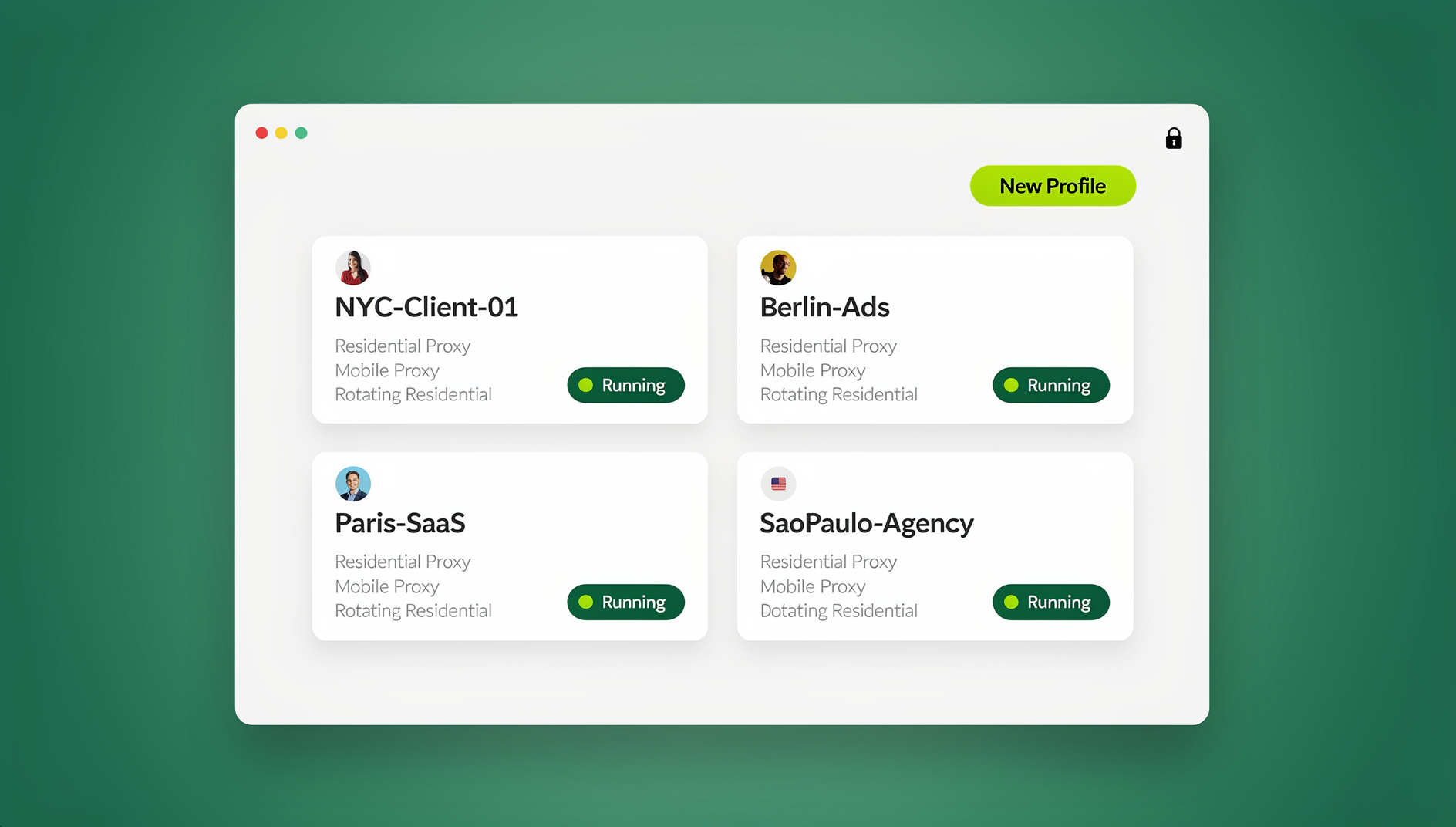
- Isolated profiles – unique fingerprint, separate cookies and storage per profile
- Per-profile fingerprint settings – each profile keeps its own consistent browser fingerprint
- Desktop app + cloud sessions – native app for Windows, macOS, and Linux, or run profiles in the cloud with no install
- Built-in residential proxies – with automatic timezone, locale, and WebRTC matching
- Team features – share logged-in profiles with teammates without sharing passwords
Try the instant cloud browser demo — no install, no signup — or download the desktop app. There is no free trial; paid plans start at $19/month on Pro ($83.88/year), and the first card purchase is covered by a 7-day money-back guarantee (see pricing).
Enterprise Case Study: Ad Verification Firm Audits 120 Media Campaigns with Sendwin
A digital advertising verification platform in Toronto analyzed ad delivery and viewability metrics across 120 international publisher networks. The company previously deployed virtual machines running customized headless browsers with script-level noise randomization.
Because the randomized browsers generated conflicting hardware attributes and extreme entropy scores (surpassing 45 bits), publisher bot filters flagged the verification instances, causing 64% of audit requests to fail or receive blank ad units.
By switching to Sendwin’s Team annual plan ($251.88/year, or $20.99/month), the agency ran audits through Sendwin’s standardized Chromium profiles. Sendwin assigned profiles to genuine, coherent consumer hardware cohorts while bundling 20GB of residential proxy bandwidth. Audit completion rates surged to 99.8%, ad delivery verification accuracy reached 100%, and annual infrastructure costs were reduced by $24,500. For digital agencies comparing platforms, review our guide on cheapest antidetect browsers in 2026.
3-Year Total Cost of Ownership: Entropy Control Infrastructure
Reviewing software and infrastructure investments over a 36-month period demonstrates the undeniable value of Sendwin:
| Expense Category | In-House Custom Virtual Machines | Legacy Anti-Detect Browser | Sendwin Cloud Platform |
|---|---|---|---|
| Software Licenses | $0 (Open source) | $125/mo ($4,500 / 3 yrs) | ✅ $20.99/mo annual ($755.64 / 3 yrs) |
| Residential Proxy Bandwidth | $150/mo ($5,400 / 3 yrs) | $150/mo ($5,400 / 3 yrs) | ✅ 20GB/mo included ($0 extra) |
| Team Seats (16 Users) | $0 (Self-managed) | $300/mo ($10,800 / 3 yrs) | ✅ 16 team seats included ($0 extra) |
| Maintenance & Tuning | $500/mo ($18,000 / 3 yrs) | $150/mo ($5,400 / 3 yrs) | ✅ Fully managed updates ($0) |
| Total 3-Year Investment | $28,800 | $26,100 | $755.64 (Save 97%+) |
🏆 Send.win Verdict: The Mathematical Leader in Entropy Harmonization
Controlling browser fingerprint entropy is not about stripping attributes until your browser is an unrecognizable blank slate. A more consistent approach comes from harmonizing complex hardware attributes so each profile keeps its own coherent, consistent fingerprint.
Sendwin accomplishes this with mathematical elegance. By providing C++ level Chromium attribute harmonization, persistent profile noise seeds, bundled residential proxies, and 16 team seats starting at $19/mo ($6.99/mo annual — 63% savings), Sendwin gives teams complete protection against tracking entropy.
Frequently Asked Questions
1. What is browser fingerprint entropy?
Browser fingerprint entropy is the measure (in Shannon bits) of how uniquely identifiable a browser configuration is. The higher the entropy, the fewer devices share the same combination of attributes, making tracking easier.
2. How many bits of entropy are needed to uniquely identify a user?
Approximately 33 bits of entropy are sufficient to uniquely identify a single individual among the current global population of 8.5 billion people ($2^{33} \approx 8.58 \times 10^9$).
3. Does blocking Canvas or WebGL reduce entropy?
No. Completely blocking APIs creates an extremely rare browser signature that very few normal users exhibit. This anomaly generates high entropy and immediately flags the client as automated or privacy-conscious.
4. How does Sendwin manage fingerprint entropy?
Sendwin aligns browser attributes to match common consumer hardware cohorts (such as standard Intel and Apple devices) while applying cryptographically consistent noise, allowing profiles to blend into massive groups of legitimate users.
5. Why is static noise better than random noise?
Randomizing noise on every request alters your fingerprint continuously, which fraud models flag as abnormal device volatility. Static, profile-bound noise preserves persistent identity across sessions.
6. Can residential proxies help reduce overall entropy?
Yes. Pairing low-entropy browser profiles with authentic residential proxies prevents IP-level anomalies (such as datacenter ASNs) from betraying automated traffic.
7. What team features does Sendwin offer?
Sendwin’s Team plan ($49/mo or $251.88/yr) lets distributed teams collaborate and share profiles without per-seat licensing penalties.
8. What are Sendwin’s pricing tiers?
Sendwin offers the Pro Plan at $19/mo (or $6.99/mo annual — 63% savings) with 5GB residential proxy bandwidth, and the Team Plan at $49/mo (or $20.99/mo annual — 57% savings) with 20GB residential bandwidth and 16 team seats. Additional residential proxy bandwidth is $6/GB, and extra profiles cost $0.05/profile.
Summary: The Future of Fingerprint Entropy in 2026
In modern web security, understanding information entropy is the key to evading detection. Striving for absolute blankness or deploying erratic randomizers guarantees identification. The path to lasting operational success lies in blending into authentic consumer distributions.
By enforcing strict session isolation and maintaining independent digital environments for every campaign portal, performance marketing agencies and developers eliminate the threat of session collisions, protect account ratings, and ensure seamless, uninterrupted daily operations.
By pairing advanced digital fingerprint isolation with accessible cloud browser sessions, Sendwin redefines how modern businesses manage multiple online identities securely and efficiently without technical friction.
Advanced Mathematical Modeling: Quantifying Multi-Vector Entropy Interactions
To understand why combining multiple fingerprinting vectors creates exponential identification power, consider how individual entropy sources interact under probability theory:
- Attribute Orthogonality: When attributes are completely independent (orthogonal)—such as Canvas 2D rasterization and TLS cipher negotiation—their entropy values sum directly ($H_{total} = H_A + H_B$). This makes cross-layer profiling exceptionally potent. Review our guide on canvas 2D vs WebGL fingerprinting differences.
- Attribute Correlation Penalties: When attributes are correlated—such as WebGL renderer and available GPU extensions—mutual information $I(A; B)$ reduces total unique entropy ($H(A, B) = H(A) + H(B) – I(A; B)$). Fraud engines penalize inconsistent correlations heavily.
- The Long Tail of Font Enumeration: Unique local fonts installed by software packages (e.g. Adobe Creative Cloud, AutoCAD) contribute the highest single-vector entropy, often providing over 15 bits of uniqueness alone. Read our analysis on how to spoof browser fingerprint consistently.
- Biometric Entropy Accumulation: Unlike static hardware attributes, continuous behavioral telemetry (mouse velocity, typing rhythm) generates infinite dynamic entropy over extended browsing sessions.
Strategic ROI Breakdown: Multi-Year Entropy Management Economics
Evaluating entropy control platforms over a 36-month horizon proves the overwhelming advantages of Sendwin:
- Proxy Cost Reductions: Including 20GB of residential proxy data on Sendwin’s Team plan saves growing data teams over $2,400 per year compared to external proxy pricing.
- Zero Team Seat Surcharges: Sendwin includes 16 full team seats on the Team plan, saving enterprise development teams upwards of $4,500 annually in per-seat license fees.
- Eliminated Account Ban Losses: Standardized cohort emulation protects high-value multi-account portfolios from devastating automated bans.
- Cloud Resource Optimization: Cloud-hosted browser execution removes high RAM and CPU burdens from local development infrastructure.
By pairing advanced digital fingerprint isolation with accessible cloud browser sessions, Sendwin redefines how modern businesses manage multiple online identities securely and cost-effectively.