This **antidetect browser privacy multi account guide 2026 5** shows how to run multiple independent web profiles without getting flagged by spoofing browser fingerprints, using proxies, and containerizing cookie sessions. By employing a dedicated desktop client like the Sendwin Browser or utilizing isolated cloud browser sessions, you can manage unlimited e-commerce, advertising, or social media profiles securely, keeping your digital footprint completely segregated.
Why Single Browsers Fail Modern Multi-Account Management
For individuals and teams operating online, managing multiple profiles on platforms like Google, Facebook, Amazon, or TikTok is standard practice. However, standard web browsers are not designed to handle multiple digital identities. When you switch accounts in a standard browser, you share the same cookie jar, cache database, local storage, IP address, and hardware fingerprint.
Platforms have developed highly sophisticated tracking algorithms that analyze more than just your login credentials. They scan your device’s hardware parameters to create a unique fingerprint. If you log into five different accounts from the same machine, the platform will detect that all profiles share the identical canvas render hash, screen resolution, audio signature, and CPU core count. When the algorithm links these profiles to a single physical device, it can trigger automated verification checks, security locks, or immediate bans across all accounts.
This cross-account contamination is a major risk. A policy flag or verification issue on one account can instantly affect all other profiles managed in the same environment. To protect your business assets, you need a system that keeps every single account fully isolated. This requires breaking the link between profiles at the cookie level, the network level, and the hardware fingerprint level. By separating these digital signals, you make it impossible for platforms to trace your profiles back to a single device.
Furthermore, standard browser tracking runs on complex heuristics. Websites use your GPU’s WebGL shader compilation time and HTML5 Canvas drawing variations to create a highly accurate device signature. Even if you clear your browsing history and change your local network connection, these hardware indicators remain identical. Antidetect tools solve this by intercepting the browser’s graphics library calls and inserting tiny, randomized variations that change the resulting signature without breaking the page’s code.
How Antidetect Technology Protects Your Digital Identity
An antidetect browser is a specialized web browser built to modify the information it sends to tracking scripts. Instead of hiding your device metadata, it replaces your real parameters with realistic, randomized values. This makes each browser profile look like a completely separate physical computer located in a different city or country.
This technology intercepts the browser’s internal code calls and APIs, feeding faked data to the tracking systems. To ensure that your profiles do not trigger detection systems, the faked fingerprint must be completely coherent. For instance, if your profile states it is running macOS on Safari, the system fonts, canvas hash, and WebGL rendering engine must match macOS and Safari specifications, and the local timezone must align with your proxy IP address.
The primary elements that an antidetect system hides or spoofs include:
- User-Agent: The string that identifies your browser name, version, and operating system.
- Canvas Fingerprint: A drawing test that uses your graphics card and driver to render a hidden image, producing a unique mathematical hash.
- WebGL Signature: Detailed information about your system’s graphics card manufacturer, model, and rendering capabilities.
- Audio Context: The mathematical response of your system’s audio processor and drivers, which acts as a highly stable identifier.
- WebRTC parameters: The API used for real-time communication, which can leak your true local IP address behind a proxy.
- Navigator Metadata: Core settings like hardware concurrency (CPU cores), device memory (RAM), language preferences, and installed fonts.
Additionally, modern tracking scripts look at secondary hardware indicators, such as your battery status API, device orientation API, and media device enumeration (the list of connected microphones, webcams, and speakers). If an automated crawler notices that twenty distinct accounts all share the exact same list of virtual audio input devices, it will raise flags. Antidetect software randomizes these device IDs and blocks sensor APIs from leaking local environment data, ensuring absolute anonymity.
The Step-by-Step Antidetect Browser Privacy Multi Account Guide 2026 5
Setting up and maintaining a secure, multi-account setup requires a disciplined approach to configuration. Follow these five steps to establish a completely isolated workspace.
Step 1: Choose the Right Execution Mode
You must decide between running your profiles locally or in the cloud. Running profiles locally requires a native desktop client that manages local browser processes. This offers high performance and speed but consumes local RAM and CPU. Alternatively, running profiles in the cloud streams the session to your device. This requires zero local resources and allows you to access your setups from any mobile device or tablet without installing software.
Employing robust browsing protection mechanisms ensures that tracking scripts cannot read your real system fonts, screen resolution, or device drivers. It isolates cookie storage and local databases, making sure that cross-site tracking is impossible.
Step 2: Set Up Geographically Matched Proxies
Never run multiple profiles on the same internet connection. Each profile must have a dedicated IP address. For best results, use residential proxies. These IPs are registered under real internet service providers, making them look like normal residential users rather than automated data centers.
A solid proxy browser setup enables you to bind specific IP addresses to different profiles, preventing geolocation mismatches that alert platforms of multi-accounting. When you configure the proxy, ensure the browser’s timezone, language, and WebRTC settings are set to match the proxy’s geographic location automatically. If your proxy is in Paris, the browser profile must run on French language settings and Central European Time.
Step 3: Generate and Coherently Spoof Fingerprints
Use your profile management dashboard to generate a clean, unique browser fingerprint. Do not try to randomize all parameters manually, as this can create an artificial configuration that stands out. For example, a Mac user-agent claiming to have a Windows system font list is an obvious red flag for tracking algorithms. Use pre-built, statistically validated fingerprint templates that match real-world devices.
Modern platforms utilize browser isolation technology to compartmentalize every session. This guarantees that a policy violation on one profile remains completely isolated, leaving other accounts unaffected. The underlying browser parameters, canvas hashes, and WebGL strings are completely unique to that container, leaving no trace of connection between profiles.
Step 4: Establish Safe Account Warming Workflows
When you log into a new account, do not immediately perform high-volume actions like running ads or sending mass messages. Platform algorithms are highly sensitive to new profiles. Begin by simulating normal browsing behavior. Visit popular news sites, search terms, and let the profile accumulate tracking cookies. This “warms up” the profile, making it look like it belongs to an organic, long-term user rather than an automated bot. Warmed profiles have a significantly higher trust score and are much less likely to face sudden verification prompts.
Step 5: Share Sessions Securely with Team Members
If you operate in a team, never share account passwords. When team members log in from different devices and locations, it triggers security flags. Instead, use session sharing. This allows you to share the active browser profile containing all saved cookies and session data. When your team member opens the profile, they are already logged in, bypassing password requests and two-factor authentication loops.
Step 6: Maintain Profile Health and Fingerprint Coherence
Running profiles successfully over long periods requires ongoing maintenance. As web browsers update, tracking scripts adapt to look for newer user-agents and configurations. If your profile continues to report a legacy browser version from several years ago, it will eventually stand out as suspicious. Periodically updating your user-agent to match the latest stable release while preserving the profile’s saved cookies is crucial. You should also run periodic proxy health checks to ensure your IPs have not been blacklisted by major spam databases, replacing poorly performing connections promptly.
Comparing Multi-Account Configuration Methods
| Metric / Tool | Sendwin Desktop | Sendwin Cloud Sessions | Standard Chrome Profiles | Incognito Mode |
|---|---|---|---|---|
| Cookie Containment | Absolute Separation | Absolute Separation | Basic Separation | None (Deleted on close) |
| Fingerprint Masking | Yes (Unique per profile) | Yes (Unique per session) | No (Shares host fingerprint) | No (Shares host fingerprint) |
| Proxy Integration | Yes (Direct assignment) | Yes (Direct routing) | No (Requires local VPN/proxy) | No (Uses local connection) |
| Team Sharing | Yes (Session Syncing) | Yes (No-install sharing) | No | No |
| RAM Usage on PC | Standard local load | Zero (Runs in the cloud) | High (Multiple local windows) | Standard local load |
| Risk of Ban | Very Low | Very Low | High | Extremely High |
Send.win: The Next-Gen Anti-Fingerprinting Platform
Implementing this multi-account strategy is simple with Send.win. Designed to eliminate the friction of managing separate profiles, Send.win provides advanced anti-fingerprinting technology without the steep learning curve or high costs of legacy systems.
Send.win operates in two flexible formats to match your specific workflow:
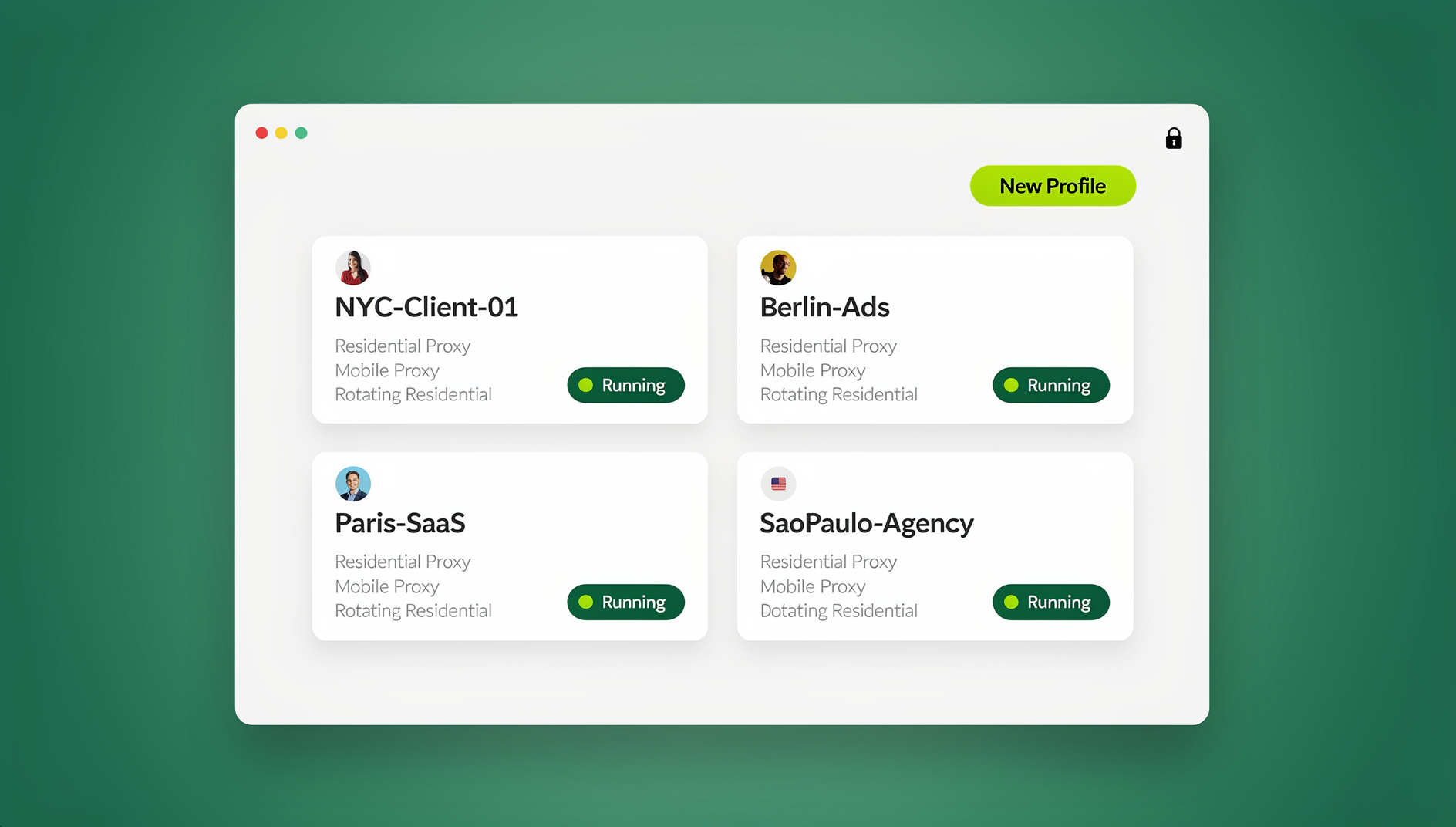
- Sendwin Browser: A native desktop application that installs locally on your computer. It creates isolated browser environments, allowing you to run dozens of profiles with unique cookies and fingerprints simultaneously. It is ideal for power users who require fast performance.
- Cloud Browser Sessions: Sandboxed environments that run entirely on remote servers. This requires no installation at all. You can access your configured profiles from a smartphone, tablet, or home computer simply by logging into the Send.win web dashboard.
Unlike other platforms that charge hundreds of dollars per month, Send.win is highly affordable. You can start with a 30-day free trial that requires no credit card. The Pro plan costs $19/mo (or $6.99/mo annually) and includes 150 profiles, 5GB of proxy bandwidth, and the local Automation API. The Team plan costs $49/mo (or $20.99/mo annually) and includes 500 profiles, 20GB of proxy bandwidth, and 16 team seats, allowing you to share profiles and collaborate with team members seamlessly.
The local Automation API, available on all paid plans, allows developers to run automated scripts using Puppeteer, Playwright, or Selenium. Since the automation runs directly inside the Sendwin Browser, your scripts benefit from the same advanced fingerprint masking and proxy routing as manual profiles. This makes it the perfect solution for secure web scraping, automated testing, and bulk account management.
Furthermore, Send.win’s built-in proxy system helps teams save on external service costs. The platform handles proxy rotation and geography matching under the hood. When you spin up a profile, Send.win assigns clean IP addresses automatically and updates the browser’s language, geolocation, and WebRTC settings to match, ensuring your account profiles look natural to tracking systems right out of the box.
🏆 Send.win Verdict
Managing multiple online accounts without fingerprint masking and proxy separation leads to swift bans and operational disruption. Send.win resolves this challenge by offering isolated native environments and cloud browser sessions that assign unique digital fingerprints and IP addresses to each profile. With plans starting at just $6.99/mo, it offers enterprise-grade antidetect features at an unmatched price point.
Try Send.win free today — Start your 30-day free trial now to protect your profiles and streamline your multi-account management.
Frequently Asked Questions
What is an antidetect browser?
It is a specialized browser designed to create multiple isolated profiles, each with its own unique cookies, local storage, and faked browser fingerprint, making them look like completely separate devices.
How does an antidetect browser prevent account bans?
It stops tracking scripts from linking your different profiles. By giving each profile a unique hardware signature (canvas, WebGL, audio context) and IP address, platforms cannot tell that the accounts are managed by the same person.
Do I need to install a local desktop application to use Send.win?
No. While the Sendwin Browser is a native desktop client that offers maximum speed, Send.win also provides cloud browser sessions that run entirely in the cloud with no local installation required.
What is the price of Send.win?
Send.win offers a 30-day free trial with no credit card required. The Pro plan costs $19/mo (or $6.99/mo annually), and the Team plan costs $49/mo (or $20.99/mo annually), which includes 16 seats for team collaboration.
Are proxies included with Send.win?
Send.win paid plans include a set amount of proxy bandwidth (5GB on Pro, 20GB on Team), allowing you to run profiles using built-in IP routing without needing to purchase third-party proxy services.
Can I automate tasks in Send.win?
Yes. The Automation API is available on all paid plans, starting with the Pro plan, enabling local automation via Puppeteer, Playwright, or Selenium directly within your profiles.
Can I share my profiles with team members?
Yes, the Team plan includes 16 seats, allowing you to share active sessions with team members. They can open the profiles and access the logged-in accounts without needing password access or 2FA codes.
Adhering to this **antidetect browser privacy multi account guide 2026 5** is the key to scaling your digital business safely. By separating your online profiles, hiding your hardware fingerprints, and routing your traffic through dedicated proxies, you eliminate the risk of chain bans and account locks. Transitioning to a secure containerized tool like Send.win simplifies your workflow, protects your critical accounts, and allows your team to expand its digital operations with total peace of mind.