What Does Incognito Mode Actually Hide When You Run Multiple Logins?
Incognito mode only stops your browser from saving history, cookies and form data once the window closes — it hides nothing from the site you are visiting. Incognito multilogin works only when each account runs inside a separate browser profile with its own fingerprint, its own storage and its own IP address. Incognito windows share one identity; isolated profiles create many. That single difference decides whether your accounts stay unlinked or get clustered together within minutes.
📌 TL;DR Executive Summary
- Core Takeaway: Incognito is a session cleaner, not an identity. Multi-login needs one isolated profile per account, each with a distinct fingerprint, its own cookies and a dedicated proxy exit IP.
- Key Risk/Challenge: Two incognito windows on the same laptop share canvas output, WebGL renderer strings, audio entropy, fonts, screen metrics, timezone and IP — every one of those is a linking signal.
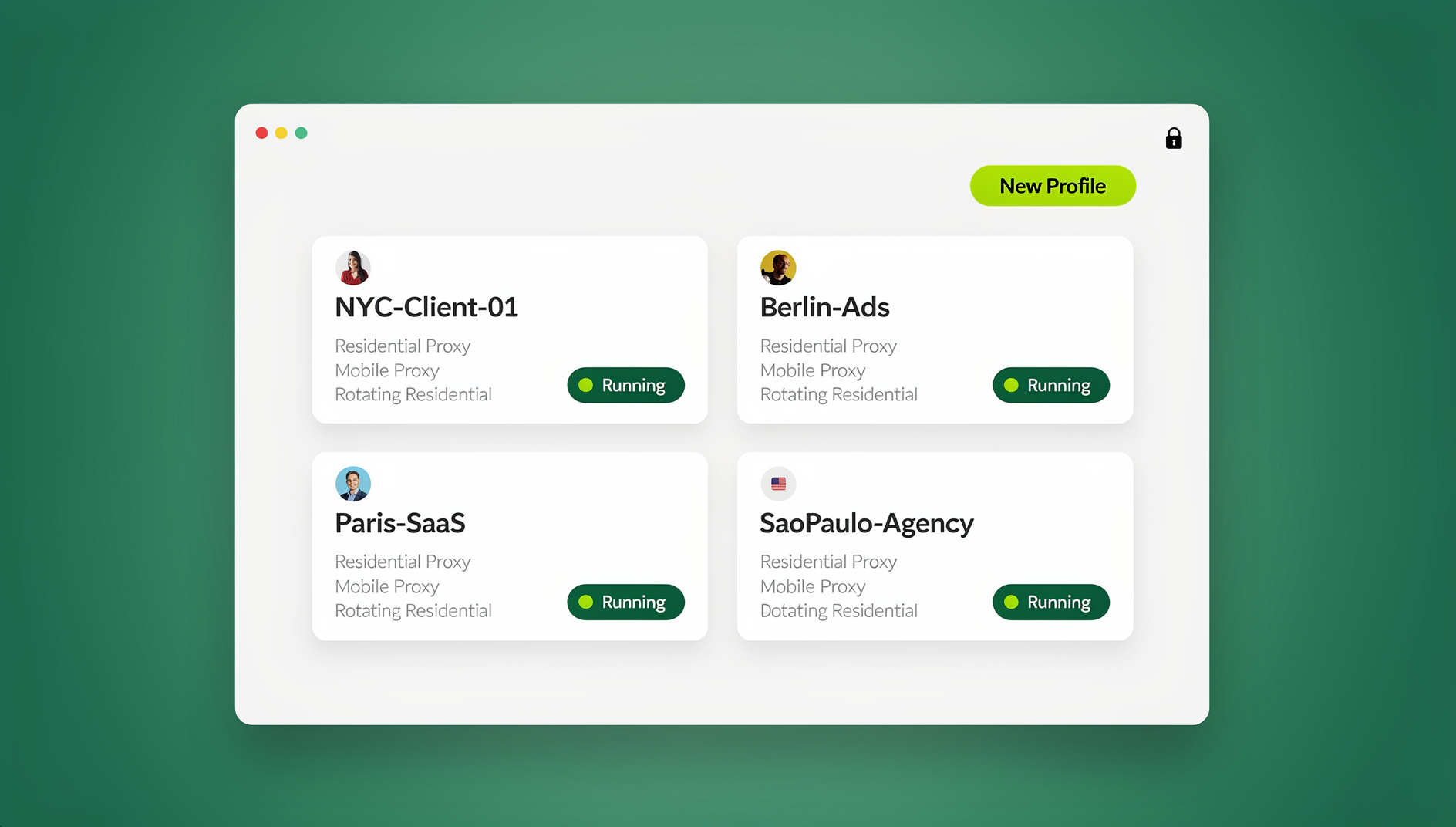
- Recommended Solution: Run each account in a dedicated profile of an anti-detect browser. Send.win ships the Stealth engine plus built-in residential proxies, so timezone, locale, WebRTC and geolocation follow the proxy’s exit IP automatically.
Incognito Defined: A Session Cleaner, Not a Privacy Shield
Close an incognito window and the browser discards the history entries, cookies, site data and form inputs created during that session. Nothing is written back to your normal profile. That is the entire feature. It exists so you can check a second webmail once on a shared machine, not so you can operate ten seller accounts without them touching each other.
The site on the other end still receives everything a normal visit exposes: IP address, user agent, screen resolution, installed font list, GPU renderer strings, timezone, language and the outputs of canvas and audio probes. Incognito changes none of it. It does not route traffic through a proxy, does not rotate your address and does not alter a single fingerprint parameter. Open three incognito windows side by side and you have three views of one machine, not three machines. The incognito browser isolation guide walks through the same model if you want the underlying mechanics.
How Fingerprinting Links Two Incognito Windows Together
Detection systems rarely ask whether a visitor looks suspicious. They ask a narrower question: are these two sessions coming from the same device? Fingerprinting answers it by sampling values your hardware and operating system produce whether you want them to or not.
Canvas, WebGL and the GPU trail
Canvas fingerprinting asks the browser to draw text and shapes onto a hidden canvas, then reads the pixels back. Anti-aliasing rules, font hinting and GPU rasterization differ per machine, so the pixel output differs too. WebGL digs deeper, exposing GPU vendor and renderer strings plus shader precision values that vary between graphics drivers.
Published entropy measurements put canvas output at roughly 5–8 bits, and the value survives browser restarts — it shifts mainly after a font, OS or GPU driver update. That persistence is what makes it useful to a tracker: your canvas hash behaves like a durable label rather than a one-off glance. The ranges are approximate and depend on the population measured, but the direction is consistent.
Audio, codecs and the parameters you never set
Audio fingerprinting pushes a fixed signal through OfflineAudioContext and measures small numeric differences in the rendered output, landing around 3–5 bits of entropy. WebCodecs and MediaCapabilities add another 4–7 bits by reporting which codecs and hardware decoders your machine supports. Each signal is weak alone. Stacked, they narrow a machine down quickly — and every incognito window on that machine reports the same numbers.
Why coherence beats parameter count
What matters is not how many fields you spoof but whether they agree. A profile claiming an Apple laptop on macOS while exposing an NVIDIA renderer string contradicts itself, because that renderer is not available on that platform. A profile claiming en-US and America/New_York while the exit IP geolocates to Frankfurt contradicts itself too. Detectors weigh internal inconsistency far more heavily than any single unusual value, because consistency is expensive to fake and inconsistency is cheap to catch.
Why Incognito Multilogin Breaks Down: Five Signals That Connect Accounts
- One fingerprint across every window. Incognito tabs run on the same engine build, GPU, font set and screen metrics as your normal browsing, so canvas, WebGL and audio outputs match.
- One IP address. All windows leave through your real connection. Two accounts logging in from the same residential IP at similar times is one of the easiest patterns to cluster.
- Timezone and locale mismatches. Connect through a VPN in another country while your system clock and language stay local, and the browser claims one place while living in another.
- WebRTC exposure. Unless the media privacy policy is changed or WebRTC is blocked, the browser can reveal local and public IP information that bypasses the tunnel.
- Shared environment details. Extension list, browser version, installed fonts and hardware concurrency are identical across windows, and each one feeds the fingerprint.
An isolated anti-detect profile breaks all five at once. Profiles keep their own cookies, cache and local storage so nothing cross-contaminates, and the stealth layer assigns each one a distinct, internally consistent fingerprint. That is the mechanism difference between a private window and a private machine.
Who This Affects: Sellers, Media Buyers, Agencies and Automation Developers
Marketplace sellers, ad buyers, agency account managers and automation developers hit the same wall from different directions. A cluster of storefronts or ad accounts sharing one device signature tends to surface as verification challenges, payment reviews or restrictions that take weeks to unwind. Agencies feel it hardest because many clients sit on the same hardware.
Automation developers hit a narrower version. Ten Playwright or Puppeteer contexts launched from one browser build are still one engine, one GPU and one host profile. Multiple browser contexts are not multiple devices, and platforms notice when every one of them gets challenged on the same day. None of that changes what a platform permits — isolation changes how traffic looks from the outside, while whether an account is allowed to exist is governed by the platform’s own terms.
Anti-Detect Profiles vs Incognito Tabs: What Actually Changes
The comparison is not about privacy philosophy. It is a list of concrete signals and which tool touches them.
| Signal | Incognito window | Isolated anti-detect profile |
|---|---|---|
| Cookies, cache, local storage | Cleared at session end, shared while open | Stored per profile, never mixing between profiles |
| Canvas, WebGL, audio, fonts | Identical to your normal window | Unique per profile, kept coherent with the claimed device |
| IP address | Your real connection | Proxy exit IP bound to that profile |
| Timezone, locale, geolocation | Host system values | Follow the proxy exit IP |
| WebRTC | Can expose local and public IP | Constrained to the profile’s network path |
| Concurrent sessions | One manual identity at a time | Local profiles run at once with no cap; cloud sessions 1/3/9 by plan |
| Team access | Shared passwords | Profile sharing to paid teammates, sessions open signed in |
| Automation | Not available | Vendor API on supported tiers |
How the Main Multi-Login Tools Compare
Incogniton and Multilogin are the two names most people land on after incognito stops working. Both create isolated profiles, and both charge for the parts you need at scale. Entry pricing and limits differ enough to matter.
| Tool | Entry paid tier | Built-in proxies | Platform support | Automation | Limits worth knowing |
|---|---|---|---|---|---|
| Incogniton | Starter Plus — $19.99/mo for 10 profiles | Bundled free proxies covering 9 countries; no own residential network at scale | Windows and macOS only | REST API and Selenium/Puppeteer, paid tiers only | Free tier gives 10 profiles for 2 months, then drops to 3; 6-month billing is the default |
| Multilogin | Pro 10 — $11/mo | 1–10 GB/month included, rollover while the account is active | Desktop profiles plus Android cloud phones (Android 10–15) | Selenium, Puppeteer, Playwright and Postman, 50–100 API requests/minute by plan | Free profiles deleted after 7 days of inactivity; free users cannot top up traffic; extra traffic starts at $2.275/GB |
| Send.win | Pro — $19/mo, or $6.99/mo billed annually | Residential proxies on every plan — 1 GB free, 5 GB on Pro, 20 GB on Team, $6/GB extra | Desktop app for Windows, macOS and Linux, plus a cloud browser that runs from any device | Local Automation API for Selenium, Puppeteer and Playwright on Team | Automation API is Team-only; the 30-day free trial continues on Pro after day 30 |
Those Multilogin and Incogniton figures come from each vendor’s own plan pages, so weigh the detection-pass and platform-testing claims on those pages as marketing rather than measurement. For a feature-level read on fingerprint engines, cookie tooling and team dashboards, the Incogniton vs Multilogin comparison covers the rest.
Practical Checklist: Isolating Profiles So Multi-Login Holds Up
Work through this in order. Skipping a step usually shows up later as a verification prompt on an account you cannot afford to lose.
- One profile per account, named clearly. Never reuse a profile for a second identity, even after a logout — the storage history stays attached.
- Bind a dedicated proxy to each profile. Residential exits suit accounts that carry money; HTTP, HTTPS and SOCKS5 are all supported by the tools above.
- Match the proxy country to the account’s origin. A UK account logging in from a Brazilian exit is a mismatch you cannot explain away.
- Let timezone, locale and geolocation derive from the exit IP. Set them by hand and you will eventually forget a field.
- Test the fingerprint before the first login. Compare canvas hash, WebGL renderer, fonts and screen against one believable device.
- Constrain WebRTC. Block it or force it through the profile’s network path.
- Warm up new profiles and keep behaviour human. Browse and scroll before logging in, and avoid razor-regular click pacing or identical session lengths across profiles.
- Store credentials in the tool, not a spreadsheet. Encrypted vaults and cloud sync keep logins on the right profile when more than one person works the accounts.
- Log the mapping. Profile, account, proxy, owner — when something breaks at scale, that table is the first thing you need.
Proxy Bandwidth: The Recurring Cost of Multi-Login
Bandwidth is where multi-account work gets expensive. Every leaked WebRTC request, image-heavy marketplace page and video session travels through the proxy, and a geo mismatch that forces a reload burns traffic twice. Multilogin includes 1–10 GB per month depending on tier and charges from $2.275 per GB beyond that; Incogniton bundles free proxy access but does not run its own residential network at scale; Send.win includes 1 GB on Free, 5 GB on Pro and 20 GB on Team, with extra capacity at $6 per GB. Scale from 20 profiles to 150 and the included allowance runs out long before the profile limit does. The Multilogin pricing breakdown shows how bundled allowances and rollover rules shift the effective cost as profile counts grow.
Common Mistakes That Get Profiles Flagged
- Treating incognito as a second identity. Different window, same device signature, same IP. Nothing about the account looks separate.
- Reusing one proxy across several profiles. The fingerprints differ, the exit IP does not — and IP is the cheapest signal to cluster on.
- Spoofing canvas but leaving WebGL alone. Partial spoofing produces the exact contradiction detectors weight most heavily.
- Copying a mobile user agent onto a desktop profile. Canvas, fonts and screen metrics still describe a desktop machine; genuine mobile behaviour needs a cloud phone, not a string swap.
- Clearing cookies and calling the profile fresh. Local storage, IndexedDB and service workers survive the cleanup.
- Picking a tool that does not run on your operating system. Incogniton is Windows and macOS only, which rules it out for Linux-based automation hosts.
How Send.win Helps With Incognito Multilogin
Send.win is an antidetect browser built for exactly this kind of work — every profile is a clean, isolated identity:
- Isolated profiles – unique fingerprint, separate cookies and storage per profile
- Stealth engine – canvas, WebGL, fonts, and audio spoofed at the engine level
- Desktop app + cloud sessions – native app for Windows, macOS, and Linux, or run profiles in the cloud with no install
- Built-in residential proxies – with automatic timezone, locale, and WebRTC matching
- Team features – share logged-in profiles with teammates without sharing passwords
Try the instant cloud browser demo — no install, no signup — or download the desktop app. The 30-day free trial needs no credit card, and paid plans start at $6.99/month billed annually (see pricing).
Where Send.win Fits in an Incognito Multilogin Workflow
Send.win replaces the private window with an isolated identity that runs on your desktop or in the cloud. The desktop app covers Windows, macOS and Linux, including the Linux automation hosts Incogniton does not support, while the cloud browser runs profiles on EU and US nodes from any device with nothing to install. The Stealth engine spoofs canvas, WebGL, audio, fonts and hardware at the engine level rather than through script injection, and keeps those values coherent so each profile reads as one plausible machine — no two profiles share a fingerprint.
Residential proxies are built in on every plan, alongside bring-your-own HTTP and SOCKS5. Timezone, locale, WebRTC and geolocation follow the proxy’s exit IP automatically, which removes the manual field-setting behind most mismatch flags. Sharing a profile with a paid teammate opens it already signed in, cloud sync carries logins across devices without passwords changing hands, and the local Automation API for Selenium, Puppeteer and Playwright sits on the Team plan. If you are weighing a desktop profile against a cloud phone for mobile-first apps, how to pick an undetectable browser lays out the criteria.
🏆 Send.win Verdict
Incognito solves a local privacy problem; multi-login solves an identity problem, and the two are not interchangeable. Send.win matters in this workflow because it closes the gaps that break incognito-based multi-login: engine-level fingerprint spoofing that stays coherent, residential proxies included on every plan instead of billed separately, and timezone, locale and WebRTC that follow the exit IP without manual setup. It also runs on Linux and in the cloud, so profiles follow the team rather than one laptop.
Try Send.win free today — 30 days at $0 with 10 isolated profiles and 1 GB of residential proxy; after day 30 the plan continues on Pro at $19/mo, or $6.99/mo billed annually.
Frequently Asked Questions
What does incognito mode actually hide from websites?
Almost nothing. Incognito stops your browser from saving history, cookies and form data locally once the session ends. The website still sees your IP address, user agent, screen size, fonts, GPU strings and canvas output exactly as it would in a normal window.
Can websites track you across incognito windows?
Yes, through fingerprinting rather than cookies. Two incognito windows on the same machine return the same canvas hash, WebGL renderer, audio entropy and screen metrics, and they usually share one IP address. Those values are enough to link the sessions even though no cookie survives.
What is the difference between incognito mode and an anti-detect browser?
Incognito changes what your browser stores. An anti-detect browser changes what the site sees. Each profile carries its own cookies, cache and local storage plus a distinct fingerprint, and it can be bound to its own proxy so the exit IP, timezone and locale match the identity.
Can I run multiple accounts with incognito mode?
You can open several accounts that way, but they will not look separate to the platform. Without distinct fingerprints and IP addresses, the accounts cluster on one device signature, and platforms commonly respond with verification challenges, payment reviews or restrictions once that overlap is visible.
Is Incogniton cheaper than Multilogin?
It depends on the tier. Incogniton’s Starter Plus is $19.99 per month for 10 profiles, while Multilogin’s Pro 10 is $11 per month. Incogniton bills every 6 months by default, with 30% off six-month and 40% off yearly prepayment, so the effective monthly rate falls if you prepay.
Does Incogniton provide proxies?
It ships bundled free proxy access covering 9 countries, including the US, UK, Germany, the Netherlands, Brazil and India, and it supports HTTP, HTTPS and SOCKS5. It does not operate its own residential network at scale, so heavier workloads usually need an external proxy provider.
Which anti-detect browser supports mobile apps?
Multilogin pairs desktop browser profiles with Android cloud phones running Android 10–15, which is what mobile-only apps require. A desktop profile with a mobile user agent is not equivalent, because the canvas, font and screen signals still describe a desktop machine.
What happens to my Incogniton free profiles after 2 months?
The free starter package includes 10 profiles for the first two months, then automatically drops to 3 profiles unless you upgrade to a paid tier. If you were running more than three identities on the free plan, plan the migration before the downgrade rather than after it.