Why Does Snapchat Ban You for Running Multiple Accounts?
Snapchat bans you for linked fingerprints, not for the number of accounts you hold. A device ban — SS06, SS07 or SS18 — blacklists the hardware, so every new login from that phone or browser profile keeps failing. To run multiple Snapchat accounts without ban, give each account its own device fingerprint, its own residential IP and its own phone number, then warm it up slowly. Snapchat’s device-graph correlation is hunting for one thing: sameness across accounts.
📌 TL;DR Executive Summary
- Core Takeaway: Snapchat polices device identity and behaviour, not account count. One account needs one fingerprint, one residential IP and one phone number — never shared.
- Key Risk/Challenge: A device ban (SS06, SS07, SS18) blacklists the hardware, so fresh accounts created on the same phone or in the same browser profile die on first login.
- Recommended Solution: One isolated browser profile per account, long sticky residential sessions, staggered creation over days, and a 14-day warm-up before you post at full speed.
The Symptoms: Which Snapchat Ban Are You Actually Looking At?
Read the error code before you change anything. Snapchat tells you whether it locked the account or blacklisted the device, and those two need opposite responses. Retrying a login from a banned device adds another failure to the same hardware record, which is how a 48-hour lock becomes permanent.
Signs that a ban is forming:
- A verification code or CAPTCHA on nearly every login, even from the device you always use.
- Sessions that die minutes after they start, with no password change on your side.
- A second or third account locked within hours of creation on the same phone.
- The same failure repeating on a brand-new account created from the same machine.
| Code | What Snapchat means | What it tells you |
|---|---|---|
| SS02 | Login banned after repeated failed attempts | Temporary and device-level; stop retrying |
| SS04 | Account locked | Account-level; the device is still usable |
| SS06 | Device ban for abuse | Hardware blacklisted |
| SS07 | Device banned for too many associated accounts | The device-graph link is confirmed |
| SS10 | Device fails integrity requirements | Emulator, rooted device, cloner or modified app |
| SS18 | Device ban for repeated violations | Hardware blacklisted |
Minor violations usually draw a 48-hour temporary lock that lifts by itself, while permanent locks are described as unrecoverable. The practical test takes one minute: log in to the same account from a different device. If it works, the ban is device-level, and the fix is a clean environment rather than an appeal.
Why It Happens: The Five Signals That Link Your Accounts
Snapchat doesn’t count accounts. It builds a graph of devices, networks and behaviour, then flags clusters. Any attribute that shows up on two accounts becomes an edge between them, and a dense cluster turns into a device ban.
1. Device-graph correlation
Snapchat cross-references IMEI, the Android advertising ID, the Wi-Fi MAC address and behavioural telemetry, and since 2024 that correlation has moved into near real time instead of running in overnight batches. Two accounts opened from one phone sit on the same node within minutes of the second login. SS06, SS07 and SS18 are what Snapchat does when a node gets crowded.
2. IP reputation and IP reuse
Datacenter ranges such as AWS, GCP and DigitalOcean are heavily flagged before you even log in, which is why residential and mobile IPs perform better. The second problem is reuse: creating accounts in rapid succession from one address makes Snapchat throttle or ban that IP, and every account behind it drops together. If you manage paid campaigns, that’s exactly how a single mistake becomes a chain reaction across Snapchat ad accounts.
3. Shared cookies and one browser profile
A single Chrome profile gives every account the same cookie jar, the same localStorage, the same canvas and WebGL output, the same font list, the same timezone and the same screen metrics. You can switch logins all day; the machine fingerprint never moves. The first login from a genuinely new device almost always triggers a verification code or CAPTCHA, while repeats from a trusted device usually don’t. So a browser that wipes itself between sessions looks like a brand-new device on every single login — to a system whose entire job is spotting new devices that behave like established ones.
4. Phone numbers and contact syncing
Every account needs its own number, and a number normally sits on one account at a time; repeated re-verification on the same number gets rate-limited. Contact syncing is the fastest way to link a new account to an old one, because Snapchat cross-references the same address book and rebuilds the same friend graph. Turn contact upload off before you create the account, not after it’s flagged.
5. Behaviour and session patterns
Snapchat allows one active session per account: logging in on a second device signs the first one out. That makes every login from an unfamiliar device visible straight away. Sudden behavioural change on a fresh account — adding dozens of friends, posting Stories in the first hour, messaging strangers — reads as automation. Wait 24 to 48 hours before aggressive activity, and add friends gradually across the first week.
Fixes by Effort: Quick Wins First
If you want to run multiple Snapchat accounts without ban, work down this list in order. The first three fixes cost nothing and solve the majority of “I only made a second account” bans. The later ones cost money but scale to dozens of accounts.
Quick win 1: Stop the log-out, log-in cycle
Snapchat’s own switching feature lets you add several accounts to one app installation and move between them by logging out and back in — published guides disagree on whether the cap is two or four, so don’t rely on any single figure. What matters is that switching only changes which account is active, never the device identity Snapchat records. Use it for accounts you own casually and don’t care about being linked. For client or brand work it moves you toward a link, not away from one.
Quick win 2: Separate your phone numbers
Give each account a number that belongs to it and nothing else, and keep a written map of number to account so recovery isn’t a scavenger hunt. Real SIM numbers verify more reliably than VoIP, which Snapchat sometimes blocks during verification. Paid virtual numbers from established telecom providers are the workable middle ground; free disposables burn out and often can’t be re-verified.
Quick win 3: One residential IP per account, held sticky
You need 50 consistent sticky IPs for 50 accounts, not 50 simultaneous connections. Thirty-minute sticky sessions are the standard default in most proxy panels, but Snapchat rewards longer persistence, so ask your provider for extended stickiness or pick one that supports it. Rotating the exit IP between logins is worse than a shared one, because the account’s “home” changes every session.
Quick win 4: One isolated browser profile per account
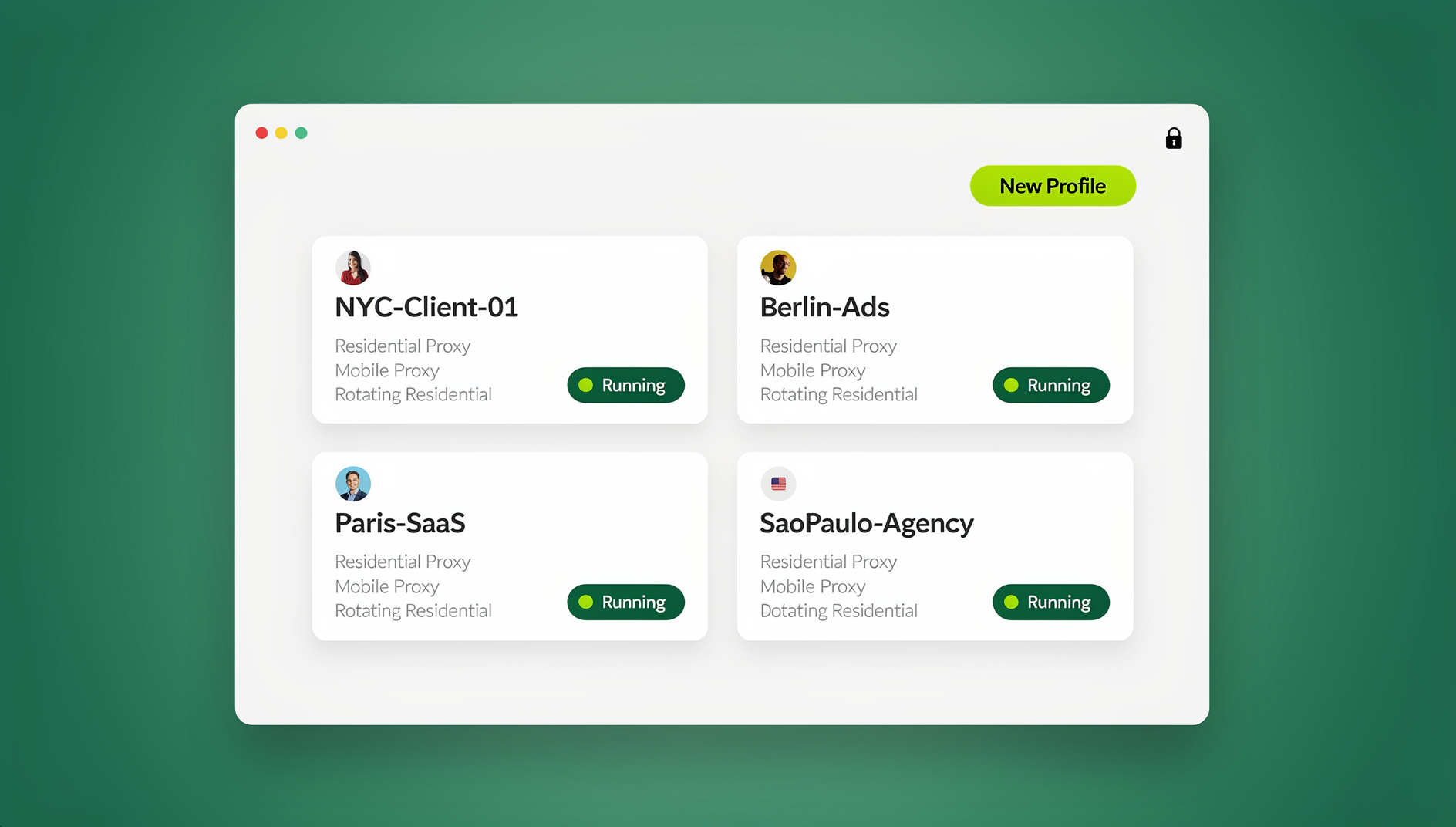
This is where the actual fix lives. An anti-detect profile spoofs canvas, WebGL, audio, fonts and hardware at the engine level and keeps them coherent, so each profile reads as a separate real machine rather than a script patching a few values. Sendwin Browser does this natively on Windows, macOS and Linux, ships residential proxies on every plan, and automatically aligns timezone, locale, WebRTC and geolocation with the proxy’s exit IP. You get 10 profiles and 10 proxies on the free trial, 150 profiles on Pro and 500 on Team — enough to run multiple Snapchat accounts without ban across a full client roster with room to spare. If you want the wider setup pattern, this run multiple Snapchat accounts walkthrough covers the profile-per-account routine end to end.
The Team plan adds the local Automation API for Selenium, Puppeteer and Playwright, which you can point at a single profile for scheduled logins and light health checks. Use the port from that profile’s own automation settings, and never reuse the same connection for a second account:
from playwright.sync_api import sync_playwright

CDP_URL = "http://127.0.0.1:PORT"  # copy it from the profile's automation settings

with sync_playwright() as p:
    browser = p.chromium.connect_over_cdp(CDP_URL)
    context = browser.contexts[0]
    page = context.new_page()
    page.goto("https://accounts.snapchat.com/accounts/login")
    page.wait_for_timeout(8000)
    # one profile per account — never reuse this CDP_URL for a second login
    page.close()
    browser.close()
Higher effort: Cloud phones when you need real app features
Stories, lenses and native camera features are app-first, and whether desktop web Snapchat is enough for real posting work is genuinely debated, so treat the browser as your management layer and the app as your publishing layer. Cloud Android instances run roughly $5 to $10 per instance per month and are the usual answer for accounts that actually post. Two cautions: virtual mobile devices inherit your desktop IP unless you attach a proxy, and cloud phone minutes are billed separately on some platforms — one vendor prices them at €0.009 per minute in prepaid credits on top of the base plan.
A 14-Day Warm-Up Schedule That Keeps New Accounts Alive
Warm-up advice is usually vague, so here is a day-by-day schedule you can work from if you want to run multiple Snapchat accounts without ban instead of rebuilding the roster every month. Keep each session short, keep the geography consistent, and never batch creation into one afternoon: creating accounts back-to-back from the same IP, device or phone number is what makes Snapchat throttle or ban that address, and every account behind it drops with it.
| Window | What to do | What to avoid |
|---|---|---|
| Days 1–2 | Log in from the account’s own profile and IP, complete verification, browse Discover for 5–10 minutes | Contact sync, adding friends, any link in a chat |
| Days 3–5 | Add 3–5 friends per day, reply to incoming Snaps, two short sessions | Mass friend adding, bulk messaging, profile edits |
| Days 6–9 | First Story to friends only, 8–12 friend adds per day, join one group chat | Public posting, links to external sites |
| Days 10–14 | Normal posting rhythm, 15–25 friend adds per day, limited outbound links | Running several accounts from one IP at once |
After day 14 the account behaves like a normal one. The rule that keeps it that way: never run dozens of sessions from one address at the same hour. Stagger your schedule so the traffic from any single IP looks like one person living a normal day.
How to Stop It Recurring: Isolation as a Routine
Treat isolation as a habit, not a one-off setup — it is the only thing that lets you run multiple Snapchat accounts without ban past the first week. One account, one profile, one proxy, one number — and a naming convention that makes the mapping obvious months later when an account needs re-verification. Record which number belongs to which profile beside the profile name, so nobody has to search a spreadsheet at the worst possible moment.
If you work with a team, stop sharing logins through a chat window. A shared team desktop means staff logins themselves become a linking signal, because two colleagues signing into two different accounts from the same machine create the exact device edge Snapchat looks for. Instead, share the profile: with Send.win, a profile shared with a paid teammate opens already signed in, no password changes hands, and live cloud sessions can be handed over when someone else takes the account. Cloud sync keeps logins following you across devices — 20 profiles on Pro, 100 on Team — and Team adds 16 seats, so a small agency can work the same roster without passing credentials around. There’s a fuller breakdown of running several accounts from one browser in manage Snapchat accounts.
Add one quarantine rule and you’ll stop most cascade bans. When an account gets locked, check the code first. SS04 is account-level, so carry on. SS06, SS07 or SS18 is device-level, which means you stop logging into every other account from that machine until you’ve rebuilt it with a clean profile and a fresh IP.
What a 50-Account Snapchat Stack Actually Costs
Published operator budgets put a 50-account Snapchat setup at roughly $115 to $145 per month before content and labour. Treat those figures as planning ranges rather than quotes — they come from one operator’s stack and one vendor’s price list, so your provider and region will move them.
| Line item | Typical monthly range | Notes |
|---|---|---|
| Anti-detect profiles | $30–$99 | Depends on seats and profile count — Send.win Pro is $19/mo for 150 profiles, Team $49/mo for 500 |
| Residential proxies | $50–$80 | 50 sticky IPs, roughly 15–20 GB/month of light traffic at $3–$8/GB; mobile proxies run $15–$20/GB |
| Phone numbers | ~$25 | Real SIM or paid virtual numbers, one per account |
| Cloud Android instances | $5–$10 each | Only if accounts post Stories from the app |
Notice where the money goes. The profile layer is the cheapest part of the stack, and it decides whether the rest survives. Send.win bundles residential proxies with every plan — 20 proxies and 5 GB per month on Pro, 20 proxies and 20 GB on Team — and Pro’s $19/mo (or $6.99/mo billed annually) sits below the $30–$99 range above. Fifty accounts that each need their own IP run past what any plan includes, so budget the custom add-on path: extra proxy bandwidth at $6 per GB and extra profiles at $0.05 each. If you’re still weighing tools, this guide to picking the best antidetect browser covers what actually separates them.
🏆 Send.win Verdict
Send.win fits this problem at the exact point where Snapchat’s device graph bites: it hands each account a coherent engine-level fingerprint plus a residential exit IP whose timezone, locale and WebRTC data follow the proxy automatically. The desktop app runs locally on Windows, macOS and Linux, and the cloud browser covers machines you don’t own — free for 10 minutes a day, unlimited on Pro and Team. Its honest limit is Snapchat itself: Stories and native camera features remain app-first, so if posting from the app is your core workflow, pair isolated profiles with cloud phones rather than expecting a browser to do everything.
Try Send.win free today — 30 days at $0, 10 profiles and 10 residential proxies included, cancel in two clicks, and your local profiles stay on your machine.
Frequently Asked Questions
How many Snapchat accounts can I have on one device?
Snapchat’s built-in switching lets you add several accounts to one app installation and move between them by logging out and back in, though published guides disagree on whether the cap is two or four, so treat any single number as unconfirmed. What matters more is that switching changes which account is active, not the device identity Snapchat records. Every account still shares one phone or one browser profile — exactly the link the device graph is built to find.
Why did my Snapchat account get banned for multiple accounts?
Because Snapchat matched the accounts to the same device, IP or phone number. Since 2024 the trust and safety team has pushed device-graph correlation into near real time, cross-referencing IMEI, the Android advertising ID, the Wi-Fi MAC address and behavioural telemetry. When several accounts land on the same node, the device gets flagged, and SS07 is the code that says too many accounts were associated with it.
What does Snapchat error code SS07 mean?
SS07 is a device ban: Snapchat decided too many accounts were tied to that hardware. It is not an account-level lock, so a fresh account created on the same phone or in the same browser profile will fail too. Move the account into a clean, isolated environment with its own fingerprint and its own residential IP, then stop retrying from the banned device.
Do I need a separate phone number for each Snapchat account?
Yes. Every account needs its own number for verification, and one number can usually sit on only one account at a time. Sharing a number breaks verification and recovery, and repeated re-verification on the same number gets rate-limited. Real SIM numbers verify more reliably than VoIP, which Snapchat sometimes blocks, so paid virtual numbers from established telecom providers are the practical middle ground.
Can I use a VPN instead of proxies for Snapchat?
A VPN is the wrong tool here. It gives the whole machine one shared exit IP, so every profile you run looks like the same visitor, and VPN ranges are already heavily flagged — datacenter ranges such as AWS, GCP and DigitalOcean certainly are. You want one dedicated residential IP per account with a long sticky session, so the account’s address stays stable for weeks instead of rotating mid-session.
How long should I wait before posting on a new Snapchat account?
Give it 24 to 48 hours before any aggressive activity, and add friends gradually over the first week. A workable pattern is light browsing and a few friend adds for the first days, a first Story to friends-only around day six, and a normal posting rhythm only after day ten. Accounts that post and add at full speed on day one are the ones that get throttled.
Is it safe to use Snapchat in an anti-detect browser?
Logging in to Snapchat through a browser you control is fine, and isolated profiles are the practical way to run multiple Snapchat accounts without ban from one machine: they cover account management, ad operations and web messaging well. Snapchat’s terms do prohibit unauthorised third-party apps and renting or selling account access, so keep the setup to accounts you legitimately own or manage for clients. Remember that Stories and native camera features are app-first, which is why some teams pair browser profiles with cloud phones.
Can I run two Snapchat accounts on one iPhone?
You can add both to the app and switch between them, but only one is active at a time and both sit behind the same device identifiers and the same IP address. That is the configuration that eventually produces a linked-device flag. If the two accounts must stay unconnected — different clients, different brands — separate them at the device, network and phone number level instead.
How Send.win Helps With Run Multiple Snapchat Accounts Without Ban
Send.win is an antidetect browser built for exactly this kind of work — every profile is a clean, isolated identity:
- Isolated profiles – unique fingerprint, separate cookies and storage per profile
- Stealth engine – canvas, WebGL, fonts, and audio spoofed at the engine level
- Desktop app + cloud sessions – native app for Windows, macOS, and Linux, or run profiles in the cloud with no install
- Built-in residential proxies – with automatic timezone, locale, and WebRTC matching
- Team features – share logged-in profiles with teammates without sharing passwords
Try the instant cloud browser demo — no install, no signup — or download the desktop app. The 30-day free trial needs no credit card, and paid plans start at $6.99/month billed annually (see pricing).