Can You Publish From Multiple Medium Accounts Without Getting Linked?
A multiple medium accounts publishing strategy is a deliberate plan for running more than one Medium profile with separate audiences, inboxes, payout rails and browser environments, so the platform never reads your profiles as one person. Medium lets a writer hold several accounts, but every one of them is bound by the same terms and can be suspended at Medium’s sole discretion, with or without notice. Separation, not posting volume, is what keeps them running.
📌 TL;DR Executive Summary
- Core Takeaway: Medium doesn’t cap how many accounts you hold. The risk isn’t the account count — it’s the shared signals: one inbox, one Stripe connection, one browser fingerprint, one IP.
- Key Risk/Challenge: A shared device, recovery email or phone number can cluster sibling profiles into one identity, and the terms let Medium suspend or terminate any account at its sole discretion, with or without notice.
- Recommended Solution: Give each profile its own inbox, its own Stripe connection and its own isolated browser profile on a proxy that matches its timezone. Send.win supplies the profiles, the proxies and the stealth layer in one place.
What a Multiple Medium Accounts Publishing Strategy Actually Is
Medium does not publish a limit on how many accounts one writer can hold. What it publishes is a single set of terms that covers all of them, so a rule broken on your experimental profile can reach the one carrying client work. A workable strategy is therefore a set of self-contained publications: each account has its own identity, its own audience and its own login environment, and none of them can be described by another’s data.
One Account, One Audience Job
Writers who sustain several profiles for years split them by job rather than by mood: a personal brand account, a technical or educational account, and one for experiments and side projects. The split holds because each profile makes one clear promise to one kind of reader. Someone who followed you for backend tutorials doesn’t want your travel notes landing in the same feed, and engagement data gets muddier for both topics when they mix.
When a Second Account Is Worth Creating
A second profile earns its place only when the audience, promise, language, region or product behaviour is meaningfully different from what you already publish. If you’re writing for the same reader, in the same voice, about the same subject, a second account splits your followers and doubles the surface you have to protect. Mixed topics inside a single profile confuse readers and produce uneven reach even when the writing is strong — the fix is a clean split, not more accounts.
How Account Linking Works Under the Hood
Medium’s sign-in is single-session. Opening a second account in the same browser replaces the first session, which is the friction you notice right away. The part you don’t notice is everything the page can read before you type a character.
The Device Layer
On each page load, a site can read canvas and WebGL rendering output, audio-stack behaviour, your installed font list, hardware concurrency, GPU strings, screen geometry, timezone and locale. If WebRTC is left open, it can also surface local IP addresses that contradict the proxy you think you’re routing through. Add cookie and local-storage state, and the browser becomes a durable identifier that survives cookie clearing far better than most people assume.
Two profiles signed into two different accounts from one browser instance are two accounts chained to one machine. Cookie-isolating add-ons such as Firefox Multi-Account Containers solve the login-switching problem inside one browser; they don’t change the fingerprint or the exit IP. That was a reasonable answer in 2021 and a thin one now, which is why browser-level isolation is where the real work happens — the same reason our walkthrough on how to manage multiple Medium accounts starts with the environment rather than the content calendar.
The Account Layer
Separately from the device, platforms assemble a graph out of account-level overlap: a recycled recovery email, one phone number used across two registrations, the same Stripe account or tax residency behind two payouts, near-identical posting intervals, mutual follows, and stories that link to each other in the first paragraph. No single signal proves anything on its own. Together they cluster your profiles long before a human reads a report.
One useful distinction: publishing through a platform’s official API is the pattern platforms expect, and it doesn’t trigger flags by itself. Link risk sits in the device and login layer, not in how a draft reaches the editor.
Why This Matters: Payouts, Reach and Platform Risk
If you monetize, the account layer stops being abstract. The Partner Program pays from a pool funded by member subscription revenue and distributes it by engaged reading time and engagement points — there is no fixed rate per view, so two stories with identical traffic can earn differently depending on who read them and how long they stayed. Medium has reported more than one million paying subscribers on the $5/month or $50/year plans feeding that pool.
Partner Program Math Per Account
Eligibility is the same on every profile you want to monetize: a complete profile, at least six published stories, at least three months of activity on Medium, a bank account and tax residence in an eligible country, and age 18 or older. A paid Medium membership is no longer required to apply. The requirement that trips up most casual multi-account setups is the payout rail — each account that accepts payments needs its own Stripe connection, so two profiles can’t quietly share one.
Illustrative models published in 2026 put 1,000 member reads at roughly three minutes average reading time somewhere in the $20–$80 range, with a 10,000-read story reaching $200–$1,000 or more. The same models sketch a curve of $0–$20/month in months one and two, $50–$300 across months three to six, $200–$1,500 in months seven to twelve, and $500–$5,000+ per month for top writers in year two. Read those as shapes, not promises; your numbers depend on niche, engagement and how many profiles you can genuinely keep fed.
What Mixed Topics and Drifting Bios Cost You
Mixed topics inside one profile produce uneven reach, and inconsistent names, bios and offers across profiles make it harder for search systems and AI assistants to build a stable picture of any one brand. That’s a discovery cost on top of the reader confusion, and it compounds: profiles that look interchangeable to a machine also look forgettable to a human deciding whether to follow.
What You’re Risking
This affects solo writers running a personal and a niche account, agencies publishing under client bylines, ghostwriting shops keeping one profile per client, and anyone treating Medium as a distribution channel beside a newsletter. Read the terms before you scale. They’ve been substantively unchanged since their September 1, 2020 effective date — a September 2026 update touched only document header metadata — and they cap Medium’s liability at the greater of $50 or what you paid, with individual arbitration, a class-action waiver and a one-year filing deadline. Access is something to protect rather than to argue about after the fact.
Paid distribution isn’t getting cheaper either; non-fiction publishers’ paid search budgets have risen 274% over three years. An audience you own is the part of distribution you don’t rent, which is why a ban on a well-built profile hurts more than the profile itself.
Step-by-Step: Building the Account Stack
- Write one sentence per account. Name the reader and the promise. If two sentences sound the same, you have one account, not two.
- Give every profile its own inbox. You cannot attach two Medium accounts to the same email address, so register a dedicated one per profile. Forward them into a single inbox for triage, so you’re not logging into six mail clients.
- Sort out the phone number before you need it. Medium requires phone verification at registration, and most failed codes trace to formatting — country code, spaces, dashes, an extra leading zero — rather than delivery. Fix the format first, and use a private number you’ll still control in two years; one-time or shared public numbers break later logins and recovery checks.
- Open a separate Stripe connection per paying account and keep one sheet mapping account → Stripe → tax details. Mixing tax identity data across payouts creates a paper trail you can’t unwind.
- Move each account into its own browser profile — not a tab, not a container. Separate cookies, storage, cache, fingerprint and network path. For the mechanics of hosted profiles, start with what a cloud browser server is.
- Align timezone, locale, WebRTC and geolocation to the proxy’s exit IP. A datacenter IP paired with a home timezone is a mismatch that needs no sophisticated detection to spot.
- Set the calendar deliberately. Schedule core content two to four weeks ahead and leave 20–30% of the slots open for real-time trends, so a news moment doesn’t force you to break cadence.
- Share one research layer across every account. The most common failure in multi-publication operations is treating each publication as a full production effort instead of feeding them from the same ideation and research work.
- Decide cross-promotion rules in advance. An occasional contextual link from the technical account to the personal one is fine. A footer link on every story teaches the graph that one person runs both.
- Keep AI out of anything you paywall. Medium’s policy bars AI-generated writing from the Partner Program whether or not it’s disclosed — use AI for notes, outlines and editing, not for the published draft.
Isolation Checklist: What Has to Be Unique Per Account
Most linking problems come from one row of this table being shared. Work down it once per profile and you’ve covered the mechanics that matter.
| Layer | Must be unique per account | What breaks if it isn’t |
|---|---|---|
| Email inbox | A dedicated address per profile | You can’t register a second account on the same address at all |
| Phone number | One private, long-lived number | Re-verification and recovery checks lock you out |
| Payout | Its own Stripe connection and tax details | Payments stall, or both accounts trace to one identity |
| Browser session | Cookies, storage and cache per profile | Single-session sign-on logs you out of the other account |
| Fingerprint | Canvas, WebGL, audio, fonts, hardware | Both profiles read as the same physical machine |
| Network | A proxy exit IP matched to the account’s country | Proxy and account geography disagree |
| Timezone / locale / WebRTC | Values that follow the exit IP | A local IP or clock contradicts the proxy |
| Content lane | A distinct topic and voice per profile | Readers and search systems get mixed signals |
The top four rows you can fix with discipline and a spreadsheet. The bottom four are browser and network configuration, and that’s the part people skip. If you’re running Windows, the setup order for local profiles is covered in this guide to set up antidetect browsers on Windows.
Common Mistakes That Get Sibling Accounts Restricted
- Calling tabs isolation. Multiple tabs or a cookie container in one browser share a fingerprint and an IP. The accounts are separated in your head, not in the data.
- Reusing a recovery email or password. Convenience here costs you the separation that protects the other profiles.
- Sharing a Stripe account or tax identity across two paying accounts — Medium’s payout rules don’t allow it anyway.
- Republishing the same story on two profiles. Engagement gets split, and both versions compete for the same readers.
- Cross-linking every post. Footer and bio links between your own profiles are the clearest authored signal you can leave.
- Buying one-time virtual numbers. They can pass registration and fail at the next check, and buying a number specifically to bypass verification may also breach Medium’s terms.
- Building a full production pipeline per account. It burns out in a month, the calendars go quiet, and silence is its own pattern.
Where Send.win Fits in a Medium Publishing Workflow
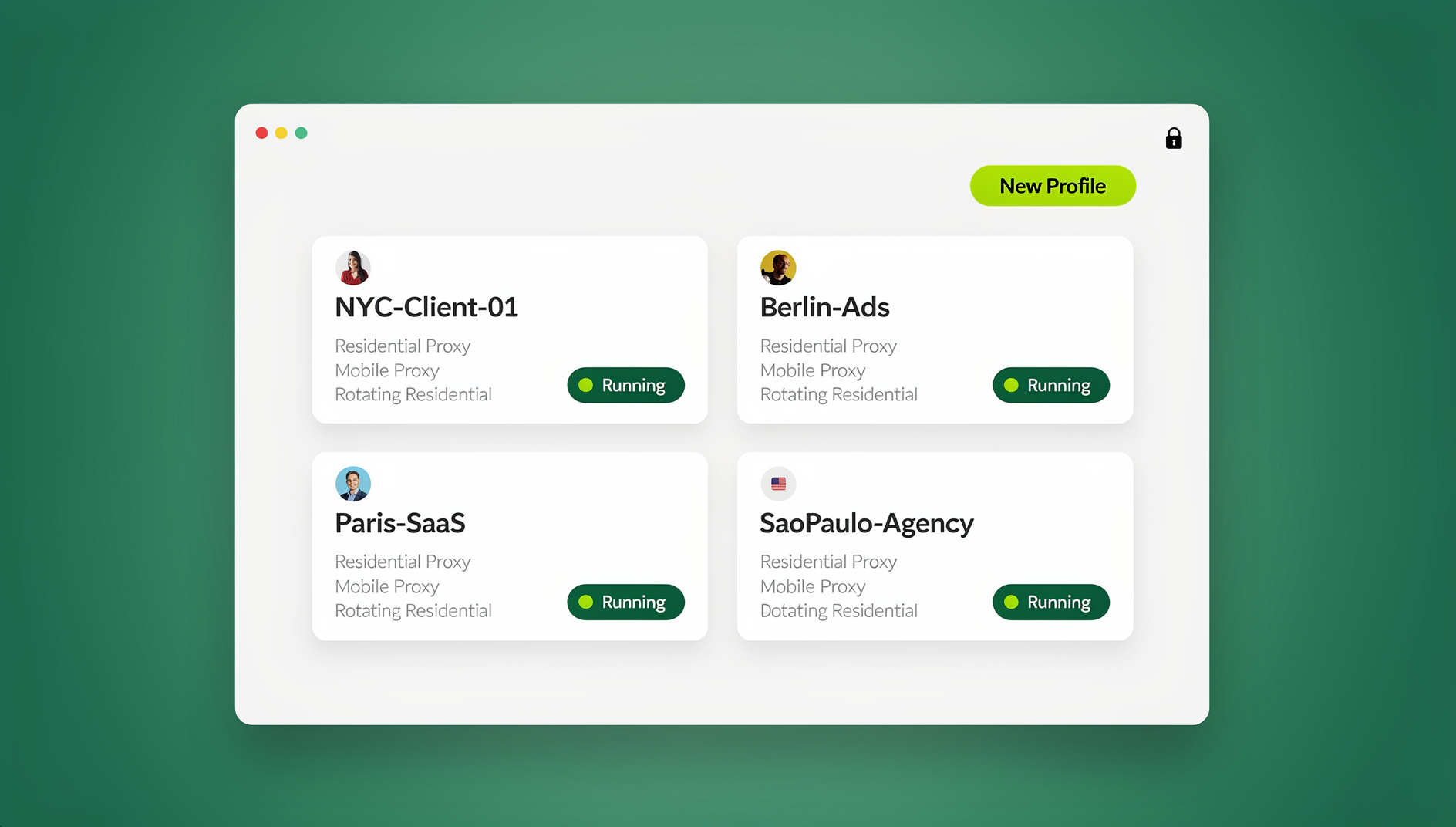
Sendwin Browser is a desktop app for Windows 10/11, macOS 12+ and Linux that runs a patched-Chromium engine with the Sendwin Stealth engine built in. Canvas, WebGL, audio, fonts and hardware are spoofed at the engine level rather than through script injection, and the values are kept coherent, so each profile reads like a separate real machine instead of a bundle of contradictory overrides. In practice that’s one saved profile per Medium account, each with its own cookies, storage and fingerprint.
Every plan includes built-in residential proxies, and you can bring your own HTTP or SOCKS5 instead. Timezone, locale, WebRTC and geolocation follow the proxy’s exit IP automatically, which clears the rows of the checklist above that are hardest to maintain by hand. Local profiles run all at once with no concurrency cap. If you want to see how this sits next to the rest of your stack first, there’s a rundown in our antidetect browser tool list.
If you’d rather not install anything on the machine you write from, the cloud browser runs the same profiles on Send.win’s EU and US cloud nodes from any device, with a free 10-minute-per-day preview and unlimited cloud browsing time on Pro and Team. Cloud sync on paid plans carries your logins across devices, so a profile you set up on a laptop opens signed in on a desktop. Sharing covers the other half: share a profile with a paid teammate and it opens already signed in, with no password changing hands — useful when a client account has its own byline and someone else handles replies.
The local Automation API for Selenium, Puppeteer and Playwright arrives on the Team plan, which is the point where pushing drafts or pulling per-account stats becomes worth scripting. The shape of it is one profile per account, each driven through the endpoint Send.win exposes for that profile:
from playwright.sync_api import sync_playwright

# One Send.win profile per Medium account (Automation API — Team plan).
# Copy the CDP URL from that profile's automation settings; don't guess the port.
CDP_URL = "http://127.0.0.1:PORT"

with sync_playwright() as p:
    browser = p.chromium.connect_over_cdp(CDP_URL)
    context = browser.contexts[0]
    page = context.new_page()
    page.goto("https://medium.com/")

    # Confirm the environment this profile presents to the site
    print(page.evaluate("Intl.DateTimeFormat().resolvedOptions().timeZone"))
    print(page.evaluate("navigator.userAgent"))
    print(page.evaluate("navigator.hardwareConcurrency"))

    browser.close()
One honest limit: Send.win separates the device, network and fingerprint layers between your profiles. It doesn’t change how Medium applies its terms, and it won’t rescue an account that breaks the AI content policy or duplicates another writer’s work. Isolation removes one class of risk; the editorial rules still apply to every profile you run.
🏆 Send.win Verdict
A multiple Medium accounts publishing strategy fails at the layer most writers never configure: the browser. Emails, Stripe connections and content lanes are things you can plan on paper, but a shared fingerprint, a mismatched timezone and a leaked local IP are what actually cluster sibling profiles. Send.win covers that layer directly — a saved profile per account with a coherent fingerprint, residential proxies that set timezone and geolocation from the exit IP, and cloud profiles plus profile sharing when you want to reach an account from another device or hand it to a teammate.
Try Send.win free today — 30 days at $0, then Pro from $6.99/month billed annually if it earns its place in your workflow.
Frequently Asked Questions
Can I have more than one Medium account?
Yes. Medium allows a writer to hold multiple accounts and doesn’t publish a cap on how many. Each one is bound by the same terms of service, and you can’t attach two accounts to a single email address, so plan for a dedicated inbox per profile from the start.
Does Medium ban users for having multiple accounts?
The terms don’t prohibit holding several accounts, but they let Medium suspend or terminate any account at its sole discretion, with or without notice. No reliable public figure exists for how often that happens, so treat it as a real but unquantified risk and keep your profiles separated.
How do I keep two Medium accounts from getting linked?
Separate every layer that can carry a signal: a distinct email address, a distinct phone number, its own Stripe connection for payouts, and its own browser profile with independent cookies, storage, fingerprint and IP. Reusing a recovery email or password is what turns two profiles into one identity.
Do I need a separate email for each Medium account?
Yes — you cannot attach two accounts to the same address. Create a dedicated mailbox per profile and forward everything into one inbox so replies still land in a single place. Keep recovery details distinct too, because reused credentials are one of the clearest ways accounts get clustered.
Does each Medium account need its own Stripe account?
Every account that accepts payments needs its own Stripe connection, so payouts can’t flow through one shared rail. Keep one tracking sheet that maps each profile to its Stripe account and tax details, especially when client bylines mean the payout entity isn’t you.
What are the Partner Program requirements in 2026?
A complete profile, at least six published stories, at least three months of activity on Medium, a bank account and tax residence in an eligible country, and an age of 18 or older. A paid Medium membership is no longer required to apply. Payment comes from a pool funded by subscription revenue and is distributed by engaged reading time, not a fixed rate per view.
Is phone verification required to open a second Medium account?
Yes, Medium requires phone verification at registration. Most failed codes come down to formatting — the country code, spaces, dashes or an extra leading zero — so correct the number before assuming delivery failed. Use a private number you’ll still control in two years, since one-time numbers break later logins and recovery checks.
How do I switch between Medium accounts quickly?
Keep each account in its own isolated browser profile that stays signed in, so switching means opening a profile rather than logging out and back in. Medium’s sign-in is single-session, so one browser holds one logged-in account at a time. Cloud sync on paid plans and shared profiles extend the same idea across devices and teammates.
How Send.win Helps With Multiple Medium Accounts Publishing Strategy
Send.win is an antidetect browser built for exactly this kind of work — every profile is a clean, isolated identity:
- Isolated profiles – unique fingerprint, separate cookies and storage per profile
- Stealth engine – canvas, WebGL, fonts, and audio spoofed at the engine level
- Desktop app + cloud sessions – native app for Windows, macOS, and Linux, or run profiles in the cloud with no install
- Built-in residential proxies – with automatic timezone, locale, and WebRTC matching
- Team features – share logged-in profiles with teammates without sharing passwords
Try the instant cloud browser demo — no install, no signup — or download the desktop app. The 30-day free trial needs no credit card, and paid plans start at $6.99/month billed annually (see pricing).