How to Scale Medium Publications and Accounts Without Partner Program Bans
To manage multiple Medium accounts safely, publication managers and ghostwriters must isolate each account’s browser fingerprint, cookies, IP location, and payout data telemetry. Medium’s anti-fraud system actively flags cross-account cookie sharing, IP overlaps, and duplicate browser environments, which leads to immediate Partner Program revocation or account termination. Utilizing isolated browser profiles with residential proxies provides hardware-level containerization, enabling creators to run multiple publications seamlessly.
Medium has established itself as one of the premier publishing platforms for digital writers, publication editors, niche content marketers, and thought leaders. With the growth of the Medium Partner Program (MPP), successful writers and content agencies frequently scale their reach by launching multiple publications, ghostwriting for corporate clients, or building brand profiles targeted at distinct audience demographics.
However, operating multiple Medium profiles from a single computer carries severe compliance and technical risks. Medium relies on advanced fraud detection mechanics to preserve platform integrity, combat automated read-time manipulation, and prevent payment fraud. Accounts caught sharing browser cookies, network fingerprints, or payment telemetry face swift penalties—ranging from silent reach suppression to permanent exclusion from the Medium Partner Program. Understanding Medium’s detection architecture and deploying dedicated profile isolation is essential for any serious content operation.
Why Medium Suspends Multiple Accounts and Partner Program Profiles
Operating a portfolio of Medium accounts requires a clear understanding of how Medium’s security systems detect multi-accounting. Medium does not rely solely on simple login logs; its anti-fraud engine analyzes hardware telemetry, network routing, and session data to detect linked accounts.
Here are the primary detection vectors Medium uses to identify and suspend linked accounts:
1. Cross-Account Cookie Leaks and Local Storage Collision
When you switch between Medium accounts in a standard browser by logging out and logging back in, residual data remains stored in your browser’s persistent storage. Session tokens, tracking pixels, IndexedDB records, and local storage variables persist across sessions. Medium’s client-side JavaScript reads these residual tokens, instantly linking your new login session to your previously logged-in author profile.
2. Hardware and Browser Fingerprint Telemetry
Medium tracks browser device telemetry to verify reader and writer authenticity. Every web browser generates a unique hardware signature known as a safe browsing fingerprint. Key tracking metrics include:
- Canvas & WebGL Fingerprints: HTML5 canvas graphics and GPU rendering attributes that form an immutable device ID.
- AudioContext & Font Hashes: OS-installed typography lists and system audio processing characteristics.
- Screen Geometry & Navigator Headers: Display resolution, window scaling, hardware thread counts, and device memory allocations.
If ten separate Medium profiles share identical hardware parameters and WebGL renderers, Medium’s system flags the accounts as operated by a single entity, triggering automated security reviews.
3. IP Address Overlaps and Subnet Tracking
Accessing multiple Medium profiles from the same home or office IP address creates a clear network correlation. If multiple accounts under your control clap, highlight, or comment on each other’s articles from an identical IP address, Medium flags the activity as unnatural engagement inflation, resulting in immediate Partner Program payouts revocation.
4. Stripe Account & Payout Information Association
Medium Partner Program earnings are processed via Stripe. If you attempt to link the exact same Stripe account, tax identification number, or bank details across multiple writer profiles without explicit agency verification, Medium’s fraud engine instantly connects those accounts. If one profile receives a policy violation penalty, all associated accounts sharing that payout telemetry face catastrophic cross-suspension.
| Risk Factor | Standard Browser Switching | Send.win Container Isolation |
|---|---|---|
| Session Persistence | Shared local storage & tracking cookies | 100% isolated sandboxed profile containers |
| IP Address Security | Single static IP across all profiles | Dedicated residential proxy assigned per account |
| Device Fingerprint | Identical GPU Canvas/WebGL hashes | Spoofed, unique hardware parameters per profile |
| Partner Program Safety | High risk of cross-account payout bans | Zero cross-contamination between writer profiles |
| Team Collaboration | Risky password sharing across writers | Encrypted profile sharing without credential exposure |
Common Pitfalls: Why Standard Browsing Workarounds Fail on Medium
Many writers and agencies attempt to manage multiple accounts using basic browser tricks, only to lose access to their publications and Partner Program earnings. Here is why conventional workarounds inevitably fail:
Incognito and Private Browsing Windows
Incognito windows clear cookies when closed, but they do not alter your hardware profile. Your screen resolution, Canvas rendering output, system fonts, and public IP address remain completely exposed to Medium’s client-side tracking scripts. Logging into Account A in regular mode and Account B in Incognito on the same machine links the accounts immediately.
Multiple Chrome or Firefox Browser Profiles
Creating separate Chrome user profiles isolates cookies between windows, but it does not isolate hardware attributes. All Chrome profiles execute on the same host operating system, utilizing the same graphics card drivers, WebGL context, and local network connection. Medium’s anti-abuse algorithms quickly correlate profiles operating on identical hardware specs.
Commercial Datacenter VPNs
Commercial VPN services route traffic through datacenter servers. Medium’s security systems recognize datacenter IP blocks (e.g., AWS, NordVPN, ExpressVPN) and treat them as high-risk sources. Datacenter IPs are frequently shared among thousands of users; if another user on your VPN server violates Medium’s terms, your accounts face shared collateral bans.
Step-by-Step Guide: Managing Multiple Medium Accounts with Send.win
To safely manage multiple Medium publications, client ghostwriting accounts, and niche author profiles, digital agencies and professional creators rely on Send.win. Send.win creates isolated, sandboxed browser profile environments with independent browser fingerprints, dedicated proxy management, and encrypted session storage.
Follow this step-by-step workflow to configure your Medium multi-account infrastructure:
Step 1: Set Up Isolated Profiles in Sendwin Browser
Open the Sendwin Browser desktop client (available for Windows, macOS, and Linux) or launch cloud browser sessions directly in your browser without local software installation. Create a dedicated container profile for each Medium account:
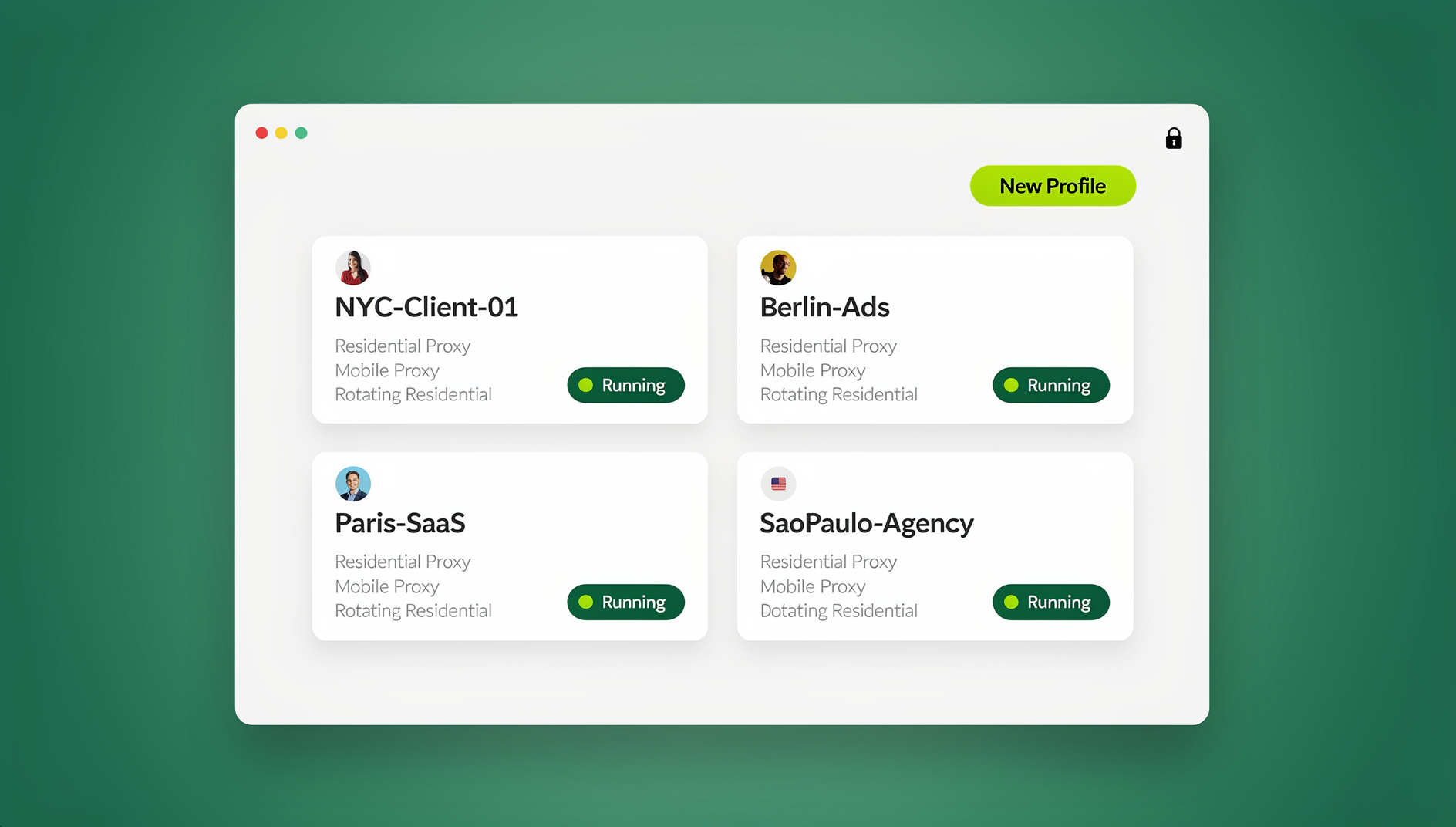
- Click New Profile within your Send.win control dashboard.
- Label the profile according to your Medium publication or client name (e.g., Medium – Tech Publication Editor).
- Configure operating system parameters (Windows, macOS, or Linux) and User-Agent strings.
- Send.win automatically generates unique Canvas, WebGL, AudioContext, and font fingerprint signatures for the profile.
Step 2: Attach Dedicated Residential Proxies
Assign a unique residential or mobile proxy to each Medium profile to guarantee complete IP separation:
For more guidance on selecting optimal proxy networks, read our complete guide on proxy browsers.
- Open the Proxy Settings tab in your Send.win profile configuration.
- Enter your residential proxy connection details (HTTP, HTTPS, or SOCKS5).
- Match the profile’s geolocation, language headers, and system timezone to your proxy’s physical location.
- Save and test the proxy connection before opening the browser environment.
Step 3: Log In and Secure Session Persistence
Launch the Send.win profile environment and navigate to Medium:
- Log into your Medium writer or publication account.
- Because Send.win utilizes advanced session isolation, your cookies, authentication tokens, and session states remain saved securely within the container.
- You will never need to repeatedly log in or deal with security 2FA triggers when reopening the profile.
Step 4: Schedule Medium Content Across Isolated Profiles
For publication managers handling large volumes of articles across multiple authors, Send.win provides isolated browser profiles on both Pro ($19/mo, or $83.88/yr) and Team ($49/mo, or $251.88/yr) plans. Each profile keeps its own cookies, storage, sessions and fingerprint settings, so you can organise story uploads, draft formatting, and publication scheduling across separate profiles.
Below is an example of how separate Send.win isolated profiles keep each Medium account’s cookies, storage and sessions apart while you work on publishing tasks:
# Send.win has no automation interface, so this step is done manually:
# open each Medium account in its own Send.win profile and work in that profile's window.
Best Practices for Multi-Account Medium Growth & Monetization
Using Send.win profile isolation solves hardware, cookie, and IP detection. However, you must also follow editorial and operational guidelines to protect your Medium accounts from behavioral policy flags.
1. Avoid Artificial Engagement Rings
Medium strictly penalizes artificial engagement networks. Never use Account A to clap 50 times, leave generic highlights, or post automated comments on Account B’s stories from the same IP network or within seconds of publishing. Maintain organic interaction patterns across your publication network.
2. Separate Stripe Payout Accounts and Tax Entities
If you manage multiple accounts enrolled in the Medium Partner Program, avoid linking identical payment details if the accounts represent different commercial entities or clients. When acting as an agency ghostwriter, have your clients link their own verified Stripe accounts directly within their respective Send.win profiles.
3. Use Team Workspace Permissions for Client Management
If you run a ghostwriting or content agency, sharing raw Medium account passwords with freelance writers exposes your client portfolio to data leaks and unauthorized logins. With Send.win’s Team Plan ($49/mo, or $20.99/mo annual for 500 profiles, 20GB storage, and 16 team seats), agency managers can grant writers access to specific Medium profile containers without sharing account passwords or two-factor authentication secrets.
4. Stagger Publication Releases and Niche Themes
Maintain distinct brand identities for each Medium publication you manage. Ensure every account publishes unique content tailored to its specific target publication, maintaining separate imagery, author bios, and external link profiles.
Comparison: Methods for Running Multiple Medium Profiles
Compare the security, cost, and operational capabilities of different multi-account management methods for Medium writers and agencies:
| Capability | Chrome Profiles | Datacenter VPN + Incognito | Send.win ($6.99/mo Pro) |
|---|---|---|---|
| Browser Fingerprint Protection | ❌ None (Exposes OS/GPU) | ❌ None (Shares Hardware Hash) | ✅ Full Canvas/WebGL/Audio Spoofing |
| IP Address Isolation | ❌ Same Public IP | ⚠️ High-Risk Datacenter IP | ✅ Dedicated Residential Proxy Support |
| Partner Program Safety | ⚠️ High Risk of Linked Ban | ⚠️ High Risk of Suspension | ✅ 100% Environment Separation |
| Automation API (Selenium/Playwright) | ❌ Not Supported | ❌ Complex Configuration | ❌ Not Supported |
| Agency Team Collaboration | ❌ Password Sharing Required | ❌ No Seat Sharing | ✅ 16 Team Seats & Granular Access |
| Pricing | Free | $5 – $15 / month | Pro $19/mo or $83.88/yr (7-day money-back guarantee; free cloud demo) |
🏆 Send.win Verdict
Scaling multiple Medium publications and ghostwriting accounts without browser isolation puts your Partner Program payouts and hard-earned reader audience at risk. Send.win gives each profile its own cookies, storage, sessions and fingerprint settings, along with proxy configuration, so your Medium accounts stay organised and separate.
Try the Send.win cloud demo — a 3-minute preview without signup, or 10 minutes a day with a free account, and scale your Medium publishing business with confidence.
Frequently Asked Questions
Is it against Medium’s rules to operate multiple accounts?
Medium permits users to maintain multiple accounts provided each account operates independently and complies with platform rules. However, using multiple accounts to manipulate read time, clap artificially for your own stories, or bypass Partner Program restrictions triggers immediate account suspension and payout forfeiture.
Will Medium ban my Partner Program payouts if accounts are linked?
Yes. If Medium’s fraud engine detects that multiple Partner Program accounts share identical browser fingerprints, IP subnets, or suspicious cross-clapping activity, it flags the network for engagement manipulation. This results in Partner Program disqualification and earnings forfeiture.
Can I use Send.win without installing software on my computer?
Yes. Send.win offers cloud browser sessions that allow you to launch and manage isolated browser profiles directly inside your web browser from any device. Alternatively, you can download the native Sendwin Browser desktop app for Windows, macOS, or Linux.
How does Send.win isolate my Medium author accounts?
Send.win isolates each profile into a separate virtual container. Each container maintains its own isolated cookie store, local storage database, WebGL/Canvas rendering signatures, font lists, and residential proxy IP. Medium sees each container as an entirely distinct physical computer.
Can I automate Medium draft creation using Selenium or Playwright?
No. Send.win does not offer an automation interface — there is no API, SDK, headless mode or Selenium/Puppeteer/Playwright support on any plan. Each profile keeps its own cookies, storage, sessions and fingerprint settings, so you can manage multiple Medium accounts in separate profiles.
How does Send.win help ghostwriting agencies manage client Medium accounts?
Send.win’s Team Plan ($49/mo, 500 profiles, 16 seats) allows agencies to delegate pre-authenticated Medium browser profile containers to team writers. Writers access the client profile to upload and edit stories without ever seeing or handling client login passwords or 2FA credentials.
Does Send.win offer a free trial for Medium creators?
Yes. Send.win offers paid plans starting at $19/mo, with the first card purchase covered by a 7-day money-back guarantee. You can set up isolated profiles, configure proxies, and test multi-account Medium management.
What is the cost of managing multiple Medium accounts with Send.win?
Send.win Pro starts at $19/month or $83.88/year for up to 150 profiles and 5GB storage. The Team plan is $49/month or $251.88/year for 500 profiles, 20GB storage, and 16 team seats. The first card purchase is covered by a 7-day money-back guarantee.
How Send.win Helps With Manage Multiple Medium Accounts
Send.win is a browser profile manager built for exactly this kind of work — every profile is a clean, isolated identity:
- Isolated profiles – unique fingerprint, separate cookies and storage per profile
- Fingerprint settings – each profile keeps its own consistent browser fingerprint, including canvas, WebGL, fonts, and audio
- Desktop app + cloud sessions – native app for Windows, macOS, and Linux, or run profiles in the cloud with no install
- Built-in residential proxies – with automatic timezone, locale, and WebRTC matching
- Team features – share logged-in profiles with teammates without sharing passwords
Try the instant cloud browser demo — no install, no signup — or download the desktop app. There is no free trial; paid plans start at $19/month, and the first card purchase is covered by a 7-day money-back guarantee (see pricing).