What Is a Cloud Browser Server?
A cloud browser server is a real browser running inside a virtualized container on remote hardware, controlled over the network instead of from your desktop. It renders pages, stores cookies and executes JavaScript in that container while your machine only sends commands and receives results. The site sees an ordinary Chromium. Your endpoint never touches the page’s code.
📌 TL;DR Executive Summary
- Core Takeaway: A cloud browser is a browser plus a virtualized container, exposed over CDP or a WebSocket so Playwright, Puppeteer or an agent attaches to a live Chromium instead of launching one.
- Key Risk/Challenge: Sessions end on the provider’s schedule — default timeout 900 seconds, ceiling 1800 — and a browser kept alive with auto_close=false keeps billing after you disconnect.
- Recommended Solution: Match the session model to your job length, batch anything over 30 minutes, and keep the browser fingerprint, timezone and proxy exit telling the same story.
A cloud browser is a browser application combined with a virtualized container that implements remote browser isolation: commands execute in a container separate from your endpoint. That definition covers a disposable session you open in a tab, a headless Chromium farm feeding an AI agent, and a Docker image your team maintains. What separates them is who owns the container, how long it lives, and how your code talks to it.
Cloud browser, headless browser, isolation
Headless describes a display mode: no visible window. Cloud describes location and ownership: the browser runs elsewhere and is exposed over a network protocol. Isolation is the property you get from the container. You can run headless Chromium in the cloud and call it a cloud browser, or run a graphical build and stream the pixels back — same architecture, different display layer.
That isolation is why the model spread past automation. Information security researchers adopted it early, and it is common in regulated sectors such as government, finance, healthcare and legal services, where opening an unknown link on a workstation is the risk you are trying to avoid.
How a Cloud Browser Server Works Under the Hood
Every provider assembles the same three parts: a browser process, a container around it, and a control channel your code speaks. The differences that matter in production live in the last two.
The container and the browser process
Your session gets Chromium — sometimes a hardened fork — inside a container in the provider’s region. The provider provisions the browser, enforces session limits, and layers on the extras: profiles, live views, replays, proxies, concurrency controls. Some destroy the container when the session ends; Browserbase documents one browser per VM that is destroyed after each session. Others keep a profile alive so cookies and logins survive between runs.
The container carries the rendering load too. Processing and rendering happen on the provider’s servers, and results are often compressed before they reach you, which is what makes a cloud browser usable from a thin client on a slow connection. For the isolation mechanics — the stream, the sandbox, the clipboard policy — this browser isolation guide covers the full picture.
The control channel: CDP or WebSocket
A cloud browser API runs a real browser on remote servers and exposes it over the Chrome DevTools Protocol or a WebSocket, so existing automation code attaches instead of launching locally. Playwright’s connectOverCDP() accepts an http://host:port or wss:// endpoint and returns a Browser whose first context is the one already open in the remote profile.
Attaching is not launching, and the difference causes real bugs. When you launch a browser, you own its lifecycle. When you attach over CDP, you hold a handle instead: closing the Browser object disconnects your client, and the remote Chrome process keeps running until something stops it. Decide how sessions end before your script exits — normally a call to the provider’s stop endpoint — and never assume that your process exiting cleaned anything up.
CDP is a Chromium protocol, and Firefox does not speak it natively, which is why connectOverCDP is documented for Chromium-based browsers only. For raw protocol work, a CDPSession gives you send(method, params) for calls, on('event') for every CDP event, and detach() to end it; the CDPSession reference lists the full surface.
from playwright.sync_api import sync_playwright

CDP_URL = "http://127.0.0.1:PORT"  # copy it from the profile's automation settings

with sync_playwright() as p:
    # Attach to a browser that is already running. Do not launch one.
    browser = p.chromium.connect_over_cdp(CDP_URL)
    context = browser.contexts[0]   # the profile's existing context, cookies included
    page = context.new_page()
    page.goto("https://example.com", wait_until="domcontentloaded")
    print(page.title())

    # Raw CDP: call protocol methods and subscribe to events on one page.
    session = context.new_cdp_session(page)
    session.send("Network.enable")
    session.on("Network.responseReceived",
               lambda e: print(e["response"]["status"], e["response"]["url"]))
    session.detach()

    # Disconnects this client. Stop the remote browser through your provider.
    browser.close()
Session Lifecycle: Resume, Timeouts and Orphaned Browsers
Most cloud browser spend leaks here, and none of it is mysterious once you know the parameters.
Resume needs two things
A managed session resume needs a stable session identifier and auto_close=false. Pass the identifier alone and the run is one-shot — the next connection gets a fresh browser. Skip the flag and the browser terminates the moment your script disconnects, so the second worker has nothing to attach to. With auto_close=false the browser keeps running and billing continues while nobody is attached. Puppeteer mirrors that split on the client side: browser.disconnect() leaves the browser alive, browser.close() ends it.
const puppeteer = require("puppeteer-core");

(async () => {
  // Your provider returns this endpoint when the session is created.
  const browser = await puppeteer.connect({
    browserWSEndpoint: process.env.BROWSER_WS_ENDPOINT,
  });
  const page = await browser.newPage();
  await page.goto("https://example.com", { waitUntil: "domcontentloaded" });

  await browser.disconnect(); // client detaches; the browser keeps running and billing
  // await browser.close();   // terminates the remote browser instead
})();
Timeout ceilings force batching
A documented session timeout defaults to 900 seconds — 15 minutes — and cannot exceed 1800 seconds, or 30 minutes, before the provider ends the session. Any crawl or agent run longer than that has to be split into batches that reconnect and re-check state. Decide the resume point before you start, because a browser vanishing mid-job is a bad place to design from.
Hunt orphaned sessions
Because a disconnected browser can keep costing money, end every run deliberately: check the provider’s session list or dashboard and call the documented stop endpoint for anything that should already be gone. Dashboards that break out browser hours, bandwidth and cost per session make a runaway browser obvious in seconds.
Why a Cloud Browser Server Matters — and Who It Changes Things For
The same architecture answers very different problems, so pick the shape that matches yours.
- Security and compliance teams. Unknown links open in a container, not on a workstation. That is the reason banks, hospitals, law firms and government agencies run browsers remotely at all.
- AI agents. An agent needs a browser that outlives one script run. The production pattern is a persistent browser in its own process or service with workers connecting over CDP: if a worker dies, the browser stays alive and the next worker reconnects. OpenAI retired Atlas in 2026, and the coverage that followed pointed readers toward running their own browser setup.
- Scrapers and automation developers. You get a real Chromium, a proxy exit and a channel your existing code already speaks, which is why a cloud browser for web scraping is a legitimate tool rather than a workaround.
- QA and support. Cross-browser checks and bug reproduction without maintaining a device lab.
- Distributed teams. Session state lives in the cloud, so a colleague can pick a session up where it stopped.
Self-Hosted vs Managed Cloud Browser Servers
Running your own browser server works fine until real traffic shows up. Then servers, Docker containers, memory leaks and adding machines by hand become the bottleneck. The failures are predictable:
- Memory leaks. Chromium processes that never release RAM take down containers, and you learn about it from a failed batch.
- Manual scaling. Adding machines by hand does not survive a queue that triples overnight.
- Lifecycle ownership. Persistent browsers, reconnects, cleanup and orphan killing become your code’s job.
- Fingerprint and proxy coherence. A container has a datacenter IP and generic hardware. If the profile claims Berlin and the IP resolves to Ashburn, the page sees the contradiction.
- Blast radius. A container on your network is on your network.
Managed providers absorb that work. If you want the control instead, open-source options exist: Steel is Apache 2.0 and self-hostable with Docker, and Browserless publishes an open-source Docker image alongside its hosted service. Either way the security model is yours to own — these cloud browser security best practices apply to rented and self-hosted containers alike.
Cloud Browser Server vs Local Browser vs Rendering API
| Dimension | Local browser / desktop profile app | Cloud browser server | Rendering or scraping API |
|---|---|---|---|
| What runs where | On your machine, limited by your CPU and RAM | Real Chromium in a remote container | No browser you manage; you get HTML or JSON |
| Control channel | None needed — you click | CDP or WebSocket | An HTTP request |
| Cookies and fingerprint | Preserved as long as the profile exists | Preserved by profile or session ID; the container itself looks generic | Per request; no durable identity unless you pass one |
| Persistence | Indefinite | Depends on session ID, auto_close and provider limits | Usually none |
| Scaling | Capped by hardware; many profiles can run at once | Provider concurrency, billed per browser hour or by traffic | Cheapest per page at volume |
| Best for | Logged-in account work, team handoffs | Agents, isolation, thin clients, long unattended work | Static pages and bulk data collection |
| Main cost driver | Hardware plus proxies | Browser hours, bandwidth, plan tier | Requests or compute |
Choose by the job. If you need a logged-in account to behave like a person on a real machine, a profile-based browser is the right tool. If you need a browser that outlives your laptop and any worker can attach to, rent the container. If you only need the data, skip the browser entirely.
What a Cloud Browser Server Costs
| Provider | Entry paid plan | Published browser-hour rate | Published concurrency |
|---|---|---|---|
| Browserbase | $20/mo Developer | $0.12 (Developer), $0.10 Startup overage | 3–250+ |
| Steel | $250/mo Scale, free Launch tier | $0.08 on Scale, $0.10 on Launch | 10–1,000+ |
| Anchor Browser | $50/mo Starter | $0.05 plus $0.01 per browser | 5–500+ |
Those rates were checked against vendor and review sites on July 23, 2026, and they only tell part of the story. The cheapest hourly number can sit behind the priciest monthly plan: Anchor’s $0.05 starts at $50 a month, while Steel’s $0.08 requires the $250 plan. Certification claims are worth checking at the source too — Browserbase publishes dated SOC 2 Type I and Type II milestones, while some competitors’ SOC 2 and ISO 27001 claims appear only on their own sites.
Other pricing models exist. One provider gives sessions away and charges only for proxy traffic, from about $1 per GB. Disposable-session services sell flat subscriptions — around $9 a month, or $24 one-time — and route everything through the vendor’s own cloud IP with no custom proxy support. Consumer cloud browsers that compress pages server-side start at a couple of dollars a month. Match the model to the workload before comparing headline numbers.
Setup Checklist for Playwright, Puppeteer and Selenium
Confirm the plumbing before you write automation code.
- Create the session and capture both the endpoint and the session ID from the API response.
- Choose the persistence model: one-shot, or
auto_close=falseplus a stored session ID. - Match the timeout to the job — anything over 30 minutes needs batching.
- Attach with
connectOverCDP()in Playwright, orpuppeteer.connect()with the WebSocket endpoint. - Reuse
browser.contexts()[0]in Playwright rather than creating a context, so you inherit the profile’s cookies. - Send a user agent, locale and timezone that match the proxy exit instead of library defaults.
- Add a finally-block that disconnects or stops the session, then check the dashboard for orphans.
Selenium needs a detour. WebDriver cannot attach to a remote CDP endpoint by itself, and providers document a bridge instead — typically a Playwright-backed wrapper between Selenium and the browser. Confirm that the bridge exists in your provider’s docs before you architect around it.
Two habits pay off repeatedly. Keep the same fingerprint across reconnects, because a new container with fresh canvas noise mid-flow is a signal rather than stealth. And separate interactive work from bulk work: do the login, 2FA or CAPTCHA handoff in the live session, then reuse that session’s cookies and fingerprint for cheap HTTP fetches instead of driving a browser for every page.
Common Mistakes That Break Sessions and Budgets
- Reconnecting without a session ID. You get a fresh browser, new cookies and a new login prompt. The identifier is the session.
- Forgetting auto_close=false. Your worker exits, the browser dies with it, and the next worker has nothing to attach to.
- Treating the timeout as negotiable. Plan for 900 seconds and batch anything longer; the 1800-second ceiling is a limit, not a target.
- Leaving an idle session running. A disconnected browser with a generous timeout bills the whole time.
- Using the wrong stop call. Puppeteer’s
browser.close()terminates the remote browser whilebrowser.disconnect()leaves it alive — pick deliberately on a session other workers share. - Mismatched identity. Datacenter IP, default timezone, default fonts: the page sees a server, not a person.
- Expecting a free pass past anti-bot systems. Hardened builds and CAPTCHA handling help, but a container full of default signals is often easier to fingerprint than a well-configured local profile.
- Modeling costs off the headline rate. Browser hours only apply on the tier that includes your target concurrency.
Where Send.win Fits
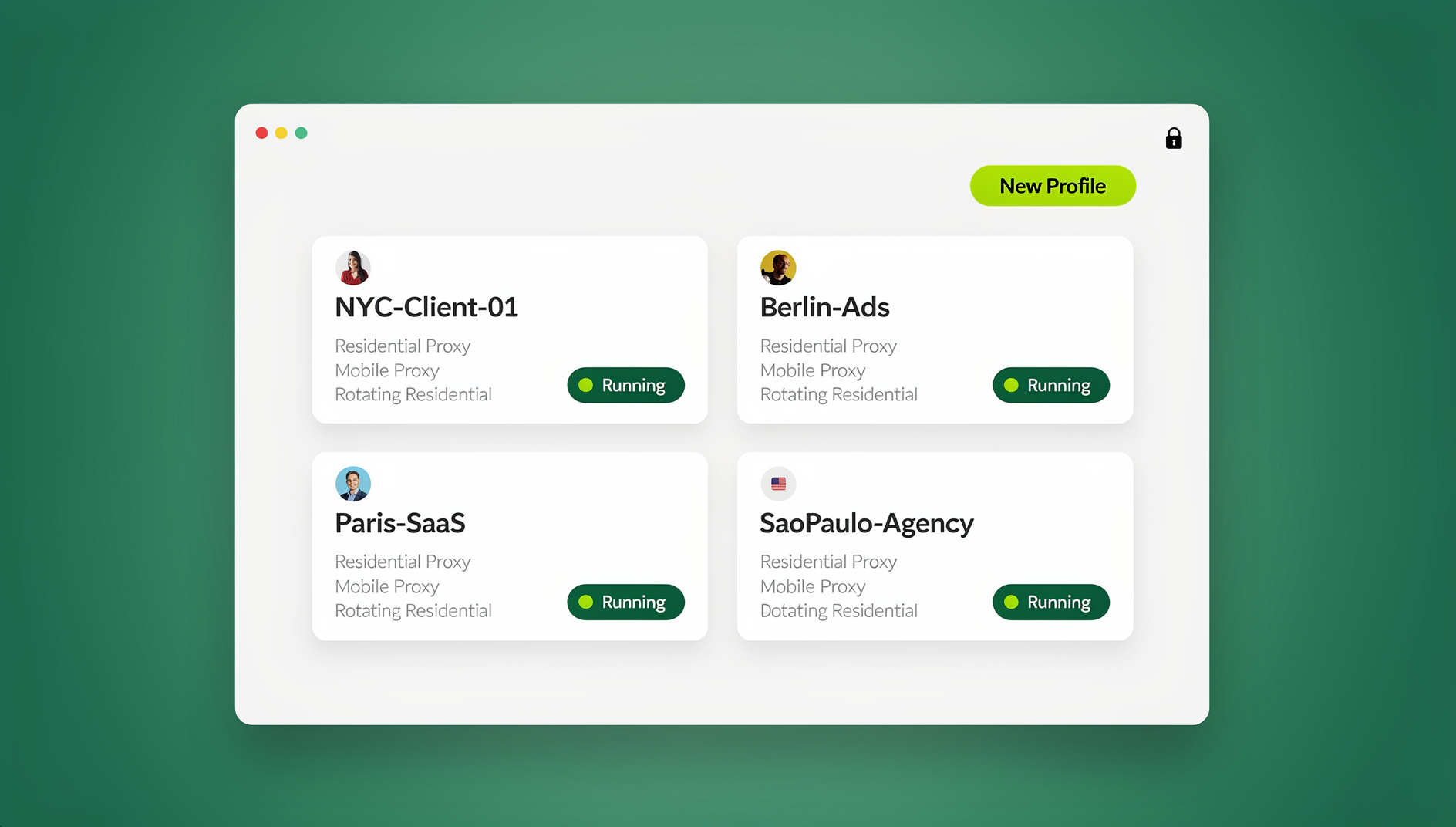
Send.win is not a per-hour headless API, and it is not sold as one. It is an anti-detect browser with two ways to run: the Sendwin Browser desktop app for Windows 10/11, macOS 12+ and Linux, or the cloud browser that runs profiles on EU and US nodes with nothing to install. An instant cloud preview needs no signup and gives you 10 minutes a day, and cloud browsing time becomes unlimited on Pro and Team.
The fingerprint work sits at the engine level. Canvas, WebGL, audio, fonts and hardware are spoofed inside the patched-Chromium engine rather than injected by brittle scripts, and they are kept coherent, so no two profiles share a fingerprint. Timezone, locale, WebRTC and geolocation follow the proxy’s exit IP automatically, which removes the mismatch problem above. Residential proxies are built into every plan, with bring-your-own HTTP/SOCKS5 as an alternative.
For teams, the cloud tier does what a rented container will not: cloud sync carries logins across devices, and sharing a profile with a paid teammate opens it already signed in, so no password changes hands. Live cloud sessions can be shared, and on Team you can block or redirect pages inside them.
Automation is local and sits on the Team plan, for Selenium, Puppeteer and Playwright. You point the script at the profile’s own endpoint rather than a provider endpoint:
from playwright.sync_api import sync_playwright

# Copy the endpoint from the profile's automation settings in Sendwin Browser.
CDP_URL = "http://127.0.0.1:PORT"

with sync_playwright() as p:
    browser = p.chromium.connect_over_cdp(CDP_URL)
    page = browser.contexts[0].new_page()
    page.goto("https://example.com", wait_until="domcontentloaded")
    print(page.title())
Pricing is flat rather than per browser hour: the 30-day trial costs $0 today and continues on Pro afterwards, Pro is $19/mo or $6.99/mo billed annually, and Team is $49/mo or $20.99/mo billed annually. Cloud concurrency is 1 session on the free preview, 3 on Pro and 9 on Team, while local profiles run without a concurrency cap. The Sendwin cloud features breakdown covers the rest.
🏆 Send.win Verdict
A cloud browser server is the right answer when you need a browser that outlives your machine — for agents, isolation or unattended work. But most of the work people do in the cloud is account work, and that is where container defaults hurt you: a datacenter IP, generic hardware and a fingerprint that does not match the proxy. Send.win is built for that case. Profiles run locally in the desktop app or in the cloud on EU and US nodes, each with a coherent engine-level fingerprint and a residential proxy on every plan, plus login-preserving sharing for teammates.
Try Send.win free today — 30 days for $0, cancel anytime, with cloud browsing unlimited on Pro and Team.
Frequently Asked Questions
What is a cloud browser server in one sentence?
A browser running in a virtualized container on remote hardware that your code controls over the network, usually through CDP or a WebSocket. It renders pages, stores cookies and runs JavaScript remotely while your machine only sends commands and receives results. That container boundary is also what makes it a remote browser isolation tool.
Run Cloud Browser Server in the Cloud With Send.win
Send.win’s cloud browser runs your isolated profiles on remote infrastructure — open a clean, fingerprint-isolated session from any device without installing anything:
- Instant cloud sessions – launch an isolated browser in seconds, no local install
- Isolated profiles – separate fingerprint, cookies, and storage per session
- Cloud sync & profile sharing – pick up the same profiles on the desktop app (Windows, macOS, Linux) or share them with your team
- Built-in residential proxies – with automatic timezone and locale matching
You can try it right now: the Send.win demo browser opens an isolated cloud session directly in this browser tab. The 30-day free trial needs no credit card, and paid plans start at $6.99/month billed annually — see pricing.
How do I connect Playwright to a cloud browser?
Call p.chromium.connect_over_cdp() with the endpoint your provider returns, then use browser.contexts()[0] to inherit the profile that is already open. Do not launch your own browser. Puppeteer’s equivalent is puppeteer.connect() with a WebSocket endpoint.
How is a cloud browser different from a headless browser?
Headless is about the display — no visible window. Cloud is about where the browser runs. A headless browser can run locally, and a cloud browser can stream a full graphical Chromium. The distinction that matters operationally is ownership: with a cloud browser, the provider provisions the process and you attach to it.
Are cloud browsers free or paid?
Both models exist. Managed infrastructure starts around $20 to $50 a month, with published browser-hour rates from about $0.05 to $0.12. Some services give sessions away and charge only for proxy traffic, from about $1 per GB. The lowest hourly rate usually sits behind the most expensive plan tier, so check the tier before you model costs.
Can a cloud browser bypass CAPTCHAs and anti-bot systems?
It can help — some commercial platforms bundle CAPTCHA solving and hardened browser builds — but nothing guarantees a pass. Anti-bot systems score device signals, IP reputation, behaviour and timing together, and a default container is easy to spot. Coherence between the browser, the proxy exit and the timezone does more for you than any single bypass feature.
Why did my session end in the middle of a long job?
Almost always the timeout. Documented defaults sit at 900 seconds and the ceiling at 1800 seconds per session, after which the provider terminates the browser. Split long runs into batches, reconnect with the session ID, and re-check state at the start of each batch rather than assuming the page is still where you left it.
Is a cloud browser secure for handling sensitive accounts?
The container keeps page code off your endpoint, which is a real gain when you open unknown links. It does not protect the credentials inside the session: anyone holding the session ID can use a logged-in profile. Share access through your provider’s roles, and stop sessions you are not using.
Should I use a rendering API or a cloud browser for scraping?
Use a rendering or scraping API when you need static HTML, predictable volume and the lowest cost per page. Use a cloud browser when you need real login state, JavaScript-heavy flows, interaction or an agent that acts on the page. Many teams run both and hand cookies from the interactive session to the cheap fetches.