Why Your IP Reputation Decides Whether Accounts Live or Die
Every IP address carries an invisible credit score that platforms check before they let you log in, run ads, or send emails. A poor score triggers CAPTCHAs, shadowbans, ad rejections, and outright suspensions — often before you even do anything wrong. This IP reputation management guide breaks down exactly how reputation scoring works, what tanks it, how to audit your current standing, and the concrete steps (residential proxies, dedicated IPs, per-profile proxy isolation) that keep every account in good standing.
What Is IP Reputation — and Why Should You Care?
IP reputation is a trust rating assigned to an IPv4 or IPv6 address by security vendors, email providers, ad networks, and social platforms. The rating is built from observed behavior: spam volume, bot traffic patterns, abuse reports, blacklist entries, and association with known threat infrastructure. Think of it like a credit bureau for internet addresses — except you rarely get to see your score, and a single bad tenant on a shared IP can trash the rating for everyone.
How Reputation Scores Are Calculated
Different vendors use different scales, but the inputs are remarkably consistent:
| Signal | Weight | What It Measures |
|---|---|---|
| Spam trap hits | Very High | Messages sent to addresses that exist only to catch spammers |
| Blacklist presence | High | Whether the IP appears on DNSBLs like Spamhaus, Barracuda, or SURBL |
| Abuse reports | High | User complaints filed against traffic from the IP |
| Traffic volume anomalies | Medium | Sudden spikes that look automated or coordinated |
| Bot signatures | Medium | Request patterns matching known scrapers, credential stuffers, or click fraud |
| ASN classification | Medium | Whether the IP belongs to a residential ISP, datacenter, or hosting provider |
| Geolocation consistency | Low–Medium | Mismatch between claimed location and actual IP geo |
| Age of IP assignment | Low | Newly allocated IPs often start with a neutral or slightly negative score |
Platforms don’t rely on a single score. Facebook’s ad review system, Google Ads, Amazon Seller Central, and email gateways like Gmail’s Postmaster each maintain their own proprietary models. But they all drink from the same upstream data: RBLs, commercial threat-intel feeds (like MaxMind, IPQualityScore, and Spur), and their own first-party behavioral logs.
How Platforms Actually Check Your IP Reputation
Real-Time Lookups at Login and Action Time
When you log into an e-commerce marketplace or ad platform, the server fires off a reputation query before the page even finishes loading. This isn’t a one-time gate — it happens on every session start, every ad submission, and every high-value action like payment changes or listing updates. If the IP comes back flagged, the platform can:
- Force CAPTCHA verification or phone/SMS challenges
- Queue manual review for ad creatives or new listings
- Throttle API requests or email delivery
- Silently shadowban the account (you see normal UI, but visibility drops to zero)
- Immediately suspend or lock the account pending identity verification
Cross-Account Correlation via IP Overlap
This is where IP reputation becomes existential for multi-account operators. Platforms maintain graphs that link accounts sharing the same IP. Two accounts logging in from the same address within a short window aren’t treated as coincidence — they’re treated as the same operator. If one account gets banned, the linked account inherits the penalty. This is exactly why understanding your browser fingerprint matters alongside IP: the two signals compound each other.
Behavioral Fingerprinting Layered on IP
Modern anti-fraud doesn’t stop at the IP. Platforms combine IP reputation with browser fingerprinting, cookie graphs, device IDs, and timing analysis. A clean IP won’t save you if your browser fingerprint is identical across accounts. Conversely, a unique fingerprint doesn’t help much if the IP is already blacklisted. Effective ip reputation management means controlling both layers simultaneously.
The 5 Biggest Sources of Bad IP Reputation
1. Shared Hosting and VPN Exit Nodes
Consumer VPNs route thousands of users through the same IP addresses. When even a small percentage of those users engage in spam, scraping, or fraud, the exit node’s reputation craters. By the time you connect, the damage is done. This is why VPN IPs trigger CAPTCHAs on almost every major platform — Google, Facebook, Amazon, and Cloudflare all maintain VPN/proxy detection lists.
2. Datacenter IP Ranges
IP addresses allocated to cloud providers (AWS, Azure, GCP, DigitalOcean, Hetzner) are classified as “datacenter” by threat intelligence providers. Many platforms flag datacenter IPs as suspicious by default because legitimate consumers don’t browse the web from a VPS. Even if your specific IP has never sent a spam email, the ASN classification alone can lower your starting reputation.
3. Recycled or Reassigned IPs
ISPs reassign IP addresses regularly. When you get a “new” residential IP from your ISP, it might carry baggage from the previous assignee — open abuse reports, unresolved blacklist entries, or historical association with botnet traffic. DHCP lease rotations mean you’re gambling on clean history every time your IP changes.
4. Neighborhood Pollution (Shared Subnets)
Reputation doesn’t always stop at the individual IP. Some systems score entire /24 subnets (256 addresses). If your neighbor on 192.168.1.x is running a spam operation, the entire range gets penalized. This is especially common in email deliverability — Gmail’s Postmaster tools explicitly show domain and IP reputation at the subnet level.
5. Your Own Historical Activity
Previous accounts that were suspended, ad campaigns that were rejected for policy violations, or automated scripts that triggered rate limits — all of this gets attached to the IP. Even legitimate bulk operations can look abusive to automated systems if the volume pattern matches known attack signatures.
How to Check Your IP Reputation Right Now
You don’t have to guess. Multiple free and paid tools let you audit any IP address:
| Tool | What It Checks | Cost |
|---|---|---|
| IPQualityScore | Fraud score, VPN/proxy/Tor detection, abuse velocity | Free tier (limited) |
| Talos Intelligence (Cisco) | Email/web reputation, volume history, blacklist status | Free |
| AbuseIPDB | Crowdsourced abuse reports, confidence score | Free tier |
| MXToolbox | Blacklist checks across 100+ DNSBLs | Free |
| Google Postmaster Tools | Gmail-specific sender reputation (domain + IP) | Free (requires domain verification) |
| Spur.us | VPN/proxy/residential classification, ASN context | Paid |
| MaxMind minFraud | Transaction risk scoring with IP context | Paid |
| Scamalytics | Fraud risk score, ISP classification | Free lookup |
What to Look For in Results
- Fraud score above 75: Most platforms will flag or block traffic from this IP
- Proxy/VPN detection = true: Expect CAPTCHAs and increased scrutiny on every session
- ASN type = “hosting”: Datacenter classification hurts reputation by default
- Active blacklist entries: Even one RBL listing (Spamhaus SBL, Barracuda) can tank deliverability
- High abuse report count: More than 5 reports in 30 days is a red flag
Run these checks on every proxy and IP you use regularly. What looks clean today can deteriorate within days if the provider’s other customers are sloppy. Maintaining proper session isolation alongside clean IPs is what separates operators who scale from those who get wiped.
The Real Impact of Bad IP Reputation
Ad Account Survival
Facebook and Google Ads review systems weight IP reputation heavily during account creation and the first few ad submissions. A flagged IP during the account’s “trust-building” phase can result in an immediate disabled account — before you’ve even spent a dollar. Even established accounts see higher rejection rates and longer review queues when accessed from low-reputation IPs.
Email Deliverability
Sending email (or transactional notifications) from a bad-reputation IP means your messages land in spam or get silently dropped. Gmail’s sender reputation system operates at both domain and IP level. A shared SMTP relay with poor IP hygiene can tank deliverability for every sender on that server.
E-Commerce Account Stability
Amazon, eBay, Walmart, and Etsy all run IP correlation checks. Multiple seller accounts from the same IP — especially a datacenter IP — trigger linked-account investigations. The penalty is usually suspension of all connected accounts, not just the newest one.
Scraping and Automation Reliability
Rate limits, CAPTCHAs, and blocks hit low-reputation IPs first. If you’re running automated workflows, data collection, or monitoring scripts, bad IP reputation means higher failure rates, more retries, and wasted proxy bandwidth.
How to Fix and Protect Your IP Reputation
Solution 1: Switch to Residential Proxies
Residential proxies route traffic through real consumer ISP connections, which carry the same ASN classification as a normal home user. Because they’re registered to actual ISPs (Comcast, BT, Deutsche Telekom), they start with higher baseline reputation than datacenter or VPN IPs. For multi-account work, residential proxies are the minimum viable option.
Key considerations when choosing a residential proxy provider:
- Pool size and exclusivity: Larger pools mean less IP reuse. Dedicated (static) residential IPs are ideal but more expensive
- Geo-targeting granularity: City-level targeting matters for platforms that check geo-consistency
- Rotation policy: Sticky sessions (same IP for 10-30 minutes) are essential for account work — rotating every request looks automated
- Provider reputation: The proxy provider’s own pool can be dirty. Check IPs through the tools above before committing
Solution 2: Use Dedicated (Static) IPs Per Account
The gold standard for IP reputation management is a 1:1 mapping between accounts and IP addresses. Each account always accesses the platform from the same dedicated IP, and no other account ever touches that IP. This eliminates cross-account correlation entirely and builds positive reputation over time through consistent, clean usage patterns.
Static residential IPs (also called ISP proxies) combine the best of both worlds: residential ASN classification with the consistency of a dedicated address. They’re more expensive than rotating residential proxies but dramatically more reliable for long-lived accounts.
Solution 3: Per-Profile Proxy Assignment in an Antidetect Browser
Proxies alone aren’t enough. If two accounts share the same browser fingerprint, cookies, or local storage — even with different IPs — platforms can still link them. The complete solution is an antidetect browser that isolates every profile into its own environment with its own assigned proxy. This ensures IP isolation AND browser isolation work together. Using a proxy browser with proper per-profile assignment is how professional operators maintain clean separation at scale.
What per-profile proxy assignment should look like:
- Each browser profile is locked to a specific proxy IP or proxy configuration
- Cookies, local storage, IndexedDB, and cache are completely isolated between profiles
- Browser fingerprint parameters (canvas, WebGL, fonts, screen resolution, timezone) are unique per profile
- The timezone and language settings match the proxy’s geolocation
- No data leaks between profiles — not through shared extensions, DNS, or WebRTC
Solution 4: Warm Up New IPs Before High-Value Actions
Don’t create a new ad account or seller profile the moment you spin up a new IP. Spend 2-3 days doing normal browsing activity — visiting mainstream sites, watching videos, checking email — to build a baseline behavioral profile on that IP. This “warming” period signals to reputation systems that the IP is associated with genuine human activity, not a fresh bot instance.
Solution 5: Monitor Continuously, Not Just at Setup
IP reputation changes. A residential IP that was clean last month can end up on a blacklist this month if the ISP reassigns it or if a compromised device on the same subnet starts sending spam. Set up regular checks:
- Weekly blacklist scans (MXToolbox, AbuseIPDB)
- Monthly fraud score checks (IPQualityScore, Scamalytics)
- Immediate investigation if any account shows unusual CAPTCHA frequency or review delays
Send.win’s Approach to IP Reputation Management
Send.win — specifically the Sendwin Browser desktop app — is built around the principle that every profile should be a completely isolated digital identity. Here’s how that maps to IP reputation management:
Per-Profile Proxy Binding
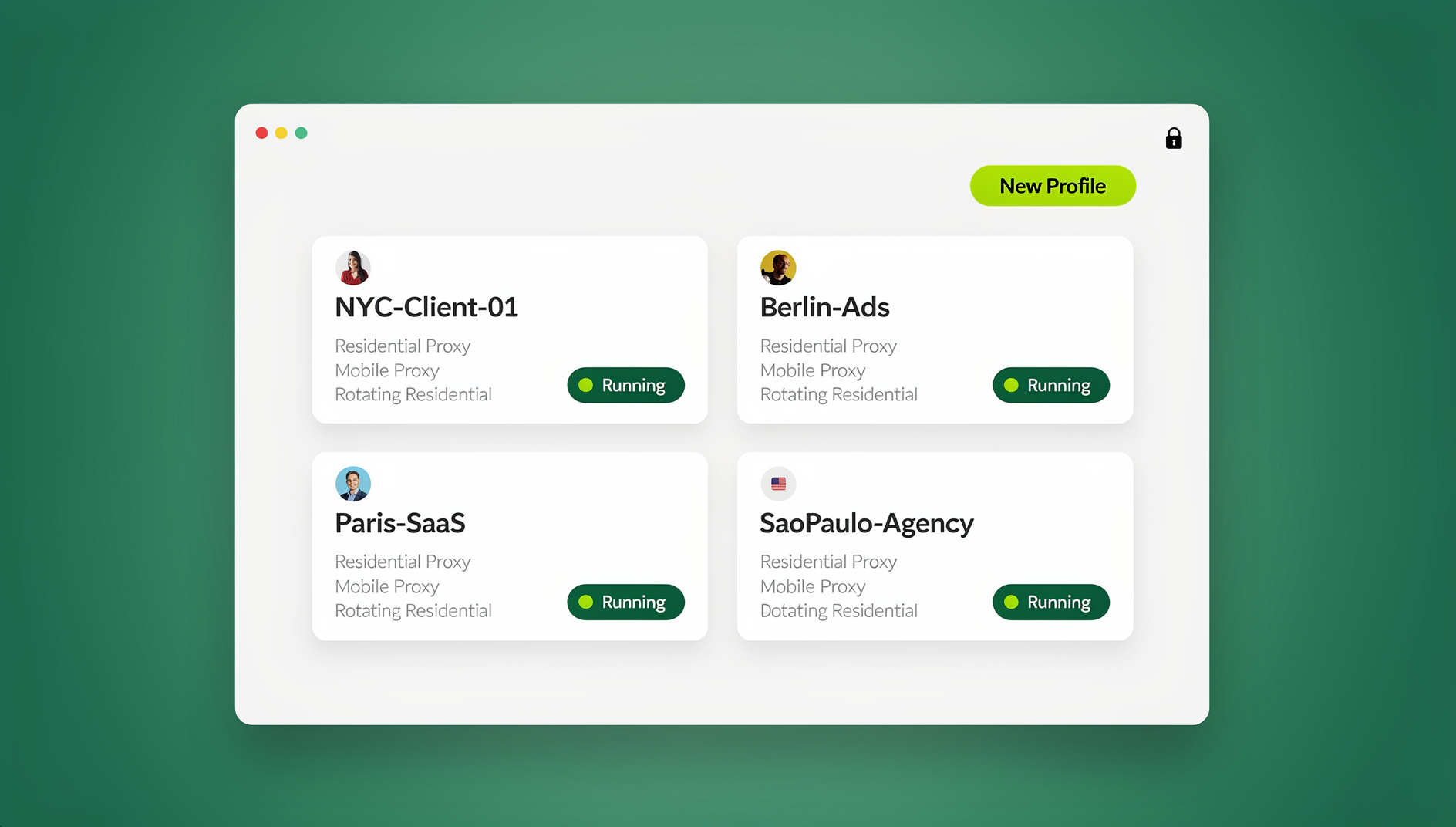
Every browser profile in Send.win can be assigned its own proxy — HTTP, SOCKS5, or residential. The proxy setting is locked to that profile. When you open the profile, it connects through its assigned proxy and only that proxy. No accidental IP leaks, no shared connections between profiles. This is the foundation of maintaining clean, per-account IP reputation.
Complete Session Isolation
Beyond the proxy, each profile runs in its own isolated environment. Cookies, cache, local storage, IndexedDB — everything is sandboxed. There’s no way for Platform A’s tracking scripts running in Profile 1 to detect cookies from Platform A in Profile 2. Combined with per-profile proxy assignment, this means each account has its own IP history AND its own browser history, with zero cross-contamination.
Fingerprint Customization Per Profile
Send.win generates unique browser fingerprints for each profile — canvas hash, WebGL renderer, installed fonts, screen dimensions, platform string, and more. The fingerprint is consistent across sessions (so the platform sees a stable device identity) but unique between profiles (so no two accounts look like they’re on the same machine). For deeper understanding of why this matters, our anonymous browsing guide covers the fingerprinting landscape in detail.
Geo-Consistency Matching
When you assign a proxy to a profile, Send.win can match the timezone, language, and locale settings to the proxy’s geolocation. This prevents the common detection vector where the browser says “timezone: America/New_York” but the IP geolocates to Frankfurt.
Cloud Browser Sessions for Clean Environments
For operators who need maximum separation, Send.win’s cloud browser sessions run profiles in the cloud with no local installation required. Each session starts from a clean environment, eliminating any risk of local machine artifacts contaminating the profile’s identity. This is particularly valuable when you need to access accounts from locations where installing desktop software isn’t practical.
Profile Isolation for Scaled Operations
Available on both the Pro plan ($19/month, or $83.88/year) and Team plan ($49/month, or $251.88/year), Send.win gives each browser profile its own cookies, storage, sessions, fingerprint settings and proxy. Each profile keeps its own consistent browser fingerprint and proxy, so your profiles stay separate and organised. The Pro plan includes 150 profiles and 5GB of proxy bandwidth; the Team plan scales to 500 profiles, 20GB bandwidth, and 16 team seats.
🏆 Send.win Verdict
IP reputation is the silent killer of multi-account operations — and fixing it requires more than just buying better proxies. You need per-profile proxy isolation, unique fingerprints, complete session separation, and geo-consistency matching working together. Send.win’s Sendwin Browser handles all four out of the box, keeping each profile’s cookies, storage, sessions and fingerprint separate. At $19/month (or $83.88/year for Pro), it’s a cost-effective way to keep every account’s IP reputation clean and independent.
Try the free Send.win cloud demo — a 3-minute preview without signup, with full proxy isolation from day one.
IP Reputation Management Checklist
Use this as a quick-reference workflow for maintaining clean IP reputation across all your accounts:
| Step | Action | Frequency |
|---|---|---|
| 1 | Audit all active IPs using IPQualityScore + MXToolbox | Weekly |
| 2 | Replace any IP with fraud score above 75 or active blacklist entry | Immediately |
| 3 | Assign each account a dedicated residential or ISP proxy | At account creation |
| 4 | Verify geo-consistency (IP location matches browser timezone/language) | At proxy assignment |
| 5 | Warm new IPs with 2-3 days of normal browsing before high-value actions | At IP rotation |
| 6 | Isolate each account in a separate browser profile with unique fingerprint | At account creation |
| 7 | Monitor CAPTCHA frequency and review delays as early warning signals | Ongoing |
| 8 | Rotate proxies proactively before reputation degrades, not after | Monthly or as needed |
Common Mistakes That Destroy IP Reputation
Running Multiple Accounts Through the Same VPN Server
This is the single most common cause of mass account suspensions. Consumer VPNs recycle a small pool of exit IPs across thousands of users. Platforms have these IPs catalogued. Every account you log into from a shared VPN exit node gets linked — to each other and to every other user of that VPN server.
Ignoring IP Type Classification
Using a datacenter proxy and assuming “clean IP = safe.” The IP might have zero abuse history, but its ASN classification as “hosting” immediately marks it as suspicious. Always check the IP type, not just the fraud score.
Switching IPs Too Frequently
Rotating through different IPs for the same account creates an inconsistent access pattern that looks automated. Real users access their accounts from 1-3 locations consistently. If your account logs in from a different city every day, that’s a red flag regardless of each individual IP’s reputation.
Neglecting DNS and WebRTC Leaks
Your proxy might route HTTP traffic through a clean residential IP, but if DNS queries go through your real ISP or WebRTC exposes your actual IP, the platform sees the mismatch. Always verify full leak protection — not just the IP shown on “what’s my IP” sites.
Reusing Burned IPs After a “Cooling” Period
Platforms have long memories. An IP that was associated with a banned account six months ago is often still flagged. “Waiting it out” rarely works — get a fresh IP from a different subnet instead.
Frequently Asked Questions
What is IP reputation and how is it different from a blacklist?
IP reputation is a continuous score reflecting the overall trustworthiness of an IP address, based on traffic patterns, abuse reports, and classification data. A blacklist is a binary yes/no entry on a specific blocklist (like Spamhaus or Barracuda). An IP can have a mediocre reputation score without being blacklisted, and being removed from a blacklist doesn’t automatically restore a good reputation score — the two systems track different signals.
Can I fix a bad IP reputation, or do I need a new IP?
It depends on the severity. Minor issues (low fraud score, no blacklist entries, just datacenter classification) can improve over time with clean usage. Major problems (active blacklist entries, high abuse report counts, association with suspended accounts) are usually faster and more reliable to fix by switching to a fresh residential IP. Delisting from specific RBLs is possible but can take days to weeks, and some vendors cache old scores.
Do residential proxies guarantee good IP reputation?
No. Residential IPs start with a higher baseline reputation because of their ISP classification, but they can still be flagged if the proxy provider’s pool is overused or if previous users of that IP engaged in abuse. Always check the fraud score and blacklist status of any proxy IP before assigning it to a valuable account.
How often should I check my IP reputation?
Weekly for active account operations. Run blacklist checks (MXToolbox or AbuseIPDB) weekly, and do a full fraud-score audit (IPQualityScore) monthly. If you notice increased CAPTCHAs or slower review times on any platform, check immediately — those are early warning signs of degrading IP reputation.
Does using an antidetect browser fix IP reputation problems?
An antidetect browser solves the isolation problem — ensuring accounts don’t share fingerprints, cookies, or browsing data — but it doesn’t fix a bad IP. You need both: clean, high-reputation IPs assigned per profile AND proper browser isolation. The antidetect browser is the container; the proxy quality determines the IP reputation each container carries.
What’s the difference between shared and dedicated proxies for reputation?
Shared proxies split a single IP across multiple users. Any user’s bad behavior hurts everyone’s reputation on that IP. Dedicated (or static) proxies give you exclusive use of an IP, meaning your reputation depends solely on your own behavior. For high-value accounts (ad accounts, established seller profiles), dedicated residential/ISP proxies are strongly recommended.
Can platforms detect that I’m using a proxy even with good IP reputation?
Yes, through secondary signals: DNS leaks, WebRTC IP exposure, timezone/geo mismatches, and behavioral patterns. A clean IP is necessary but not sufficient. Full protection requires leak-proof proxy configuration, matching geo settings, consistent access patterns, and isolated browser profiles — which is why a complete antidetect setup matters, not just the proxy itself.
How does IP reputation affect email deliverability specifically?
Email providers (Gmail, Outlook, Yahoo) maintain separate IP reputation systems focused on sending behavior — spam complaints, bounce rates, spam trap hits, and authentication records (SPF, DKIM, DMARC). A single high-volume spam run from an IP can take months to recover from. Shared SMTP relays are particularly vulnerable because one bad sender can poison deliverability for every user on that relay’s IP range.
How Send.win Helps With Ip Reputation Management Guide
Send.win is a browser profile manager built for exactly this kind of work — every profile is a clean, isolated identity:
- Isolated profiles – unique fingerprint, separate cookies and storage per profile
- Fingerprint settings – canvas, WebGL, fonts, and audio configured per profile
- Desktop app + cloud sessions – native app for Windows, macOS, and Linux, or run profiles in the cloud with no install
- Built-in residential proxies – with automatic timezone, locale, and WebRTC matching
- Team features – share logged-in profiles with teammates without sharing passwords
Try the instant cloud browser demo — no install, no signup — or download the desktop app. There is no free trial; paid plans start at $19/month, and the first card purchase is covered by a 7-day money-back guarantee (see pricing).