What Is Chrome’s IP Protection and How Does It Work?
The ip protection chrome privacy feature is Google’s initiative to mask users’ IP addresses through a two-hop proxy system, designed to prevent third-party trackers from covertly identifying and monitoring you across the web. Rather than broadcasting your direct IP to every site you visit, this built-in capability routes specific tracking requests through Google-owned and third-party servers, decoupling your identity from your internet traffic without severely degrading browsing performance. Understanding this tool is vital for navigating modern digital privacy.
Understanding the Basics of IP Address Tracking
Before diving into how Chrome’s new feature changes the landscape, it is essential to understand why IP addresses are considered sensitive data in the first place. An Internet Protocol (IP) address is a unique numerical label assigned to every device connected to a computer network that uses the Internet Protocol for communication. It serves two principal functions: host or network interface identification and location addressing. This foundational technology of the internet has, unfortunately, become a primary vector for unconsented surveillance.
Because your IP address is exposed to every server you communicate with, it has become one of the most reliable and persistent data points used by advertising networks, data brokers, and analytics platforms to track you. Even if you clear your cookies or use privacy-focused search engines, a static IP address can tie your activities together into a unified profile. This pervasive tracking is precisely why the anonymous browsing ecosystem has grown so rapidly, offering solutions ranging from VPNs to dedicated proxy configurations. In a world where your IP address acts as a digital fingerprint, masking it is the first line of defense.
How the IP Protection Chrome Privacy Feature Works
Google’s implementation of IP Protection is not a blunt instrument like a traditional VPN that encrypts and reroutes all device traffic. Instead, it is a highly targeted, application-level proxy system designed specifically for the Chrome browser. The architecture relies on what is known as a “two-hop” or “multi-hop” proxy design.
The Two-Hop Proxy Architecture Breakdown
When you navigate to a website, Chrome identifies whether certain requests on that page (such as third-party tracking scripts or pixels) fall under its known list of tracking domains. If a request is flagged, it is not sent directly to the tracker. Instead, the request undergoes a meticulous two-step routing process designed to fragment trust and information access:
- Request Identification: Chrome’s internal engine checks the requested URL against an evolving, locally stored list of known tracking domains. If there is a match, the IP protection sequence is triggered.
- Hop One (Google’s Ingress Proxy): Your browser establishes an encrypted connection to a proxy server operated directly by Google. This server receives your real IP address but does not have visibility into the final destination (the tracker’s domain) of your request. Its only job is to authenticate the user and forward the payload to the next node.
- Hop Two (Third-Party Egress Proxy): The second proxy server, operated by an independent third-party Content Delivery Network (CDN) partner like Fastly or Cloudflare, receives the request from Google’s server. Crucially, this second proxy only sees Google’s proxy IP address as the source, not your real one. It does, however, see the intended destination (the tracker) and completes the request on your behalf.
- Response Routing: The tracker receives the request from the third-party proxy, believing that proxy to be the user. It sends the data back through the reverse path: from the tracker, to the third-party proxy, to Google’s proxy, and finally back to your Chrome browser.
This separation of knowledge ensures that no single entity—not even Google—has access to both your identity (your IP address) and your browsing destination simultaneously. The tracker at the end of the chain only sees the IP address of the second proxy, completely masking your true location and identity. By utilizing high-bandwidth CDN partners, Google minimizes the latency typically associated with multi-hop networks.
The Phased Rollout Strategy
Because routing traffic through proxies can introduce latency and break certain geo-restricted services, Google is executing a meticulously planned, phased rollout for this feature. They cannot flip a switch without risking a massive disruption to the global internet architecture.
- Phase 0: The Testing Ground: The initial rollout (Phase 0) targets a very limited subset of users on US-based IP addresses. In this phase, the proxy only routes requests to Google’s own domains. This allows Google to stress-test the infrastructure, measure latency, and refine the two-hop authentication process without involving third-party CDNs or breaking external websites.
- Phase 1: Expanding the Tracker List: In subsequent phases, Google begins applying the two-hop proxy to a curated, publicly available list of known cross-site trackers. This phase is opt-in, allowing privacy-conscious users to test the feature on real-world sites and report breakage.
- Phase 2 and Beyond: Default Activation and Broad Implementation: Eventually, the goal is to enable IP Protection by default for a wider user base. The list of covered trackers will expand dramatically, and the infrastructure will scale globally to handle the immense bandwidth requirements of routing a significant portion of Chrome’s daily traffic.
Comparing Chrome IP Protection to VPNs and Tor
While the new feature represents a significant step forward for mainstream browser privacy, it is often misunderstood as a replacement for Virtual Private Networks (VPNs) or the Tor network. Understanding the differences is critical for implementing effective safe browsing practices.
Comparison Table: IP Protection vs VPN vs Tor vs Send.win
| Feature / Tool | Chrome IP Protection | Traditional VPN | Tor Browser | Send.win Per-Profile Proxies |
|---|---|---|---|---|
| Scope of Protection | Chrome browser only, limited to known trackers | System-wide (all apps and browsers) | Tor browser only (highly isolated) | Isolated per browser profile (Chrome/Firefox engines) |
| Privacy Level | Moderate (hides IP from specific third parties) | High (masks IP for all traffic, ISP blind) | Extreme (multi-node encryption, ISP blind) | High (custom residential/mobile IPs, total isolation) |
| Speed/Latency | Very Fast (CDN optimized) | Fast to Moderate (depends on server load) | Very Slow (due to multi-node routing) | Fast (depends on chosen proxy quality) |
| Fingerprint Spoofing | No | No (only changes IP) | Yes (uniform generic fingerprint) | Yes (highly customizable hardware/software spoofing) |
| Cost | Free (built-in) | Paid monthly/yearly subscriptions | Free (open source) | Freemium (Pro/Team tiers for scale) |
| Ease of Use | Seamless (automatic in Chrome) | Easy (requires app installation) | Moderate (requires specific browser habits) | Moderate to Advanced (powerful dashboard control) |
Chrome IP Protection vs. Traditional VPNs
A standard VPN operates at the operating system level. When you connect to a VPN, all traffic leaving your device—whether from your browser, email client, or background applications—is encrypted and routed through the VPN server. This provides comprehensive IP masking for your entire digital footprint. Furthermore, VPNs usually allow you to choose your proxy location, giving you the ability to bypass geo-restrictions.
In contrast, Chrome’s IP Protection only masks IP addresses for specific requests within the browser itself. It does not encrypt your overall device traffic, nor does it allow you to select a server location to spoof your geographic position.
Chrome IP Protection vs. The Tor Browser
The Tor network is the gold standard for anonymity. It routes your traffic through at least three decentralized, volunteer-operated nodes, encrypting the data at every step. This makes it virtually impossible for anyone to trace the connection back to your real IP address. However, this high level of security comes at a steep cost to performance, making Tor unsuitable for high-bandwidth activities like video streaming.
Chrome’s two-hop proxy is heavily optimized for speed. Because it relies on high-capacity servers operated by tech giants, the performance impact is negligible. However, the trust model is centralized, relying on corporate entities rather than a decentralized network.
Impact on Advertising and Geo-Targeting
The implementation of Chrome’s IP Protection is sending shockwaves through the digital advertising and marketing industries. For decades, IP addresses have been a cornerstone of ad targeting, campaign attribution, and geographic personalization.
Disrupting the Ad-Tech Ecosystem
Advertisers rely heavily on cross-site tracking to build user profiles. By understanding that an IP address visited a car blog, a finance site, and an electronics store, ad networks can infer the user is a high-income individual looking for a new vehicle. By masking the IP address for these third-party trackers, Chrome effectively blinds the ad-tech industry, preventing them from connecting the dots between disparate browsing sessions. This forces a shift toward contextual advertising or reliance on massive first-party data ecosystems (like Google’s own ecosystem).
Challenges for Geo-Targeting and Localization
Many websites use IP addresses to automatically serve localized content—think of news sites defaulting to your city or e-commerce stores displaying the correct currency. When IP Protection routes traffic through a proxy, the website sees the location of the proxy server, not the user. While Google attempts to mitigate this by assigning users to proxies within their general geographic region, hyper-local targeting (down to the zip code or city block) will become significantly less reliable. This means users may have to manually enter their location more frequently to get accurate local results.
Limitations and Deep Privacy Analysis
While masking your IP address from third-party trackers is a net positive, Chrome’s implementation has several notable limitations that privacy advocates frequently point out. It is essential to approach this feature with a clear understanding of its boundaries.
The Google Paradox and Metadata Visibility
The most glaring contradiction in the feature is Google’s role as the operator of the first proxy hop. Google is the world’s largest advertising company. While the two-hop design technically prevents Google’s proxy from seeing the final destination of the traffic, Google still maintains deep visibility into your overall browsing habits through other vectors—Google Search, Chrome sync, Google Analytics, and the fact that you are likely logged into a Google account while browsing.
Furthermore, running the first hop means Google still collects metadata about the sheer volume of your traffic, the timing of your connections, and your real IP address. For users seeking absolute privacy from major tech conglomerates, relying on Google to protect them from other trackers is a paradoxical strategy.
Incomplete Protection Against Fingerprinting
Masking your IP address is only one piece of the privacy puzzle. Advanced trackers increasingly rely on browser fingerprinting—a sophisticated technique that gathers massive amounts of data about your device’s hardware, software, screen resolution, installed fonts, WebGL rendering capabilities, and browser extensions to create a unique identifier.
Even if your IP address is perfectly hidden by Google’s proxies, a modern tracking script can still identify you with high accuracy based on your browser’s unique fingerprint. For a deep dive into this complex topic, you should read our comprehensive browser fingerprint explained article. True digital privacy requires a dual approach: robust IP masking combined with strict anti-fingerprinting measures.
Coverage is Limited to Known Trackers
Chrome’s IP Protection is not a blanket proxy. It only activates when a request is made to a domain that exists on Google’s curated list of known trackers. If a new ad network launches, or a malicious actor uses an unlisted domain for surveillance, Chrome will happily send your real IP address directly to them. This reliance on a reactive blocklist means you are always vulnerable to zero-day tracking domains.
How Send.win Provides Comprehensive Privacy Management
While built-in browser features are excellent for basic, passive protection, professionals managing multiple accounts, conducting market research, or operating marketing agencies require a more robust and customizable solution. This is where Send.win excels, offering a completely different paradigm for online privacy.
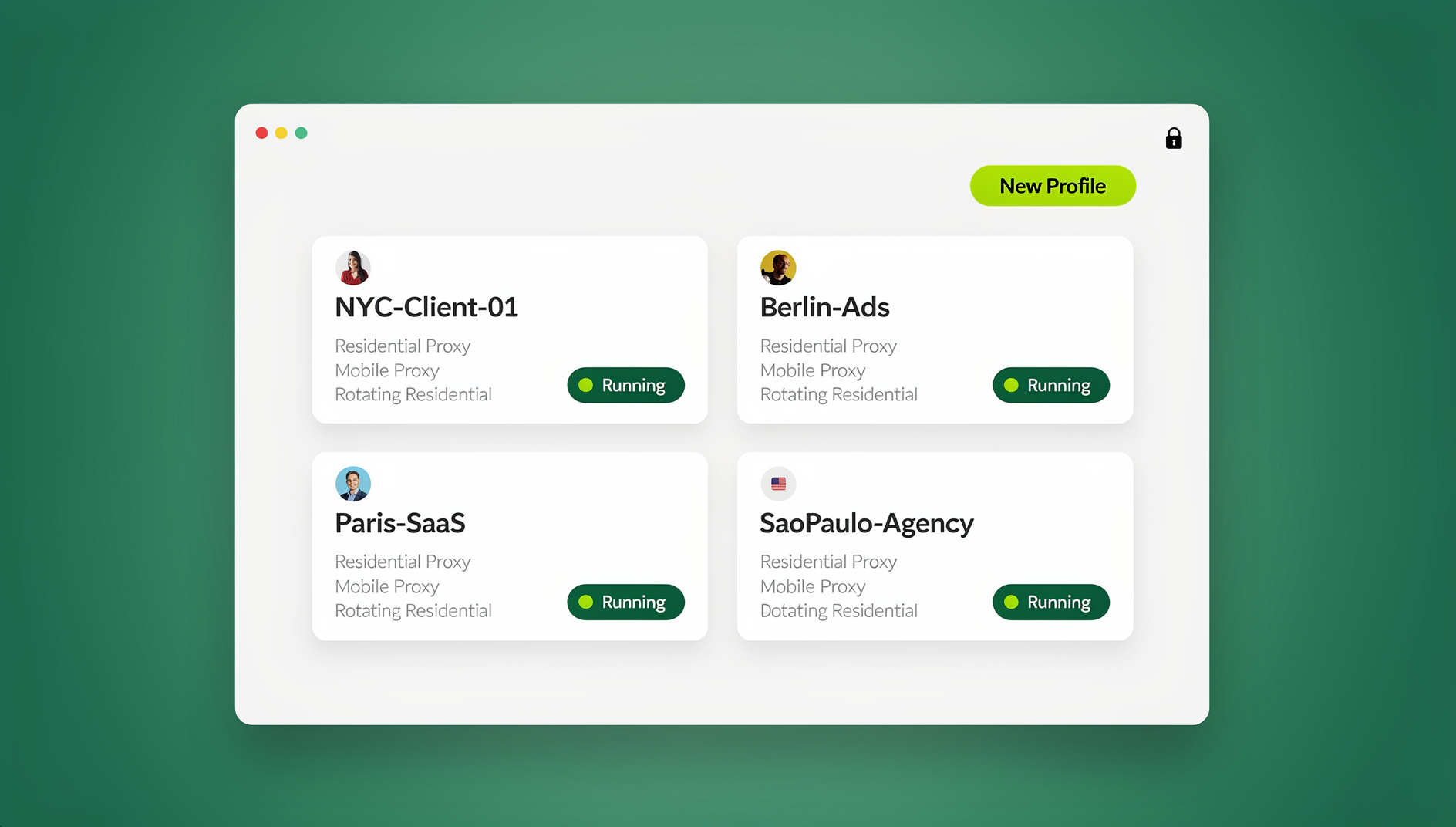
Send.win is a powerful desktop application and cloud session manager purpose-built for granular identity isolation. Instead of relying on a one-size-fits-all proxy controlled by a tech giant, Send.win allows you to create hundreds of completely isolated browser profiles, each with its own unique proxy connection, cookies, and digital fingerprint.
Per-Profile Proxy Assignments for Total Control
Unlike Chrome’s automated, unchangeable proxy routing, Send.win gives you complete, granular control over your network layer. You can assign residential, mobile, or datacenter proxies to individual profiles. This means Profile A can appear to be browsing from a residential IP in New York, while Profile B connects through a mobile IP in London. This level of segmentation is impossible with native browser features and is essential for tasks like ad verification or social media management without triggering account bans.
Superior Fingerprint Spoofing Technology
Send.win goes far beyond basic IP masking by spoofing the entire browser fingerprint at a deep level. It can intelligently alter your user agent, canvas fingerprint, WebGL data, audio context, and hardware concurrency. This ensures that each profile appears as a distinctly different, highly generic, and legitimate device. This comprehensive approach defeats the advanced tracking mechanisms that standard IP masking fails to address, ensuring true isolation.
Desktop App and Cloud Flexibility
Send.win offers two distinct modes to fit your workflow. The Sendwin Browser desktop app (available natively for Windows, macOS, and Linux) provides a high-performance environment for running profiles locally. Alternatively, the cloud browser sessions allow you to launch profiles directly in the cloud without any local installation — perfect for accessing accounts from restricted networks or low-powered devices.
The Automation API supports Selenium, Puppeteer, and Playwright across both Pro and Team plans. Pro starts at $19/month ($6.99/month with annual billing) with 150 profiles and 5GB bandwidth. The Team plan at $49/month ($20.99/month annual — 57% savings) scales to 500 profiles, 20GB bandwidth, and 16 seats. Both plans include a 30-day free trial with no credit card required.
For more insights on how customized routing and isolated profiles outperform native features, check out our in-depth guide on proxy browsers.
Best Practices for Enhancing Your Browser Security
To achieve the best possible privacy posture, you should adopt a multi-layered approach rather than relying on a single feature like IP Protection. Here are actionable steps you can take today to secure your digital footprint:
- Audit Your Extensions Heavily: Browser extensions have deep access to your data. Remove any unused or untrusted extensions, as they can leak your real IP address or inject tracking code into pages, completely bypassing any proxy protections you have in place.
- Implement DNS over HTTPS (DoH): Enable encrypted DNS in your browser settings immediately. This critical step prevents your Internet Service Provider (ISP) from seeing which domain names you are resolving, adding an extra layer of privacy before your traffic even reaches the proxy network.
- Segment Your Workflows Strictly: Do not mix personal browsing with professional tasks, financial management, or sensitive research. Use dedicated profiles or specialized isolation tools like Send.win to keep different online identities completely walled off from one another.
- Regularly Clear Session Data: Configure your browser to clear cookies, cache, and site data automatically upon closing. While IP masking hides your location, persistent cookies will still uniquely identify you as a returning visitor regardless of your IP.
How Send.win Helps With Ip Protection Chrome Privacy Feature
Send.win is an antidetect browser built for exactly this kind of work — every profile is a clean, isolated identity:
- Isolated profiles – unique fingerprint, separate cookies and storage per profile
- Stealth engine – canvas, WebGL, fonts, and audio spoofed at the engine level
- Desktop app + cloud sessions – native app for Windows, macOS, and Linux, or run profiles in the cloud with no install
- Built-in residential proxies – with automatic timezone, locale, and WebRTC matching
- Team features – share logged-in profiles with teammates without sharing passwords
Try the instant cloud browser demo — no install, no signup — or download the desktop app. The 30-day free trial needs no credit card, and paid plans start at $6.99/month billed annually (see pricing).
🏆 Send.win Verdict
Chrome’s IP Protection is a welcome addition for casual users looking to reduce third-party tracking, but its reliance on Google infrastructure, incomplete blocklists, and total lack of customizability make it insufficient for professional account management, web scraping, or true anonymity.
Try Send.win free today — take absolute control of your digital identity with comprehensive browser isolation, dedicated proxy support, and unparalleled anti-fingerprinting technology.
Frequently Asked Questions
Is Chrome’s IP Protection turned on by default?
During the initial rollout phases, the feature is strictly opt-in for most users. You typically need to enable it manually by navigating to Chrome’s privacy and security settings and toggling the specific option. As the feature matures, passes extensive stability testing, and the global proxy infrastructure scales up, Google intends to enable it by default for the vast majority of Chrome users.
Does this feature slow down my internet connection?
Because the traffic is routed through two separate proxy servers before reaching its destination, there is a theoretical increase in latency for those specific requests. However, because Google and its CDN partners utilize massive, highly optimized global server networks, the actual performance impact is negligible. For standard web browsing, page load times should remain virtually unchanged.
Can websites tell if I am using Chrome’s IP Protection?
Yes, websites and server administrators can easily identify proxy usage. The IP addresses used by the second-hop proxy servers (operated by CDNs) are publicly known to the tech industry. Consequently, aggressive fraud-prevention systems can identify that the traffic is originating from a proxy network rather than a standard residential internet connection, which may occasionally trigger security checks like CAPTCHAs.
Does this feature hide my activity from my ISP?
Your Internet Service Provider (ISP) will not be able to see the specific URLs or page content you visit if you are using HTTPS, but they will be able to see that you are connecting to Google’s proxy servers. Furthermore, if you are not utilizing an encrypted DNS protocol (like DNS over HTTPS), your ISP can still see the domain names you are requesting before the proxy connection is even established.
Will this feature bypass geo-blocking for streaming services?
No, Chrome’s IP Protection is completely ineffective for bypassing regional content blocks on platforms like Netflix or Hulu. The IP protection system is engineered to spoof your location for privacy, not for media access. The proxies generally route your traffic to a server geographically close to your actual physical location to minimize latency, ensuring your regional identity remains largely intact.
How does this affect local search results and weather?
Because your exact, hyper-local IP address is hidden, websites that rely on IP geolocation to serve local news, precise weather updates, or nearby store locations might become slightly less accurate. However, Google mitigates this severe degradation by assigning you a proxy IP address that is generally in the same state or metro region as your actual location, preserving broad local relevance.
Is Send.win better than Chrome’s built-in proxy?
For casual, everyday browsing, Chrome’s built-in feature is a convenient, frictionless upgrade. However, if you manage multiple professional accounts, need to scrape data without triggering IP bans, or require strict separation between distinct digital identities, Send.win is vastly superior. Send.win provides exact, per-profile proxy control and deeply defeats browser fingerprinting, whereas Chrome only offers a generic, uncustomizable proxy for a limited subset of web traffic.