What Is Multilogin (Multi-Accounting) — And Why Almost Every Business Ends Up Doing It
Multilogin, also called multi-accounting, is the practice of creating and operating more than one account on the same platform — whether that’s a second Facebook Ads account, five Amazon seller stores, a dozen client social profiles run by an agency, or ten Gmail inboxes managed by one operations team. It sounds like a niche gray-area tactic, but in 2026 it’s just how modern businesses operate: agencies manage clients, marketers run parallel ad campaigns, e-commerce sellers diversify across storefronts, and remote teams share access to shared tools without handing out personal passwords.
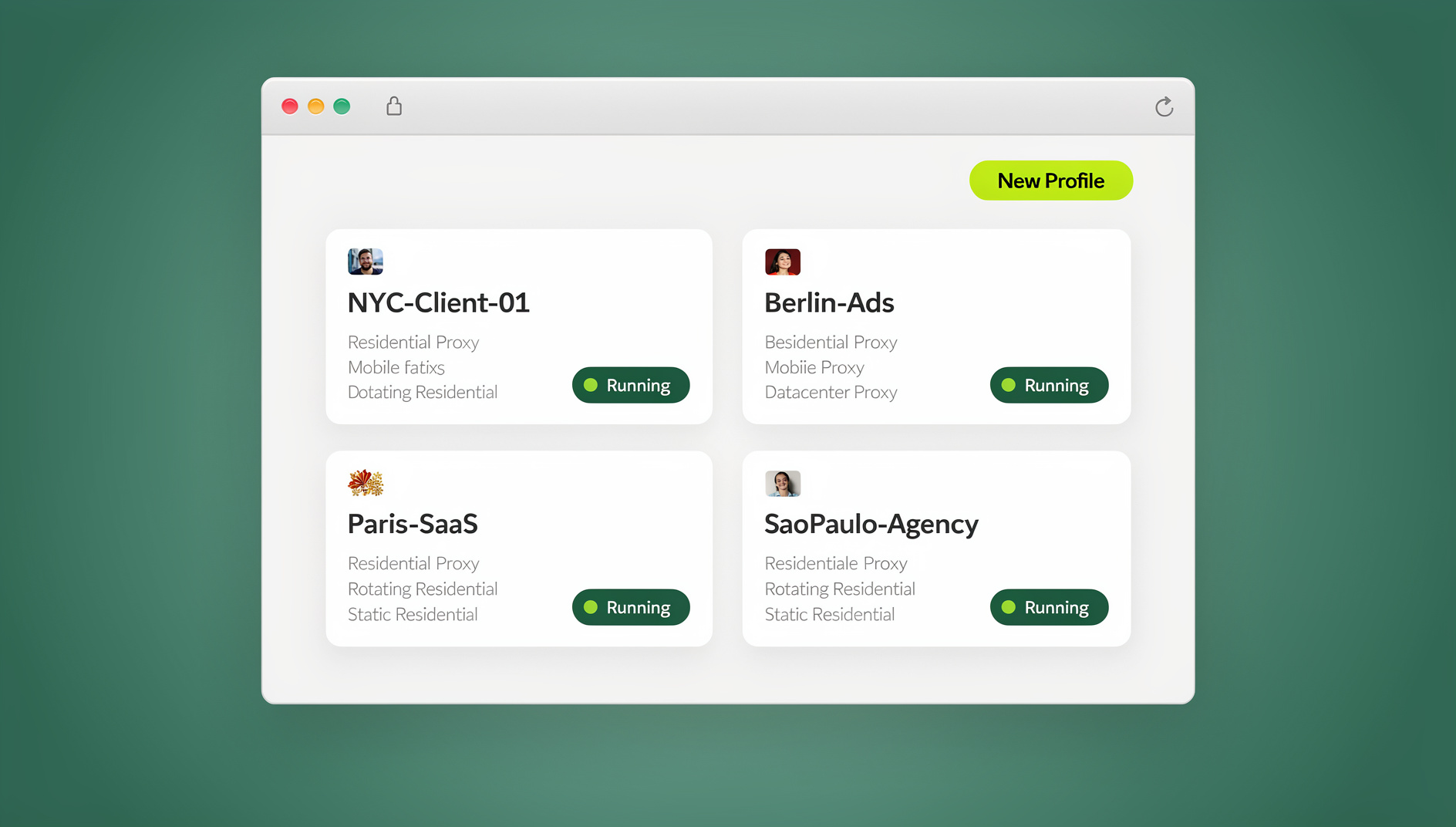
The problem is that most platforms — Meta, Google, Amazon, TikTok, Reddit, and nearly every marketplace or ad network — were built around a “one person, one account” assumption. When they detect multiple accounts connected to the same person, device, or network, their automated risk systems treat it as suspicious by default, regardless of whether the intent was legitimate. That mismatch between how businesses actually operate and how platforms police accounts is where multilogin risk comes from, and it’s exactly what this guide is about: understanding the real risks, and building a prevention strategy that keeps your accounts — and your business — safe.
Why Businesses Create Multiple Accounts
Before getting into risk and prevention, it’s worth being clear-eyed about why multi-accounting exists in the first place. It’s rarely about gaming a system — it’s usually about operational necessity:
- Separating personal and professional identity. Employees and founders don’t want their personal social profiles mixed with brand or client accounts.
- Agency and freelance client work. An agency managing 15 clients’ ad accounts, social pages, and marketplace stores needs to keep each one completely separate — legally and operationally.
- Multi-store and multi-brand e-commerce. Sellers running several Amazon, Shopify, or Etsy stores need each one to look and behave like an independent business, not a single operator wearing five hats.
- Testing and QA. Developers and marketers need clean, disposable accounts to test onboarding flows, ad creative, and new features without polluting a production account.
- Team access without password sharing. Multiple team members often need to log into the same shared tools (ad platforms, CRMs, analytics dashboards) without everyone using one shared login.
None of these reasons are inherently against platform rules — most terms of service allow multiple accounts for legitimate business purposes. The risk isn’t in having multiple accounts. It’s in how those accounts are accessed and whether the platform’s detection systems can tell they’re connected.
The Real Risks of Multilogin for Your Business
When multiple accounts are accessed from the same browser, device, or network without proper isolation, businesses expose themselves to a specific set of risks. Here’s what actually goes wrong, and how often it does.
1. Platform Detection and Account Bans
This is the risk business owners fear most, and for good reason. Platforms like Meta Business Suite, Amazon Seller Central, and Google Ads run automated fraud and abuse detection that flags accounts sharing a browser fingerprint, IP address, or device signature. Once flagged, the platform can suspend one account or — in the worst cases — cascade the suspension across every linked account, freezing ad spend, seller inventory, or client work overnight.
2. Fingerprint and IP Correlation
Even if you use different emails, passwords, and payment methods for each account, standard browsers leak a consistent browser fingerprint — canvas rendering, WebGL signature, installed fonts, screen resolution, timezone, and more. If ten “different” accounts all present the same fingerprint and the same IP address, platforms treat them as the same operator regardless of how careful you were with credentials.
3. Security Risk — One Breach, Many Accounts
Multi-accounting without isolation also creates a security blast radius. If your browser profile, cookies, or saved credentials are compromised, an attacker doesn’t just get one account — they potentially get every account logged in through that same environment. Businesses managing dozens of client accounts in one unsegmented browser are effectively storing all their keys in one basket.
4. Legal and Compliance Exposure
For agencies and regulated industries, mixing client accounts in a single unmanaged environment can violate client contracts, data-separation clauses, or industry compliance requirements (particularly in finance, healthcare-adjacent, and advertising verticals where client data segregation is contractually mandated).
5. Brand and Reputation Damage
When followers, customers, or partners notice a business juggling accounts clumsily — duplicate posts, inconsistent activity, or a sudden account suspension mid-campaign — it erodes trust. A banned ad account mid-launch or a suspended seller account during peak season is a direct revenue hit, not just an inconvenience.
6. Operational Chaos and Lost Productivity
Even without any ban or breach, poorly managed multi-accounting is a productivity drain. Constant logging in and out, password resets, confusion over which account posted what, and manually tracking dozens of credentials in a spreadsheet all cost real hours every week.
| Risk | Typical Trigger | Business Impact |
|---|---|---|
| Account suspension/ban | Shared fingerprint or IP across accounts | Lost ad spend, frozen inventory, halted campaigns |
| Fingerprint correlation | Same browser profile used for multiple logins | Platform links “separate” accounts, triggers review |
| Security breach cascade | Shared passwords/cookies in one browser | One compromise exposes every connected account |
| Compliance violation | Client data mixed in unmanaged environment | Contract breach, legal liability, lost clients |
| Reputation damage | Inconsistent activity, sudden suspensions | Lost customer/partner trust, revenue disruption |
| Productivity loss | Manual login switching, credential sprawl | Wasted hours, human error, missed deadlines |
How Platforms Actually Detect Multi-Accounting
Understanding detection is the first step toward prevention. Modern platforms don’t just look at your email or password — they build a fingerprint profile from dozens of signals collected the moment your browser loads a page. Here are the signals that matter most:
| Signal | What It Reveals | Why It Matters |
|---|---|---|
| Canvas & WebGL fingerprint | GPU/rendering signature unique to your device | Identical across “different” accounts run from the same machine |
| IP address | Network location and ISP | Multiple accounts on one IP look like one operator |
| Cookies & local storage | Session and device history | Shared browser data links accounts together |
| Timezone & locale | Claimed vs. actual geographic location | Mismatches (e.g., US account, EU timezone) raise flags |
| Font list & screen resolution | OS and hardware configuration | Identical values across accounts suggest shared device |
| Behavioral patterns | Typing speed, click timing, navigation habits | Automated systems flag near-identical behavior across “different” users |
This is why simply using different browsers, incognito windows, or clearing cookies isn’t enough — the underlying device and network fingerprint stays the same, and that’s what platforms actually key on.
A Step-by-Step Framework to Prevent Multilogin Risk
The good news: multilogin risk is very preventable once you understand what platforms are actually watching. Here’s the framework businesses use to run multiple accounts safely and legitimately.
Step 1 — Give Every Account Its Own Isolated Browser Fingerprint
Instead of reusing one browser (or even multiple browsers on the same OS) for every account, each account needs its own isolated environment with a unique, consistent fingerprint — separate canvas signature, WebGL output, fonts, and cookies. This is the single biggest factor in preventing correlation.
Step 2 — Pair Each Profile With a Dedicated, Matching Proxy
Fingerprint isolation without IP isolation is only half the job. Each profile should route through its own proxy so accounts don’t share a network origin. Ideally the proxy’s geolocation matches the account’s claimed location and timezone — a US-based seller account routed through a European IP is an instant red flag.
Step 3 — Separate Credentials, Strong Passwords, and 2FA
Every account still needs the basics done right: a unique, strong password (never reused across accounts), two-factor authentication wherever the platform supports it, and no cross-account credential storage in the same password field or notes file. Fingerprint isolation protects you from platform detection; credential hygiene protects you from breaches.
Step 4 — Share Access Without Sharing Passwords
For teams and agencies, the highest-risk moment is often not the fingerprint — it’s a password shared over Slack or email so a teammate can log into a client account. That message sits in chat history forever, and revoking access later usually means resetting credentials for everyone. A better approach is sharing accounts without passwords, granting and revoking session access per teammate without ever exposing the underlying login.
Step 5 — Keep a Consistent Behavioral Pattern Per Profile
Treat each isolated profile like a distinct persona. Don’t jump between five profiles in the same ten-minute window doing identical actions — that pattern itself is a detection signal. Proper session isolation keeps each account’s history, cookies, and activity cleanly separated so behavior looks organic per account rather than mechanically synchronized.
Step 6 — Automate Carefully, Not Manually at Scale
Once you’re managing dozens or hundreds of profiles, manual clicking doesn’t scale. Teams running QA, scraping, or bulk account operations at volume typically look for a controlled automation layer — for example, an Automation API that lets Selenium, Puppeteer, or Playwright scripts drive isolated profiles programmatically, each with its own fingerprint and proxy, rather than scripting against one shared, unisolated browser instance. Note that Send.win does not offer an automation interface: there is no API, SDK, headless mode or Selenium/Puppeteer/Playwright support on any plan.
Manual Methods vs. Browser Extensions vs. Antidetect Browsers
Businesses typically try one of three approaches to multi-accounting. Here’s how they actually compare on the risks discussed above:
| Approach | Fingerprint Isolation | Proxy Per Profile | Team Sharing | Automation Support | Best For |
|---|---|---|---|---|---|
| Incognito windows / multiple browsers | None — same device fingerprint | Manual, error-prone | No | No | Occasional personal use only |
| Free login-switcher extensions | Partial — cookies only, not device signals | Not built in | Limited | No | Very small teams, low-stakes accounts |
| Virtual machines per account | Full, but expensive and slow to scale | Manual setup per VM | Difficult | Complex | High-security, low-volume use cases |
| Browser profile manager (e.g., Send.win) | Full — unique fingerprint per profile | Built-in, geo-matched | Native, password-free | No | Agencies, e-commerce sellers, marketing teams at scale |
How Send.win Helps Prevent Multilogin Risk
Send.win is a browser profile manager built specifically for the problem this article describes: businesses that legitimately need multiple accounts while keeping their security and compliance risk low. Rather than relying on incognito tabs or separate physical devices, Send.win creates isolated browser profiles, each with its own consistent fingerprint, its own cookies and local storage, and — critically — its own built-in proxy so the IP address, timezone, and account identity all line up.
For agencies and multi-account operators, Send.win adds team sharing that lets you grant a teammate or client access to a specific profile without ever handing over the underlying password — access can be revoked instantly the moment someone leaves the project. If your team, like many others managing dozens of Amazon, Shopify, or ad accounts, needs multi-account management that avoids bans, this isolation-plus-sharing model is the core mechanism that makes it possible.
Send.win also ships a native Desktop app for Windows, macOS, and Linux, so profiles run in a dedicated, persistent environment rather than a browser tab that resets. Send.win does not offer an automation interface — there is no API, SDK, headless mode or Selenium/Puppeteer/Playwright support on any plan.
Setting Up Your First Isolated Profile in Send.win
- Start with a paid plan. Send.win has no free trial; plans start at $19/mo (Pro) or $49/mo (Team), and your first card purchase is covered by a 7-day money-back guarantee. You can also preview it for free in the cloud demo at https://send.win/demo-browser/ before committing.
- Create a new profile. Each profile generates its own unique, consistent browser fingerprint — separate from every other profile in your workspace.
- Attach a matching proxy. Assign a built-in residential or datacenter proxy that matches the account’s intended geography and timezone.
- Log into the target account inside that profile. From this point on, that account’s cookies, cache, and session data stay isolated to this profile only.
- Repeat per account, keeping a one-profile-to-one-account rule so no two accounts ever share a fingerprint or IP.
- Invite teammates via session sharing instead of distributing the account password directly, and revoke access individually when needed.
- Scale with the Desktop app once you’re managing enough profiles that manual switching becomes the bottleneck.
Multilogin Risk Prevention Checklist
- One isolated browser profile per account — never reuse a fingerprint across accounts
- A dedicated, geo-matched proxy assigned to each profile
- Unique, strong passwords with two-factor authentication enabled everywhere possible
- Team access granted via session sharing, not shared passwords in chat or email
- Consistent, organic-looking activity patterns per account — avoid synchronized, robotic switching
- A documented offboarding process that revokes access the moment a teammate or client relationship ends
- Automation (if used) routed through isolated, proxy-backed profiles rather than one shared browser instance
🏆 Send.win Verdict
Multilogin risk isn’t about whether you should run multiple accounts — most businesses have to. The risk comes from doing it in a single unisolated browser where every account shares the same fingerprint, IP, and cookies. Send.win addresses that at the root: unique fingerprints per profile, built-in geo-matched proxies, password-free team sharing, and a native Desktop app. It’s built for exactly the scenario this article describes.
Try Send.win today — plans start at $19/mo, your first card purchase is covered by a 7-day money-back guarantee, and you can isolate your first account in minutes.
Frequently Asked Questions
Is multi-accounting or multilogin illegal?
No. Multi-accounting itself is not illegal in most cases — it’s a violation of an individual platform’s terms of service if done to abuse promotions, evade bans, or manipulate rankings. Legitimate business use cases like agency client management, multi-store e-commerce, and team access are generally allowed, but each platform’s specific policy should be checked, especially for regulated industries.
What actually gets a business account banned when running multiple accounts?
The most common trigger is correlation, not the mere existence of multiple accounts. When a platform detects the same browser fingerprint, IP address, or device signature across accounts that are supposed to be independent, its fraud-detection systems flag or suspend them — even if the business use is entirely legitimate.
Does using incognito mode or a different browser prevent detection?
Not reliably. Incognito mode clears cookies at the end of a session, but it does not change your device’s canvas fingerprint, WebGL signature, fonts, or IP address — the signals platforms actually correlate. Different accounts opened in different browsers on the same device and network still look connected to detection systems.
What’s the difference between a proxy and a fingerprint-masking browser?
A proxy changes your IP address and apparent location. A fingerprint-masking (antidetect) browser goes further, generating a unique, consistent device signature — canvas, WebGL, fonts, screen resolution — per profile. Effective multilogin risk prevention needs both together; a proxy alone still leaves your device fingerprint identical across accounts.
How many accounts can one business safely manage this way?
There’s no fixed technical ceiling — agencies and e-commerce operators routinely manage dozens to hundreds of isolated profiles. The limiting factor is usually proxy bandwidth and profile management overhead, both of which scale with plan tier rather than the isolation method itself.
Can I automate logins and actions across multiple accounts safely?
Yes, provided the automation runs through isolated, proxy-backed profiles rather than one shared browser session. Tools that support an Automation API with Selenium, Puppeteer, or Playwright integration let scripts operate each profile independently, preserving the same fingerprint and proxy isolation a human operator would use manually. Send.win itself does not offer an automation interface on any plan.
How do I share account access with my team without giving out the password?
Session-sharing features let you grant a teammate direct access to a specific browser profile without ever revealing the underlying credentials. Access can be revoked instantly and individually, which avoids the common failure mode of a shared password sitting in old chat logs long after someone has left the project.
Does Send.win require installing software, or is it fully browser-based?
Send.win offers a native Desktop app for Windows, macOS, and Linux for full functionality, alongside browser-accessible profile management. For teams managing large profile volumes, the Desktop app is the recommended way to run isolated sessions reliably.