Manage multiple Twitter/X accounts is one of the most common headaches for creators, agencies, freelancers, and marketers in 2026. Maybe you run a personal profile and a brand account. Maybe you manage X for five clients. Maybe you’re testing growth strategies across several niche accounts. Whatever the reason, constantly logging out and back in — or juggling a pile of browser tabs — wastes hours every week and puts your accounts at risk of getting flagged for suspicious activity.
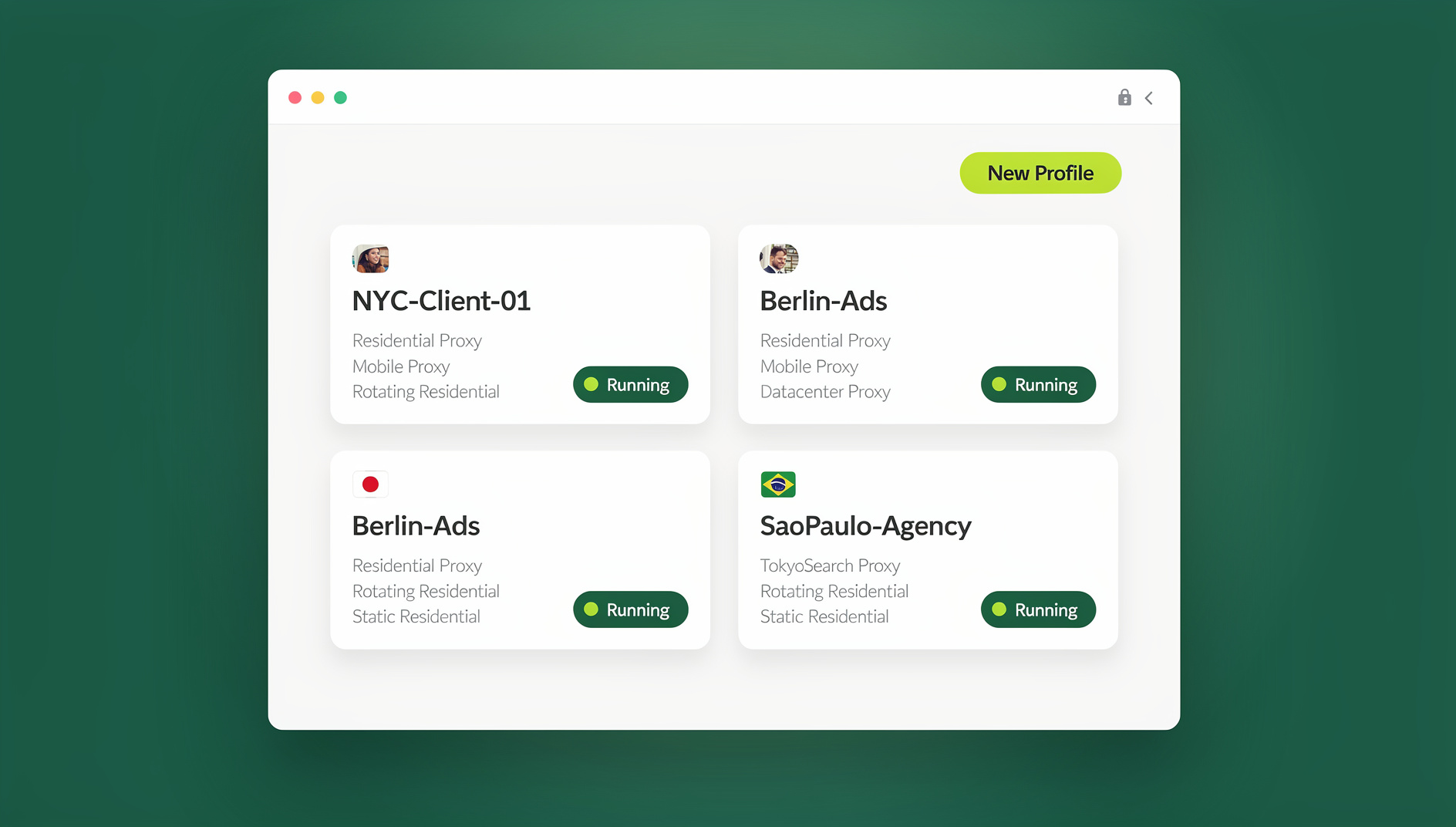
This guide walks through every realistic way to run multiple Twitter/X accounts in 2026, from X’s built-in account switcher to free browser tricks to purpose-built multi-login tools. We’ll cover what actually works, what gets accounts banned, and how a dedicated browser profile manager like Send.win solves the problem properly — with isolated profiles, built-in proxies, and a native desktop app for teams that need to scale.
Why People Run Multiple Twitter/X Accounts
Before getting into the “how,” it helps to understand the “why” — because the right method depends heavily on your use case.
- Personal + professional separation: Keeping a private account distinct from a public or work-facing one.
- Agencies and social media managers: Handling X profiles for multiple clients from a single workstation.
- Brand + niche accounts: Running a flagship brand account alongside topic-specific or regional accounts.
- Growth testing: A/B testing content, bios, or posting cadence across parallel accounts.
- Affiliate and monetization accounts: Running multiple niche accounts to diversify traffic and revenue sources.
- Backup accounts: A safety net in case a primary account is locked or restricted.
Each of these scenarios has a very different risk profile. A single person switching between two personal accounts has less to worry about than an agency running twenty client accounts from one office IP address — but the underlying technical problem is the same: X (and every major platform) is watching for signs that “different” accounts are actually controlled by the same operator.
The Core Challenge: Login Limits and Account Correlation
X’s native app does let you add several accounts and switch between them with a tap, and that’s genuinely useful for casual multi-account use. But it comes with a structural limitation that most people don’t think about until it bites them: every account you switch between on the same device, using the same browser, shares the same underlying fingerprint.
That fingerprint includes things like your device’s canvas and WebGL rendering signature, installed fonts, screen resolution, timezone, language settings, and — critically — your IP address. Platforms like X use this data to build a picture of which accounts are “linked,” even if you never explicitly connect them. When several accounts share an identical fingerprint and IP, the platform can reasonably conclude they’re operated by the same person, which is fine for personal use but becomes a real problem the moment:
- One account gets reported or breaks a rule, and the others get swept into the same restriction.
- You’re running accounts that are meant to look independent (client brands, separate businesses, or regional presences).
- You’re posting at high volume or engaging in ways that look automated across several profiles at once.
This is exactly why simple tab-switching or logging in and out repeatedly isn’t a durable long-term strategy — it works until it doesn’t, and when it stops working, it can take several accounts down with it.
Free and Low-Cost Ways to Manage Multiple X Accounts
Let’s go through the realistic options in order of effort and reliability, starting with what’s genuinely free.
1. X’s Native Account Switcher
The simplest option: add multiple accounts inside the X app or on x.com and tap your profile picture to switch. It costs nothing and takes seconds. The downside is exactly what we covered above — every account shares the same device fingerprint and IP, so this only really works well for a couple of personal accounts you’re happy to have associated with each other.
2. Separate Browsers or Browser Profiles
Using Chrome for one account and Firefox (or Edge, Brave, etc.) for another creates some separation, and built-in browser profiles (like Chrome’s “Add Person” feature) take this a step further by giving each profile its own cookies and local storage. This is free and better than nothing, but standard browser profiles still typically share the same machine-level fingerprint and — unless you’re manually configuring different proxies per browser — the same IP address. It’s a reasonable stopgap for two or three accounts, but it doesn’t scale and doesn’t fully solve the correlation problem.
3. Private/Incognito Windows
Incognito or private browsing windows avoid cookie collisions between sessions, which lets you stay logged into two accounts at once in different windows. It’s free and quick, but sessions don’t persist after you close the window, so you’re re-entering credentials constantly, and — again — fingerprint and IP are unchanged.
4. A Multi-Login / Anti-Detect Browser
This is the option built specifically for the problem: software that creates genuinely separate browser profiles, each with its own isolated fingerprint (canvas, WebGL, fonts, screen, timezone, and more) and, ideally, its own proxy/IP address. Instead of one browser trying to juggle several identities, you get what looks — to X and to any tracking script — like several completely independent devices and browsers, each logged into one account. This is the approach tools like Send.win are built around, and it’s the only method on this list that actually addresses account correlation at the root rather than just hiding tabs from each other.
How Send.win Keeps Multiple X/Twitter Accounts Separate and Safe
Send.win is a browser profile manager built for exactly this kind of workload — running many accounts on the same platform with separate cookies, storage and fingerprint per profile. Here’s what that looks like in practice for Twitter/X management specifically.
Isolated Browser Profiles with Unique Fingerprints
Every profile you create in Send.win behaves like a distinct browser instance with its own fingerprint parameters — canvas rendering, WebGL, audio context, fonts, screen resolution, timezone, and language. Log into one X account per profile, and from X’s point of view, each profile is a different device belonging to a different person. You can build out a library of profiles labeled by client, niche, or purpose, and switch between them in a couple of clicks instead of logging in and out.
Built-In Proxies for IP Diversity
Fingerprint isolation alone isn’t enough if every profile still connects from the same office or home IP. Send.win includes built-in residential and datacenter proxy options so each profile can browse from a different, matched location — pairing IP geography with the profile’s timezone and language settings for a coherent, low-risk identity rather than an obvious mismatch that trips detection systems.
A Native Desktop App for Windows, macOS, and Linux
Unlike the extension-based tools that dominated this space back in 2022, Send.win now ships as a full native desktop application for Windows, macOS, and Linux. That matters for account management specifically: a desktop client gives you a proper local process with more consistent fingerprint control and stability than a browser extension bolted onto Chrome, plus a dashboard where you can organize dozens (or hundreds) of X profiles, tag them by client or campaign, and see which ones are active at a glance. If you’re still thinking of browser profile management as “just an extension,” the desktop app is worth trying — it’s the primary way most current users run Send.win day to day.
Team Sharing Without Handing Out Passwords
If you manage X accounts as part of a team or agency, Send.win lets you share specific profiles with teammates without ever exposing the underlying account password. Access can be granted or revoked per profile, so when a client relationship ends or a team member moves off an account, you simply remove their access — no password resets, no awkward credential handoffs. For anyone managing client accounts, this alone is a meaningful upgrade over the “keep it in a shared spreadsheet” approach.
Scaling Beyond Manual Switching
Step-by-Step: Setting Up Multiple X Accounts with Send.win
- Sign up and download the desktop app. Create a Send.win account and install the native client for your operating system — paid plans start at $19/mo, and the first card purchase is covered by a 7-day money-back guarantee.
- Create a new profile for each X account. Give each profile a clear name (e.g., “Client A – X,” “Brand Backup,” “Growth Test 1”) so you’re never guessing which profile is which.
- Assign a proxy to each profile. Use Send.win’s built-in proxies and match the location/timezone to where the account is meant to be based.
- Log into X inside that profile. The session, cookies, and login state stay saved to that specific profile going forward.
- Repeat for each additional account. Build out your full roster of profiles once, then reuse them daily.
- Switch between accounts from the dashboard. Instead of logging out and back in, just open the profile you need — the correct account is already signed in.
- Share profiles with teammates as needed (Team plan).
Comparison: Ways to Manage Multiple X Accounts
| Method | Cost | Fingerprint Isolation | IP Isolation | Best For |
|---|---|---|---|---|
| X’s native account switcher | Free | None | None | 1-2 personal accounts |
| Separate browsers/profiles | Free | Partial | None (unless manually proxied) | A handful of low-risk accounts |
| Incognito/private windows | Free | None | None | Quick, temporary dual-login |
| Multi-login browser (Send.win) | Paid plans from $19/mo; 7-day money-back guarantee on first card purchase | Full, per profile | Full, built-in proxies | Agencies, brands, teams, scaling account count |
Best Practices for Running Multiple X Accounts Safely
Even with the right tooling, a few habits go a long way toward keeping every account in good standing:
- Warm up new accounts gradually. Avoid mass-following, mass-posting, or aggressive engagement in the first few days.
- Keep posting behavior human-paced. Perfectly identical timing or content across accounts is a detection signal in itself.
- Match proxy location to account identity. A “US-based” brand account browsing from a mismatched country/timezone looks suspicious.
- Never log a second account into a profile meant for another. Keep the one-account-per-profile rule strict — it’s the whole point of the isolation.
- Review X’s current rules on multiple accounts so your workflow stays within policy, especially for commercial or automated use.
- Document account ownership if you’re managing this for clients — for a broader look at organizing accounts across a team, our guide on managing multiple social media accounts covers the workflow side in more depth.
If X/Twitter is just one of several platforms you’re juggling, it’s worth setting up your profile structure with the bigger picture in mind. Many teams use the same multi-login browser setup to manage Instagram, LinkedIn, and TikTok alongside X, since the underlying fingerprint-and-proxy problem is identical across platforms. If you’re also active on newer networks, our breakdown of managing multiple X, Threads, and Bluesky profiles is a useful companion piece.
It’s also worth understanding what makes a tool like Send.win different from generic privacy software. For a deeper technical comparison of fingerprinting protection across the market, see our browser profile manager review, which benchmarks Send.win against other popular options.
Send.win Pricing for Multi-Account X Management
Send.win has no free trial; paid plans start at $19/mo, and the first card purchase is covered by a 7-day money-back guarantee. You can also preview the cloud browser for free at the demo.
| Plan | Price | Profiles | Bandwidth | Automation API |
|---|---|---|---|---|
| Pro | $19/mo ($6.99/mo billed annually — 63% off) | 150 | 5GB proxy bandwidth | Not included |
| Team | $49/mo ($20.99/mo billed annually — 57% off) | 500 | 20GB proxy bandwidth | Included (Selenium/Puppeteer/Playwright), 16 seats |
For solo creators or freelancers managing a handful of X accounts, Pro is typically enough. For agencies managing client rosters or teams that want more seats and headroom, Team is the better fit.
🏆 Send.win Verdict
If you only need two personal X accounts, the native switcher or a spare browser profile will get you by. But the moment you’re managing client accounts, brand accounts, or anything where keeping accounts separate carries real consequences, you need genuine fingerprint and IP isolation — not just separate tabs. Send.win gives every X account its own isolated profile, built-in proxy, and a proper desktop app to manage it all from.
Try Send.win today — set up your first isolated X profile in minutes; paid plans start at $19/mo with a 7-day money-back guarantee on your first card purchase.
Frequently Asked Questions
Is it free to manage multiple Twitter/X accounts?
Yes, X’s native account switcher is completely free and lets you add several accounts to one device. It’s a fine starting point for a couple of personal accounts, but it doesn’t isolate fingerprints or IP addresses, so it isn’t ideal once you’re managing client, brand, or higher-risk accounts. Send.win has no free trial; paid plans start at $19/mo, and the first card purchase is covered by a 7-day money-back guarantee if you want to test a fully isolated setup.
Can X detect that I’m running multiple accounts from the same device?
Yes. X, like most major platforms, analyzes device fingerprints (browser, canvas/WebGL rendering, fonts, screen resolution) and IP address to identify patterns that suggest multiple accounts are linked. Using the same unmodified browser for several accounts makes this correlation straightforward, even if you never manually connect the accounts.
What’s the difference between browser profiles and an anti-detect browser?
Standard browser profiles (like Chrome’s “Add Person”) separate cookies and local storage, but they typically still share the same machine-level fingerprint and IP address. A browser profile manager like Send.win gives each profile its own consistent fingerprint and pairs it with a distinct proxy IP, so each profile keeps its own separate browser identity rather than the same computer switching contexts.
Does Send.win require installing software, or is it browser-based?
Send.win runs primarily through a native desktop application available for Windows, macOS, and Linux. Installing the desktop app is required for the full profile-management experience — it’s not a lightweight bookmarklet or purely cloud-based tool, which is part of why it offers more stable fingerprint control than older extension-only approaches.
How many X accounts can I manage on Send.win?
It depends on your plan. The Pro plan supports up to 150 profiles with 5GB of proxy bandwidth, while the Team plan supports up to 500 profiles with 20GB of bandwidth and 16 seats for team members. Additional profiles beyond your plan limit can be added for a small per-profile fee.
Can my team access the same X accounts without sharing passwords?
Yes. Send.win lets you share individual profiles with teammates, so they can log in and manage the account without ever seeing the actual X password. You can revoke a teammate’s access to a specific profile at any time, which is especially useful for agencies managing accounts on behalf of clients.
Do I need an automation interface?
Send.win does not offer an automation interface — there is no API, SDK, headless mode or Selenium/Puppeteer/Playwright support on any plan. If you’re manually managing a small number of accounts, that’s unlikely to matter; if you need to automate repetitive tasks across many accounts, you’ll need a different tool.
Will using proxies slow down my browsing on X?
Not meaningfully in normal use. Send.win’s built-in proxies are selected to match your profile’s intended location, and for typical browsing, posting, and messaging activity on X, the difference in speed is negligible compared to a direct connection. Heavy media uploads or downloads may be modestly slower depending on the proxy route.
Final Thoughts
Managing multiple Twitter/X accounts for free is absolutely possible with the tools built into X itself — but “possible” and “safe at scale” are two different things. If you’re juggling a couple of personal accounts, the native switcher or a spare browser profile will serve you fine. If you’re responsible for client accounts, brand presences, or anything where an account ban would actually hurt, investing in proper fingerprint and IP isolation isn’t optional — it’s the only way to keep those accounts genuinely independent in the eyes of the platform. Send.win’s combination of isolated profiles, built-in proxies, a native desktop app, and password-free team sharing covers that entire range, from a solo creator’s second account to an agency running hundreds of client profiles.