Why Crypto Traders Are Switching to Cloud Browsers
A cloud browser for cryptocurrency trading isolates exchange sessions, masks device fingerprints, and stops cross-tab wallet theft by giving each account its own sandboxed environment. This prevents account linking, IP bans, and phishing malware from accessing your assets across different tabs.
The Threat Landscape for Crypto Traders
Before the five reasons, it helps to understand exactly what you are defending against. Crypto losses from phishing and social engineering topped $1.1 billion in 2025, and the techniques keep evolving.
Phishing and Fake dApps
Attackers clone exchange login pages or DeFi front-ends pixel-for-pixel. A single misfired click approves a malicious smart contract or surrenders your session cookie. In a standard browser, that phishing tab shares the same cookie jar, local storage, and extension context as your real exchange tab—one compromised tab can access everything.
Clipboard Hijacking
Clipboard malware silently swaps the wallet address you copy with the attacker’s address. Because every tab in a normal browser shares one clipboard, a single compromised page can intercept the next address you paste into a withdrawal form on a different exchange.
Exchange Fingerprint Linking
Exchanges and DeFi front-ends collect dozens of browser fingerprint signals—canvas hash, WebGL renderer, installed fonts, screen resolution, timezone, language. If two “separate” accounts share the same fingerprint, the platform flags them as linked. That leads to frozen withdrawals, KYC re-verification, or outright bans.
Session Theft and Cookie Replay
Attackers who steal session tokens—via XSS, browser extension vulnerabilities, or local malware—can replay your authenticated exchange session from their own machine. Your funds are drained before the exchange even sends a login alert email.
IP-Based Restrictions and Geo-Blocks
Some exchanges block or restrict features by IP geolocation. Traders who travel frequently, use VPNs that rotate endpoints mid-session, or live in regions with partial restrictions can trigger security holds that freeze withdrawals for days.
Reason 1 — Isolated Sessions Per Exchange Kill Cross-Contamination
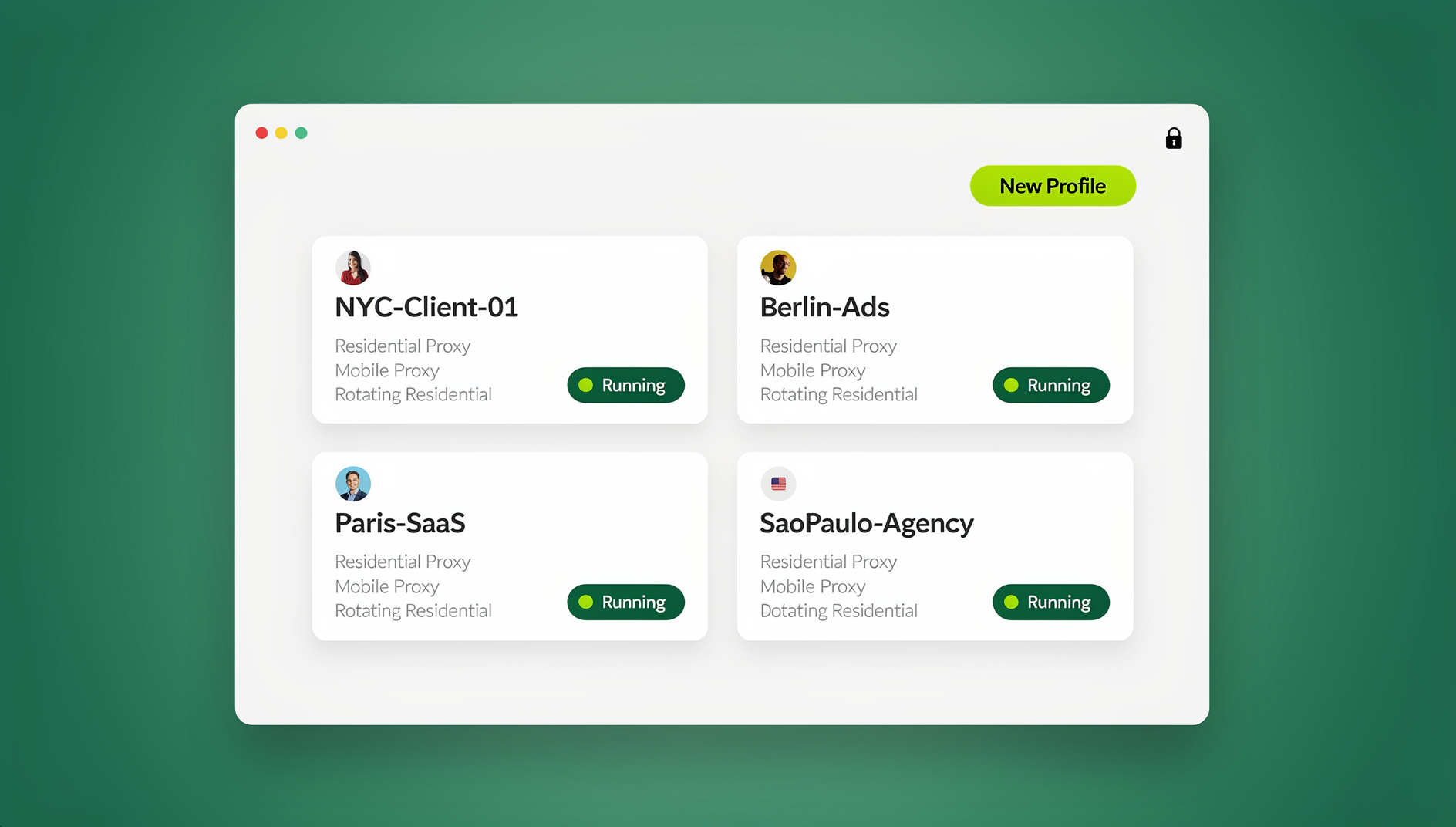
The single most important benefit of a cloud browser for crypto is session isolation. Each exchange profile runs in its own sandboxed environment with a completely separate set of cookies, local storage, IndexedDB, cache, and extensions. Here is what that means in practice:
- Phishing containment. If you accidentally visit a phishing site inside Profile A (your Binance session), the attacker gains zero access to Profile B (your Kraken session) or Profile C (your MetaMask wallet). The damage is limited to one profile, not your entire crypto stack.
- No shared clipboard. A malicious script in one session cannot read or write the clipboard of another session. Each profile has its own isolated clipboard context, which makes clipboard-hijacking malware ineffective across profiles.
- Extension isolation. A compromised wallet extension in one profile cannot read data from extensions in another profile. You can run MetaMask in one profile, Phantom in another, and a Ledger Live bridge in a third—none of them share state.
Without session isolation, a single compromised tab can cascade across every exchange and wallet you have open. With it, the blast radius of any attack shrinks to one profile.
Reason 2 — Unique Fingerprints Prevent Account Linking
Exchanges use fingerprinting to detect when the same person operates multiple accounts. Canvas hashes, WebGL parameters, audio context signatures, font enumeration, and hardware concurrency all combine into a device-unique identifier. A cloud browser generates a unique, internally consistent fingerprint for every profile you create.
| Fingerprint Signal | Normal Browser | Cloud Browser Profile |
|---|---|---|
| Canvas Hash | Same across all tabs | Unique per profile |
| WebGL Renderer | Real GPU exposed | Spoofed per profile |
| Screen Resolution | Real monitor size | Randomized per profile |
| Timezone | System timezone | Matched to proxy region |
| Language Headers | OS language | Matched to proxy region |
| Installed Fonts | All system fonts | Curated subset per profile |
| Audio Context | Real audio stack | Noise-injected per profile |
The key word is consistent. A good antidetect cloud browser does not just randomize values—it ensures that the timezone, language, geolocation, and screen size all match the assigned proxy region. Inconsistencies (e.g., a US timezone with a Japanese IP) are exactly the kind of signal exchanges flag.
Reason 3 — Geo-Matched Proxies Solve IP Restrictions Cleanly
Many cloud browsers let you assign a residential or mobile proxy directly to each profile. When the proxy IP, timezone, language, and WebRTC leak protection all align, exchanges see a normal user from a specific region—not a VPN user cycling through data-center IPs.
For a deeper look at how proxy browsers combine isolation with IP management, we have a dedicated guide. The short version: data-center proxies get flagged by most exchanges, residential proxies pass, and mobile proxies are the gold standard for platforms with aggressive bot detection.
Practical Proxy Setup for Crypto
- One sticky residential proxy per exchange profile. Rotating proxies mid-session trigger exchange security alerts. Use a sticky session that lasts at least 30 minutes—ideally longer for trading platforms where sessions can run for hours.
- Match timezone and language. If your proxy exits in Frankfurt, set the profile timezone to Europe/Berlin and the language to de-DE. This consistency is what makes the fingerprint believable.
- Separate proxy for DeFi wallets. DeFi front-ends do not require login, but they log IP and fingerprint against wallet addresses. Keep your DeFi browsing on its own proxy, separate from CEX profiles.
Reason 4 — No Local Wallet Contamination
Running a hot wallet extension (MetaMask, Phantom, Rabby) in your everyday browser is a known risk vector. Malicious ads, compromised browser extensions, and even rogue autofill managers can interact with wallet pop-ups. A cloud browser solves this by keeping wallet extensions inside isolated profiles that share nothing with your general browsing environment.
Cloud browser sessions take this a step further—your wallet extension state lives in the cloud, not on your local machine. If your laptop is compromised by malware, the attacker still cannot access your cloud-hosted wallet profile because the session requires its own authentication to launch. This physical separation between your local OS and your wallet environment is the closest you can get to a hardware wallet’s security model without actually using cold storage for every transaction. For more strategies on keeping your browsing clean, see our safe browsing guide.
Reason 5 — Separate Identities for DeFi, CEX, and Research
Most active crypto traders operate across multiple contexts that should never overlap:
- CEX trading accounts — Binance, Coinbase, Kraken, OKX, Bybit. Each has its own KYC, and exchanges cross-reference fingerprints.
- DeFi wallets — MetaMask, Phantom, Keplr. Wallet addresses linked to the same fingerprint can be clustered by on-chain analytics firms.
- Research and alpha hunting — Discord, Telegram web, Twitter, crypto forums. You do not want your research browsing fingerprint linked to your trading identities.
- Airdrop eligibility — Some traders maintain separate wallet profiles for protocol airdrops. See the ethics section below.
A cloud browser lets you create a dedicated profile for each context. Your Binance session runs with fingerprint A, your Uniswap wallet with fingerprint B, your crypto Twitter with fingerprint C. No context ever leaks into another.
Use Case: Multi-Exchange Arbitrage
Arbitrage traders exploit price differences between exchanges—buy ETH on Exchange A where it is $0.50 cheaper and sell on Exchange B within seconds. Speed matters, and so does isolation:
- Create one profile per exchange with its own fingerprint and residential proxy in the same region as the exchange’s primary user base.
- Keep all profiles open simultaneously. Cloud browser sessions let you run multiple profiles side by side without resource conflicts, since the processing happens on cloud infrastructure rather than your local CPU and RAM.
- Keep each trading account in its own profile. Send.win gives every profile its own cookies, storage, fingerprint settings and proxy, so you can stay signed in to multiple exchanges side by side without sharing one browser identity.
- Monitor without cross-contamination. Even if one exchange flags unusual activity and freezes your account, the others remain completely unaffected because they share zero fingerprint or session data.
Use Case: Portfolio Separation
Keeping long-term holdings, active trading, and experimental DeFi positions in separate browser profiles mirrors the same logic as using separate wallets—but extends it to the browser layer. If a DeFi protocol you are testing gets exploited and a phishing link harvests your session, only the profile dedicated to that protocol is exposed. Your main CEX accounts and long-term wallets stay untouched.
This is especially valuable for traders managing funds for multiple clients or family members. Each client gets their own profile with its own fingerprint, proxy, and wallet extension—creating a clean audit trail and preventing any accidental cross-account actions.
A Note on Airdrop Farming and Ethics
Some traders use multiple browser profiles to interact with protocols across several wallet addresses, hoping to qualify for token airdrops from multiple “identities.” While cloud browsers technically make this possible by providing distinct fingerprints per profile, there are important considerations:
- Terms of Service. Most protocols explicitly prohibit sybil-style airdrop farming in their terms. Violating ToS can result in disqualification from airdrops, blacklisting of all associated wallets, and loss of any accrued tokens.
- On-chain clustering. Airdrop teams increasingly use on-chain analytics to detect sybil wallets (e.g., wallets funded from the same source, transacting at the same timestamps, or interacting with the same contracts in identical patterns). Browser-level isolation does not protect against on-chain behavioral analysis.
- Ethical and legal implications. Sybil farming extracts value intended for genuine community participants. It harms protocol health and can carry legal risk depending on jurisdiction.
We mention airdrop farming because it is a real and widespread use case for cloud browsers in crypto, but we strongly recommend operating within each protocol’s rules. Using separate profiles for legitimate reasons—such as separating personal and business wallets, or testing a protocol before committing real funds—is a perfectly valid and ethical approach.
How Send.win Fits Crypto Trading Workflows
Send.win is built for exactly this kind of multi-profile, high-stakes workflow. Here is how its features map to the crypto use cases above:
Sendwin Browser (Desktop App)
The native Windows, macOS, and Linux desktop app (requires install) lets you create up to 150 profiles with 5GB storage on the Pro plan ($19/month, or $83.88/year billed annually). Each profile gets its own fingerprint, cookie jar, and proxy assignment. Note that Send.win has no browser extension—all isolation happens within the main app.
Cloud Browser Sessions
For traders who need access from multiple machines—or want to keep wallet profiles physically separate from their personal laptop—Send.win’s cloud browser sessions run profiles on cloud infrastructure with no local install required. Your wallet extensions, session cookies, and fingerprint configurations live in the cloud, accessible from any device but isolated from your local environment.
Cloud browser sessions
Send.win runs a cloud browser on its own servers in the EU, so you can open your isolated profiles from any machine without installing the desktop app. Each session keeps its profile’s own cookies, storage, fingerprint settings and proxy.
Team Plan for Trading Groups
The Team plan ($49/month, or $251.88/year billed annually) includes 500 profiles, 20GB of storage, and 16 seats—enough for a trading desk to give each member their own set of isolated exchange profiles without sharing credentials.
Step-by-Step: Setting Up Send.win for Crypto Trading
- Try the free cloud demo — a 3-minute preview at send.win/demo-browser/ without signup, or 10 minutes a day with a free account. Paid plans start at $19/month, and your first card purchase is covered by a 7-day money-back guarantee.
- Create one profile per exchange. Name them clearly: “Binance-Main,” “Kraken-Trading,” “MetaMask-DeFi.” Assign each a unique fingerprint configuration.
- Assign proxies. Use residential proxies with sticky sessions. Match the proxy region to your exchange account’s registered region for maximum consistency.
- Install wallet extensions per profile. Load MetaMask into your DeFi profile, keep it out of your CEX profiles. Each profile’s extensions are completely isolated from every other profile.
- Bookmark and organize. Set each profile’s homepage to the relevant exchange or DeFi dashboard. When you open a profile, you land directly on your trading interface.
- Enable 2FA per profile. Use a different TOTP seed for each exchange account, stored within that profile’s password manager. Never share 2FA seeds across profiles.
🏆 Send.win Verdict
Crypto trading demands isolation at every layer—sessions, fingerprints, proxies, and wallet extensions. Send.win delivers this through the Sendwin Browser desktop app and cloud browser sessions, with separate cookies, storage, fingerprint settings and proxy per profile. At $83.88 per year (annual Pro), it is a fraction of the cost of competitors like Multilogin or GoLogin, and the 7-day money-back guarantee on your first card purchase lets you test the full workflow risk-free.
Try the free Send.win cloud demo — 3 minutes without signup, 10 minutes a day with a free account, 150 profiles on Pro.
Frequently Asked Questions
Is a cloud browser safer than a VPN for crypto trading?
Yes, for most practical purposes. A VPN masks your IP address but does nothing about browser fingerprinting, cookie isolation, or clipboard security. A cloud browser provides all of those protections plus the ability to assign a dedicated proxy (including residential or mobile IPs) per profile, which exchanges trust far more than data-center VPN exits.
Can exchanges detect that I am using an antidetect cloud browser?
A well-configured antidetect browser with consistent fingerprint parameters and residential proxies is effectively undetectable by current exchange security systems. Detection happens when fingerprint values are inconsistent (e.g., timezone mismatches), when cheap data-center proxies are used, or when multiple profiles share behavioral patterns that suggest automation.
How many profiles do I need for crypto trading?
Most individual traders need 3 to 8 profiles: one per CEX account, one or two for DeFi wallets, and one for crypto research and social media. Send.win’s Pro plan supports up to 150 profiles, which is more than enough for even active traders running arbitrage across many exchanges.
Does using a cloud browser slow down my trading?
The Sendwin Browser desktop app runs profiles locally with full hardware acceleration, so latency is comparable to a standard browser. Cloud browser sessions add minimal latency since the browsing happens on optimized cloud infrastructure. For high-frequency arbitrage where milliseconds matter, the desktop app is the better choice.
Can I use Send.win with hardware wallets like Ledger or Trezor?
Yes. When using the Sendwin Browser desktop app, hardware wallets connect via USB just as they would in any Chromium-based browser. Each profile can have its own Ledger Live bridge or Trezor Suite integration, isolated from other profiles. Cloud browser sessions may have limited USB passthrough depending on your setup, so the desktop app is recommended for hardware wallet use.
Is it legal to use a cloud browser for cryptocurrency trading?
Using a cloud browser for privacy, security, and session isolation is entirely legal. It is the same principle as using separate devices for different accounts. However, using multiple profiles to circumvent exchange terms of service—such as creating duplicate accounts to exploit promotions or referral bonuses—may violate those terms and could lead to account restrictions.
What type of proxy should I use for crypto exchanges?
Residential proxies with sticky sessions are the best choice. They use real ISP-assigned IP addresses, which exchanges trust far more than data-center IPs. Mobile proxies are even better for exchanges with aggressive bot detection but cost more. Avoid free proxies entirely—they are often compromised and can intercept your traffic, including exchange credentials.
How does Send.win compare to running multiple virtual machines?
Virtual machines provide strong isolation but consume enormous resources—each VM needs its own OS, RAM, and storage allocation. Running five VMs for five exchange accounts requires a powerful machine and significant setup time. Send.win profiles share the underlying browser engine but isolate everything at the session, fingerprint, and network layers. You can run dozens of profiles on a standard laptop with far less overhead, and cloud browser sessions offload the processing entirely.
Run Cloud Browser For Cryptocurrency Trading in the Cloud With Send.win
Send.win’s cloud browser runs your isolated profiles on remote infrastructure — open a clean, fingerprint-isolated session from any device without installing anything:
- Instant cloud sessions – launch an isolated browser in seconds, no local install
- Isolated profiles – separate fingerprint, cookies, and storage per session
- Cloud sync & profile sharing – pick up the same profiles on the desktop app (Windows, macOS, Linux) or share them with your team
- Built-in residential proxies – with automatic timezone and locale matching
You can try it right now: the Send.win demo browser opens an isolated cloud session directly in this browser tab. The cloud demo is free, and paid plans start at $19/month — see pricing.