How Do Affiliate Marketers Safely Run Multiple Accounts?
Running affiliate marketing multiple accounts means maintaining separate, unlinked identities across ad networks like Google Ads, Facebook, and TikTok — plus affiliate platforms like ClickBank, ShareASale, and CJ Affiliate. Each account needs its own browser profile with a unique fingerprint, a dedicated residential proxy, and separate payment credentials. Without that isolation, platforms cross-reference cookies, canvas hashes, and IP addresses, then ban every linked account in a single sweep. Below you’ll learn how top affiliates structure multi-account operations and a step-by-step workflow using Send.win to keep every account walled off.
Why Affiliates Need Multiple Accounts in the First Place
The single-account model breaks down fast for anyone running more than a handful of campaigns. Here’s why serious affiliates multiply:
Split-Testing Across Ad Accounts
Ad platforms throttle spend on new accounts and reward account history with lower CPMs. By running parallel accounts, affiliates can A/B test entirely different offer angles — health vs. finance, short-form video vs. carousel — without one poor performer tanking the trust score of everything else. A banned Facebook ad account doesn’t just kill that campaign; it flags every other account sharing the same browser environment.
Geo-Targeting and Localization
Affiliates promoting international offers need accounts that look local. A U.S.-based marketer running campaigns in Germany, Brazil, and Japan can’t credibly do that from a single browser session. Each geo needs its own profile with a matching timezone, locale, language settings, and IP address — or the platform’s fraud team will flag the mismatch.
Risk Distribution
Ad platforms are unpredictable. Policy changes, algorithm shifts, and manual reviews can shut down a profitable account overnight. Affiliates who concentrate everything in one account are one review away from zero revenue. Distributing campaigns across multiple accounts — each with its own payment method and identity — ensures that a single ban never wipes out the entire business.
Network Diversification
Smart affiliates don’t rely on a single traffic source. They run Google Ads for search intent, Facebook for impulse buys, TikTok for younger demographics, and native ads for content-heavy funnels. Each platform has its own compliance team and detection stack, but they all look for the same signals: shared fingerprints, recycled payment methods, and overlapping login patterns.
The Real Risks of Running Unprotected Multiple Accounts
Before diving into the setup, you need to understand exactly what platforms detect and how bans cascade.
Account Linking via Browser Fingerprints
Every browser exposes a fingerprint — a combination of canvas rendering, WebGL output, installed fonts, screen resolution, timezone, and dozens of navigator properties. Platforms like Facebook and Google collect this fingerprint on login. If two accounts share the same fingerprint, they’re linked permanently. Even if you use different emails and payment methods, the fingerprint alone is enough to trigger a ban.
IP-Based Cross-Referencing
Logging into multiple accounts from the same IP address is the fastest way to get flagged. This applies to both your home IP and any shared VPN exit node. Datacenter IPs are even riskier — platforms maintain blocklists of known datacenter ranges. Only residential or mobile proxies provide the trust level that ad networks expect from legitimate users.
Cookie and Session Leakage
Standard browsers share cookies across tabs and windows. Opening Account A and Account B in the same Chrome instance means tracking pixels from one session bleed into the other. Facebook’s pixel, Google’s tracking cookies, and TikTok’s session identifiers all persist in the same cookie jar. This is precisely the kind of cross-contamination that makes session isolation essential for affiliates.
Payment Method Linking
Ad platforms check billing details — card BIN ranges, billing addresses, PayPal email associations, and bank account identifiers. Two accounts sharing the same Visa ending in 4532 are trivially linked. Affiliates need separate payment instruments for each account, ideally from different banks or virtual card providers like Privacy.com, Revolut, or Wise.
Commission Clawbacks on Affiliate Platforms
Affiliate networks like ClickBank, ShareASale, and CJ don’t just ban accounts — they claw back commissions. If they determine you’re running duplicate accounts to game exclusive offers, stack bonuses, or circumvent approval limits, they’ll reverse pending payouts, withhold earned commissions, and sometimes pursue legal action. The financial stakes go far beyond losing ad spend.
A Day in the Life: The Multi-Account Affiliate Workflow
Here’s what a typical day looks like for an affiliate marketer managing 15-20 accounts across three ad networks and two affiliate platforms.
Morning: Account Health Check (30 Minutes)
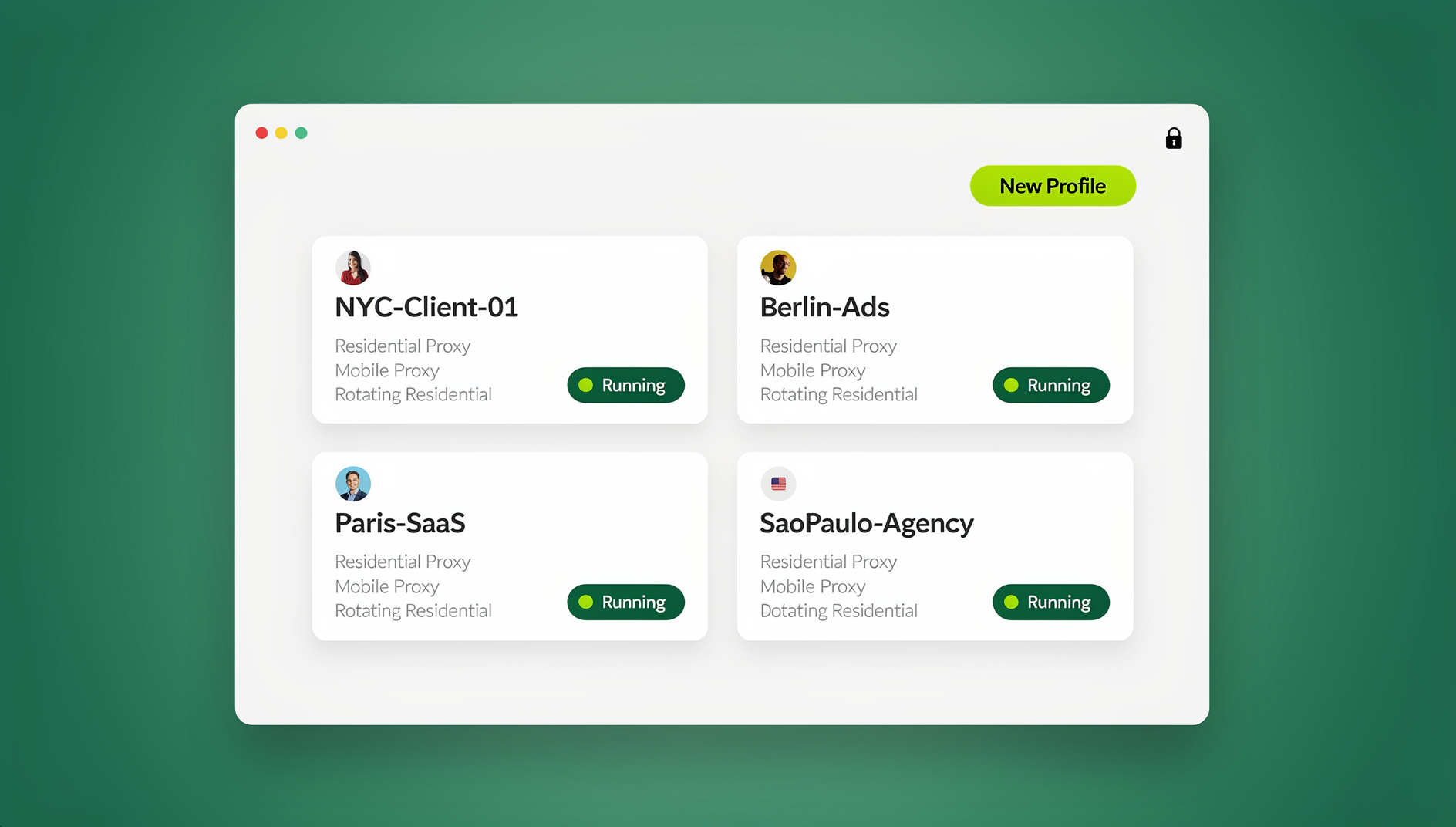
Open the Sendwin Browser desktop app and review the profile dashboard. Each profile represents one complete account identity — its own fingerprint, proxy, timezone, and saved login sessions. Check overnight spend, look for policy violations or review flags, and verify that no accounts were suspended while you slept. Profiles that were running TikTok campaigns in Southeast Asian timezones may have been active for hours already.
Midday: Campaign Optimization (2 Hours)
Launch profiles one or two at a time to adjust bids, swap creatives, and pause underperformers. In Sendwin Browser, each profile opens in its own isolated window — cookies, localStorage, and fingerprint data never cross boundaries. You might adjust a Google Ads campaign in Profile 7 while reviewing Facebook Analytics in Profile 12, with zero risk of session overlap. This is the core benefit of a purpose-built proxy browser over trying to juggle Chrome profiles or incognito windows.
Afternoon: New Campaign Launch (1 Hour)
Launching a new campaign on a fresh ad account? Create a new Send.win profile. Assign it a residential proxy from the target geo, set the timezone and locale to match, and use a clean payment method that isn’t associated with any other profile. Log into the ad platform, complete verification, and submit your first campaign — all from an environment that looks like a completely new user on a completely different machine.
Evening: Affiliate Platform Management (45 Minutes)
Switch to your affiliate network profiles. Check ClickBank analytics in one profile, update ShareASale links in another, and apply for new CJ offers in a third. Each profile maintains its own login session, so you never accidentally trigger a “multiple login” alert by having two sessions active from the same browser. Review payout thresholds, ensure tracking pixels are firing correctly, and schedule any offer rotations for the next day.
Step-by-Step Setup: One Send.win Profile Per Account
Here’s how to configure your multi-account operation from scratch.
Step 1: Plan Your Account Structure
Before creating profiles, map out every account you need to manage. Create a spreadsheet with columns for:
- Platform (Google Ads, Facebook, TikTok, ClickBank, etc.)
- Account identifier (email or username)
- Target geo (determines proxy and timezone)
- Payment method (card number last 4 digits)
- Proxy assignment (IP or provider session ID)
- Profile name in Send.win (use a naming convention like
FB-US-01,GADS-DE-03)
How Send.win Helps With Affiliate Marketing Multiple Accounts
Send.win is a browser profile manager built for exactly this kind of work — every profile is a clean, isolated identity:
- Isolated profiles – unique fingerprint, separate cookies and storage per profile
- Consistent fingerprint per profile – canvas, WebGL, fonts, and audio settings kept consistent within each profile
- Desktop app + cloud sessions – native app for Windows, macOS, and Linux, or run profiles in the cloud with no install
- Built-in residential proxies – with automatic timezone, locale, and WebRTC matching
- Team features – share logged-in profiles with teammates without sharing passwords
Try the instant cloud browser demo — no install, no signup — or download the desktop app. There is no free trial; paid plans start at $19/month, and the first card purchase is covered by a 7-day money-back guarantee (see pricing).
This spreadsheet becomes your operational bible. When you’re managing 50+ accounts, you cannot afford to guess which proxy belongs to which profile.
Step 2: Create Isolated Profiles in Sendwin Browser
Open the Sendwin Browser desktop app (available on Windows, macOS, and Linux). For each account:
- Click New Profile
- Name it using your naming convention
- The profile automatically generates a unique browser fingerprint — canvas hash, WebGL renderer, navigator properties, screen resolution, and font list are all randomized
- Assign the profile to a group (e.g., “Facebook Accounts” or “ClickBank”) for easier management
Each profile is fully isolated. Cookies, cache, localStorage, IndexedDB, and service workers are sandboxed. Nothing leaks between profiles, even when multiple windows are open simultaneously.
Step 3: Assign Dedicated Proxies
For each profile, configure a proxy that matches the account’s target geography:
- Residential proxies for ad network accounts — these carry the highest trust score because they come from real ISP-assigned IP ranges
- Mobile proxies for TikTok and Instagram accounts — mobile IPs are the most trusted on social platforms
- Sticky sessions where possible — rotating IPs on every request looks suspicious to platforms that expect a user to maintain the same IP during a session
Send.win includes 5GB of proxy bandwidth on the Pro plan and 20GB on the Team plan. You can also bring your own proxies from providers like Bright Data, Smartproxy, or IPRoyal and configure them per-profile.
Step 4: Match Timezone, Locale, and Language
A residential proxy from Frankfurt means nothing if your browser reports America/New_York as the timezone and en-US as the locale. Platforms check for these mismatches. In each Send.win profile, set:
- Timezone to match the proxy’s location
- Language/locale to match the target market
- Geolocation API coordinates consistent with the proxy IP
This consistency is what separates a believable identity from one that triggers automated fraud detection. For a deeper dive into maintaining anonymous browsing across sessions, see our dedicated guide.
Step 5: Use Separate Payment Methods
This step sits outside the browser but is equally critical. For each ad account, use a distinct payment method:
- Virtual cards from Privacy.com, Revolut, or Wise (each generates unique BINs)
- Prepaid Visa/Mastercard gift cards for low-spend test accounts
- Separate bank accounts for high-spend campaigns
- Different PayPal accounts linked to different cards for affiliate platform payouts
Never reuse a payment method across two accounts on the same platform. The BIN, billing address, and cardholder name are all cross-referenced.
Step 6: Warm Up New Accounts
New accounts that immediately launch high-spend campaigns get flagged. Warm each account naturally:
- Browse the platform organically for 2-3 days — read documentation, explore the interface
- Start with a low-budget campaign ($5-10/day) running broad targeting
- Gradually increase spend over 7-14 days
- Avoid sudden changes to targeting, bidding strategy, or creative volume
Send.win’s profile persistence makes warmup seamless — close the profile on Monday, reopen it on Wednesday, and every cookie, session, and cached credential is exactly where you left it. The platform sees a returning user, not a freshly created bot.
Platform-Specific Tips for Multi-Account Affiliates
Google Ads
| Risk Factor | Mitigation |
|---|---|
| Phone verification on signup | Use unique numbers — VOIP numbers are often blocked; physical SIMs or services like TextVerified work better |
| MCC (Manager Account) linking | Never link multiple ad accounts to the same MCC if they promote similar offers |
| Landing page similarity | Use different domains, hosting providers, and page designs per account |
| Conversion tracking pixels | Each account gets its own Google Tag — never share a single GA4 property across accounts |
Facebook / Meta Ads
| Risk Factor | Mitigation |
|---|---|
| Business Manager fingerprinting | Each Business Manager gets its own Send.win profile — never access two BMs from the same browser environment |
| Selfie verification | Increasingly common; accounts linked to real identities are harder to replace — invest in keeping them clean |
| Ad creative reuse | Don’t upload identical creatives across accounts; even minor differences in filenames can trigger detection if the images are pixel-identical |
| Pixel cross-contamination | Each ad account uses its own Facebook Pixel — session isolation prevents pixel data from leaking between profiles |
TikTok Ads
| Risk Factor | Mitigation |
|---|---|
| Mobile-first detection | Use mobile proxies wherever possible; TikTok’s fraud team weights mobile IP trust heavily |
| Business Center linking | Similar to Facebook’s BM — keep each Business Center in its own isolated profile |
| Rapid account creation | Space out account signups by at least 48 hours; batch creation triggers automated blocks |
Scaling from 5 to 50+ Accounts
Once your foundational setup works, scaling introduces new challenges. Here’s how to handle them.
Automate Repetitive Tasks
At scale, manually logging into 50 profiles to check metrics is unsustainable. Send.win does not offer an automation interface — there is no API, SDK, headless mode or Selenium/Puppeteer/Playwright support on any plan. The Pro plan is $19/month, or $83.88/year, and the Team plan is $49/month, or $251.88/year, with higher bandwidth and team seat allowances.
Use Profile Groups and Tags
Organize profiles by platform, geo, and campaign type. When you need to update proxy settings for all German Facebook accounts, you shouldn’t have to hunt through an unsorted list of 150 profiles. If you want a comprehensive overview of managing multiple accounts at scale, our full guide covers organizational strategies in depth.
Rotate Proxies Strategically
As you scale, static residential proxies become expensive. Consider a tiered approach:
- High-value accounts (established, profitable): dedicated static residential IPs — reliability matters more than cost
- Medium-value accounts (growing, moderate spend): sticky rotating residential — same IP for 10-30 minute sessions
- Test accounts (new, low spend): rotating residential — cheapest option, acceptable risk for accounts you can afford to lose
Monitor Account Health Proactively
Build a simple dashboard or spreadsheet that tracks each account’s status daily:
- Policy warnings or violations
- Spend pacing vs. budget
- Conversion rate trends
- Login anomalies (unexpected 2FA prompts, security emails)
Catching a warning early — before it becomes a ban — saves the account and all its historical data and trust score.
Plan for Account Loss
Even with perfect isolation, accounts get banned. It’s an operational reality of affiliate marketing. Plan accordingly:
- Never put more than 20% of total ad spend through a single account
- Keep backup accounts warmed up and ready to take over
- Store creative assets, landing pages, and tracking setups externally — not just inside the ad platform
- Document what works in each niche so you can replicate campaigns quickly on new accounts
Common Mistakes That Get Affiliate Accounts Banned
- Using incognito mode instead of isolated profiles — incognito doesn’t change your fingerprint, it only clears cookies on close. The canvas hash, WebGL output, and navigator properties remain identical.
- Sharing proxies between accounts — even for “just a quick check,” a single shared IP login creates a permanent link between accounts
- Reusing email patterns —
[email protected],[email protected],[email protected]are trivially linked by pattern analysis - Logging into personal accounts in the same browser — your personal Gmail session can leak identity data to any Google Ads account accessed in the same browser instance
- Neglecting timezone/locale consistency — a U.S. proxy with a European timezone instantly flags the account
- Batch-creating accounts on the same day — space signups by at least 48 hours and vary the registration flow
🏆 Send.win Verdict
For affiliate marketers managing multiple accounts, Send.win delivers the three things that matter most: genuine browser fingerprint isolation per profile, per-profile proxy assignment with included bandwidth, and session persistence that survives restarts. The Pro plan at $19/month or $83.88/year gives you 150 profiles and 5GB of proxy bandwidth — enough for most solo affiliates. Teams running 50+ accounts across multiple marketers can upgrade to the Team plan at $49/month or $251.88/year for 500 profiles, 20GB bandwidth, and 16 team seats. The first card purchase is covered by a 7-day money-back guarantee, and you can try the free cloud demo at https://send.win/demo-browser/ before committing.
Try the free Send.win cloud demo today — a 3-minute preview without signup, or 10 minutes a day with a free account. Set up your first isolated affiliate profile in under two minutes.
Frequently Asked Questions
Is running multiple affiliate accounts legal?
Running multiple accounts is not illegal, but it typically violates the terms of service of ad networks and affiliate platforms. The legal risk is contractual, not criminal — you risk account bans and commission clawbacks, not prosecution. Many affiliates accept this risk as a cost of doing business and plan their operations accordingly.
How many Send.win profiles do I need per ad account?
One profile per account, always. Never share a Send.win profile between two accounts on the same platform. You can reuse a profile across different platforms (e.g., one profile for a Google Ads account and the same profile for an unrelated analytics tool), but for maximum safety, dedicated profiles per login are recommended.
Can I use free proxies with Send.win for affiliate accounts?
Technically yes, but practically no. Free proxies are overwhelmingly datacenter IPs that are already blocklisted by ad platforms. They’re also shared with thousands of other users, meaning your accounts will be associated with spammy, suspicious traffic. Use residential or mobile proxies for any account that handles real ad spend or affiliate commissions.
What happens if one of my affiliate accounts gets banned?
If your accounts are properly isolated — each in its own Send.win profile with a unique proxy, fingerprint, and payment method — a single ban stays contained. The banned account can’t be linked back to your other accounts because there are no shared signals. Without isolation, platforms can chain-ban every account they link through shared fingerprints, IPs, or cookies.
How does Send.win differ from using Chrome profiles?
Chrome profiles share the same underlying browser fingerprint. Your canvas hash, WebGL renderer, installed fonts, and many navigator properties remain identical across Chrome profiles. Send.win generates a completely unique fingerprint per profile, isolates all session data, and lets you assign per-profile proxies — none of which Chrome’s built-in profiles can do.
Do I need the Sendwin Browser desktop app or can I use cloud sessions?
Both work for affiliate account management. The Sendwin Browser desktop app (Windows, macOS, Linux) is ideal when you need the fastest performance and full local control. Cloud browser sessions let you access your profiles from any device without installing anything — useful if you manage accounts on the go or from multiple workstations. Your profiles sync between both modes.
What’s the best proxy type for Facebook ad accounts?
Residential proxies with sticky sessions are the gold standard for Facebook. Mobile proxies work even better if your budget allows — Facebook trusts mobile IPs more because they expect real users to browse from phones. Avoid datacenter proxies entirely for Facebook; their fraud detection specifically flags datacenter IP ranges.
How much does a proper multi-account affiliate setup cost?
Send.win Pro at $6.99/month (annual billing) covers the browser profiles and includes 5GB of proxy bandwidth. Budget $50-150/month for additional residential proxies depending on how many geos you’re targeting. Virtual cards from Privacy.com or Revolut are free or low-cost. Total overhead for a 10-20 account operation: roughly $80-200/month, which is trivial compared to the ad spend those accounts manage.