What an Amazon Stealth Account Has to Survive in 2026
How to create stealth Amazon accounts 2026 that stay unlinked comes down to separating every signal Amazon compares: browser fingerprint, IP and network, device and hardware IDs, cookies, payment instruments, email, phone and legal entity. Amazon hashes a composite fingerprint on each page load and cross-references payment methods across marketplaces, so one shared value links the stores — and its automated system can deactivate all of them within minutes, before a human reads the case.
📌 TL;DR Executive Summary
- Core Takeaway: A workable setup is one real registered entity plus one isolated browser profile, one dedicated residential or mobile IP, and payment and contact details that exist for that store alone.
- Key Risk/Challenge: Amazon hashes fingerprints per page load, keeps an unusually persistent
ubid-maincookie, and matches cards by BIN range plus billing ZIP. A shared fingerprint can pull both accounts into manual review within 24-48 hours, and related-account deactivations cannot be appealed until the primary account is reinstated. - Recommended Solution: Run each store in its own Sendwin Browser profile with a built-in residential proxy assigned to it, so timezone, locale, WebRTC and geolocation follow the exit IP — then never log a second store into that profile, not even once.
How Amazon Detects Linked Seller Accounts
Amazon does not publish its detection list, so any tidy “eight vectors” summary is inferred from deactivation notices rather than read off a spec sheet. What the published enforcement guidance confirms is the principle: accounts under the same ownership are treated as related, and a violation in one can take down all of them.
Browser fingerprint. Amazon builds a composite fingerprint from canvas, WebGL, audio, font and hardware values and hashes it per page load. The same hash appearing on two seller accounts is the classic trigger for manual review inside 24-48 hours. It is also why clearing cookies is useless as a fix — the fingerprint is rebuilt the moment the next page renders.
Cookies and local storage. Amazon’s ubid-main cookie is unusually resilient and survives standard browser clears, feeding a browsing-history profile that keeps visits connected even when you believe you started clean.
Network. Amazon maintains a database of known datacenter and VPN ranges, and datacenter IPs are flagged for sellers automatically. Separately, two seller accounts logging in from the same residential IP within 90 days triggers an investigation.
Device identifiers. The Seller Central desktop and mobile apps collect hardware identifiers such as MAC address and device serial number, and those persist across browser clears and VPN changes. That is the vector most sellers forget they left switched on.
Payments and contacts. Payment methods are cross-referenced across marketplaces; even the same card BIN range combined with the same billing ZIP code raises a flag. A reused email address or phone number is a hard link with no ambiguity.
| Signal | What Amazon compares | How to keep it unique per store |
|---|---|---|
| Browser fingerprint | Hashed composite per page load: canvas, WebGL, audio, fonts, hardware | One isolated profile per store, spoofed at engine level and kept internally coherent |
| IP and network | Known datacenter and VPN ranges; 90-day window on residential IPs | Dedicated residential or mobile IP, sticky for the life of the profile |
| Device and hardware IDs | MAC address, device serial via Seller Central apps | Never install Amazon’s apps on a device that has touched another store |
| Cookies and local storage | ubid-main plus the browsing-history profile it feeds |
Separate profiles; never treat a browser clear as isolation |
| Payment method | Card, BIN range plus billing ZIP, payout bank account | Card with a unique BIN; payout account used by nothing else |
| Email and phone | Any reused mailbox or number | New mailbox and number created only for this store |
| Entity and public records | Legal entity, beneficial owners holding 25% or more, registered address | One real registered entity per store, with documents dated in the last 90 days |
| Off-platform footprint | Shopify pages, social profiles and ads versus the Amazon listing | Identical product claims on every surface you control |
Once you know which signals Amazon compares, how to create stealth Amazon accounts 2026 becomes a checklist problem: every value in that table has to differ from every other store’s. If you are already running parallel stores, our walkthrough on multiple Amazon accounts maps the same vectors onto day-to-day operations.
The Amazon Policy Wall You Should Read Before You Build
Amazon’s seller policies prohibit multiple accounts unless you have a legitimate business need and written approval — and approval is rarely granted. Multiple accounts are contemplated only for genuinely distinct purposes; an individual is not allowed more than one personal account. A March 2026 compliance update reaffirmed the enforcement position: opening a new account to bypass a suspension leads to automatic deactivation of all linked accounts.
The consequences are stacked, not parallel. When a related account is deactivated you cannot appeal it directly — you must first reinstate the primary account that committed the violation. A stealth store can therefore become collateral damage for a problem that originated somewhere else entirely.
Two lines you should not cross. First, do not use another person’s identity, borrowed documents or fabricated paperwork: that converts a contract dispute into a fraud exposure, and the ownership and liability problems it creates outweigh any short-term gain. Second, do not treat an anti-detect profile as a legal shield. Separating environments is a technical practice; it does not create permission.
There are legitimate routes worth exhausting first. Amazon Household lets two adults share Prime benefits while keeping separate purchase histories. If your second store genuinely sells a different brand or serves a different market, the approval request is the cleaner path — document the distinct business purpose instead of hiding the link.
Prerequisites: Five Things That Must Be Unique Per Store
Before you open a registration form, confirm all five of these exist and belong to exactly one store:
- A real registered business entity. Amazon typically verifies three pillars: the legal entity itself, beneficial owners holding 25% or more, and the financial instruments — the seller-fee credit card and the payout bank account.
- One dedicated network path. A residential or mobile IP reserved for that profile, not a pool you share with another store.
- One isolated browser profile. Its own fingerprint, its own storage, its own cookie jar. You can keep it on your own machine, or run the store entirely on remote hardware and create sessions in the cloud browser when you would rather nothing seller-related lives on a local disk.
- Unique financial instruments. A card and a payout account that appear in no other Amazon account, in any marketplace.
- Unique contact identity. A mailbox, a phone number and an address string that exist for this store and nothing else.
How to Create Stealth Amazon Accounts 2026: Step by Step
Work through these in order. The sequence matters: the profile and the network have to exist before the first Amazon request, not after.
- Register the entity and collect the paperwork. You need the legal entity details, the owners holding 25% or more, and address proof. Check afterwards: every document shows your name and address exactly as you will type them into Seller Central, and the address proof is dated within the last 90 days.
- Reserve the network path before you touch Amazon. Buy one dedicated residential or mobile IP for this store and keep the session sticky. No mid-session rotation, and no shared pool that a second store also draws from. Check: the exit IP’s country and city match the identity you registered.
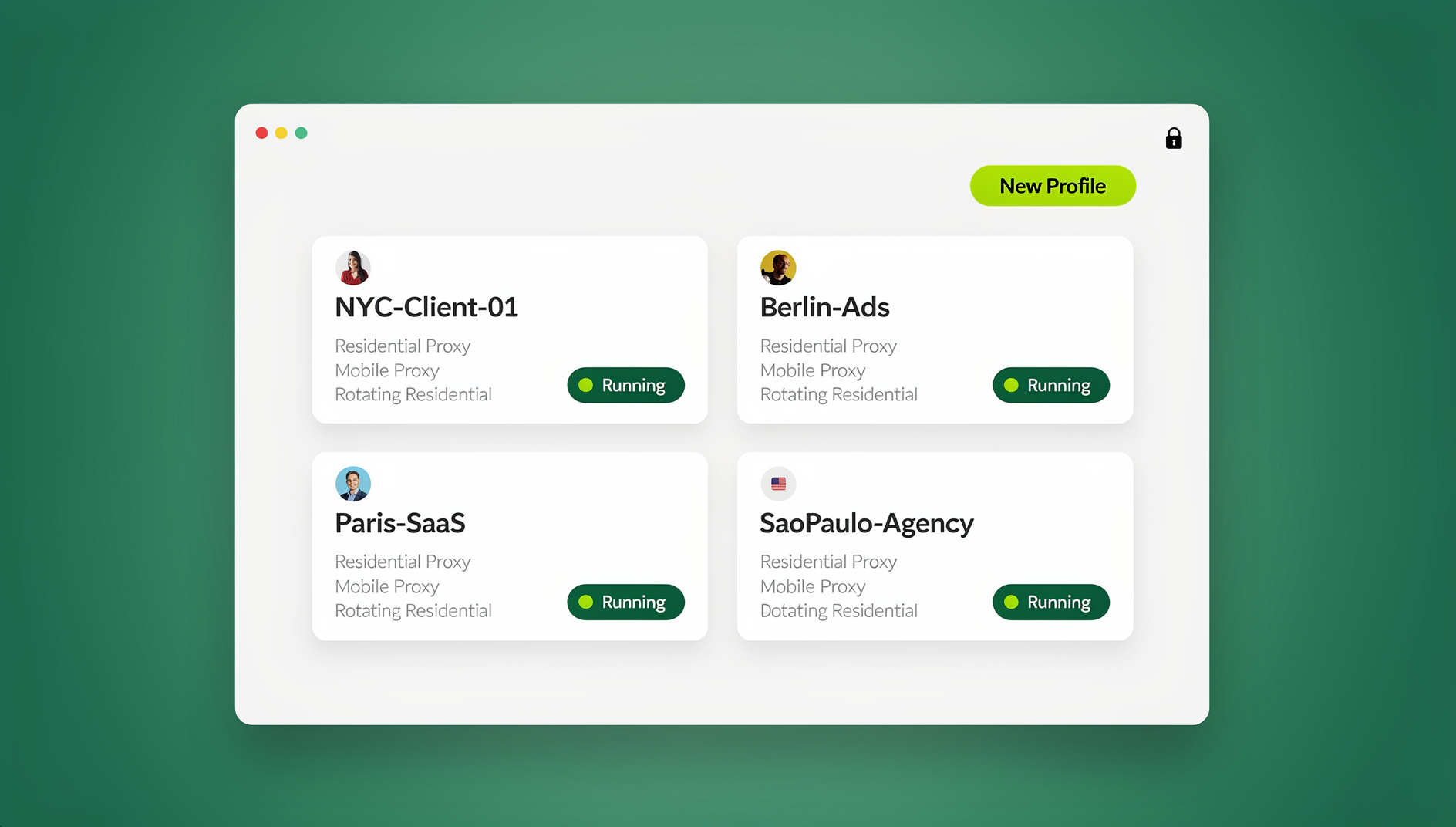
- Create the isolated browser profile. In Sendwin Browser, add a new profile and assign the proxy to it, then stop. In the Stealth engine, canvas, WebGL, audio, fonts and hardware are spoofed at the engine level and kept coherent, so the profile reads as one real machine rather than a stack of injected patches. Check: no two profiles on your machine share a fingerprint value.
- Confirm the environment inside the profile. Timezone, locale, WebRTC and geolocation follow the proxy’s exit IP automatically once the proxy is attached, which is what stops the “German IP, New York clock” mismatch. Check: run the pre-flight script below and compare the exit IP, timezone and locale against your intended identity.
- Create the financial instruments. Use a card whose BIN appears on no other store’s account — virtual card providers such as FlexCard issue unique numbers with unique BINs — and a payout account used nowhere else. If Amazon cannot send payments to your country, Hyperwallet is the Amazon-recommended route to an instant US bank account. Check: neither the card nor the payout account has ever been entered in another Seller Central session.
- Create a dedicated mailbox and phone number. Both should exist for this store alone. Check: search your own records for that number and address before you submit them; if they appear anywhere else, replace them.
- Register from inside the profile. Choose Individual ($0.99 per item sold) or Professional ($39.99 per month, plus selling fees) and complete the form in one continuous session, at a human pace. Never register on mobile data from your personal handset, and never paste details in from a document on the same machine. Check: the session stayed on the assigned proxy for the whole registration.
- Complete verification. Upload entity, ownership and financial documents plus address proof. Most US sellers are approved within 24 hours; business accounts that need extra checks can take 48-72 hours. Check: watch Seller Central notifications for a request for more information rather than assuming silence means approval.
- Warm the account before you list aggressively. No warm-up duration is published, so base it on behaviour: complete the seller profile, set shipping and return settings, browse the categories you intend to sell in, and publish a small first catalog instead of a hundred SKUs in week one.
- Lock the operating rules. In Sendwin Browser you can share the profile with a paid teammate so it opens already signed in, without anyone passing passwords around, and cloud sync on paid plans keeps those logins following you across devices. Check: the profile is paired to one proxy and one store, permanently, and nobody else has opened their own Amazon account inside it.
Pre-flight check: verify the exit IP and locale first
The local automation API is available on the Team plan and exposes a CDP endpoint for Selenium, Puppeteer and Playwright. Copy the URL from the profile’s automation settings and run this before registration, not after.
from playwright.sync_api import sync_playwright

CDP_URL = "http://127.0.0.1:PORT"  # copy it from the profile's automation settings

with sync_playwright() as p:
    browser = p.chromium.connect_over_cdp(CDP_URL)
    context = browser.contexts[0]
    page = context.new_page()

    page.goto("https://api.ipify.org?format=json")
    print("exit IP:", page.inner_text("body"))
    print("timezone:", page.evaluate("Intl.DateTimeFormat().resolvedOptions().timeZone"))
    print("locale:", page.evaluate("navigator.language"))

    browser.close()
If the printed timezone or locale does not match the address you registered, fix the profile before you submit anything to Amazon. Fingerprint and network mismatches are cheap to repair at this stage and expensive later.
Residential vs Mobile CGNAT Proxies for Amazon in 2026
Proxy choice is where most setups fail, because the failure is silent. Amazon classifies the IP before it looks at your documents.
| Proxy type | How Amazon treats it | Use it for a stealth store? |
|---|---|---|
| Datacenter | Ranges are known and flagged for sellers automatically | No |
| Commercial VPN | Shared exits sit in the same flagged range lists; one VPN IP may serve hundreds of accounts | No |
| Residential | Household ISP addresses are hard to classify as proxy traffic | Yes |
| 4G/5G mobile with CGNAT | Carrier IPs are shared by thousands of real users, so the traffic blends with ordinary mobile sessions | Yes — the common 2026 recommendation |
There is no published head-to-head comparison of mobile CGNAT versus residential behaviour specifically on Amazon, so treat the mobile preference as the stronger default rather than a proven ranking. Both beat datacenter and VPN IPs, and the IP has to stay glued to one profile: a store that logs in from three different residential addresses in a month looks like a shared login, not a household.
Sendwin Browser ships with built-in residential proxies on every plan, sized to the plan you are on, with extra bandwidth at $6 per GB if a store outgrows its allowance. You can also attach your own HTTP/SOCKS5 proxy instead.
Identity, Payments and the Off-Platform Footprint
Amazon’s 2026 enforcement is AI-first, which changed what “identity” means. The system can deactivate an account within minutes, and the first human reviewer sees only your appeal — so there is no early warning window during which you can correct a mismatch. That shift is the reason a plan for how to create stealth Amazon accounts 2026 now rests on documents and records as much as on browser settings.
The AI also checks your entire digital footprint, including your own website, social pages and ads, against the Amazon listing and treats inconsistencies as violations. If your Shopify page claims a certification the Amazon listing quietly avoids, that gap is evidence. Keep product claims, brand story and contact details consistent across every surface, and remember that shared third-party logistics providers and overlapping bank details create links you never typed anywhere.
Address proof must be dated within the last 90 days and show the full name and address exactly as entered in Seller Central. Verification cross-references public records too, which is the mechanism that stops someone previously banned from registering under a new name.
Warming Up and Running the Store Day to Day
Warm-up is about keeping a new account’s activity plausible while it has no history to vouch for it. Sign in at similar hours, keep session lengths human, open the pages a real seller opens — inventory, orders, reports — and only then increase listing volume. Nothing here should look like an automated pattern in the first weeks.
For repetitive work, use the Team plan’s local automation API, which supports Selenium, Puppeteer and Playwright against a real profile rather than a headless imitation. Our stealth automation guide covers how to pace and schedule that work so it does not read as traffic. If you would rather keep the operation off local hardware, the cloud browser runs profiles on EU and US nodes: 10 minutes a day of free preview, unlimited cloud browsing on Pro and Team, and up to 9 concurrent cloud sessions on Team.
Humans are usually the leak. A virtual assistant who opens their own Amazon account inside your profile hands Amazon a connection you cannot undo. Sharing a Send.win profile with a paid teammate opens the session already signed in, which removes the password handoff but not the rule: one profile, one store, one person’s job.
Pitfalls That Get Stealth Accounts Banned Fast
- Building the identity after the account. If the profile, proxy or payment instrument is finalised after registration, the early sessions already carry the wrong fingerprint and geo — and those first logs are exactly what gets pulled for review.
- Reusing anything. One email, one phone number, one card BIN plus billing ZIP, one payout account or one address string is enough to link two stores permanently.
- Clearing cookies instead of isolating profiles.
ubid-mainand the composite fingerprint both survive a clear, so the “clean slate” is imaginary. - Letting anyone else sign into Amazon inside your profile. A single session ties both accounts to one fingerprint, and the link cannot be undone afterwards.
- Rotating IPs mid-session. A store that hops addresses looks like a shared login, and two accounts on the same residential IP inside 90 days triggers an investigation.
- Sharing a 3PL, warehouse or returns address. The accounts look clean separately and obviously related on paper.
- Copying listings, images or copy from the suspended store. Identical assets and identical claims create the catalog-side link, and the off-platform audit in 2026 catches the same overlap in your ads and site.
- Letting documents drift. Expired address proof, or a name spelled differently between entity records and Seller Central, stalls verification — and a stalled verification invites a closer look at everything else.
How Send.win Helps With How To Create Stealth Amazon Accounts 2026
Send.win is an antidetect browser built for exactly this kind of work — every profile is a clean, isolated identity:
- Isolated profiles – unique fingerprint, separate cookies and storage per profile
- Stealth engine – canvas, WebGL, fonts, and audio spoofed at the engine level
- Desktop app + cloud sessions – native app for Windows, macOS, and Linux, or run profiles in the cloud with no install
- Built-in residential proxies – with automatic timezone, locale, and WebRTC matching
- Team features – share logged-in profiles with teammates without sharing passwords
Try the instant cloud browser demo — no install, no signup — or download the desktop app. The 30-day free trial needs no credit card, and paid plans start at $6.99/month billed annually (see pricing).
Appeals First, or a Stealth Rebuild First?
Start with the appeal, because a related-account suspension inherits the primary account’s problem: if the primary account is down, the linked store’s appeal has nothing to attach to. An estimated 15-30% of Plans of Action succeed in serious cases — an industry figure with no published methodology, so treat it as a rough expectation rather than a rate you can bank on.
Two things speed up diagnosis. Section 3 policy violations, including counterfeit and review manipulation, are now the hardest and slowest category to resolve. A free tool such as Suspension Analyzer by Mr. Jeff AMZ audits a deactivation notice in about 60 seconds and breaks down the trigger, which beats guessing at the cause. Related-account suspensions are among the fastest-growing suspension types in 2026, driven by device fingerprinting, IP matching, shared 3PLs and overlapping bank details.
Note the flip side: false positives are more common in 2026 because the AI acts first and verifies later, and they can take longer to clear than genuine violations. If your evidence is clean, the appeal is the faster path — and if you are rebuilding anyway, start with the linkage audit above and the operating rules in our guide to managing multiple seller accounts, not with a fresh registration on the same devices. A second attempt at how to create stealth Amazon accounts 2026 on the hardware that got the first store suspended simply rebuilds the same link.
🏆 Send.win Verdict
Stealth account work is an isolation problem, and isolation is the one thing a general-purpose browser cannot give you. Sendwin Browser is an installed desktop app for Windows, macOS and Linux whose Stealth engine spoofs canvas, WebGL, audio, fonts and hardware values inside the engine and keeps them coherent, so each store reads as a separate real machine. Built-in residential proxies on every plan carry timezone, locale, WebRTC and geolocation with the exit IP, and profile sharing with paid teammates means nobody passes passwords or borrows a session.
Try Send.win free today — 30 days at $0, 10 isolated profiles with unique fingerprints and 10 built-in residential proxies included, cancel anytime, and your local profiles stay on your machine.
Frequently Asked Questions
Is creating an Amazon stealth account legal?
Building a separate, isolated environment is not itself illegal, but breaching Amazon’s operating agreement is a contract matter with real commercial consequences: linked accounts can be deactivated together, and related accounts cannot be appealed directly. Crossing into someone else’s identity or fabricated documents moves the problem into fraud territory, which is a different and much worse category. Keep the separation technical, not deceptive.
How does Amazon detect linked seller accounts?
It cross-references signals rather than looking for one smoking gun: the hashed browser fingerprint per page load, cookies such as ubid-main, IP and network ranges, hardware identifiers from its own apps, payment instruments including card BIN and billing ZIP, contact details, entity records and your off-platform footprint. A shared fingerprint on two accounts typically produces manual review within 24-48 hours.
Can I use a VPN for a stealth Amazon account?
Not for a seller account. Amazon keeps a database of known datacenter and VPN ranges, and datacenter IPs are flagged automatically. VPN exits are also shared by many users at once, so the address itself is a weak identifier. Use one dedicated residential or mobile IP per store and keep it sticky.
Do I need a new bank account for each Amazon account?
Yes, if the accounts are meant to stay unlinked. Payment methods are cross-referenced across marketplaces, and overlapping bank details create links that are invisible while everything is healthy and obvious during a review. If Amazon cannot send payments to your country, Hyperwallet is the Amazon-recommended way to open an instant US bank account.
Can I use the same phone number on two Amazon accounts?
No. A reused number is one of the cleanest links Amazon can build, and it survives every browser-side precaution you take. Treat any number that has verified one Amazon account as spent, and issue a dedicated number for each store before registration rather than after.
How long should I warm up a new Amazon account?
No warm-up duration is published, so judge it by behaviour rather than a stopwatch. Complete the seller profile and settings, browse the categories you plan to sell in, keep sessions human-paced, and start with a small catalog instead of a full one. Increasing activity gradually over the early weeks is safer than following any fixed calendar.
What tools do I need for an Amazon stealth account?
The essentials are an anti-detect browser with engine-level fingerprint spoofing, one dedicated residential or mobile proxy per store, a payment card with a unique BIN, a payout account used nowhere else, and a dedicated mailbox and phone number. Those cover the environment half of how to create stealth Amazon accounts 2026. Sendwin Browser bundles the first two — isolated profiles plus built-in residential proxies — and keeps the profile’s geo settings following the proxy exit IP.
What happens if Amazon links my accounts?
All linked accounts can be deactivated, and the related account cannot be appealed on its own — you have to reinstate the primary account that committed the violation first. Since the March 2026 compliance update, opening a new account to get around a suspension is treated as grounds to deactivate every linked account automatically.