Anonymity vs Pseudonymity: What’s the Real Difference?
Online anonymity vs pseudonymity comes down to one question: do you need zero identity trail, or a reusable fake one? Anonymity means no one — not platforms, not ISPs, not other users — can tie an action back to you. Pseudonymity means you operate under a consistent alias that builds reputation without revealing your legal identity. Both protect privacy, but they serve different goals, demand different tooling, and break down differently when the setup is wrong. This guide walks through exactly when each approach fits and what technical stack you need.
Defining Anonymity: The Zero-Footprint Model
True anonymity severs every link between an online action and any real-world identity. There is no username, no persistent cookie, no device fingerprint that could be correlated across sessions. Each interaction is a standalone event — disposable and untraceable.
How Anonymity Works Technically
- Network-layer obfuscation — Tor routing, VPN chains, or proxy rotation so the origin IP is never exposed.
- Session isolation — every browsing session starts from a clean state with no cookies, localStorage, or cached credentials carried over. For a deep dive, read our session isolation guide.
- Fingerprint randomization — canvas, WebGL, AudioContext, and navigator properties are spoofed or blocked so the browser itself can’t be identified across visits. See our full breakdown of browser fingerprint explained.
- No account creation — any login instantly creates a persistent pseudonym, which breaks anonymity by definition.
How Send.win Helps With Online Anonymity Vs Pseudonymity
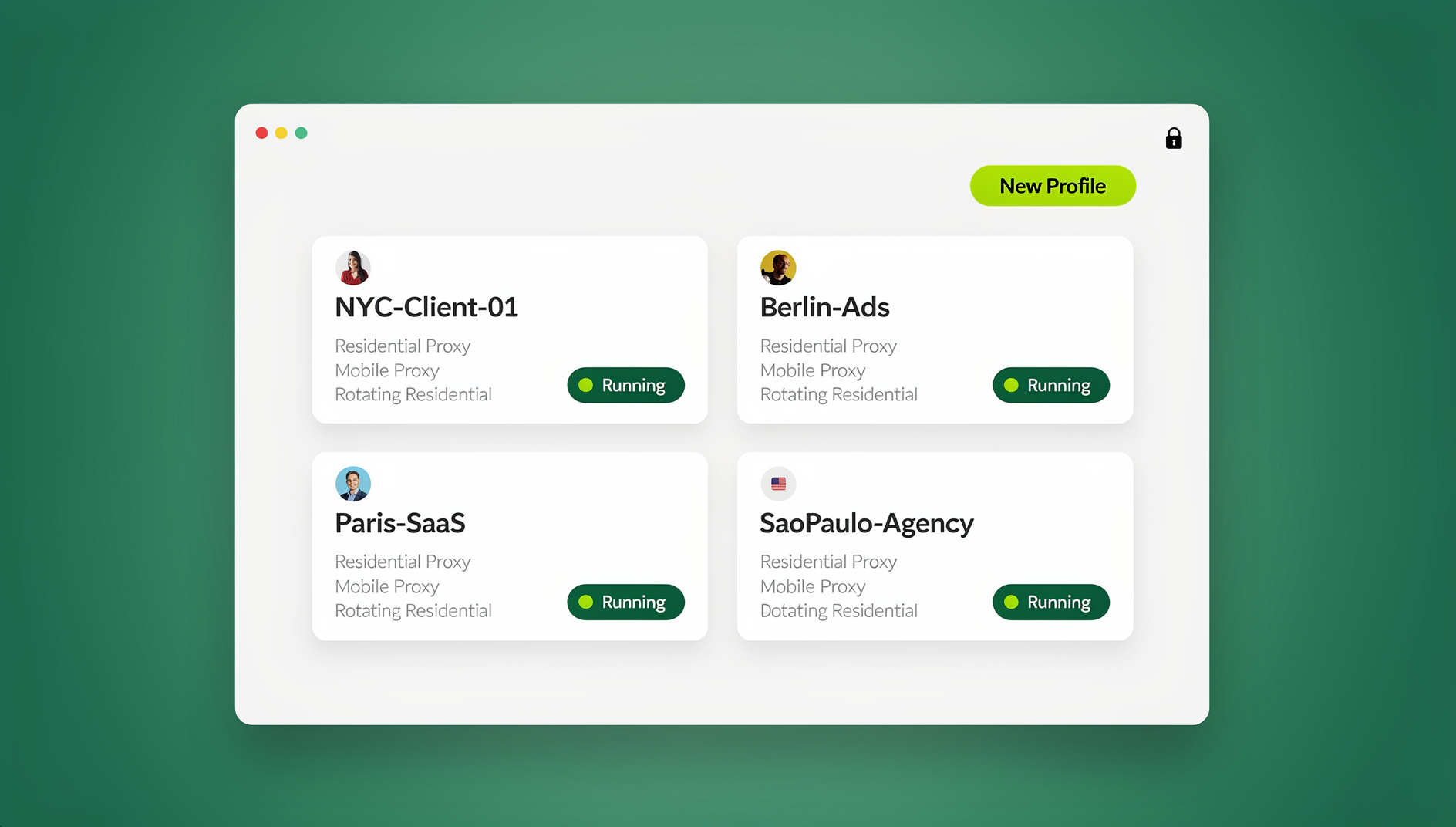
Send.win is a browser profile manager built for exactly this kind of work — every profile is a clean, isolated identity:
- Isolated profiles – unique fingerprint, separate cookies and storage per profile
- Consistent fingerprint per profile – each profile keeps its own browser fingerprint, including canvas, WebGL, fonts, and audio settings
- Desktop app + cloud sessions – native app for Windows, macOS, and Linux, or run profiles in the cloud with no install
- Built-in residential proxies – with automatic timezone, locale, and WebRTC matching
- Team features – share logged-in profiles with teammates without sharing passwords
Try the instant cloud browser demo — no install, no signup — or download the desktop app. There is no free trial; paid plans start at $19/month, and the first card purchase is covered by a 7-day money-back guarantee (see pricing).
When You Need True Anonymity
Not every privacy concern warrants full anonymity. It’s the right choice when the stakes are high enough that even a consistent pseudonym is a liability:
- Whistleblowing and journalism — sources communicating with reporters need sessions that cannot be traced back, even by a compromised platform. SecureDrop and similar tools assume Tor-level anonymity as a baseline.
- Sensitive research — investigating extremist networks, surveillance technology, or competitor pricing strategies where repeat visits from the same fingerprint would attract attention or skew results.
- One-time interactions — posting a tip, accessing a geo-restricted resource, or testing a website’s behavior without leaving any data behind.
- Evading state-level surveillance — in jurisdictions where browsing certain topics carries legal risk, anonymity isn’t a preference — it’s survival.
The Cost of Anonymity
Full anonymity is expensive in terms of usability. You can’t log in to anything. You can’t build a following. CAPTCHAs hit harder because there’s no trust signal. Page loads are slower through Tor. And one mistake — a single session where you accidentally log in to a personal account — can de-anonymize your entire history retroactively.
Defining Pseudonymity: The Persistent Alias
Pseudonymity means operating under a stable fake identity. You have a username, an avatar, a post history — but none of it traces back to your legal name. Think of it as wearing a consistent mask rather than being invisible.
How Pseudonymity Works Technically
- Dedicated browser profiles — each alias gets its own isolated environment with its own cookies, fingerprint, and proxy. The profiles persist across sessions so the alias maintains continuity.
- Consistent fingerprint per alias — rather than randomizing the fingerprint every session (anonymity), you lock each profile to a stable, realistic fingerprint that platforms see as “the same returning user.”
- Separate IP assignments — each pseudonym routes through a different residential or datacenter proxy so platforms can’t link aliases by IP overlap.
- Credential isolation — email, phone number, payment method — everything tied to one alias stays siloed from every other alias and from your real identity.
When Pseudonymity Is the Right Call
Pseudonymity serves anyone who needs persistent online identities that don’t point back to their real name:
- Social media alt accounts — managing brand accounts, niche community personas, or testing content strategies across demographics without cross-contamination.
- Business operations — running separate storefronts on Amazon or eBay, managing client ad accounts, or operating region-specific business profiles. Our guide on managing multiple accounts covers the operational details.
- Affiliate marketing — promoting offers across distinct verticals where each vertical needs its own identity, ad account, and tracking profile.
- Privacy-conscious everyday browsing — you want to use services that require login (banking, email, social) but don’t want those services to know your real name or link your activity to a master identity graph.
Anonymity vs Pseudonymity: Side-by-Side Comparison
| Dimension | Anonymity | Pseudonymity |
|---|---|---|
| Identity trail | None — every session is disposable | Consistent alias — builds history under a fake name |
| Account creation | Not possible (breaks the model) | Required (the whole point is a persistent persona) |
| Fingerprint strategy | Randomize or block per session | Lock a unique, stable fingerprint per profile |
| Proxy usage | Rotating proxies or Tor | Sticky residential proxies per alias |
| Usability | Low — CAPTCHAs, slow speeds, no logins | High — normal browsing experience per profile |
| Reputation building | Impossible | Core feature — each alias accrues trust |
| Risk if compromised | Single session exposed | Entire alias history exposed (but not real identity if isolation held) |
| Use cases | Whistleblowing, research, one-time access | Multi-account ops, brand management, affiliate marketing |
The Technical Stack for Each Strategy
Anonymity Stack
- Tor Browser — routes traffic through three relays, blocks JavaScript by default, and resets state on close. The gold standard for network-level anonymity.
- Tails OS — a live operating system that routes everything through Tor and leaves no trace on the host machine.
- Disposable VMs — Whonix or Qubes OS for compartmentalized browsing where each VM is destroyed after use.
- No-log VPNs — as an additional layer (never as a replacement for Tor in high-stakes scenarios).
The limitation: none of these tools let you log in to platforms repeatedly without creating a linkable identity. The moment you need accounts, you’ve crossed into pseudonymity territory.
Pseudonymity Stack
- Browser profile managers — tools like Sendwin Browser that create isolated profiles, each with its own fingerprint, cookies, and proxy. This is the core enabling technology for pseudonymity at scale.
- Residential proxies — sticky sessions from real ISP IPs so each alias appears to browse from a genuine household connection.
- Dedicated email providers — separate email accounts per alias, ideally from different providers.
- Virtual phone numbers — for SMS verification on platforms that require phone authentication.
- Password managers — to keep credentials for dozens (or hundreds) of aliases organized without cross-contamination.
Where Most People Go Wrong
Mistake 1: Using Anonymity Tools for Pseudonymity Tasks
Running Tor Browser to manage five Amazon seller accounts doesn’t work. Tor’s rotating exit nodes trigger fraud detection, its fingerprint is flagged as “Tor user” by most platforms, and clearing state on every close means you lose your login sessions. You need persistent, isolated profiles — not disposable ones.
Mistake 2: Using Pseudonymity Tools Without Proper Isolation
Creating three Chrome profiles in the same browser window doesn’t make them pseudonymous. Chrome profiles share the same browser binary fingerprint, often leak data through shared extensions, and can be linked via hardware-level identifiers. True pseudonymity requires anonymous browsing infrastructure at the profile level — each profile needs its own isolated fingerprint and network path.
Mistake 3: Mixing Identities Across Profiles
Logging in to your personal Gmail from a pseudonymous profile — even once — permanently links that alias to your real identity in Google’s database. Cross-contamination is the single most common failure mode in pseudonymity setups. It’s also irreversible: once the link is made, deleting the profile doesn’t undo the server-side correlation.
Mistake 4: Ignoring Behavioral Fingerprinting
Even with perfect technical isolation, your writing style, posting schedule, and topic interests can link aliases together through behavioral analysis. Stylometry research shows that as few as 5,000 words can uniquely identify an author. If you’re running pseudonymous accounts in the same niche, vary your writing patterns and posting times across profiles.
Browser Isolation: The Missing Layer
Whether you’re going for anonymity or pseudonymity, browser isolation is the technical foundation that makes either strategy work at a practical level. Without it, every privacy tool you stack on top has a single point of failure: the browser itself.
What Browser Isolation Actually Does
Browser isolation creates hard boundaries between browsing contexts. Each isolated profile runs with:
- Its own cookie jar and local storage — no data leaks between profiles
- A unique, realistic browser fingerprint — canvas hash, WebGL renderer, installed fonts, screen resolution, timezone, and language all match a coherent identity
- An independent network path — each profile routes through its assigned proxy
- Separate process memory — one profile can’t read another profile’s data through side-channel attacks
For Anonymity: Disposable Isolated Sessions
Create a profile, use it once, destroy it. The isolation ensures that the session’s fingerprint can’t be correlated with any previous or future session. This is Tor Browser’s model, but with better fingerprint control — Tor’s fingerprint is well-known and actively flagged by many sites.
For Pseudonymity: Persistent Isolated Profiles
Create a profile, assign it a stable fingerprint and proxy, and reuse it indefinitely. The isolation ensures that Profile A and Profile B can never be linked — not by cookies, not by fingerprint, not by IP. Each profile is, from the platform’s perspective, a completely separate user on a completely separate device in a completely separate location.
Scaling Pseudonymity: From 2 Accounts to 200
Individual pseudonymity — one alt account for personal use — is manageable with manual effort. But professional pseudonymity at scale (dozens or hundreds of accounts across multiple platforms) requires infrastructure:
Profile Management
Each pseudonym needs its own browser profile with locked fingerprint settings. Manually configuring these is impractical beyond a handful of profiles. Tools like Sendwin Browser let you create isolated profiles, each with its own fingerprint, from a single dashboard.
Proxy Assignment
Each profile needs its own IP. At scale, this means a proxy provider with enough residential IPs to assign one per profile, with sticky sessions so the IP doesn’t change mid-session. Send.win includes proxy bandwidth on both its Pro plan (5 GB) and Team plan (20 GB), with additional bandwidth available as an add-on.
Automation
Team Access
When multiple team members manage different aliases, you need shared access to profile configurations without sharing credentials. Send.win’s Team plan supports 16 seats, so your team can collaborate on profile management without compromising isolation between accounts.
Legal and Ethical Considerations
Neither anonymity nor pseudonymity is inherently illegal in most jurisdictions, but the context matters:
- Terms of Service — most platforms prohibit operating multiple accounts. Pseudonymity for multi-account management is a TOS violation on platforms like Facebook, Amazon, and Google. This doesn’t make it illegal, but it does mean account suspension is a business risk.
- Fraud and impersonation — using a pseudonym to deceive people about who you are (impersonating a real person, faking credentials) crosses into fraud territory regardless of the tool you use.
- Whistleblower protections — many jurisdictions explicitly protect anonymous speech and whistleblowing. In the US, the First Amendment broadly protects anonymous online speech.
- Data protection regulations — GDPR and similar laws give you the right to minimize personal data exposure, which both anonymity and pseudonymity serve.
Decision Framework: Which Do You Need?
Ask yourself three questions:
- Do I need to log in to anything? If yes → pseudonymity. Anonymity and logins are incompatible.
- Do I need to build reputation or history? If yes → pseudonymity. Anonymity can’t accumulate trust.
- Could linking this activity to any identity (even a fake one) put me at risk? If yes → anonymity. Pseudonyms can be subpoenaed, hacked, or correlated.
For most business and marketing use cases, pseudonymity is the right answer. For most safety-critical and investigative use cases, anonymity is the right answer. For everyday privacy, pseudonymity gives you 90% of the protection with 10% of the friction.
🏆 Send.win Verdict
Whether you need disposable anonymous sessions or persistent pseudonymous profiles, browser isolation is the enabling technology. Sendwin Browser gives you both — spin up throwaway profiles for anonymous research, or lock profiles with stable fingerprints and proxies for long-running pseudonymous accounts. With 150 profiles on the Pro plan ($6.99/month annually) and 500 on Team ($20.99/month annually), you can run anonymity and pseudonymity strategies side by side without overlap.
Try Send.win today — plans start at $19/month, with a 7-day money-back guarantee on your first card purchase, and full profile isolation from day one.
Frequently Asked Questions
Can I be both anonymous and pseudonymous at the same time?
Not with the same session. Anonymity means no identity at all; pseudonymity means a consistent fake identity. However, you can use both strategies simultaneously across different activities — anonymous sessions for sensitive research and pseudonymous profiles for account-based work — as long as you never cross-contaminate between them.
Is a VPN enough for anonymity?
No. A VPN hides your IP from the websites you visit, but the VPN provider can still see your traffic, and your browser fingerprint remains constant across sessions. True anonymity requires IP obfuscation (Tor or proxy chains), fingerprint randomization, and session isolation working together.
How do platforms detect that multiple pseudonymous accounts belong to the same person?
Through browser fingerprinting (canvas, WebGL, fonts, screen size), IP correlation (multiple accounts from the same IP or subnet), cookie and localStorage leaks between profiles, behavioral patterns (similar posting times, writing style), and device-level identifiers like hardware serial numbers. Proper isolation addresses the first four; only dedicated hardware or virtual machines address the last.
Does pseudonymity protect me from law enforcement?
It depends on your setup. If your pseudonymous profiles use a proxy provider that logs IPs and responds to subpoenas, law enforcement can trace the alias back to you. Pseudonymity primarily protects against platform-level linking and public identification, not against state-level investigation with legal authority to compel data from intermediaries.
What’s the biggest mistake people make with online anonymity?
Assuming a single tool provides complete anonymity. Using Tor but logging in to personal accounts, using a VPN but keeping the same browser fingerprint, or using incognito mode and thinking it provides any real anonymity. True anonymity is a layered strategy, and the weakest layer defines your actual protection level.
How many browser profiles do I need for pseudonymity?
One per alias, minimum. If an alias is used across multiple platforms (e.g., the same persona on Twitter, Instagram, and Reddit), those can share one profile since they’re the same identity. But different personas need different profiles — sharing a profile between aliases defeats the entire purpose of pseudonymous separation.
Is pseudonymity legal?
Using a pseudonym is legal in most jurisdictions. The US Supreme Court has recognized the right to anonymous and pseudonymous speech. However, using pseudonyms to commit fraud, evade legal obligations, or violate platform terms of service may carry separate legal consequences depending on the specific actions taken.
Can browser fingerprinting break both anonymity and pseudonymity?
Yes, but in different ways. For anonymity, a consistent fingerprint across sessions lets trackers link “anonymous” visits into a browsing profile. For pseudonymity, a shared fingerprint between profiles lets platforms detect that two accounts are operated by the same person. Browser isolation with per-profile fingerprint management addresses both failure modes.