Running Multiple Etsy Shops: The Complete Setup
If you want to run multiple Etsy shops without risking suspension, you need more than just different email addresses. Etsy’s detection systems cross-reference IP addresses, browser fingerprints, cookies, payment methods, and even shipping addresses to identify sellers operating multiple storefronts. The solution is complete isolation: each shop lives in its own browser profile with a unique fingerprint, dedicated residential proxy, separate payment method, and distinct branding. Here’s exactly how I set up and manage five profitable Etsy shops — and how you can do the same.
Why Sellers Run Multiple Etsy Shops
Before diving into the how, let’s address the why. There are legitimate, profitable reasons to operate more than one Etsy storefront.
Niche Separation
A shop selling vintage jewellery and a shop selling digital wedding invitations attract completely different buyers. Mixing them in one store dilutes your brand, confuses the algorithm, and hurts conversion rates. Separate shops let you build focused brands that rank better in Etsy search and convert higher.
Risk Diversification
If your single Etsy shop gets suspended — even temporarily — your entire income disappears overnight. Multiple shops spread that risk. A policy change, a baseless intellectual property complaint, or an algorithmic glitch on one shop doesn’t take down your entire business.
Market Testing
Want to test a new product category, pricing strategy, or branding approach? A separate shop lets you experiment without risking your established store’s reputation or search ranking.
Geographic Targeting
Different shops can target different markets. A shop optimised for UK buyers with GBP pricing and UK shipping options performs differently than one targeting the US market. Multiple shops let you tailor the entire buying experience to each audience.
How Etsy Detects Linked Accounts
Etsy explicitly states in its policies that sellers may only operate one shop per person. In practice, many sellers successfully run multiple shops — but only if Etsy can’t link them. Here’s how Etsy identifies connected accounts.
IP Address Tracking
The most obvious signal. If two Etsy seller accounts consistently log in from the same IP address, Etsy links them. This includes your home IP, office network, and mobile data connection. Even occasional overlaps — logging into the wrong account from the wrong network — can create a permanent association.
Browser Fingerprinting
Etsy collects detailed browser fingerprints: your user agent string, screen resolution, installed fonts, WebGL renderer, canvas hash, timezone, language, and hardware concurrency. If two seller accounts share the same fingerprint, Etsy knows they’re the same person regardless of what IP they’re using.
Cookies and Session Data
When you log into one Etsy account, cookies and tracking data persist in your browser. If you log out and log into a different account in the same browser, Etsy’s tracking scripts can detect that the same browser environment just authenticated two different seller accounts. This creates an immediate link.
Payment Method Overlap
Shared bank accounts, credit cards, or PayPal accounts between shops create a financial link that Etsy can detect. Even if the account names differ slightly, the underlying financial instruments connect the shops.
Shipping Address and Return Address
If multiple shops ship from the same physical address or list the same return address, Etsy flags the connection. This extends to print-on-demand and fulfilment partners — if two shops use the same Printful or Printify account, the link is visible.
Email and Phone Number Patterns
Using email aliases ([email protected], [email protected]) or the same phone number for verification across shops is an easy way for Etsy to connect the dots.
My Day-in-the-Life Workflow: Managing 5 Etsy Shops
Here’s what a typical day looks like managing five separate Etsy storefronts. This workflow keeps everything organised, isolated, and efficient.
Morning: Check Metrics and Orders (30 minutes)
I open Send.win and launch each shop’s browser profile one at a time. Each profile opens Etsy with its own saved session — I’m already logged in, and my fingerprint and IP are consistent with previous sessions. I check overnight orders, messages, and shop stats for each store. I never open two shop profiles simultaneously on the same screen to avoid accidental cross-contamination.
Mid-Morning: Product Listing and SEO (90 minutes)
I work on one shop at a time. Today, Shop 3 (digital planners) needs five new listings. I open that profile, create the listings with optimised titles and tags, upload mockup images, and set pricing. Each shop has its own keyword research spreadsheet and content calendar stored locally in a folder named after the shop.
Afternoon: Customer Service and Reviews (45 minutes)
I cycle through each shop’s profile to respond to buyer messages, handle any issues, and thank customers for reviews. Each profile’s message history is preserved in its isolated session, so I never mix up which customer belongs to which shop.
Late Afternoon: Fulfilment and Shipping (60 minutes)
For physical product shops, I process shipments through each shop’s dedicated fulfilment pipeline. Each shop has its own shipping address and carrier accounts. For digital product shops, Etsy handles delivery automatically, so this time goes toward creating new digital assets instead.
Evening: Analytics and Planning (30 minutes)
I review each shop’s performance for the day, note trends, and plan tomorrow’s tasks. I keep a master spreadsheet (offline, not linked to any Etsy account) that tracks overall revenue across all shops.
Step-by-Step Setup: One Send.win Profile Per Etsy Shop
Here’s the exact process I use to set up a new Etsy shop with complete isolation.
Step 1: Create a Dedicated Browser Profile
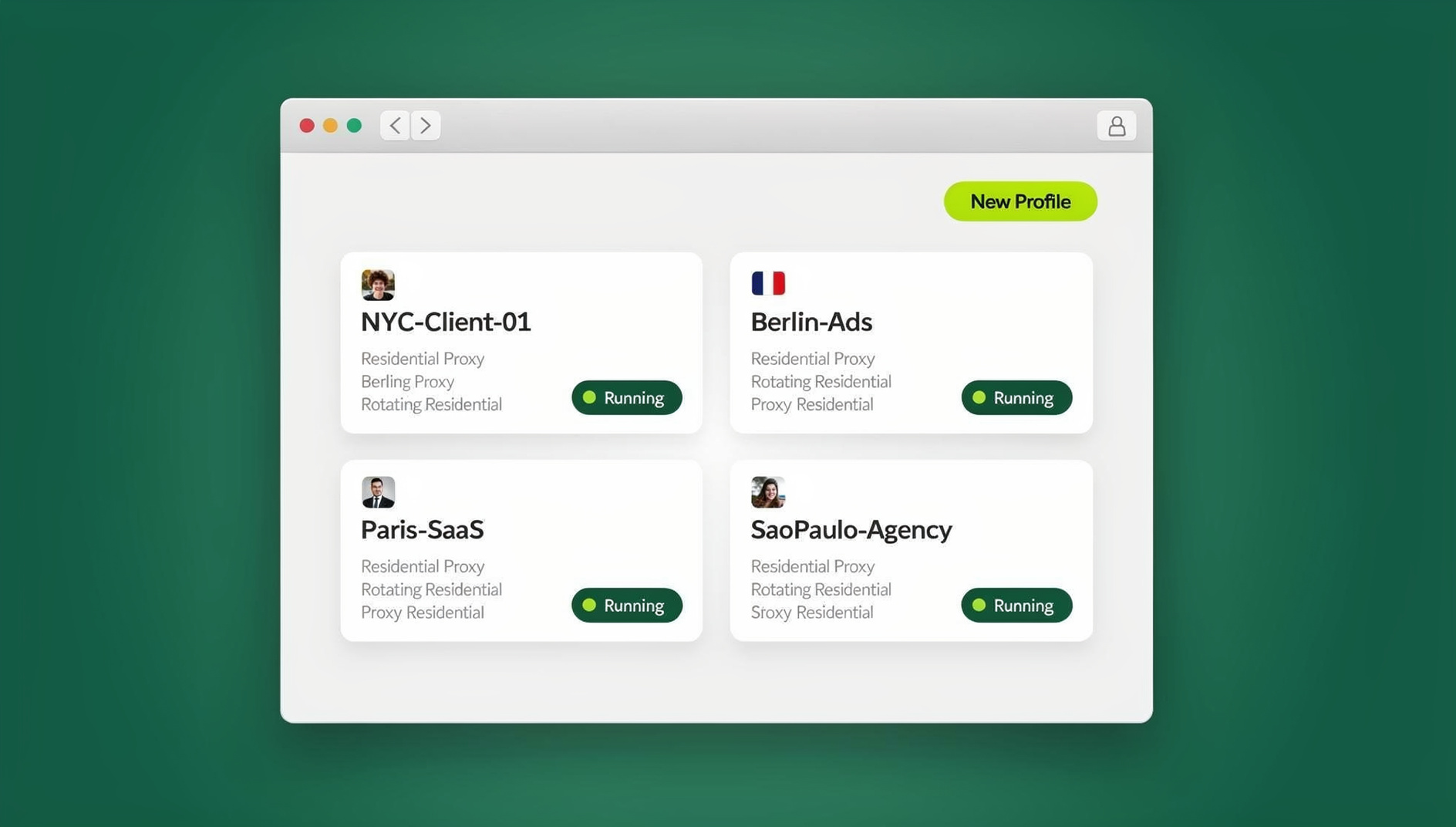
In Send.win, click “New Profile” and name it with a clear convention — I use “ETSY-[ShopName]” (e.g., ETSY-VintageFinds, ETSY-DigitalPlanners). Send.win automatically generates a unique browser fingerprint for each profile, including:
- Unique user agent string
- Distinct canvas and WebGL hashes
- Different screen resolution and colour depth
- Separate font list and hardware concurrency values
- Isolated timezone and language settings
This is the foundation of session isolation — each profile is a completely separate browser identity.
Step 2: Assign a Residential Proxy
Each profile gets its own dedicated residential proxy. I use sticky residential proxies so the IP address stays consistent across sessions — Etsy expects to see the same “device” logging in from the same general location each time.
Geographic matching matters. If a shop targets US buyers, I use a US-based proxy. For a UK-focused shop, a UK proxy. This keeps the IP location consistent with the shop’s market and shipping origin. You can learn more about setting this up in our guide on proxy browsers.
Step 3: Create an Isolated Email Account
Each shop gets its own email address from a different provider. Shop 1 might use a Gmail address, Shop 2 a ProtonMail address, Shop 3 an Outlook address. I create each email from within that shop’s Send.win profile, so even the email provider’s device fingerprint matches the shop’s browser identity.
Step 4: Set Up Separate Payment Methods
This is critical. Each Etsy shop needs:
- A unique bank account for receiving Etsy Payments deposits. Many online banks let you open multiple accounts easily.
- A separate card or payment method for Etsy billing (listing fees, advertising). Prepaid cards, virtual cards from services like Privacy.com or Revolut, or separate debit cards all work.
- A distinct PayPal account if applicable, each linked to different bank accounts and email addresses.
Step 5: Register the Etsy Shop
From within the dedicated Send.win profile, navigate to Etsy and create a new account using the shop-specific email. Go through the shop setup process — name, categories, listings, payment setup — all within this isolated browser environment. Etsy will only ever see this shop from this fingerprint and this IP.
Step 6: Unique Branding and Content
Each shop needs to look, feel, and sound completely different:
- Shop name and banner: Unique branding that reflects the niche
- About section: Different writing style and brand story
- Product photography style: Distinct visual identity
- Shop policies: Written differently (even if the substance is similar)
- Listing descriptions: Unique voice and formatting
Scaling Tips: From 2 Shops to 5 and Beyond
Running multiple shops is manageable at two or three. Scaling to five or more requires systems and discipline.
Inventory Management
If you sell physical products, each shop needs its own inventory tracking. I use separate spreadsheets for each shop with columns for SKU, stock level, reorder point, and supplier. For shops with overlapping suppliers, I place orders from different accounts to maintain separation.
For digital products, inventory isn’t an issue — but version control is. Keep each shop’s digital assets in separate folders with clear naming conventions. Never cross-list the same digital file across shops; create unique variations instead.
Shipping Logistics
Each shop ideally ships from a different address. Options include:
- PO Boxes: Inexpensive and available at most post offices. Each shop gets its own PO Box.
- Virtual mailboxes: Services like Anytime Mailbox provide real street addresses that work as shipping origins.
- Fulfilment services: Use different fulfilment accounts for different shops. If Shop 1 uses Printful, Shop 2 uses Printify, and Shop 3 uses Gooten, there’s no overlapping fulfilment link.
- Friends and family: With permission, use a trusted person’s address as the shipping origin for a shop.
Naming Conventions and Organisation
With multiple shops, organisation is everything. Here’s my system:
| Element | Convention | Example |
|---|---|---|
| Send.win profile | ETSY-[ShopName] | ETSY-VintageFinds |
| [shopname]@[provider] | [email protected] | |
| Local folder | /Etsy/[ShopName]/ | /Etsy/VintageFinds/ |
| Spreadsheet | [ShopName]_inventory.xlsx | VintageFinds_inventory.xlsx |
| Proxy label | proxy-etsy-[shop] | proxy-etsy-vintagefinds |
Time Management
Assign specific time blocks to each shop. Don’t try to manage all shops simultaneously — context switching kills productivity and increases the risk of logging into the wrong profile. I dedicate morning hours to Shops 1–3 and afternoon hours to Shops 4–5.
Outsourcing and Delegation
As you scale, consider delegating specific tasks. Send.win’s Team plan ($49/mo, or $251.88/yr) supports 16 seats, so you can bring on virtual assistants and give each one access to specific shop profiles without exposing your entire operation. The Pro plan ($19/mo, or $83.88/yr) supports plenty of profiles for most solo multi-shop sellers. Each team member works within their assigned profile — isolated, secure, and compartmentalised. This ties into broader strategies for managing multiple accounts across teams.
What to Do If an Etsy Shop Gets Suspended
Even with perfect isolation, suspensions can happen — a buyer complaint, a policy misinterpretation, or an algorithm error. Here’s how to handle it.
Don’t Panic — And Don’t Cross-Contaminate
The worst thing you can do is log into the suspended shop from another shop’s profile to “check on it.” This creates the exact link you’ve been working to avoid. Only access the suspended shop from its dedicated Send.win profile.
Appeal Through Proper Channels
Etsy allows appeals for most suspensions. Draft a professional, specific response addressing the exact reason for suspension. If it’s a policy violation, explain how you’ll correct it. If it’s a misunderstanding, provide documentation.
Protect Your Other Shops
If the suspension is legitimate (you actually violated a policy), review your other shops for similar issues. Fix them proactively before Etsy’s systems flag them independently.
Consider Starting Fresh
If the appeal fails, you can start a new shop — but only from a completely clean environment. Create a new Send.win profile, use a new proxy, a new email, and new payment methods. Never reuse any element from the suspended shop, especially if you’re exploring stealth eBay selling or other marketplace strategies in parallel.
Etsy Multi-Shop Checklist
Use this checklist every time you set up a new shop to ensure complete isolation.
| Isolation Element | Requirement | Status |
|---|---|---|
| Browser profile | Unique Send.win profile per shop | ☐ |
| Browser fingerprint | Auto-generated, unique per profile | ☐ |
| Residential proxy | Dedicated IP per shop, geo-matched | ☐ |
| Email address | Unique, from different provider | ☐ |
| Phone number | Unique per shop | ☐ |
| Bank account | Separate for Etsy Payments | ☐ |
| Billing card | Separate for Etsy fees | ☐ |
| Shipping address | Unique per shop (PO Box or virtual) | ☐ |
| Shop branding | Distinct name, banner, voice | ☐ |
| Product content | Unique listings, no cross-shop duplicates | ☐ |
Cost Breakdown: Running 5 Etsy Shops with Send.win
Transparency matters. Here’s what it actually costs to run this operation.
| Expense | Monthly Cost | Notes |
|---|---|---|
| Send.win Pro (annual) | $6.99 | 150 profiles, 5GB proxy bandwidth |
| Residential proxies (5x) | $25–50 | ~$5-10 per sticky residential proxy |
| Etsy listing fees | $10–30 | $0.20 per listing, varies by shop size |
| PO Boxes (5x) | $25–75 | $5-15 per PO Box depending on location |
| Virtual cards/bank accounts | $0–10 | Many services offer free accounts |
| Total | $67–166 | Before Etsy transaction fees and ad spend |
If each shop generates even $500/month in revenue (very achievable on Etsy), that’s $2,500/month total against $67–166 in multi-shop overhead. The ROI speaks for itself.
🏆 Send.win Verdict
Running multiple Etsy shops is one of the most effective ways to scale an e-commerce business — but only if each shop is completely isolated. Send.win gives you dedicated browser profiles with unique fingerprints, isolated cookie storage, and proxy support per profile. Create one profile per Etsy shop, assign a residential proxy, and Etsy sees each shop as a separate seller on a separate device. No linked accounts, no cascading suspensions, no risk.
Try the free Send.win cloud demo — a 3-minute preview without signup, or 10 minutes a day with a free account. Start with Pro at $19/mo (or $83.88/yr), or scale with Team at $49/mo (or $251.88/yr) for 16 team seats. The first card purchase is covered by a 7-day money-back guarantee.
Frequently Asked Questions
Is it legal to run multiple Etsy shops?
Yes, it’s legal. There are no laws against owning multiple online storefronts. However, Etsy’s Terms of Service state that each person should operate only one shop. Violating this policy can result in suspension of all linked shops. The key is ensuring complete isolation so each shop appears to be operated independently.
Can Etsy detect multiple shops from the same person?
Yes — through IP addresses, browser fingerprints, cookies, payment methods, shipping addresses, and email patterns. Without proper isolation, Etsy’s systems can link shops within hours. With complete isolation using tools like Send.win, each shop appears to be an independent seller on a separate device and network.
What happens if Etsy links my shops?
Etsy may suspend all linked shops simultaneously, freeze funds temporarily, or permanently ban your selling privileges. In less severe cases, they may issue a warning and ask you to close the duplicate shops. The severity depends on whether Etsy believes the multiple shops were used for policy violations.
Do I need separate payment methods for each Etsy shop?
Absolutely. Shared bank accounts, credit cards, or PayPal accounts create a financial link that Etsy can easily detect. Each shop needs its own bank account for receiving deposits and a separate card for billing. Virtual card services make this manageable without opening dozens of traditional bank accounts.
How many Etsy shops can I realistically manage?
Most solo sellers can effectively manage 3–5 shops. Beyond that, you’ll likely need to delegate. The limiting factor isn’t technical — Send.win supports hundreds of profiles — it’s your time and attention. Each shop needs regular listing updates, customer service, and order fulfilment. With the Team plan’s 16 seats, you can bring on virtual assistants to scale further.
Can I sell the same products in multiple Etsy shops?
Technically yes, but it’s risky and usually counterproductive. Identical listings across shops are a strong signal that the shops are linked. More importantly, you’d be competing against yourself in Etsy search. Each shop should have a distinct niche, unique product lines, and different branding to maximise both safety and revenue.
What’s the best proxy type for Etsy multi-shop management?
Sticky residential proxies are ideal. “Sticky” means the IP stays the same across sessions, so Etsy sees consistent login locations. “Residential” means the IP comes from a real ISP, not a datacenter, so it looks like a normal home user. Assign one proxy per shop and match the proxy’s geographic location to the shop’s target market.
How do I handle Etsy’s two-factor authentication across multiple shops?
Each shop needs its own phone number for 2FA. Options include separate SIM cards, virtual phone numbers from services like Google Voice or TextNow, or VOIP services. Set up 2FA during the initial account creation within each shop’s dedicated Send.win profile to keep everything isolated.
How Send.win Helps With Run Multiple Etsy Shops
Send.win is a browser profile manager built for exactly this kind of work — every profile is a clean, isolated identity:
- Isolated profiles – unique fingerprint, separate cookies and storage per profile
- Per-profile fingerprint – each profile keeps its own consistent browser fingerprint, including canvas, WebGL, fonts, and audio
- Desktop app + cloud sessions – native app for Windows, macOS, and Linux, or run profiles in the cloud with no install
- Built-in residential proxies – with automatic timezone, locale, and WebRTC matching
- Team features – share logged-in profiles with teammates without sharing passwords
Try the instant cloud browser demo — no install, no signup — or download the desktop app. There is no free trial; paid plans start at $19/month, and the first card purchase is covered by a 7-day money-back guarantee (see pricing).