What Is Browser Pool Management for Scraping?
Browser pool management for scraping is the practice of maintaining a set of concurrent browser instances that share work, rotate proxies, and recycle themselves automatically so your scraping jobs finish faster without crashing or getting blocked. Instead of launching one browser per task (expensive) or reusing a single instance for everything (fragile), a pool manager keeps a fixed number of healthy browsers ready, assigns URLs to whichever instance is idle, and replaces any instance that fails. Below you will find a complete architecture breakdown, working Node.js/Puppeteer code, and guidance on when to switch from self-managed pools to a cloud-managed alternative like Send.win.
Why You Need a Browser Pool
Sequential scraping with a single browser is simple but painfully slow. Spinning up hundreds of browsers simultaneously is fast but will eat your RAM and trigger anti-bot defenses within minutes. A pool sits in the sweet spot: you control the concurrency ceiling, each instance gets its own proxy and fingerprint context, and the manager handles lifecycle events (launch, health-check, retire) so your application code only thinks about URLs and data.
Key Benefits
- Predictable resource usage — cap memory at, say, 8 browsers × ~300 MB each instead of letting hundreds spawn.
- Higher throughput — 8 concurrent browsers finish 1,000 pages roughly 8× faster than one.
- Fault isolation — a crashed tab kills one task, not the entire job.
- Proxy affinity — each instance binds to its own proxy, making rotation seamless and reducing the chance that a single flagged IP poisons the whole run.
Manage Browser Profiles For Scraping With Send.win
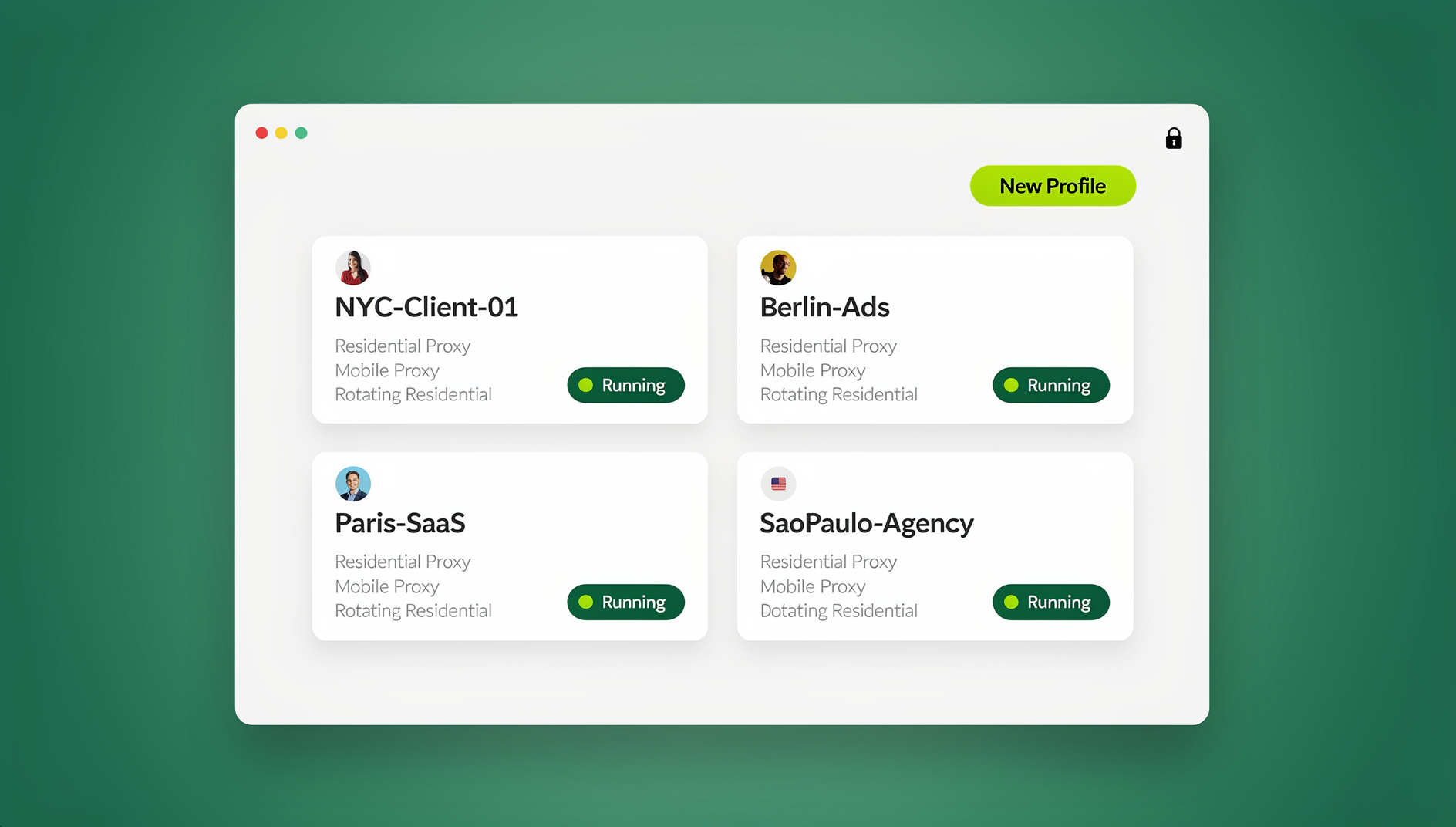
Send.win pairs isolated, fingerprint-managed browser profiles with a cloud browser that runs on Send.win’s servers in the EU, so your work stays in profiles that keep their own separate cookies, storage and fingerprint:
- Isolated browser profiles – each profile keeps its own cookies, storage, sessions, fingerprint settings and proxy (Team plan)
- Isolated profiles – each with its own fingerprint, cookies, and storage
- Built-in residential proxies – with automatic timezone, locale, and WebRTC matching
- Desktop app for Windows, macOS & Linux – plus cloud sessions when you don’t want a local install
Try the instant cloud browser demo — no install, straight from your browser. Then compare plans: there is no free trial, paid plans are Pro at $19/month or $83.88/year and Team at $49/month or $251.88/year, and the first card purchase is covered by a 7-day money-back guarantee.
Pool Architecture Overview
Every browser pool, whether hand-rolled or provided by a library, has the same four components:
| Component | Responsibility |
|---|---|
| Pool Manager | Maintains the list of live instances, assigns work, enforces concurrency limits. |
| Instance Lifecycle | Handles launch, warm-up, task execution, and graceful shutdown of each browser. |
| Health Checker | Periodically pings instances, detects zombies (high memory, unresponsive pages), and triggers replacement. |
| Resource Limiter | Caps total browsers, tabs per browser, memory ceiling, and maximum task duration. |
Instance Lifecycle in Detail
A single browser instance moves through these states:
- Cold start —
puppeteer.launch()with a unique proxy flag and user-data directory. - Idle — browser is open, no active page navigation. The pool marks it available.
- Busy — the pool assigns a URL; the instance navigates, extracts data, and returns results.
- Cooldown — after N tasks (or a time limit), the instance closes all pages, clears cookies, and either resets or retires.
- Retired —
browser.close()is called, and the pool launches a fresh replacement with a new proxy.
Building a Puppeteer Pool: Full Working Code
The following Node.js module gives you a production-ready pool with concurrency control, per-instance proxy rotation, automatic retries, and health checks. It depends only on puppeteer (or puppeteer-core if you supply your own Chromium).
Prerequisites
- Node.js 18+
npm install puppeteer- A list of proxy strings in
host:port:user:passformat
Pool Manager Module
// browser-pool.mjs
import puppeteer from 'puppeteer';

const PROXIES = [
  'dc1.proxyvendor.io:10001:user1:pass1',
  'dc2.proxyvendor.io:10002:user2:pass2',
  'res1.proxyvendor.io:20001:user3:pass3',
  'res2.proxyvendor.io:20002:user4:pass4',
];

class BrowserPool {
  constructor({ maxConcurrency = 4, maxTasksPerInstance = 50 } = {}) {
    this.maxConcurrency = maxConcurrency;
    this.maxTasks = maxTasksPerInstance;
    this.instances = [];       // { browser, proxy, taskCount, busy }
    this.queue = [];           // pending work items
    this.proxyIndex = 0;
  }

  // Round-robin proxy selection
  _nextProxy() {
    const proxy = PROXIES[this.proxyIndex % PROXIES.length];
    this.proxyIndex++;
    const [host, port, user, pass] = proxy.split(':');
    return { server: `http://${host}:${port}`, user, pass };
  }

  // Launch a single browser instance with its own proxy
  async _createInstance() {
    const proxy = this._nextProxy();
    const browser = await puppeteer.launch({
      headless: 'new',
      args: [
        `--proxy-server=${proxy.server}`,
        '--no-sandbox',
        '--disable-dev-shm-usage',
        '--disable-gpu',
      ],
    });
    return { browser, proxy, taskCount: 0, busy: false };
  }

  // Health check: close and replace unresponsive instances
  async _healthCheck(instance) {
    try {
      const pages = await instance.browser.pages();
      if (!pages.length) throw new Error('No pages');
      await pages[0].evaluate(() => document.readyState);
      return true;
    } catch {
      console.warn('[Pool] Unhealthy instance detected, replacing...');
      await this._retire(instance);
      return false;
    }
  }

  // Retire an instance and spawn a replacement
  async _retire(instance) {
    try { await instance.browser.close(); } catch {}
    const idx = this.instances.indexOf(instance);
    if (idx !== -1) {
      this.instances[idx] = await this._createInstance();
    }
  }

  // Warm up the pool
  async init() {
    for (let i = 0; i < this.maxConcurrency; i++) {
      this.instances.push(await this._createInstance());
    }
    console.log(`[Pool] Initialized ${this.maxConcurrency} browsers`);
  }

  // Execute a scraping function on the next available instance
  async execute(taskFn, retries = 3) {
    // Find an idle, healthy instance
    let instance = this.instances.find(i => !i.busy);
    if (!instance) {
      // Wait for one to free up
      await new Promise(resolve => this.queue.push(resolve));
      instance = this.instances.find(i => !i.busy);
    }

    instance.busy = true;
    let lastError;

    for (let attempt = 1; attempt <= retries; attempt++) {
      try {
        const page = await instance.browser.newPage();

        // Authenticate proxy if needed
        if (instance.proxy.user) {
          await page.authenticate({
            username: instance.proxy.user,
            password: instance.proxy.pass,
          });
        }

        const result = await taskFn(page);
        await page.close();

        instance.taskCount++;
        // Retire instance after N tasks to rotate proxy
        if (instance.taskCount >= this.maxTasks) {
          await this._retire(instance);
        }

        instance.busy = false;
        if (this.queue.length) this.queue.shift()();
        return result;
      } catch (err) {
        lastError = err;
        console.warn(`[Pool] Attempt ${attempt} failed: ${err.message}`);
        if (attempt === retries) {
          // Replace the instance on final failure
          await this._retire(instance);
          instance = this.instances.find(i => !i.busy) || this.instances[0];
        }
      }
    }

    instance.busy = false;
    if (this.queue.length) this.queue.shift()();
    throw lastError;
  }

  // Graceful shutdown
  async destroy() {
    await Promise.all(
      this.instances.map(i => i.browser.close().catch(() => {}))
    );
    this.instances = [];
    console.log('[Pool] All browsers closed');
  }
}

export default BrowserPool;
Usage Example: Scraping with the Pool
// scrape.mjs
import BrowserPool from './browser-pool.mjs';

const urls = [
  'https://example.com/page/1',
  'https://example.com/page/2',
  'https://example.com/page/3',
  // ... hundreds more
];

const pool = new BrowserPool({ maxConcurrency: 6, maxTasksPerInstance: 30 });
await pool.init();

const results = await Promise.all(
  urls.map(url =>
    pool.execute(async (page) => {
      await page.goto(url, { waitUntil: 'domcontentloaded', timeout: 30000 });
      const title = await page.$eval('h1', el => el.textContent).catch(() => '');
      const price = await page.$eval('.price', el => el.textContent).catch(() => '');
      return { url, title, price };
    })
  )
);

console.log(`Scraped ${results.length} pages`);
await pool.destroy();
Concurrency Control Strategies
The pool above uses a simple idle-check with a callback queue. For heavier workloads, consider these patterns:
Semaphore-Based Limiting
Wrap pool.execute() inside a semaphore (e.g., the p-limit npm package) to hard-cap in-flight tasks regardless of available instances. This is useful when the target site rate-limits per IP and you need to throttle even if browsers are free.
Priority Queues
Not all URLs are equal. A priority queue lets you push high-value pages (product pages, pricing) to the front while bulk category pages wait. Implement with a min-heap or use the async-priority-queue package.
Backpressure Signals
When more than half your instances are busy, slow down the producer (the code enqueuing URLs). This prevents memory bloat from thousands of queued promises. A practical approach: pause the URL generator when queue.length > maxConcurrency * 2.
Proxy Rotation Per Instance
The code above binds one proxy to each browser at launch via --proxy-server. When the instance retires after maxTasksPerInstance pages, the replacement gets the next proxy in the rotation. This gives you two rotation layers:
- Inter-instance rotation — different browsers use different proxies concurrently.
- Temporal rotation — each browser slot cycles through the proxy list over time.
For finer control, you can skip the --proxy-server flag and route traffic through a local proxy manager (like proxy browsers with per-request switching), but the per-instance approach is simpler and sufficient for most scraping at scale.
Health Checks and Self-Healing
Browsers leak memory, freeze on JavaScript-heavy pages, and occasionally segfault. Without health checks, your pool degrades silently. Implement these three monitors:
1. Liveness Probe
Every 60 seconds, call page.evaluate(() => 1) on each idle instance. If it throws or times out after 5 seconds, retire the instance. The code above includes this in _healthCheck().
2. Memory Watchdog
Query /json/version on the browser’s DevTools port or use process.memoryUsage() on the Node side. If RSS exceeds 500 MB per browser, force-retire. Chromium notoriously leaks on long sessions.
3. Task Timeout
Wrap every page.goto() in a Promise.race() with a 30-second deadline. Pages that hang (infinite scroll, heavy WebSocket streams) should be aborted rather than blocking the instance indefinitely. Understanding how sites detect automation through browser fingerprint analysis helps you tune these timeouts — some sites deliberately slow responses to bot-like sessions.
Resource Limits: How Many Browsers Can You Run?
Each headless Chromium instance in --no-sandbox mode typically consumes:
| Resource | Per Instance (idle) | Per Instance (active page) |
|---|---|---|
| RAM | ~80 MB | 150–400 MB |
| CPU | <1% | 5–15% (rendering) |
| File descriptors | ~50 | ~200 |
On a 16 GB server, 8–12 concurrent instances is a safe ceiling. On a 4 GB VPS, stay at 2–4. Over-provisioning doesn’t just slow things down — it causes OOM kills that lose in-progress data.
Retry Logic That Actually Works
The pool’s execute() method retries failed tasks up to 3 times. But blind retries waste time on permanent failures. Smarter retry logic checks the error type:
- Network timeout / DNS failure — retry with a different proxy (the current one may be dead).
- HTTP 403 / 429 — the IP is flagged. Retire the instance immediately, wait 5–10 seconds, retry on a fresh browser+proxy. Learning to bypass anti-bot detection will reduce how often you hit this.
- HTTP 5xx — server-side issue. Retry after exponential backoff (1s, 4s, 16s).
- Selector not found — the page structure changed or loaded differently. Log and skip rather than retrying the same broken selector.
Local Pools vs. Cloud-Managed Pools
Self-managed pools (the code above) give you full control but come with operational overhead: you provision servers, monitor memory, rotate proxies, and handle Chromium updates. Cloud-managed pools abstract all of that.
| Factor | Local Pool | Cloud-Managed Pool |
|---|---|---|
| Setup time | Hours (code + infra) | Minutes |
| Scaling | Limited by server RAM | Elastic — spin up 50+ sessions on demand |
| Proxy management | You buy and rotate | Built-in, per-profile binding |
| Fingerprint diversity | Manual (user-agent, viewport, etc.) | Automatic per profile |
| Maintenance | Chromium updates, memory leaks, crash recovery | Provider handles everything |
| Cost at 10 profiles | ~$20/mo (VPS) + proxy costs | From $6.99/mo (Send.win Pro annual) |
| Best for | Custom pipelines, air-gapped networks | Teams, multi-account ops, fast iteration |
Send.win Cloud Sessions as a Managed Pool
If you are spending more time debugging Chromium crashes than writing scraping logic, a managed solution removes that burden entirely. Send.win offers cloud browser sessions that function as a pre-built browser pool:
- Each profile is an isolated browser instance with its own fingerprint, cookies, and proxy binding — equivalent to one slot in your pool, but managed for you. Proper session isolation is handled automatically.
- Cloud browser sessions — run profiles in the cloud without installing the Sendwin Browser desktop app. No server provisioning, no Chromium updates, no memory management.
- Pro plan starts at $6.99/month (annual) with 150 profiles and 5 GB proxy bandwidth — enough for most scraping workloads. Team plan at $20.99/month (annual) adds 500 profiles, 20 GB bandwidth, and 16 seats for collaborative operations.
You still write the scraping logic (selectors, data extraction, storage), but the pool infrastructure — launching, health-checking, proxy rotation, fingerprint management — is handled by Send.win.
🏆 Send.win Verdict
Building your own browser pool teaches you how concurrency, proxy rotation, and instance lifecycle work — and the Puppeteer code above is genuinely production-ready. But once your scraping scales beyond a single server, the operational cost of managing Chromium instances, proxies, and fingerprints outweighs writing the pool manager. Send.win’s cloud browser sessions give you a fully isolated browser pool with per-profile proxy binding, starting at $19/month — less than most VPS bills.
Try Send.win today — paid plans start at $19/month, with a 7-day money-back guarantee on your first card purchase.
Frequently Asked Questions
How many browser instances can I run on a single server?
On a 16 GB RAM server, 8–12 headless Chromium instances is a practical ceiling. Each active instance consumes 150–400 MB depending on page complexity. Monitor RSS memory and set a hard cap in your pool manager to prevent OOM kills.
Should I use Puppeteer or Playwright for a browser pool?
Both work well. Puppeteer has a larger ecosystem of scraping-focused plugins and examples. Playwright offers built-in multi-browser support (Chromium, Firefox, WebKit) and better auto-waiting. The pool architecture is identical for both — swap puppeteer.launch() for playwright.chromium.launch().
How do I rotate proxies within a browser pool?
Bind one proxy per browser instance at launch using the --proxy-server flag. When an instance retires (after N tasks or a health-check failure), the replacement launches with the next proxy in your list. This gives you both concurrent and temporal rotation without mid-session proxy switching.
What causes browser instances to become unresponsive?
The most common causes are memory leaks from JavaScript-heavy pages, WebSocket connections that never close, and pages with infinite scroll that keep allocating DOM nodes. Implement a liveness probe (evaluate a simple expression every 60 seconds) and a memory watchdog to catch these before they block your pool.
How is a browser pool different from browser tabs?
Tabs share the same browser process, memory space, and — critically — the same proxy and fingerprint. If one tab triggers a CAPTCHA, the site may flag the entire browser session. A pool uses separate browser processes, each with its own proxy, cookies, and fingerprint context, providing real isolation.
When should I switch from a local pool to a cloud-managed pool?
When you spend more than 20% of your development time on infrastructure — provisioning servers, debugging Chromium crashes, updating proxy lists, managing fingerprints — rather than on your actual scraping logic. Cloud-managed pools like Send.win’s cloud sessions eliminate that overhead entirely.
Can I use browser pool management for scraping behind login walls?
Yes. Each pool instance maintains its own cookies and local storage, so you can authenticate once per instance and reuse the session for subsequent tasks. Set maxTasksPerInstance to match the site’s session timeout so the instance retires and re-authenticates before cookies expire.
How do I handle CAPTCHAs in a browser pool?
Integrate a CAPTCHA-solving service (2Captcha, Anti-Captcha) into your task function. When a CAPTCHA is detected, send the challenge to the solver, wait for the token, inject it, and continue. The pool’s retry logic should treat CAPTCHA failures as retriable — the next attempt on a fresh instance with a different proxy often avoids the CAPTCHA entirely.