Switching between users without logging out is one of those small frictions that quietly eats hours out of every week. If you manage a personal account and a work account, run several client profiles, or juggle five social channels for a side hustle, you already know the drill: log out, clear cookies, log back in, repeat. It is slow, it is annoying, and in apps that flag “suspicious activity” after repeated logouts and logins from the same device, it can even get an account flagged or restricted.
The good news is that in 2026 you no longer need to choose between convenience and security. Whether you want to switch between two Gmail accounts, run ten Instagram profiles for client work, or keep a personal and business Facebook login open side by side, there are several proven methods — from native “add account” menus to dedicated multi-login browsers — that let you switch instantly, with every session kept completely separate. This guide walks through every practical option, ranked from quick built-in tricks to the dedicated tools power users and agencies rely on, and shows exactly how to set each one up.
Why Logging In and Out Constantly Is a Bad Habit
Before getting into the fixes, it is worth understanding why the “log out, log back in” cycle causes more problems than it solves:
- It wastes time. Even a fast logout/login cycle costs 20-40 seconds. Multiply that by 10-20 switches a day and you lose 15-20 minutes daily — well over an hour a week.
- It risks data loss. Logging out sometimes clears unsaved drafts, open tabs, form data, or shopping carts tied to the session you just left.
- It can trigger security flags. Repeated logins and logouts from the same IP and device fingerprint look unusual to platforms like Google, Meta, and Amazon, which use behavioral signals to detect account sharing or bot activity. Frequent re-authentication can prompt extra verification steps or, in edge cases, a temporary lock.
- It breaks focus. Constantly re-entering credentials (or waiting on 2FA codes) interrupts deep work, especially for social media managers, agencies, and freelancers hopping between client accounts all day.
- It doesn’t scale. Logging in and out might be tolerable for two accounts. It becomes unmanageable at five, and effectively impossible at fifty.
The fix is to stop treating “one browser, one identity” as a fixed rule. Modern tools let a single device hold many fully separate identities at once — each with its own cookies, cache, and (optionally) its own IP address — so switching is a click, not a re-login.
The Best Ways to Switch Between Users Without Logging Out (2026)
Here are the six approaches that actually work, starting with the built-in options and moving up to dedicated software.
1. Use a Multi-Login Browser (the most reliable method)
A multi-login browser — sometimes called an antidetect browser — creates isolated browser profiles inside a single app. Each profile has its own cookies, local storage, cache, and browser fingerprint, so every account you open behaves like it’s on a completely separate computer. You never log out of one profile to open another; you simply click a different profile and you’re in.
This is the category Send.win belongs to, alongside tools like Sessionbox and Multilogin. Here’s how the three compare on the features that actually matter for everyday account switching:
| Feature | Send.win | Sessionbox | Multilogin |
|---|---|---|---|
| Free trial | No free trial; 7-day money-back guarantee on first card purchase | Limited free plan only | No free trial |
| Starting price | $19/mo (Pro) | Paid tiers, limited support | From $99/mo |
| Desktop app | Yes — native Windows/macOS/Linux | Yes | Yes |
| Browser extension | No — native desktop app + cloud sessions | Yes (Chrome, Edge, Firefox) | No |
| Built-in proxy per profile | Yes | Extra setup required | Yes |
| Team session sharing (no password) | Yes | No | Limited |
| Automation API (Selenium/Puppeteer/Playwright) | No | No | Yes (higher tiers) |
| Cloud sync across devices | Yes, unlimited encrypted storage | Yes | Yes |
The core benefit is simple: open the app, click on the profile you want, and you’re instantly working inside that account — no logout, no cleared cookies, no waiting on a fresh login screen. If you want to understand how this stacks up against the free option built into your existing browser, our Chrome profiles vs multi-login browsers comparison breaks down exactly when each makes sense.
2. Use the Native “Add Account” Feature in the App
Most major apps — Gmail, Facebook, Instagram, Slack, and others — support adding a second account natively, without a dedicated tool. This is the simplest option if you only need to switch between two or three accounts inside the same app:
- Open the app and tap your profile picture or avatar (usually top-right).
- Look for “Add Account,” “Manage Accounts,” or a similar option in the menu.
- Sign in with the second account’s credentials.
- Once added, switching is a matter of tapping your profile picture again and selecting the account you want from the list — no logout required.
This works well for personal use, but it has real limits: it usually only applies within a single app (your Gmail switcher won’t help you switch Amazon or Etsy accounts), most apps cap how many accounts you can add, and business platforms increasingly monitor for signs that “linked” accounts belong to the same operator, which can trigger review flags on ad or seller accounts.
3. Create Separate Browser Profiles
Chrome, Edge, and Firefox all support multiple browser profiles, each with its own cookies, bookmarks, and logins. This is a solid free option if you’re managing a handful of accounts and don’t need proxies or fingerprint masking:
- Click your profile icon in the top-right corner of the browser.
- Select “Add” or “Add Profile.”
- Name the profile (e.g., “Work” or “Client A”) and finish setup.
- Switch between profiles anytime by clicking the profile icon and selecting a different one — each opens in its own window with its own separate session.
The catch: browser profiles all share the same device fingerprint and, unless you configure it separately, the same IP address. For casual personal/work separation that’s fine. For anything where platforms actively look for duplicate accounts (marketplaces, ad platforms, social media at scale) it isn’t enough — see our full breakdown of Chrome extensions for managing multiple login sessions for lighter-weight add-ons that sit on top of profiles.
4. Use Private/Incognito Browsing for a Quick Second Session
Opening an incognito or private window is the fastest way to get a second, temporary session running alongside your main one. It’s useful in a pinch — checking how a page looks logged out, testing a second login quickly, or avoiding leaving a trace on a shared computer — but it isn’t a real long-term solution:
- Incognito sessions don’t save cookies after you close the window, so you’ll need to log in again next time.
- You can’t easily save multiple incognito sessions to switch between later.
- It doesn’t scale past two accounts open at once (your normal window plus one incognito window).
Think of incognito mode as a stopgap, not a daily-driver solution for managing recurring multi-account work.
5. Use a Password Manager to Speed Up Re-Logins
If you do need to log in and out occasionally, a password manager like Bitwarden, 1Password, or Dashlane removes the friction of typing credentials every time. It stores and auto-fills logins, generates strong unique passwords per account, and syncs across devices.
It’s a smart security layer for anyone juggling multiple logins, but it’s important to be clear about what it does and doesn’t solve: a password manager makes logging back in faster, it doesn’t eliminate the logout/login cycle itself. If your goal is genuinely staying logged into multiple accounts at once, pair a password manager with browser profiles or a multi-login browser rather than relying on it alone.
6. Automate Account Switching for Bulk or Recurring Workflows
If you or your team need to check dozens of accounts on a schedule — verifying ad campaigns are live, confirming logins across client accounts, or running QA across many test profiles — manual clicking through profiles doesn’t scale even with a great multi-login browser. Send.win has no automation interface: there is no API, SDK, headless mode or Selenium/Puppeteer/Playwright support on any plan, so routine account switching is done by hand. What Send.win does provide is isolated browser profiles, each with its own cookies, storage, sessions, fingerprint settings and proxy, so agencies running 50+ profiles can keep each account’s data separate.
Step-by-Step: Switching Users Instantly with Send.win
If you decide a dedicated multi-login browser is the right fit — which it usually is once you’re past 3-4 recurring accounts — here’s exactly how to set it up:
- Sign up for a paid plan. Go to send.win and create an account. There is no free trial; the first card purchase is covered by a 7-day money-back guarantee, and you can preview the cloud browser for free at the demo.
- Install the Desktop app. Send.win ships a native Desktop app for Windows, macOS, and Linux — download it directly from the site (it’s the first item in the navigation menu). This is what gives you the full profile manager, proxy assignment, and team-sharing controls, while cloud browser sessions remain available if you’d rather skip the install and run a profile entirely in the cloud.
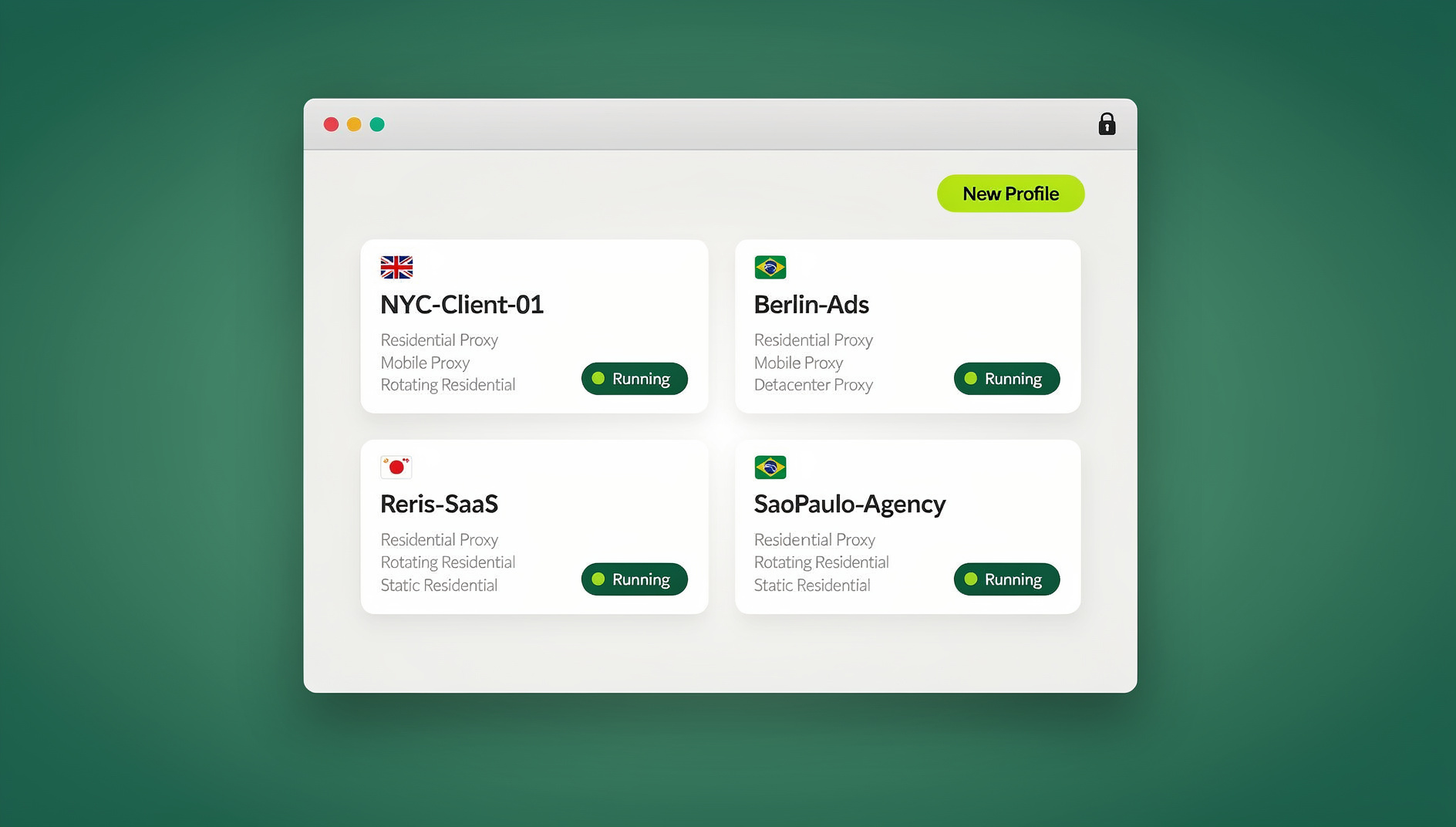
- Create a profile per account. Inside the app, click “New Profile,” name it (e.g., “Client A – Instagram” or “Personal Gmail”), and Send.win generates a unique, consistent browser fingerprint for it.
- Assign a proxy (optional but recommended). For accounts where geography or IP consistency matters — ad accounts, marketplace seller accounts, social profiles — attach a residential or datacenter proxy to that specific profile so it always connects from the same location.
- Log into the account inside that profile, once. The session is saved to the profile going forward — cookies, local storage, and login state persist.
- Switch instantly. To move to a different account, click the other profile in your dashboard. It opens in its own isolated window, already logged in, with zero overlap with any other open profile.
- Share with your team without sharing passwords. On the Team plan, you can grant teammates access to specific profiles directly — no need to hand out the actual account password, and access can be revoked instantly if someone leaves the team.
For agencies specifically, this last point is often the biggest win — you can read more in our one-click account switching guide for agency owners managing many client logins at once.
Comparison: Which Method Fits Your Situation?
| Your situation | Best method | Why |
|---|---|---|
| 2 personal accounts in the same app (e.g., two Gmail addresses) | Native “Add Account” feature | Free, built-in, no setup needed |
| 3-5 accounts across a couple of apps, casual use | Browser profiles | Free, simple, good enough separation for low-risk use |
| Quick one-off second session | Incognito/private mode | Instant, no account creation needed |
| 5+ accounts, especially social/ad/marketplace accounts | Multi-login browser (Send.win) | True isolation, proxy support, separate cookies, storage and fingerprint per profile |
| Team needs shared access to client accounts | Multi-login browser with team sharing | No password sharing, instant revoke, audit trail |
| Recurring bulk checks across many profiles | Manual checks across isolated profiles | Keeps each profile’s cookies, storage and fingerprint separate |
Common Mistakes When Switching Between Accounts
- Using the same IP for every account. If accounts are meant to look independent (ad accounts, marketplace stores, social profiles), sharing an IP across all of them is one of the fastest ways to get them linked and flagged together.
- Clearing cookies between switches. This forces a fresh login every time and defeats the entire point of session isolation — use separate profiles instead of clearing and re-entering credentials.
- Sharing passwords with teammates. Beyond the security risk, shared logins make it impossible to tell who did what on an account, and a leaked password compromises every account that reused it.
- Relying only on incognito mode long-term. It’s fine for a quick check, but it isn’t built for repeatable, daily multi-account workflows — sessions vanish the moment you close the window.
- Skipping fingerprint isolation for high-scrutiny platforms. Browser profiles alone don’t mask canvas, WebGL, or font fingerprints — for platforms that actively fingerprint devices, that gap is exactly what gets accounts linked. Our guide on session isolation covers this in more depth.
Desktop App and Cloud Browser: What’s Actually New in 2026
Two capabilities are worth calling out specifically, because they change what’s realistically possible compared to a few years ago:
The Desktop app (native for Windows, macOS, and Linux) gives Send.win users a full profile manager outside the browser — you get proxy configuration, bulk profile creation, team permission controls, and offline profile management. It’s the primary way to run larger operations (dozens or hundreds of profiles), while cloud browser sessions remain a lightweight option for quick, no-install profile access from any device.
The Desktop app gives you isolated browser profiles, each with its own cookies, storage, sessions, fingerprint settings and proxy, so QA teams, agencies, and developers can keep each account’s data separate without a person logging in and out of each one. Send.win has no automation interface — no API, SDK, headless mode or Selenium/Puppeteer/Playwright support on any plan — so switching between profiles is done manually in the app.
🏆 Send.win Verdict
If you only ever need to switch between two accounts in one app, the native “Add Account” menu is free and fine. But the moment you’re managing more than a handful of logins — client work, ad accounts, social profiles, or team access — a dedicated browser profile manager is the only method that lets you switch instantly without logging out, without ever sharing a password, and with each profile keeping its own cookies, storage and fingerprint. Send.win gives you isolated profiles with built-in proxies and a native Desktop app for serious multi-account operations.
Try Send.win today — plans start at $19/month, the first card purchase is covered by a 7-day money-back guarantee, and you can switch between your first two accounts in under five minutes.
Frequently Asked Questions
What’s the fastest way to switch between users without logging out?
For two accounts inside the same app, the built-in “Add Account” feature is fastest since it requires no extra software. For more than a few accounts, or accounts across different platforms, a multi-login browser like Send.win is faster overall because every profile stays permanently logged in — there’s no re-authentication step at all, just a click to switch.
Is it safe to stay logged into multiple accounts at once?
Yes, as long as each account’s session is properly isolated. The risk isn’t staying logged in — it’s platforms detecting that multiple accounts share the same device fingerprint or IP address. Using separate browser profiles, and ideally separate proxies per account, keeps each session looking independent.
Will switching accounts without logging out get my account banned?
Switching itself doesn’t cause bans. What can trigger a review is when a platform notices several accounts sharing identical technical signals (IP, device fingerprint, browser cache) in ways that suggest a single operator running multiple accounts against the platform’s terms. Proper isolation — via browser profiles or a multi-login browser — avoids this.
What’s the difference between browser profiles and a multi-login browser?
Browser profiles (built into Chrome, Edge, and Firefox) separate cookies and history but share the same underlying device fingerprint and IP by default. A multi-login browser like Send.win goes further, giving each profile its own distinct browser fingerprint and, optionally, its own dedicated proxy — real isolation rather than just separate cookie jars.
Does Send.win require an app to be installed, or does it work purely in the browser?
Send.win offers both. The native Desktop app (Windows, macOS, Linux) delivers the full feature set — bulk profile management, proxy assignment at scale, and team permission controls — while cloud browser sessions let you work entirely in the cloud with zero local install, metered by cloud browsing time.
Can my whole team switch between the same set of client accounts?
Yes. Send.win’s Team plan lets you share specific profiles with teammates without ever revealing the underlying password, and access can be revoked instantly if a team member leaves or changes roles.
Can I automate switching between accounts for testing or monitoring?
No — Send.win has no automation interface: no API, SDK, headless mode or Selenium/Puppeteer/Playwright support on any plan. Account switching across isolated profiles is done manually in the Desktop app or cloud browser.
How much does a multi-login browser cost?
Send.win has no free trial. The Pro plan is $19/month (or $83.88/year) and the Team plan is $49/month (or $251.88/year). The first card purchase is covered by a 7-day money-back guarantee, and the only free option is the cloud demo at https://send.win/demo-browser/. Pricing scales with the number of profiles and proxy bandwidth you need.