How to Manage Multiple GitHub Accounts on Windows in 2026
To manage multiple github accounts windows developers can use separate SSH keys configured in a local SSH config file, set up conditional Git directory includes, or run sandboxed environments like Sendwin Browser or cloud browser sessions. By isolating credentials, you prevent Git from using the wrong cached login details from the Windows Credential Manager.
When you work as a software engineer, web developer, or system administrator on a Windows machine, you will almost certainly need to access different GitHub profiles at some point in your daily workflow. For example, you might have a personal profile for open-source contributions, developer networking, and hobby side projects, alongside a corporate profile linked to your employer’s private repositories. While setting up multiple profiles might seem like a straightforward task, the Windows environment introduces unique hurdles that can quickly turn your Git workflow into a frustrating loop of authentication errors and security prompts.
The root cause of these issues lies in the way the Windows operating system handles authentication credentials. By default, when you interact with GitHub using the HTTPS protocol, Git relies on the Windows Credential Manager to store your username and authorization token. This helper operates globally on your operating system. Once you authenticate successfully with one account, Windows caches those credentials and automatically applies them to all subsequent Git commands—regardless of the repository you are trying to push to. This leads to configuration conflicts, incorrect commit attributions, and failed pushes that disrupt your productivity.
The Dilemma: How Windows Caches Git Credentials
If you try to push a commit to your personal repository while Windows has your corporate credentials cached, the operation will fail with a ‘permission denied’ or ‘repository not found’ error. Worse, you might accidentally push commits to a corporate repository using your personal email address, or vice versa, causing commit history contamination and compliance violations. To maintain professional boundaries and ensure seamless workflows, you need a robust, automated setup that keeps these accounts completely separated. In this guide, we will walk you through the most effective methods to achieve this separation on Windows, ranging from SSH key configurations to advanced session isolation using Send.win.
Method 1: Configuring Separate SSH Keys (The CLI Standard)
The most secure and widely recommended way to access multiple GitHub profiles from the command line is by using SSH (Secure Shell) keys. By generating a unique SSH key pair for each profile, you can map different repositories to their respective profiles without relying on HTTPS authentication tokens cached in Windows. This method routes your code commits securely based on cryptographic identity rather than username passwords.
Step 1: Generate Unique SSH Key Pairs
First, you need to generate separate SSH keys for each of your GitHub accounts. Open Git Bash (which comes preloaded with Git for Windows) and run the following commands, substituting your actual email addresses:
# Generate a key for your personal account
ssh-keygen -t ed25519 -C "[email protected]" -f ~/.ssh/id_ed25519_github_personal

# Generate a key for your work account
ssh-keygen -t ed25519 -C "[email protected]" -f ~/.ssh/id_ed25519_github_work
When prompted, you can choose to enter a secure passphrase for additional protection, or leave it blank for passwordless operations. This will create two keys in your user’s .ssh directory: one public key (with a .pub suffix) and one private key. The suffix distinguishes the public key, which you will share with GitHub, from the private key, which must remain secure on your local machine.
Step 2: Add Public Keys to Your GitHub Accounts
Next, you must add the public keys to their respective GitHub profiles:
- Open your
id_ed25519_github_personal.pubfile using a text editor or by runningcat ~/.ssh/id_ed25519_github_personal.pubin Git Bash, and copy its entire content. - Log into your personal GitHub account in your web browser. Go to Settings > SSH and GPG keys > New SSH Key, paste the content, give it a descriptive title like ‘Windows Personal Laptop’, and save.
- Log out of your personal account, log into your work GitHub account, copy the content of
id_ed25519_github_work.pub, and repeat the process in your work account settings.
Step 3: Create an SSH Configuration File
Now, you must instruct SSH on how to select the correct key file when communicating with GitHub. In Git Bash, create or open your SSH config file:
nano ~/.ssh/configPaste the following configuration, which defines host aliases for each account:
# Personal GitHub Account
Host github.com-personal
    HostName github.com
    User git
    IdentityFile ~/.ssh/id_ed25519_github_personal
    IdentitiesOnly yes

# Work GitHub Account
Host github.com-work
    HostName github.com
    User git
    IdentityFile ~/.ssh/id_ed25519_github_work
    IdentitiesOnly yes
This configuration establishes two custom host aliases: github.com-personal and github.com-work. When Git uses these hosts, SSH will automatically use the correct private key file rather than querying the global Windows Credential Manager.
Step 4: Clone Repositories Using Aliases
When cloning a repository, you must modify the remote URL to use your custom host alias instead of the default github.com domain. For example:
# Normal URL: [email protected]:personal-user/personal-repo.git
# Modify to:
git clone [email protected]:personal-user/personal-repo.git

# Normal URL: [email protected]:work-org/work-repo.git
# Modify to:
git clone [email protected]:work-org/work-repo.git
If you have already cloned a repository and want to update its remote URL to use an alias, navigate to the repository directory and run:
git remote set-url origin [email protected]:personal-user/personal-repo.gitStep 5: Configure Local User Identity Per Repository
Even with SSH routing traffic correctly, Git will still use your global name and email configurations for commit metadata unless you override them locally. If your global configuration is set to your work email, your personal commits will show your work identity. To fix this, navigate to each cloned repository and configure your local user details:
# In a personal repository
git config --local user.name "Your Personal Name"
git config --local user.email "[email protected]"

# In a work repository
git config --local user.name "Your Work Name"
git config --local user.email "[email protected]"
Now, your commits will be attributed to the correct GitHub account, keeping your contribution charts clean and verified.
Method 2: Conditional Git Config Includes (The Automated Setup)
If you manage dozens of repositories, manually configuring your name and email for every single repository is tedious and prone to human error. Git provides an elegant solution: conditional configuration includes. This allows you to apply different configuration settings automatically based on the directory path of the repository. This is an essential automation technique for developers working on Windows.
To implement this, organize your repositories into distinct folders on your Windows machine, such as:
C:/Projects/Personal/— containing all your personal projectsC:/Projects/Work/— containing all your professional projects
Now, open your global Git configuration file (usually located at C:/Users/YourUsername/.gitconfig) and structure it as follows:
# Default configurations for personal projects
[user]
    name = Your Personal Name
    email = [email protected]

# Conditional override for work projects
[includeIf "gitdir:C:/Projects/Work/"]
    path = ~/.gitconfig-work
Next, create the secondary configuration file referenced above at ~/.gitconfig-work (which translates to C:/Users/YourUsername/.gitconfig-work) and add your work details:
[user]
    name = Your Work Name
    email = [email protected]
Whenever you navigate to a directory inside C:/Projects/Work/, Git automatically detects the path and overlays the settings in .gitconfig-work onto your global configuration. Any commits made inside those directories will automatically use your work identity, while repositories located elsewhere will default to your personal details. This approach is highly efficient and guarantees that you never make a commit under the wrong email address.
Method 3: Configuring Git Credential Manager for HTTPS
If you prefer using HTTPS instead of SSH, Git Credential Manager (GCM) is the default helper that ships with Git for Windows. GCM handles authentication securely by generating and storing OAuth tokens. While it historically struggled with multiple profiles, modern versions support multi-account authentication through custom configuration. This is ideal for developers who do not want to manage SSH key files locally.
To configure GCM for multiple HTTPS accounts, you must specify a unique username configuration for each repository. Navigate to your local repository directory and run:
# In your personal repository
git config credential.https://github.com.username "your-personal-github-username"

# In your work repository
git config credential.https://github.com.username "your-work-github-username"
By setting these configurations, GCM will query Windows Credential Manager for credentials associated with that specific username, rather than just the generic github.com domain. When you run a Git command like git push, GCM will launch an OAuth browser popup allowing you to log into the correct account, and it will save that token separately under a scoped namespace.
If you ever need to clear cached credentials to start fresh, follow these steps:
- Press the Windows Key, type Credential Manager, and press Enter.
- Click on Windows Credentials.
- Scroll down to find entries starting with
git:https://github.com. - Click on the entry and select Remove.
The next time you perform a Git action in that repository, GCM will prompt you for fresh credentials.
Method 4: Managing Browser-Based GitHub Accounts Natively
While CLI isolation handles your code pushes and pull requests, you also need to manage multiple GitHub profiles in your web browser. Pull request reviews, managing issues, reviewing projects, and monitoring GitHub Actions all require you to be logged into the GitHub web interface. Signing in and out of different accounts on github.com is highly inconvenient. Standard browsers only maintain a single active session cookie for a website. To address this, many developers set up different profiles within their default web browser.
For example, you can create a dedicated Chrome profile for your work life and another for your personal life. Each profile runs in its own window and maintains separate cache, bookmarks, add-ons, cookies, and login states. If you want to maintain different logins across other web apps, setting up a secure Chrome multi account workspace is a solid starting point. Similarly, for advanced web operations like digital advertising, using a specialized browser for ads management can isolate distinct user profiles and cookies.
However, native browser profiles have serious limitations. First, they share the same browser engine, meaning they share hardware details, canvas fingerprint data, and IP addresses. Platforms like Google and GitHub can easily link these sessions through statistical analysis. Second, running multiple profiles simultaneously consumes vast amounts of system RAM, slowing down your development environment. Finally, they lack collaborative capabilities; you cannot share a profile with a team member without sharing raw passwords or exporting cookie databases manually, which exposes security vulnerabilities.
Method 5: Complete Isolation with Send.win Browser and Cloud Sessions
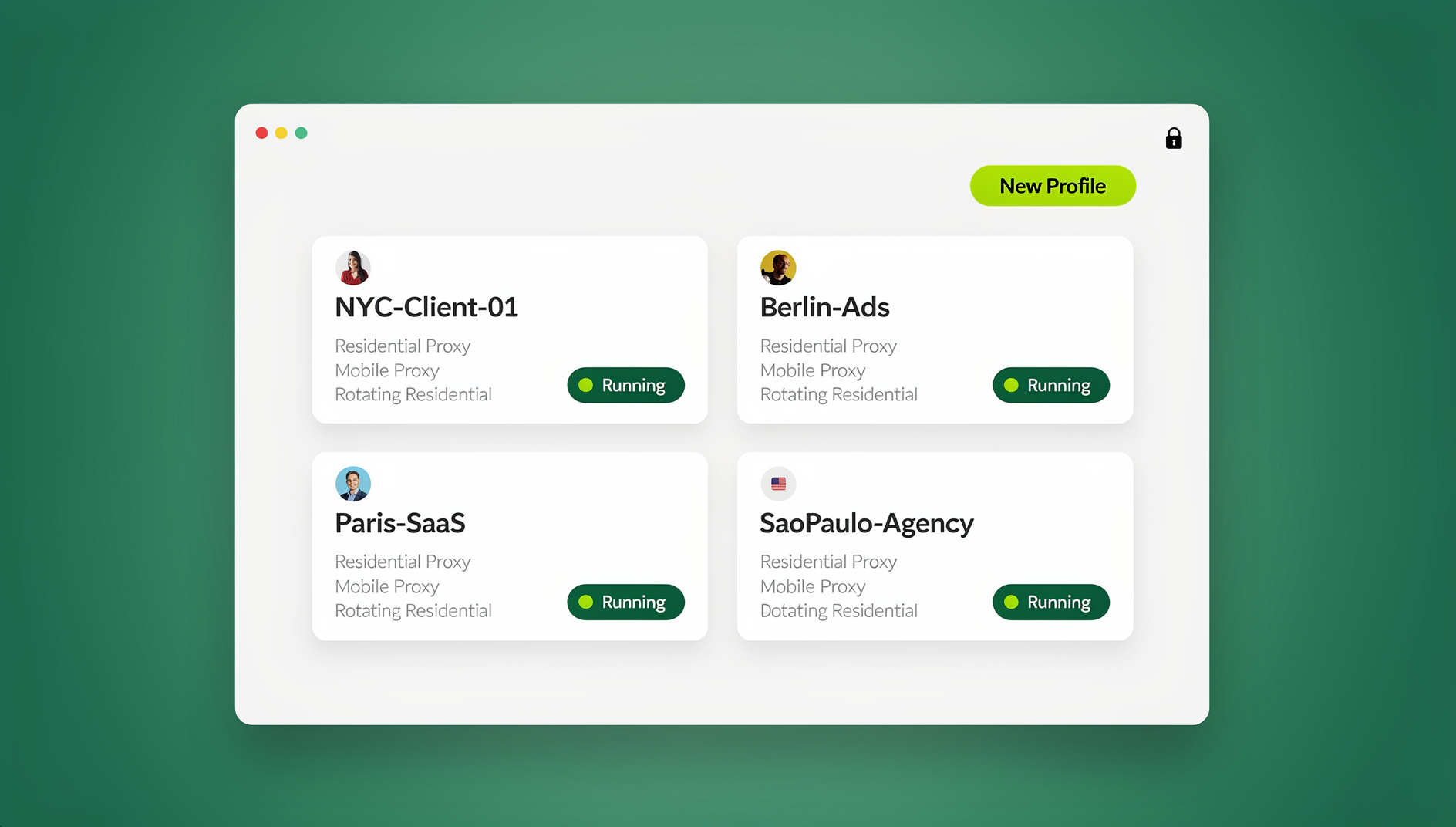
For developers, agency owners, and security teams who need absolute isolation and seamless switching between GitHub accounts, Send.win provides a comprehensive solution. By running isolated browser profiles, Send.win keeps your cookie databases, local storage, and digital fingerprints completely separated. It eliminates the limitations of native browser profiles by offloading execution and providing robust fingerprint spoofing.
Send.win operates in two primary modes to support different development workflows:
1. The Sendwin Browser (Native Desktop Client)
The Sendwin Browser is a native desktop client compatible with Windows, macOS, and Linux. When you create a profile within the client, it generates an entirely unique, isolated digital fingerprint. This fingerprint includes custom canvas hashes, WebGL configurations, audio context profiles, user-agents, and dedicated proxy settings. To GitHub’s tracking scripts, each profile appears as a completely different computer running on a separate network. This is ideal for developers who manage multiple client organizations daily and require fast local performance.
2. Cloud Browser Sessions
For teams that collaborate on shared accounts, Send.win offers cloud browser sessions. These sessions run on remote, secure cloud servers and require no local setup. You can launch, run, and manage your virtual profiles directly within any standard browser window from any device. Cloud sessions allow teams to share active sessions with colleagues with a single click, allowing them to access the repository or administration dashboards without sharing raw passwords or triggering security flags.
When managing cookies across profiles, employing an efficient cookie management tool ensures session tokens remain completely separated. This practice of profile isolation is highly analogous to how e-commerce sellers run multiple Amazon accounts without risking automated linked suspensions. By using Send.win, developers avoid cookie leaking, credential conflicts, and the risk of automated security triggers, all while enjoying a unified workspace that keeps system resource usage low.
Comparison: Comparing GitHub Account Management Methods
To help you choose the best approach for your Windows setup, here is a detailed breakdown comparing the core methods based on key parameters:
| Feature | SSH Keys | Conditional Config | GCM (HTTPS) | Chrome Profiles | Send.win Cloud Sessions |
|---|---|---|---|---|---|
| CLI Support | Excellent | Excellent (Directory-based) | Good | None | Good (via API integration) |
| Browser Isolation | None | None | None | Partial (shared fingerprint) | Complete (unique fingerprint & IP) |
| Setup Complexity | Medium | Medium | Medium | Easy | Easy |
| Team Sharing | No | No | No | No | Yes (password-free) |
| Memory Resource Usage | Extremely Low | Extremely Low | Low | High | Very Low (offloaded to cloud) |
Troubleshooting and Best Practices
To ensure your multi-account system operates smoothly, follow these professional development guidelines:
Verify Your Commit Configuration
Before pushing code, verify which identity Git is using for your current repository. Run the following commands inside the repository folder:
git config user.name
git config user.email
If they display incorrect details, remove the global settings and apply them locally using the --local flag. This overrides any caching behavior.
Start Your SSH Agent Automatically
If Git Bash fails to remember your SSH keys, you may need to start the SSH agent manually or configure it to start automatically when Git Bash launches. Add the following script to your ~/.bashrc or ~/.profile file:
# Start ssh-agent if not running
if [ -z "$SSH_AUTH_SOCK" ] ; then
    eval "$(ssh-agent -s)"
fi
ssh-add ~/.ssh/id_ed25519_github_personal
ssh-add ~/.ssh/id_ed25519_github_work
Review Authorized OAuth Apps Regularly
For accounts linked via HTTPS and Git Credential Manager, check your GitHub profile settings under Developer Settings > Authorized OAuth Apps. Revoke any outdated tokens or applications to maintain a high level of security across your Windows development machine.
Pricing Models for Advanced Workspaces
If you scale your developer workspace to a team, Send.win offers pricing tiers designed to fit your requirements. It begins with a 30-day free trial requiring no credit card. The Pro plan is priced at $19/month (or $6.99/month when billed annually) and includes 150 profiles, 5GB of proxy bandwidth, and full access to the local Automation API. The Team plan is priced at $49/month (or $20.99/month when billed annually) and includes 500 profiles, 20GB of proxy bandwidth, the local Automation API, and 16 team seats. Additional resources are available as add-ons, starting at $6/GB for bandwidth and $0.05 per extra profile.
🏆 Send.win Verdict
While SSH configurations and conditional directory files are fantastic for Git CLI tasks, they do not solve the problem of managing multiple developer accounts in the browser. Send.win fills this gap perfectly, allowing you to run completely isolated browser sessions for separate GitHub profiles side-by-side without any profile switching, cache confusion, or local environment clutter.
Try Send.win free today — claim your 30-day free trial and experience seamless multi-account developer workflows.
Frequently Asked Questions
Can I use the same SSH key for multiple GitHub accounts?
No, GitHub does not allow you to add the same SSH public key to more than one account. Each key is uniquely bound to a single user profile. To connect to different accounts, you must generate distinct keys for each profile and configure your SSH settings to select the correct key file.
How do I check which Git credentials Windows is currently caching?
You can check cached credentials by opening the Windows Credential Manager through your Start menu. Navigate to Windows Credentials and search for entries starting with ‘git:https://github.com’. Expanding these entries will display the username associated with the cached token.
Will my GitHub contributions graph show commits from both accounts?
GitHub attributes contributions to accounts based on the email address specified in the commit metadata. If your repository is configured with your personal email, the contributions will show on your personal profile. If it is configured with your work email, they will show on your work profile, provided both emails are verified in their respective accounts.
Does GitHub allow one person to operate multiple accounts?
Yes, GitHub allows individuals to maintain separate accounts for personal and professional use. However, you must not use multiple accounts to game repository statistics, bypass limits, or engage in abusive behavior. Keeping them separated through proper configuration ensures compliance with GitHub policies.
What is the benefit of using conditional Git configs?
Conditional Git configs automate user identity switching. By defining folders like ‘Projects/Work’ and ‘Projects/Personal’ and linking them to separate config files, Git automatically updates your username and email address based on where the repository is stored, preventing commit attribution mistakes.
How does Send.win keep browser sessions for multiple accounts secure?
Send.win isolates each browser session within its own sandbox. This means that cookies, local storage, and digital fingerprints (including canvas hashes and user-agents) are completely separated between profiles. Google and GitHub cannot link your accounts because each session appears to be running on an entirely different physical device.
Is the local Automation API available on all Send.win plans?
The local Automation API, which supports automation libraries like Selenium, Puppeteer, and Playwright, is available on both the Pro plan ($19/month monthly or $6.99/month annually) and the Team plan ($49/month monthly or $20.99/month annually). This allows developers to automate multi-account workflows easily.