For digital agencies and media buyers, managing multiple facebook ad accounts requires using Meta Business Suite to organize permissions, combined with a multi-session browser like Send.win to isolate logins. By running accounts in separate virtual profiles, you avoid account linkages, prevent security blocks, and streamline daily advertising workflows without constant logouts.
Understanding the Architecture of Managing Multiple Facebook Ad Accounts
When running a digital agency or managing paid acquisition for diverse brands, managing multiple facebook ad accounts is a baseline operational requirement. Meta structures its advertising ecosystem to maintain clear boundaries between businesses, assets, and users. However, for agencies, juggling these distinct entities without triggering security flags can be incredibly complex. A single misstep can result in a cascade of banned accounts, taking down multiple client campaigns simultaneously.
To successfully navigate this, one must understand how Meta structures its business assets. The primary interface is the Meta Business Suite (formerly known as Facebook Business Manager). Within this ecosystem, you have the Business Portfolio, which acts as the umbrella organization. Underneath the portfolio, you manage individual ad accounts, Facebook Pages, Instagram accounts, conversion pixels, product catalogs, and custom audiences. Access is granted to team members (People) or third-party agencies (Partners) with varying levels of permission, from Admin down to Analyst.
However, while Meta provides a clean hierarchy on paper, the practical reality of accessing these accounts daily is fraught with risk. If a media buyer logs into multiple client accounts using the same browser profile, Meta’s security algorithms detect identical browser cookies, canvas fingerprints, and local storage data. If one client account violates an ad policy—even accidentally—Meta may flag all other accounts accessed from that same browser session as related, leading to permanent restrictions. Thus, keeping each account completely isolated at the browser level is just as important as setting up your permissions correctly inside Meta Business Suite.
The Challenges and Risks of Multi-Account Advertising
Managing several clients’ advertising budgets comes with significant platform-specific challenges. The biggest risk is account linkage. Meta’s anti-fraud systems are designed to detect suspicious behavior, such as coordinated inauthentic behavior or evasion of platform bans. When Meta bans an ad account, it does not just look at the specific account. It looks at the personal profile of the user who made the edits, the billing details, the pixel data, and most importantly, the browser fingerprint of the computer that accessed it.
If you are managing multiple accounts, any sign of shared browser data can link them. For example, if you manage accounts for a high-risk industry (like weight loss or finance) alongside standard e-commerce clients, a ban on the high-risk account can easily spread to your clean e-commerce accounts if they share a browser session. This is because Meta’s automated systems assume a single actor is running both, violating the platform’s multi-account policies.
To avoid this, agencies must practice absolute isolation. This means ensuring that every Facebook profile used to manage ads has a unique digital footprint, a unique IP address, and isolated cookies. This prevents Meta’s algorithms from linking the accounts together, ensuring that a policy strike on one client’s account remains isolated and does not disrupt your other clients’ campaigns.
Comparison of Methods for Managing Multiple Facebook Ad Accounts
There are three common approaches to managing several Facebook ad accounts, each with its own pros, cons, and risk profile. Let’s compare them to see which fits your workflow best.
Method 1: Relying Solely on Meta Business Suite
This is the official method recommended by Meta. You invite your personal Facebook account to the client’s Business Portfolio as a user, or add the client’s ad account as an asset in your agency’s Business Portfolio. While this is clean and compliant on paper, it has severe practical limitations. First, you are forced to use your personal Facebook profile to access all client accounts. If your personal profile is flagged or restricted (a common issue for media buyers), you lose access to all client accounts instantly. Second, this method does not allow you to run ads from different personal accounts (e.g., helper profiles or client-provided accounts) without constantly logging in and out, which triggers security verification loops.
Method 2: Juggling Multiple Chrome Profiles
To bypass the single-profile limitation, many media buyers set up multiple profiles in Google Chrome. Each profile is logged into a different Facebook account. While this solves the logout problem, it fails on security. Chrome profiles do not mask your hardware fingerprint. Meta’s security scripts can still read your CPU cores, GPU renderer, screen resolution, and audio context across all Chrome profiles. Furthermore, Chrome profiles do not natively support dedicated proxies per profile without complex configuration. This means all profiles share your local IP address, making account correlation trivial for Meta’s AI.
Method 3: Using a Native Multi-Session Desktop Client
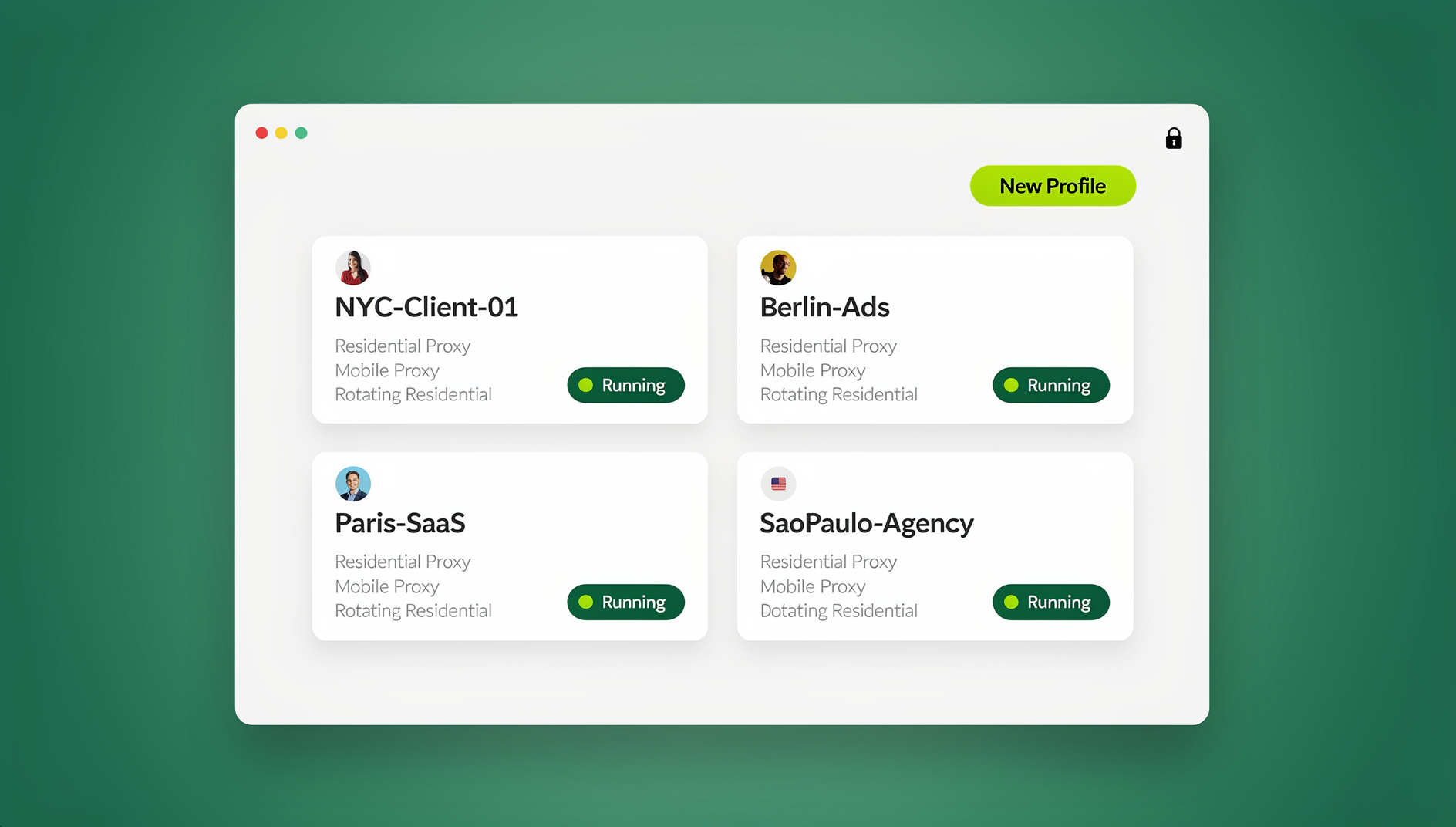
A native multi-session desktop client like the Sendwin Browser represents the gold standard for media buyers. It creates fully isolated browser profiles, each with its own unique cookies, local storage, and spoofed hardware fingerprints. Each profile can be assigned a dedicated residential proxy, ensuring that every Facebook session appears to originate from a completely different user, device, and location. This provides total isolation, letting you safely run multiple independent accounts side-by-side without any risk of platform linkage or security blocks.
Method Matrix: Comparison Table
| Feature / Dimension | Meta Business Suite Only | Chrome Profiles | Sendwin Browser (Desktop Client) |
|---|---|---|---|
| Profile Isolation | None (Shared browser session) | Basic (Shared hardware, separate cookies) | Complete (Unique hardware fingerprints & cookies) |
| IP Address Management | Single IP (No proxy integration) | Single IP (Complex proxy configuration required) | Dedicated Proxy per profile (Simple setup) |
| Multiple Personal Logins | No (Forced to use one personal account) | Yes (But easily linked by hardware) | Yes (Safe and completely isolated) |
| Risk of Cascading Bans | High (If one is restricted, all are flagged) | Medium-High (Linked via hardware fingerprint) | Extremely Low (Zero data leakage between profiles) |
| Collaboration | Supported natively | Manual profile exporting | Cloud profile sharing and team seats |
Feature-by-Feature Evaluation of Dedicated Tools
When looking at professional solutions for multi-account management, anti-detection tools are the primary systems used by high-volume advertisers. Let’s look at how they compare in detail.
Dolphin Anty: The Specialized Anti-Detect
Dolphin Anty is designed specifically for media buyers, particularly those in affiliate marketing and crypto. It offers a fast, user-friendly interface and features tailored for Facebook, such as quick-status tagging and integration with Facebook automation tools. Users can easily manage hundreds of profiles and monitor connection status in real-time. However, Dolphin Anty is quite expensive, and its pricing scales rapidly as you add profiles or team members, making it less accessible for growing agencies or solo advertisers.
AdsPower: The High-Volume Farming Specialist
AdsPower is known for its robust fingerprinting engine and its advanced automation features. It supports both Chromium and Firefox-based engines, allowing for flexible profile generation. AdsPower is highly customizable but has a steep learning curve. Its custom pricing structure can also become complex, as you have to pay for specific combinations of profiles and team seats, which can lead to unexpected costs as your team grows.
Send.win: The Modern, Secure, and Affordable Alternative
Send.win is a powerful multi-account browser platform that stands out by offering a premium, secure environment at an affordable price point. Unlike tools that require heavy local installations and complex configurations, Send.win provides two real, current modes of operation: the Sendwin Browser (a native desktop app for Windows, macOS, and Linux) and cloud browser sessions (which run entirely in the cloud and require no local installation, allowing you to access your profiles from any device). This flexibility ensures that you can manage your ad accounts securely whether you are working from your office workstation or a laptop on the go.
Furthermore, Send.win includes advanced features like isolated browser profiles, each with its own cookies, storage, sessions, fingerprint settings and proxy. With pricing plans starting at just $19/month ($83.88/year) for the Pro plan, and $49/month ($251.88/year) for the Team plan, and the first card purchase covered by a 7-day money-back guarantee, Send.win offers enterprise-level security and performance at a fraction of the cost of traditional browser profile managers.
Honest Pros and Cons of Leading Solutions
To make an informed decision, it is essential to look at the strengths and weaknesses of each platform objectively.
Dolphin Anty Pros and Cons
- Pros: Excellent, specialized interface for Facebook ads; quick-status monitoring; built-in proxy checker.
- Cons: High starting price; no cloud browser sessions (requires desktop download only); security concerns reported in past audits regarding data storage.
AdsPower Pros and Cons
- Pros: Powerful automation engine; support for multiple browser engines; granular fingerprint controls.
- Cons: Complex, unintuitive user interface; pricing structure is difficult to navigate; customer support can be slow for non-enterprise tiers.
Send.win Pros and Cons
- Pros: Extremely affordable pricing ($83.88/yr Pro); two flexible modes (desktop client and cloud browser sessions); 7-day money-back guarantee on the first card purchase; free cloud demo available.
- Cons: Brand is newer compared to legacy platforms; lacks some of the hyper-specific affiliate widgets found in Dolphin Anty.
Step-by-Step Guide to Secure Facebook Multi-Accounting
If you want to scale your agency without fearing Meta’s ban hammer, follow this step-by-step setup procedure using Send.win.
Step 1: Planning and Proxy Setup
Before launching a single browser profile, secure high-quality residential proxies. Never use cheap datacenter proxies, as Meta blocks them instantly. Assign one dedicated residential proxy to each client profile. The proxy location must match the billing address of the ad account or the location of the client’s business page to avoid triggering geographic alerts.
Step 2: Profile Creation and Fingerprint Spoofing
Open the Sendwin Browser desktop client and create a new profile. Name it after your client (e.g., “Client_Acme_Ads”). Send.win automatically generates a unique canvas, WebGL, audio, and hardware fingerprint for this profile. Enter your residential proxy credentials in the profile settings and save. This ensures that when the profile launches, it runs in a sandboxed, isolated environment.
Step 3: Account Warm-Up and Cookie Accumulation
When logging into a new Facebook profile, do not jump straight to the Ads Manager. Instead, spend 3-5 days warming up the account. Browse popular news sites, watch videos, search for products, and interact with posts to accumulate normal user cookies. This signals to Meta’s automated security systems that the session belongs to a real human, not an automated bot, building trust and lowering the risk of sudden flags.
Step 4: Accessing Meta Business Suite and Ad Setup
Once warmed up, navigate to Meta Business Suite. Request access to your client’s ad assets. By doing this within the isolated profile, your connection is fully protected. If you run multiple stores or brands, you can follow similar steps to manage safe multi-store operations for e-commerce, ensuring each brand has its own secure workspace. For a broader overview of how this fits into retail platforms, check out our guide on managing multiple Amazon accounts to see how browser isolation keeps all your business profiles completely safe. If you need a review of tools that make this possible, explore our comparison of the best browser for multiple accounts for agencies.
Standard Operating Procedures (SOPs) for Agencies
Consistency is key to maintaining a clean multi-account setup. Implement these standard procedures across your media buying team. First, enforce a strict naming convention for all campaigns, ad sets, and ads. This prevents confusion when pulling reporting data. For example: [ClientName]_[Objective]_[Audience]_[AdFormat]. Second, set up automated budget alerts. Meta allows you to set account-level spending limits, which prevent campaigns from running wild and overspending client budgets. Finally, perform weekly audits of profile assignments to make sure only authorized media buyers have access to client profiles, minimizing the risk of unauthorized edits or security slips.
🏆 Send.win Verdict
When managing multiple Facebook ad accounts, relying solely on Meta Business Suite leaves your profiles vulnerable to security bans and cross-contamination. Send.win provides true multi-account browser isolation, allowing you to run each Facebook identity in its own sandboxed profile with matching proxies. It is the ultimate tool to protect your agency’s assets.
Try Send.win free today — protect your Facebook ad accounts from bans.
Frequently Asked Questions
Can I manage multiple Facebook ad accounts with a single profile?
Yes, you can manage multiple ad accounts under a single personal Facebook profile by adding them as assets within a Meta Business Portfolio. However, if your personal Facebook profile gets restricted or banned, you will lose access to all managed ad accounts instantly. For security, it is highly recommended to distribute access across multiple secure profiles.
Is using a VPN safe for Facebook ad accounts?
No, standard VPNs are generally unsafe for managing Facebook ad accounts. VPNs use shared IP addresses that are often flagged by Meta’s security algorithms, and changing locations frequently triggers automated account locks. Instead, you should use high-quality residential proxies, which provide a stable, dedicated IP address for each account profile.
Will a ban on one ad account affect my other client accounts?
If you access different client accounts using the same browser session or device without isolation, a ban on one account can trigger automated bans on the others due to shared browser footprints. If you use a dedicated multi-session desktop client to isolate each account profile, a ban on one account will remain isolated and won’t affect the others.
What is the difference between claiming and requesting access to an ad account?
Claiming an ad account transfers ownership of that account to your Business Portfolio permanently, which is irreversible. Requesting access allows the client to retain ownership of their ad account while granting your agency permission to manage campaigns. Agencies should always request access rather than claiming client accounts.
Do I need a proxy for every Facebook profile?
Yes, assigning a unique residential proxy to each profile is critical for maintaining true isolation. Sharing a single IP address across multiple profiles defeats the purpose of fingerprint masking, as Meta’s systems can easily link the profiles based on their identical network location.
Can I use Puppeteer or Selenium to automate Facebook ad tasks?
Send.win does not offer an automation interface: there is no API, SDK, headless mode or Selenium/Puppeteer/Playwright support on any plan. Instead, Send.win focuses on isolated browser profiles, each with its own cookies, storage, sessions, fingerprint settings and proxy, so bulk account work stays organised and separate.
How does Sendwin Browser prevent accounts from linking?
Sendwin Browser prevents accounts from linking by generating a unique digital fingerprint for each profile. This includes spoofing cookies, local storage, canvas rendering, and hardware identifiers. When combined with dedicated proxies, Meta’s security algorithms see each profile as an entirely different computer and user, preventing link-based bans.
Conclusion
Managing multiple Facebook ad accounts successfully requires a balance of official platform organization and advanced browser-level security. By combining Meta Business Suite with a dedicated, isolated setup like Send.win, you protect your agency from cascading restrictions and improve team collaboration. Choose the best browser to build a resilient, scalable digital marketing infrastructure that keeps client ads running smoothly and securely.