How Social Media Agencies Manage 100+ Client Accounts Safely
Deploying an antidetect browser for social media marketing enables digital marketing agencies, SMM managers, and media buyers to run 100+ client accounts across platforms like Facebook, Instagram, TikTok, LinkedIn, and X without triggering security blocks or account bans. By constructing completely isolated browser environments with custom residential proxies and localized browser fingerprints, agencies eliminate cross-account contamination and streamline multi-client delegation.
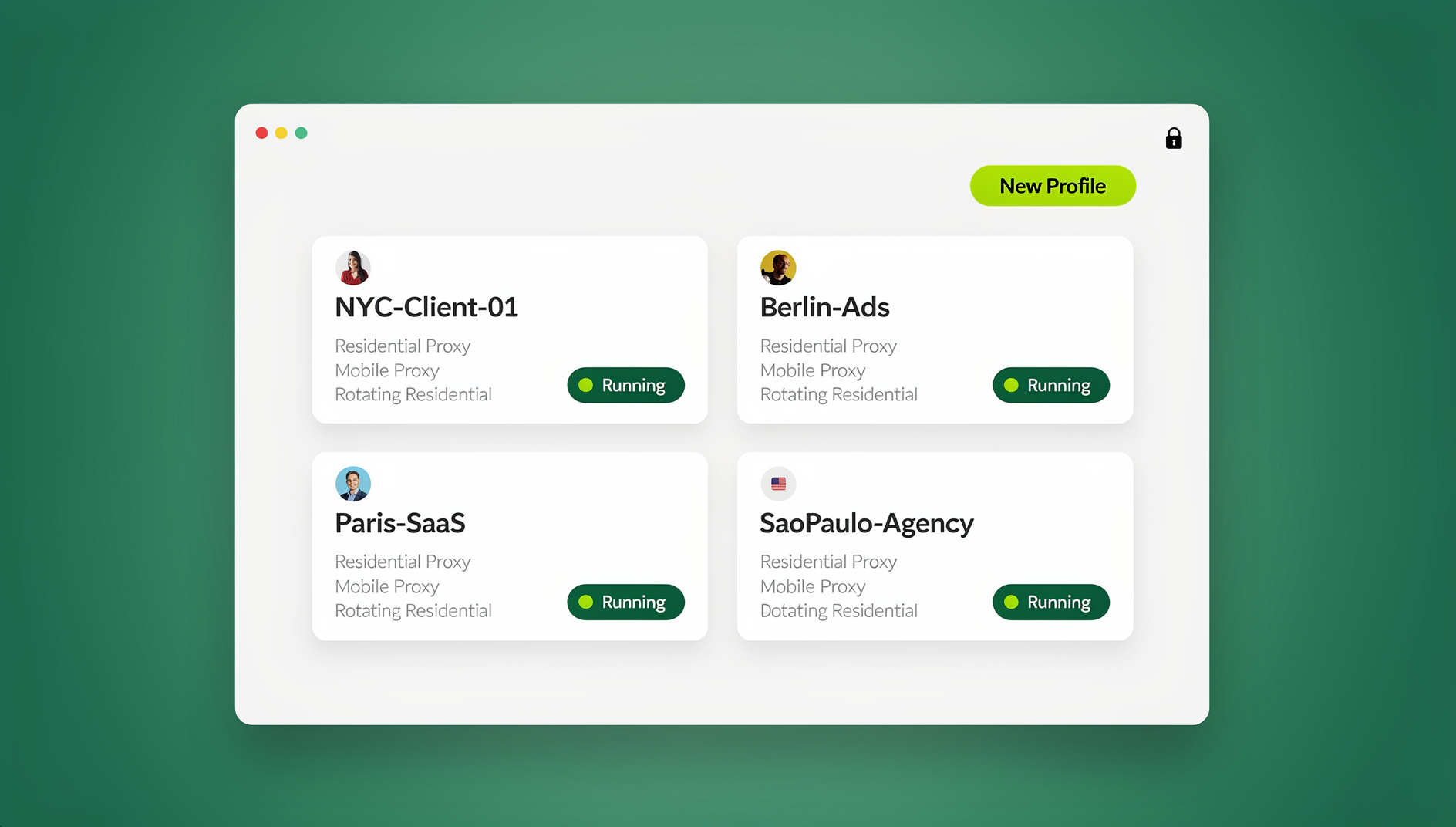
The Growing Multi-Account Challenge for Modern SMM Agencies
Managing social media channels at scale has evolved into a high-stakes operational puzzle. Five years ago, digital marketing agencies could manage multiple client brand accounts simply by using built-in profile switchers or logging in and out of native web applications. Today, social media networks enforce sophisticated security algorithms designed to detect unauthorized account management, bot networks, and multi-login abuse.
Whether you manage Facebook Ad Managers, LinkedIn Sales Navigator accounts, TikTok Creator Portals, or high-volume X (Twitter) handles, platforms closely monitor account activities. When an agency logs into 15 different client accounts from a single office Wi-Fi connection or laptop, security triggers assume those accounts are controlled by a single spam operation. The result? Sudden account checkpoints, temporary shadowbans, or catastrophic permanent account suspensions that jeopardize client relationships.
To scale agency operations securely, social media managers must adopt specialized tools that provide individual digital environments for every client. Using a high-performance antidetect browser for social media marketing ensures that each client account operates within its own dedicated container, complete with localized IP addresses, independent cookies, and realistic browser device fingerprints.
How Social Media Platforms Cross-Reference and Flag Client Accounts
Social networks employ multi-layered detection systems that evaluate off-page signals, network connections, and hardware identifiers. When managing client accounts, agencies frequently trigger security blocks due to five primary detection vectors.
1. Browser Fingerprint Aggregation (Canvas, Audio, WebGL)
When you open a web browser, websites execute background scripts to collect data about your device. Parameters such as operating system version, browser engine build, screen resolution, GPU renderer, system fonts, installed plugins, and Canvas/AudioContext rendering outputs combine to form a unique hardware signature.
If an agency employee uses standard browser windows to log into 20 client Facebook pages, Facebook’s security engine sees 20 different business accounts originating from the exact same hardware fingerprint. When one client account triggers an ad review flag, all 19 other accounts linked to that hardware fingerprint risk immediate suspension. To understand how browser tracking works in detail, read our browser fingerprint explained analysis.
2. Network Subnet and IP Address Association
Logging into dozens of accounts from a single commercial office IP or generic datacenter VPN creates an immediate trust penalty. Platforms expect local business accounts to connect from residential or mobile IP addresses in the client’s home geographic region. When an account based in London suddenly logs in from a Miami VPN server on a shared IP subnet, anti-fraud algorithms flag the login as a potential account takeover.
3. Cookie Pool Cross-Contamination
Standard web browsers maintain shared cookie stores, local storage, and IndexedDB databases across tabs and browser sessions. Even if you log out of Account A before logging into Account B, persistent tracking scripts, third-party pixel cookies, and session tokens remain stored in memory. Social platforms read these residual tokens to map linkages between accounts. Implementing comprehensive session isolation guarantees that tracking artifacts from one client never contaminate another.
4. Behavioral Telemetry and Simultaneous Logins
Social networks monitor session behavior. If an agency manager has 10 client account tabs open simultaneously, sending messages or publishing posts with identical micro-second response rates, anti-bot mechanisms flag the activity as automated spam execution.
5. Mobile App vs Desktop Device Mismatch
Platforms like Instagram and TikTok prioritize mobile traffic. When managing desktop logins for mobile-centric platforms, discrepancies between mobile User-Agent strings and desktop screen resolutions or touch event APIs create instant trust flags. Utilizing dedicated proxy browsers with tailored device emulation eliminates hardware mismatch issues.
Why Traditional Solutions Fail for Social Media Agencies
Agencies often attempt workarounds to avoid purchasing specialized antidetect software, only to experience account bans when security updates roll out.
| Method | Fingerprint Protection | IP Isolation | Team Collaboration | Agency Security Assessment |
|---|---|---|---|---|
| Chrome Profiles | ❌ Identical hardware hashes | ❌ Shared local IP address | ❌ Requires sharing passwords | 🔴 High Risk: Mass account bans |
| VPN Switchers | ❌ Unchanged hardware fingerprint | ⚠️ Datacenter IPs flagged easily | ❌ Manual IP toggling per user | 🔴 High Risk: Frequent checkpoints |
| Password Managers | ❌ Zero fingerprint spoofing | ❌ Zero IP separation | ✅ Secure password vault | 🟡 Moderate: Only solves auth storage |
| Send.win Platform | ✅ Full Canvas/WebGL/Hardware isolation | ✅ Per-profile proxy binding | ✅ Role-based access without sharing credentials | 🟢 Enterprise Grade: Complete safety |
As detailed in our guide on managing multiple accounts, relying on password managers or simple Chrome profile switchers leaves your agency vulnerable to sudden multi-account bans because they fail to isolate underlying hardware telemetry.
Architecture of an Untouchable Agency Social Media Setup
To safely scale client account management across 100+ social profiles, agencies should implement a standardized three-pillar operational architecture.
Pillar 1: Dedicated Hardware & Fingerprint Customization
Each client account must be allocated a distinct browser profile. Within Send.win, each profile generates a unique, authentic browser fingerprint that matches real-world consumer devices:
- User-Agent String: Matches the target operating system (Windows, macOS, Linux).
- Canvas & WebGL Spoofing: Adds subtle, non-repeatable noise to graphics rendering so no two profiles share hardware hashes.
- AudioContext & Font Masking: Prevents audio frequency analysis and font enumeration from linking profiles.
- Screen Resolution & Touch Support: Emulates exact client device specifications.
How Send.win Helps With Antidetect Browser For Social Media Marketing
Send.win is an antidetect browser built for exactly this kind of work — every profile is a clean, isolated identity:
- Isolated profiles – unique fingerprint, separate cookies and storage per profile
- Stealth engine – canvas, WebGL, fonts, and audio spoofed at the engine level
- Desktop app + cloud sessions – native app for Windows, macOS, and Linux, or run profiles in the cloud with no install
- Built-in residential proxies – with automatic timezone, locale, and WebRTC matching
- Team features – share logged-in profiles with teammates without sharing passwords
Try the instant cloud browser demo — no install, no signup — or download the desktop app. The 30-day free trial needs no credit card, and paid plans start at $6.99/month billed annually (see pricing).
Pillar 2: Geolocation & Residential Proxy Binding
Assign a dedicated residential or 4G/5G mobile proxy to each client profile. The proxy location must align with the client’s physical location:
- Timezone Alignment: Profile system time must match the proxy exit IP timezone automatically.
- Geolocation API: HTML5 location requests return coordinates within the target city.
- Language & Headers: HTTP Accept-Language headers match the local geographic demographic.
Pillar 3: Passwordless Team Delegation and Session Sharing
Never send raw client passwords via email, Slack, or messaging apps. With Send.win, account managers configure logins once inside the profile. Team members or external freelancers open the cloud or desktop profile with active session cookies pre-loaded, allowing them to create posts or run ad campaigns without ever viewing or storing sensitive login credentials.
Step-by-Step Guide: Managing 100+ Client Accounts with Send.win
Step 1: Create Client Profiles in Send.win
Organize your agency structure inside Send.win by creating dedicated profiles for each client brand (e.g., Client_Acme_Facebook, Client_Beta_TikTok). You can run profiles through the native Sendwin Browser desktop application (available for Windows, macOS, and Linux) or launch Cloud Browser Sessions directly in your browser without any local software installation.
Step 2: Configure Proxy Settings
In the profile creation menu, select HTTP, SOCKS5, or SSH proxy protocol. Paste your residential proxy credentials. Send.win automatically validates proxy connectivity, checks IP reputation, and configures the profile’s virtual timezone and WebRTC leak protection parameters.
Step 3: Perform Initial Client Logins and Save Cookies
Launch the profile and execute initial logins for Facebook Ads Manager, LinkedIn Sales Navigator, TikTok Ads Manager, or X Pro. Once authenticated, Send.win encrypts and saves session cookies in cloud storage. Subsequent session launches bypass login forms entirely, preventing unnecessary two-factor authentication (2FA) triggers.
Step 4: Assign Team Permissions
On Send.win Team plans ($20.99/mo billed annually, supporting up to 500 profiles and 16 team seats), administrators can assign specific client profiles to individual media buyers or SMM managers. If an account manager leaves your agency, revoke their profile access in one click—instantly securing all client accounts without changing passwords.
Automating Agency SMM Tasks with Send.win Automation API
Digital agencies running large-scale social media campaigns often require custom automation for post scheduling, reporting, comment moderation, or account warming. Send.win includes a native **Automation API** (supporting Selenium, Puppeteer, and Playwright) on both Pro ($19/mo) and Team ($49/mo) plans.
This allows your development team to script routine browser workflows that run through authentic profile environments with real residential proxies attached.
Example: Puppeteer Automation Script for Social Account Warming
The following Node.js script demonstrates how an agency can connect Puppeteer to a local Send.win profile endpoint to perform natural, automated page scrolling and engagement on a client’s social media feed:
const puppeteer = require('puppeteer-core');

(async () => {
  // Connect to Send.win local profile via Automation API WebSocket
  const profileWebSocketUrl = 'ws://127.0.0.1:9222/devtools/browser/smm-client-profile-8821';

  const browser = await puppeteer.connect({
    browserWSEndpoint: profileWebSocketUrl,
    defaultViewport: null
  });

  const page = (await browser.pages())[0] || await browser.newPage();

  console.log('Navigating to client social dashboard...');
  await page.goto('https://www.linkedin.com/feed/', { waitUntil: 'networkidle2' });

  // Simulate realistic human scrolling behavior
  for (let i = 0; i < 5; i++) {
    const scrollAmount = Math.floor(Math.random() * 300) + 150;
    await page.evaluate((y) => window.scrollBy(0, y), scrollAmount);

    // Pause with randomized human delay (1.8s - 4.2s)
    const delay = Math.floor(Math.random() * 2400) + 1800;
    await page.waitForTimeout(delay);
  }

  console.log('Automated engagement activity complete.');
  await browser.disconnect();
})();
Platform-Specific Best Practices for Social Media Marketers
Facebook Ads Manager & Business Manager
Facebook enforces strict risk scoring on ad accounts. Always log into Business Manager using a consistent residential proxy from the business’s registered city. Never create multiple Business Managers from the same browser profile. If an ad account gets restricted, isolate the profile completely while submitting appeals.
LinkedIn Sales Navigator & Recruiter
LinkedIn tracks browser fingerprint signatures and connection velocities aggressively. Keep daily connection requests under platform thresholds and use Send.win profile isolation to ensure outreach specialists do not cross-contaminate client corporate pages.
TikTok Ads & Creator Marketplace
TikTok evaluates mobile device emulation parameters. Ensure your Send.win profile is configured with a mobile user agent, appropriate touch point simulation, and clean residential proxies to maintain high video reach and unhindered ad approvals.
🏆 Send.win Verdict
Managing dozens of client social media accounts using standard Chrome profiles or VPN switchers creates severe operational risks for digital agencies. Send.win delivers an all-in-one antidetect browser solution featuring isolated browser environments, team passwordless delegation, cloud browser sessions, and local Automation API support—starting at just $6.99/month on annual plans with a 30-day free trial.
Try Send.win free today — protect your client accounts from social media bans and scale your agency safely.
Frequently Asked Questions
What is an antidetect browser for social media marketing?
An antidetect browser for social media marketing is software that generates isolated browser environments with distinct hardware fingerprints, cookies, and proxy configurations. It allows agencies to manage multiple client accounts across Facebook, Instagram, LinkedIn, and TikTok without triggering security flags or account linkability.
Why do platforms like Facebook and LinkedIn ban agencies managing multiple accounts?
Platforms monitor browser hardware signatures (Canvas, WebGL), IP addresses, and cookie pools. When multiple client accounts log in from identical device hardware or office IP addresses, security algorithms assume the accounts are operated by a single spam entity or compromised user, leading to suspensions.
Can I manage client accounts without asking for their passwords?
Yes. With Send.win, an administrator can log in once or import the client’s session cookies into a profile. Team members can then launch the profile in the Sendwin Browser desktop app or via Cloud Browser Sessions and manage the social accounts without ever needing access to raw passwords.
Does Send.win support automated post scheduling scripts?
Yes. Send.win includes a native Automation API with Puppeteer, Playwright, and Selenium support on both Pro ($19/mo) and Team ($49/mo) plans. You can script automated social actions that execute directly through your isolated profiles and proxies.
What is the difference between Sendwin Browser app and Cloud Browser sessions?
The Sendwin Browser is a native desktop client for Windows, macOS, and Linux that runs profiles locally on your computer. Cloud Browser sessions run profiles entirely inside cloud virtual environments, allowing you to access client accounts from any device without installing software.
How does Send.win pricing compare to other antidetect tools?
Send.win is significantly more cost-effective. The Pro plan costs $19/month ($6.99/month billed annually — 63% savings) for 150 profiles, 5GB storage, and Automation API access. The Team plan costs $49/month ($20.99/month annual — 57% savings) for 500 profiles, 20GB storage, Automation API access, and 16 team seats. A 30-day free trial is available without a credit card.
Is a browser extension required to use Send.win?
No. Send.win operates as a standalone native desktop application (Sendwin Browser) and as a cloud browser web platform. No browser extension install is required or needed.