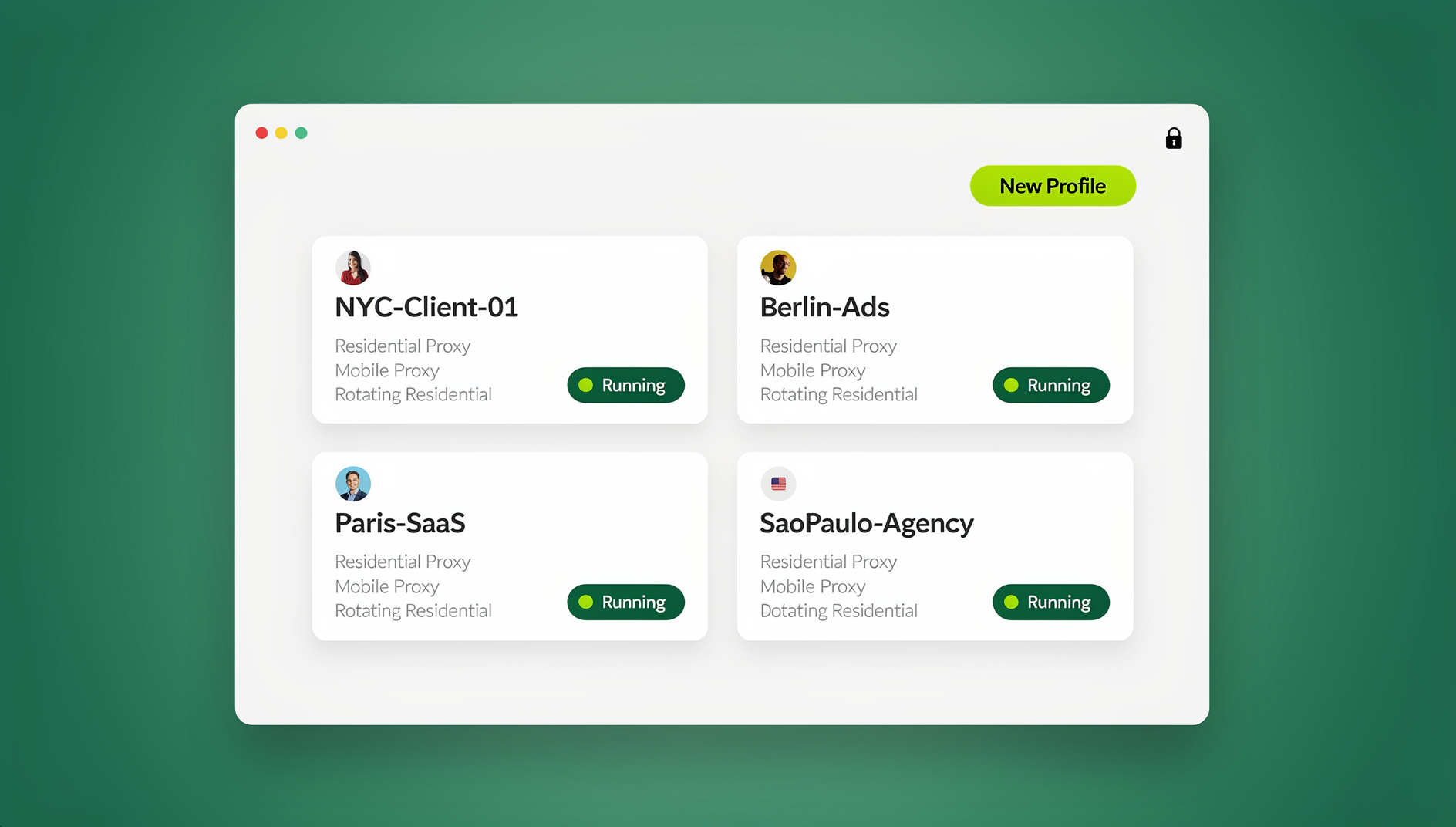
Implementing best practices for managing multiple business accounts requires using enterprise password managers, enforcing role-based access controls, and utilizing multi-session desktop clients like the Sendwin Browser to isolate digital identities. By isolating each business account’s cookies, cache, and device fingerprint into separate sandboxed browser profiles with dedicated proxy IPs, companies can eliminate credential leaks, session conflicts, and security suspensions across banking, social, and advertising platforms.
The Operational Complexity of Modern Business Multi-Accounting
Every modern business operates across a broad array of digital channels. A typical company manages dozens of accounts, including banking portals, payment processors, social media profiles, advertising dashboards, and SaaS productivity suites. Without a systematic approach to managing these credentials, teams quickly experience password fatigue, security vulnerabilities, and operational inefficiencies.
Managing these accounts requires balancing security with accessibility. If your security protocols are too strict, team members will bypass them to save time. If they are too lax, your business is exposed to data breaches, unauthorized access, and compliance violations. Implementing best practices for managing multiple business accounts is critical for maintaining security and operational efficiency.
1. Conduct a Centralized Account Audit and Inventory
The first step in organizing your digital workspace is conducting a comprehensive audit of all active accounts. You cannot secure what you do not know exists. Create a master inventory document that details every platform your business utilizes.
For each account, document the following information:
- The account name, platform, and official URL.
- The primary email address associated with the account.
- The business owner or administrator responsible for the account.
- The active two-factor authentication (2FA) method and backup codes.
- The team members who require access, along with their roles (e.g., admin, editor, analyst).
- The billing cycle, cost, and payment method associated with the account.
2. Implement Enterprise Password Management
Sharing passwords via spreadsheets, text messages, or email is one of the most common security vulnerabilities in business. To eliminate this risk, your company must implement an enterprise-grade password manager. These tools encrypt credentials and allow teams to share access securely.
Enterprise Password Manager Comparison
| Platform | Security Architecture | Sharing Capabilities | SSO Integration | Ideal For |
|---|---|---|---|---|
| 1Password Business | Zero-Knowledge (Master Password + Secret Key) | Granular Shared Vaults | Yes | Design-focused & Security-conscious Teams |
| Bitwarden Enterprise | Open-Source, Zero-Knowledge | Organizational Collections | Yes | Technical Teams & Self-hosted Deployments |
| Dashlane Business | Zero-Knowledge, Built-in VPN | Secure Password Sharing | Yes | Small to Medium Businesses |
| Keeper Business | Zero-Knowledge, Proprietary Encryption | Shared Folders & Files | Yes | Compliance-heavy Environments |
A password manager ensures that every account has a unique, strong password. It eliminates password reuse, which is the primary cause of credential-stuffing attacks. Furthermore, it allows administrators to revoke access instantly when a team member leaves the company.
3. Establish a Robust Two-Factor Authentication (2FA) Protocol
Two-factor authentication (2FA) adds a critical layer of security to your business accounts. Even if a hacker steals your password, they cannot access the account without the second factor. However, managing 2FA across a team can create significant operational bottlenecks.
To implement 2FA efficiently, follow these best practices:
- Use Authenticator Apps: Avoid SMS-based 2FA, which is vulnerable to SIM-swapping attacks. Use authenticator apps like Google Authenticator or Microsoft Authenticator instead.
- Store Recovery Codes Securely: When setting up 2FA, platforms provide emergency recovery codes. Store these codes in a secure, encrypted vault in your password manager, rather than on local machines.
- Share 2FA Tokens Safely: Use password managers that support shared TOTP (Time-based One-Time Password) keys. This allows multiple team members to generate 2FA codes directly from their password vaults, eliminating the need to coordinate with a single mobile device.
4. Isolate Browser Profiles and Fingerprints
Modern web platforms use sophisticated device fingerprinting algorithms to track users. They scan your browser’s canvas elements, WebGL settings, installed fonts, and hardware profiles. If you log into multiple business accounts from the same browser, the platform links those accounts to a single user identity.
If you run multiple client accounts or separate brands, this linkage is dangerous. If one account is suspended, all linked accounts are immediately flagged. To prevent this, you must use a specialized best browser for multiple accounts. This tool isolates cookies and generates a unique browser fingerprint for each profile, ensuring that platforms see each session as an entirely different physical device.
This isolation is especially critical for e-commerce agencies. When managing multiple Amazon accounts, even minor cookie leaks or fingerprint overlaps can result in permanent store suspensions and significant loss of revenue.
5. Segregate IP Addresses with Dedicated Proxies
In addition to browser fingerprints, web platforms track the IP address of every login. If you log into five different business bank accounts or ad dashboards from the same residential IP address within a short window, the platform’s security algorithms will flag the activity as automated or suspicious.
To avoid this, you must route your isolated browser profiles through dedicated proxies. This is especially true for businesses operating multiple storefronts, where following a multiple amazon accounts complete guide to safe multi store operations 2026 strategy involves assigning a unique residential or mobile proxy to each store profile. This ensures that your IP address matches the registered business address, keeping your stores compliant and operational.
6. Define Role-Based Access Control (RBAC)
Not all team members require the same level of access. To maintain security, enforce the principle of least privilege. Assign roles to employees based on their job responsibilities, limiting their access to only the platforms and tools necessary to perform their work.
For example, a content creator only needs access to social media scheduling tools, not the underlying billing profiles or ad accounts. A bookkeeper only needs read-only access to bank portals, not the ability to authorize transfers. Defining clear roles reduces the risk of accidental configuration changes and insider threats.
7. Standardize Onboarding and Offboarding Checklists
Onboarding and offboarding employees are critical transition points for business security. Create standardized checklists to ensure that access is granted and revoked systematically.
Onboarding Checklist:
- Create the employee’s corporate identity in your SSO portal (e.g., Google Workspace).
- Add the employee to your enterprise password manager and assign them to their department’s vault.
- Provision access to required platforms using their corporate email address.
- Require the employee to set up MFA on all business-related portals.
Offboarding Checklist:
- Disable the employee’s single sign-on (SSO) account immediately upon departure.
- Remove the employee from the enterprise password manager, revoking access to all vaults.
- Change any shared passwords the employee had access to during their tenure.
- Revoke the employee’s access from social media, ad accounts, and partner portals manually.
- Document the revocation date and time in the employee’s file.
8. Establish a Disaster Recovery and Business Continuity Plan
Even with strict security protocols, emergencies happen. Your business must prepare for situations such as account suspensions, credential loss, or team member unavailability. Create a detailed disaster recovery plan that outlines how to regain access to critical systems.
Your business continuity plan should include:
- A secure, offline physical vault containing master recovery keys and 2FA backup codes.
- Designated backup administrators for all critical platforms.
- Clear procedures for contacting platform support and verifying business identities in the event of an lock.
- Regular training exercises to ensure team members understand how to execute recovery steps.
9. Integrate Isolated Sessions into Daily Operations
To maintain high productivity while securing your business accounts, integrate session isolation into your team’s daily routines. Rather than forcing employees to log in and out of different client accounts or brands, use a centralized session workspace. This is the core of modern managing multiple accounts workflows.
This allows your team to keep client ad dashboards, social feeds, and banking portals open side-by-side in secure, isolated tabs. It eliminates the frustration of session logouts, reduces MFA alerts, and allows team members to switch between client tasks instantly without compromising security.
Send.win: The Professional Workspace for Multi-Account Teams
Send.win is a premium multi-session browsing platform designed to secure business multi-accounting. It replaces insecure workarounds with a unified, sandboxed workspace built on advanced browser isolation technology.
Two Deployment Options
Send.win fits easily into any business workflow by providing two distinct operational modes:
- Sendwin Browser (Desktop Client): A native client for Windows, macOS, and Linux. It allows you to run all your isolated profiles locally on your computer with maximum speed and hardware performance.
- Cloud Browser Sessions: Run profiles entirely on Send.win’s secure cloud servers. This requires no installation, enabling your team to access business portals safely from home computers, tablets, or client offices via a secure web browser.
Clear and Predictable Pricing
Send.win offers flexible pricing plans designed to scale with your business:
- 30-Day Free Trial: Full access to all capabilities for 30 days without requiring a credit card.
- Pro Plan: $19/mo (or $6.99/mo billed annually — 63% off). Includes 150 sandboxed profiles, 5GB of secure proxy bandwidth, and the local Automation API.
- Team Plan: $49/mo (or $20.99/mo billed annually — 57% off). Includes 500 sandboxed profiles, 20GB of proxy bandwidth, 16 team seats, one-click session sharing, and the local Automation API.
- Scalable Add-ons: Add extra proxy bandwidth at $6/GB and additional profiles at $0.05/profile as your business expands.
The Automation API (Included on Pro & Team)
Send.win includes its local Automation API on both the Pro and Team plans. This API allows technical teams and developers to connect Selenium, Puppeteer, or Playwright scripts directly to their browser profiles. Businesses can automate repetitive administrative tasks—such as daily account-status audits, banking ledger downloads, or automated ad placements—improving team efficiency and reducing manual errors.
🏆 Send.win Verdict
Implementing best practices for managing multiple business accounts requires a secure, isolated browsing environment. Send.win provides the exact architecture teams need, combining persistent session sandboxing, unique device fingerprints, and dedicated proxy configurations. With its native desktop client, secure cloud browser sessions, and a local Automation API available on both Pro and Team plans, Send.win eliminates login conflicts and compliance flags, allowing your business to scale securely.
Try Send.win free today — start your 30-day free trial, no credit card required, and secure your business accounts.
Frequently Asked Questions
What are the best practices for managing multiple business accounts?
The best practices include conducting regular account audits, implementing an enterprise-grade password manager, enforcing role-based access control, using authenticator apps for 2FA, and utilizing multi-session tools like Send.win to isolate logins and browser fingerprints.
How does browser fingerprinting impact business accounts?
Websites scan your browser’s canvas, WebGL, fonts, and device characteristics to build a unique device signature. If you log into multiple business accounts from the same fingerprint, platforms will link the accounts, increasing the risk of cascading suspensions.
Can multiple team members use the same 2FA authenticator?
Yes. By utilizing an enterprise password manager that supports shared TOTP (Time-based One-Time Password) keys, team members can generate 2FA verification codes directly from their password vaults, eliminating the need to coordinate with a physical device.
Why should we avoid using a VPN for multi-account management?
A VPN only encrypts your network traffic and masks your IP address at a global level. It does not separate browser cookies, cache, or device fingerprints. Furthermore, VPNs route traffic through shared IPs, which can trigger fraud alerts on sensitive portals.
What is the most secure way to offboard a departing employee?
The most secure method is to immediately disable the employee’s identity in your single sign-on (SSO) portal. This revokes access to all connected apps. Next, remove them from your password manager and manually revoke access from non-SSO platforms.
Does Send.win offer an Automation API for business accounts?
Yes. Send.win includes its local Automation API on both the Pro and Team plans, allowing developers to script browsing tasks using Selenium, Puppeteer, or Playwright to automate recurring audits and data exports.
How does the Pro plan differ from the Team plan?
The Pro plan ($19/mo) is designed for solo professionals and supports 150 profiles. The Team plan ($49/mo) is built for agencies, offering 500 profiles, 16 user seats, and secure profile sharing. Both plans include the Automation API.
Is a credit card required to start the Send.win trial?
No. You can sign up for the 30-day free trial of Send.win without entering any credit card details. This allows you to evaluate the platform’s features, session isolation, and team management tools completely risk-free.