Agencies can implement best practices for managing multiple client accounts by establishing client-tier service level agreements (SLAs), standardizing standard operating procedures (SOPs), using dedicated project management workspaces, and securing profile logins via isolated environments like Send.win’s native desktop tool or cloud browser sessions. Consolidating login credentials, preventing cross-profile cookies, and assigning structured teams to distinct client pods are crucial steps to scale operations safely.
The Operational Risks of Scaling Client Portfolios in Modern Agencies
For growing digital marketing, advertising, and consulting agencies, taking on new clients is a milestone of success. However, as the client roster expands, the complexity of managing their respective accounts grows exponentially. Without structured processes, what began as a highly coordinated operation can quickly devolve into administrative chaos. The fundamental challenge of agency scaling is maintaining a high quality of service across dozens of accounts without burning out your team or compromising client security.
One of the greatest operational risks in a multi-client environment is account cross-contamination. In the advertising and social media space, logging into multiple client portals from a single browser profile can trigger security flags. Platforms like Facebook, Google, and Amazon monitor browser fingerprints and IP addresses to detect suspicious activity. If one client’s account is flagged or suspended, other accounts accessed from the same browser can suffer a chain-reaction ban. This makes strict session isolation a matter of survival for modern digital agencies.
Moreover, team efficiency suffers when there is no standardized way to access client assets. Team members waste valuable hours searching for login credentials, clearing cookies to log into different accounts, or requesting multi-factor authentication (MFA) codes from clients. Overcoming these hurdles requires adopting best practices for managing multiple client accounts that prioritize workflow organization, technical security, and team collaboration. By doing so, agencies can focus on delivering results rather than managing operational friction.
Additionally, client trust is fragile and highly dependent on confidentiality. If client data leaks, or if your team accidentally posts a campaign update meant for Client A onto Client B’s social media page, the consequences can be catastrophic. The operational risks of scaling client portfolios go beyond technical security; they include the human errors that naturally occur when team members are forced to multitask across multiple account panels without clear boundaries.
Tiered Client Account Categorization and Service Level Agreements
A foundational best practice for any scaling agency is to classify clients into distinct tiers based on revenue, growth potential, and service complexity. Not all client accounts require the same level of daily interaction, and trying to treat every client identically leads to inefficient resource allocation. By establishing a clear tiering system, agencies can align their team’s efforts with the financial value of each account.
Typically, agencies use a three- or four-tier model. Tier 1 (Platinum) clients are high-revenue accounts that receive dedicated account managers, weekly strategic calls, and proactive campaign insights. Tier 2 (Gold) clients have moderate budgets and are managed by shared account managers with bi-weekly updates. Tier 3 (Silver) and Tier 4 (Bronze) clients follow highly standardized, templated workflows and rely on automated reporting. Setting clear Service Level Agreements (SLAs) for response times, reporting frequency, and deliverable cadences per tier ensures that clients know exactly what to expect while preventing scope creep.
Alongside tiering, establishing documentation standards is critical. Every client account must have a centralized, secure wiki page that contains the client’s goals, target audience, brand guidelines, scope of work, key contacts, and approved messaging. This ensures that if an account manager goes on leave or leaves the company, another team member can step in immediately without disrupting the client’s service. To understand how to manage various digital assets safely, you can refer to our guide on managing multiple accounts across different online services.
To make documentation actionable, agencies should implement a standard format for onboarding checklists. When a new client signs a contract, the onboarding checklist should guide the team through account setup, credit card integration, brand asset gathering, and dashboard access provisioning. Standardizing this phase guarantees that no critical step is missed and that the account is built on a solid foundation from day one.
Comparison: Client Classification and Service Standards
To illustrate how agencies allocate resources based on client tiers, the following table compares service standards and communication frequencies across different levels:
| Client Tier | Monthly Revenue | Staff Assignment | Communication Cadence | SLA Response Time |
|---|---|---|---|---|
| Platinum (Tier 1) | $10,000+ | Dedicated Account Director & Specialist Pod | Weekly strategic calls, daily updates | Under 4 hours |
| Gold (Tier 2) | $5,000 – $10,000 | Shared Account Manager & Specialists | Bi-weekly progress calls, weekly reports | Under 8 hours |
| Silver (Tier 3) | $1,500 – $5,000 | Junior Account Manager, Shared Specialists | Monthly review call, monthly reports | Under 24 hours |
| Bronze (Tier 4) | Under $1,500 | Self-Service Portal, Support Ticket Queue | Automated monthly dashboard | Under 48 hours |
Communication Standards: Preventing Client Cross-Contamination
Effective communication is the cornerstone of client retention. However, when managing multiple clients, the risk of sending sensitive information to the wrong recipient increases significantly. Juggling dozens of active Slack channels, email threads, and text chains requires strict protocols to prevent embarrassing and potentially client-losing errors. Sending Client A’s conversion report to Client B can instantly destroy trust and damage your agency’s reputation.
To mitigate this risk, agencies should establish strict communication boundaries. Use dedicated workspace channels for each client (e.g., ‘#client-acme-marketing’ in Slack) and color-code client folders in your email and calendar applications. Implementing visual cues makes it immediately obvious which client context you are working in. Additionally, require team members to double-check recipient addresses and attachment names before sending any outbound communication, especially when sharing performance files or strategic roadmaps.
Furthermore, onboarding protocols should outline the preferred communication channels for each client. Some clients prefer structured weekly emails, while others want real-time updates via Slack. By documenting these preferences and training your team to adhere to them, you ensure a consistent and professional client experience. Integrating secure profile setups, as detailed in our review of the best browser for multiple accounts, can also help keep client communication portals fully isolated.
To reinforce these boundaries, agencies should schedule regular audits of active communication channels. Over time, client channels can accumulate ex-employees or external vendors who no longer require access. Conducting a monthly review of Slack guests and shared Google Drive permissions ensures that client data remains strictly confidential and that only authorized personnel can view active discussion threads.
Team Structure: The Pod Model vs. Traditional Account Specialists
As an agency grows, organizing your team structure is essential to maintain execution quality. There are two primary organizational structures: the traditional specialist department model and the cross-functional pod model. In the department model, teams are grouped by skill set (e.g., an SEO team, a Paid Ads team, a Design team). When a client project arises, it is passed from department to department. While this develops deep technical expertise, it often leads to information silos, slow communication, and a fragmented client experience.
To address these challenges, many scaling agencies are adopting the Pod Model. A pod is a small, cross-functional team (typically containing an Account Manager, an SEO specialist, a copywriter, and a paid media buyer) that is collectively responsible for a specific group of clients. Because the pod works together daily, they share context about their clients’ goals and challenges, leading to faster execution and more cohesive campaigns. The pod model also makes capacity planning easier: as you take on more clients, you simply spin up a new pod rather than trying to balance workloads across bloated departments.
Whether you choose a pod structure or a traditional specialist model, tracking utilization rates is crucial. Ensure that your account managers are not overloaded. A common industry standard is to cap workloads at 5-8 clients per account manager (depending on tier). This leaves enough time for strategic thinking, creative brainstorming, and proactive client communication, preventing burnout and maintaining a high standard of work.
Another benefit of the pod structure is the natural redundancy it creates. In a traditional specialist model, if your sole Google Ads specialist falls ill, multiple campaigns across different accounts can stall. In a pod structure, specialists from other pods can quickly step in because the workflows and templates are standardized across the agency. This team configuration builds a resilient operational flow that can withstand sudden staffing changes.
Security and Technical Safeguards for Multi-Client Dashboard Operations
Managing digital assets for clients requires accessing sensitive advertising dashboards, social media accounts, e-commerce stores, and financial portals. Historically, agencies managed this by sharing passwords in spreadsheets and logging in locally, which is a major security risk. Today, password managers like 1Password and Bitwarden are standard tools, but they only solve the credential storage problem — they do not protect you from session tracking and IP correlation flags.
When multiple employees log into different client portals from the same local browser, the browser shares fingerprints, canvas rendering data, and device characteristics. Platforms like Google and Facebook use this data to link profiles together. If Client A’s ad account is flagged for policy violations, and your team accesses Client B’s account from the same browser, both accounts can be suspended under suspicion of multi-accounting. This makes strict technical isolation a core operational requirement.
To prevent this, agencies use isolated profile environments. By separating the cookies, cache, local storage, and browser fingerprints of each client’s profile, you ensure that web portals see each account as an independent visitor. This is especially true for agencies managing e-commerce portfolios or running multiple amazon accounts, where automated detection systems are extremely sensitive to profile links. Implementing secure multi-session isolation is a vital safeguard for protecting client assets and ensuring business continuity.
Modern anti-fraud algorithms are highly sophisticated. They look beyond basic cookies and analyze hardware identifiers such as WebGL metadata, AudioContext signatures, font lists, and screen resolutions. If these parameters remain identical across multiple active accounts, the platforms assume the profiles belong to a single entity. Using specialized browser profiles that modify these fingerprint values is the only way to operate safely at scale without triggering automated blocks.
How Send.win Streamlines Multi-Client Operations and Profile Security
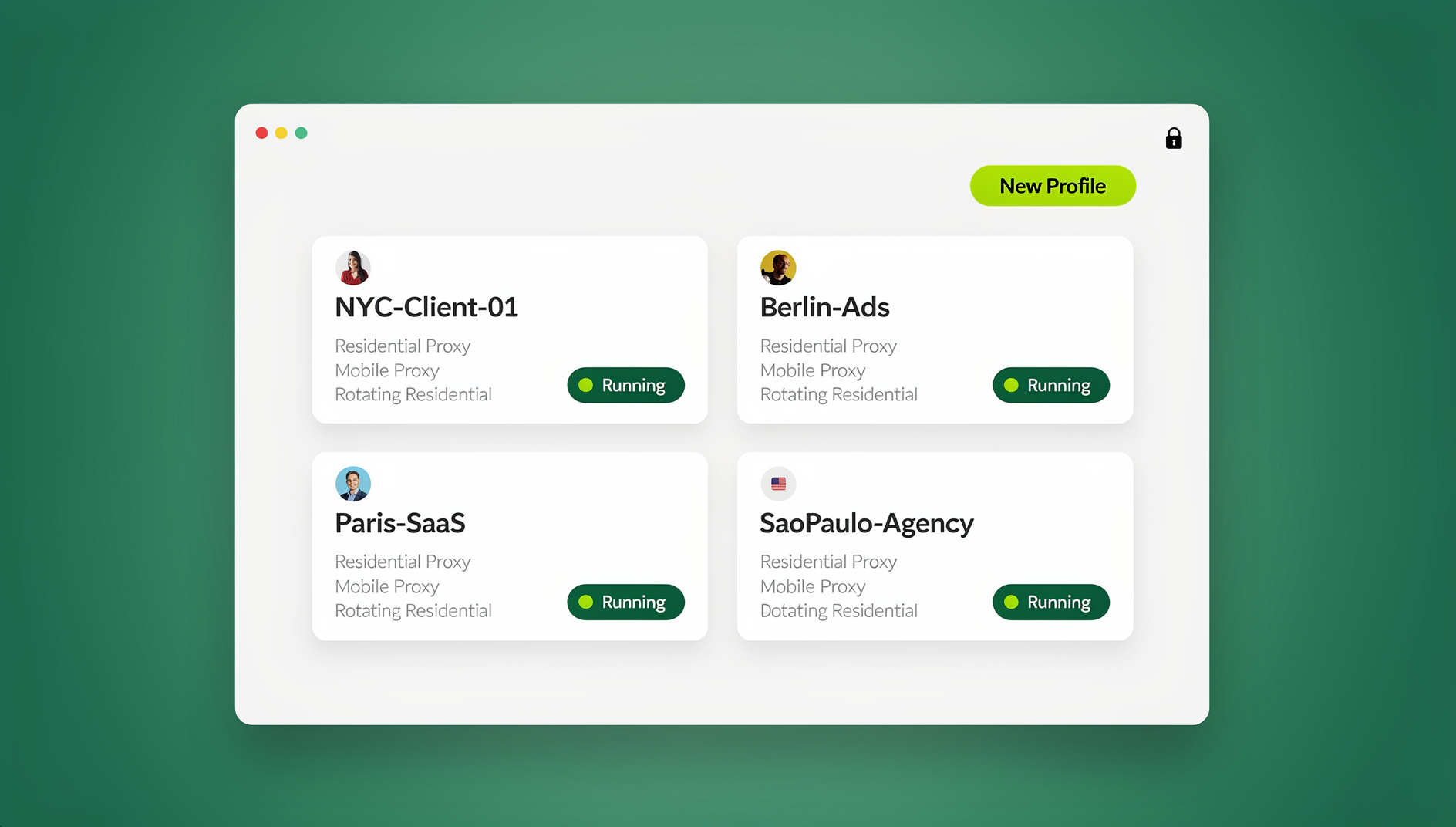
Send.win is a dedicated multi-account management platform designed to help agencies execute best practices for managing multiple client accounts. Unlike generic browsers, Send.win provides sandboxed profiles that isolate cookies, cache, and local storage on a per-tab basis. This means your team can run dozens of client portals simultaneously in a single window without any risk of session crossover or security flags.
Crucially, Send.win has no browser add-on or browser plugin — it operates through two main modes: the native Sendwin Browser desktop client (available for Windows, macOS, and Linux) and cloud browser sessions that run entirely on Sendwin’s remote infrastructure without requiring any local installation. This architecture allows agencies to assign distinct proxies to individual client profiles, matching the geographic location of each client. If a client is based in Chicago, their dedicated Send.win profile can be routed through a Chicago-based residential proxy, ensuring their portals see consistent login locations.
Send.win’s Team plan also supports robust collaboration features. Team leaders can share client sessions with junior staff members without revealing the underlying login credentials. This reduces the risk of password leaks and allows for instant access revocation when an employee leaves the agency. Furthermore, for agencies that automate repetitive tasks like report extraction or dashboard audits, Send.win’s local Automation API (available on both Pro and Team plans) allows integration with Selenium, Puppeteer, and Playwright to drive isolated profiles programmatically.
Proxy matching within Send.win is highly flexible. The platform supports HTTP, HTTPS, SOCKS4, and SOCKS5 proxy protocols. This allows agencies to integrate residential, datacenter, or mobile proxy networks depending on the specific requirements of the client’s platform. For instance, highly sensitive platforms like Instagram or TikTok are best managed using mobile proxies, which mimic standard cellular data connections and are less likely to trigger verification requests.
Centralized Reporting and Automated Account Audits
Reporting is one of the most time-consuming aspects of agency operations. Manually logging into dozens of client dashboards at the end of the month to copy and paste metrics into spreadsheets is an inefficient use of resources and prone to errors. Implementing automated reporting dashboards is a key best practice for scaling agencies.
By connecting client platforms to tools like Google Looker Studio, DashThis, or AgencyAnalytics, you can create real-time, white-labeled performance dashboards for your clients. This gives clients instant visibility into their campaign performance while freeing up your team to focus on strategic optimizations. Automated reporting also ensures data consistency and eliminates the delay associated with compiling manual reports.
Alongside reporting, regular account audits are essential. Set up recurring calendar alerts to review account settings, check pixel integrations, monitor ad budgets, and verify user permissions. By catching minor issues before they become major problems, you demonstrate proactive value to your clients and build long-term trust. Using automated workflows in isolated profiles ensures these audits are completed quickly and securely.
Furthermore, automated audits can be configured to alert your team immediately if an ad campaign stops running or if a pixel connection is lost. Many agencies build custom scripts that interface with payment and ad portals via APIs, cross-checking active statuses and budget caps hourly. This proactive defense saves thousands of dollars in lost ad spend and maintains the health of client campaigns.
🏆 Send.win Verdict
Successfully executing best practices for managing multiple client accounts requires a combination of structured team organization and robust technical safeguards. Accessing client portals from standard browsers is a security risk that can lead to account suspensions. Send.win offers the ideal solution, providing secure, isolated browser profiles through its native Sendwin Browser desktop client and cloud browser sessions, ensuring zero risk of account cross-contamination.
Try Send.win free today — secure all your client assets with a 30-day free trial.
Frequently Asked Questions
How many client accounts should one account manager handle?
The optimal number of client accounts per manager depends on the complexity of the services. Generally, a manager should handle 3-5 high-touch Platinum clients, 5-8 mid-tier Gold clients, or up to 15 standardized Silver/Bronze clients. Juggling more than this leads to reduced service quality and employee burnout.
What is client cross-contamination and how do we prevent it?
Client cross-contamination occurs when cookies, local storage, or browser fingerprints link separate client accounts together, leading to security locks or bans. You can prevent this by using isolated profile systems that sandbox each client session, ensuring that web portals see each account as an independent visitor.
Should agencies share password manager access directly with clients?
No. Agencies should use secure credential managers internally to store logins, but should never share master vault access. For maximum security, use platforms like Send.win that allow team members to access client portal sessions without ever exposing the raw password credentials to the staff.
What is the pod model in agency operations?
The pod model groups cross-functional specialists (e.g., an account manager, an SEO specialist, and a media buyer) into a dedicated unit responsible for a specific group of clients. This improves communication, shares client context, and allows the agency to scale by simply adding new pods.
How does Send.win isolate client profiles?
Send.win isolates cookies, cache, local storage, and browser fingerprints on a per-tab basis. This sandboxing ensures that different tabs can run active sessions on the same website under different credentials simultaneously without any data leaks or session overlaps.
Can teams collaborate on the same client profiles in Send.win?
Yes. Send.win’s Team plan allows managers to share specific client browser profiles with team members. This allows team collaboration on client dashboards without having to share raw login details, and access can be revoked instantly from the master panel.
What are the pricing options for Send.win’s team features?
Send.win offers a 30-day free trial with no credit card required. Paid plans include the Pro plan at $19/month ($6.99/month billed annually — 63% savings) supporting up to 150 profiles, and the Team plan at $49/month ($20.99/month billed annually — 57% savings) which includes 500 profiles and team collaboration seats.