What Are Session Groups in Send.win (and Why Category-Based Organization Matters)
Session groups — sometimes called categories — are Send.win’s built-in way of clustering related browser profiles together so you’re not scrolling through one giant, unsorted list every time you need to switch accounts. If you’re running five Instagram profiles, three client Facebook Business Managers, and a stack of Amazon seller accounts inside the same workspace, grouping them by category (Instagram, Client A, Amazon) turns a chaotic list into a clean, navigable workspace. This guide walks through exactly how session categories work in 2026, how to create and reassign them step by step, and how the same organizational logic now extends across Send.win’s cloud browser sessions and the native Desktop app.
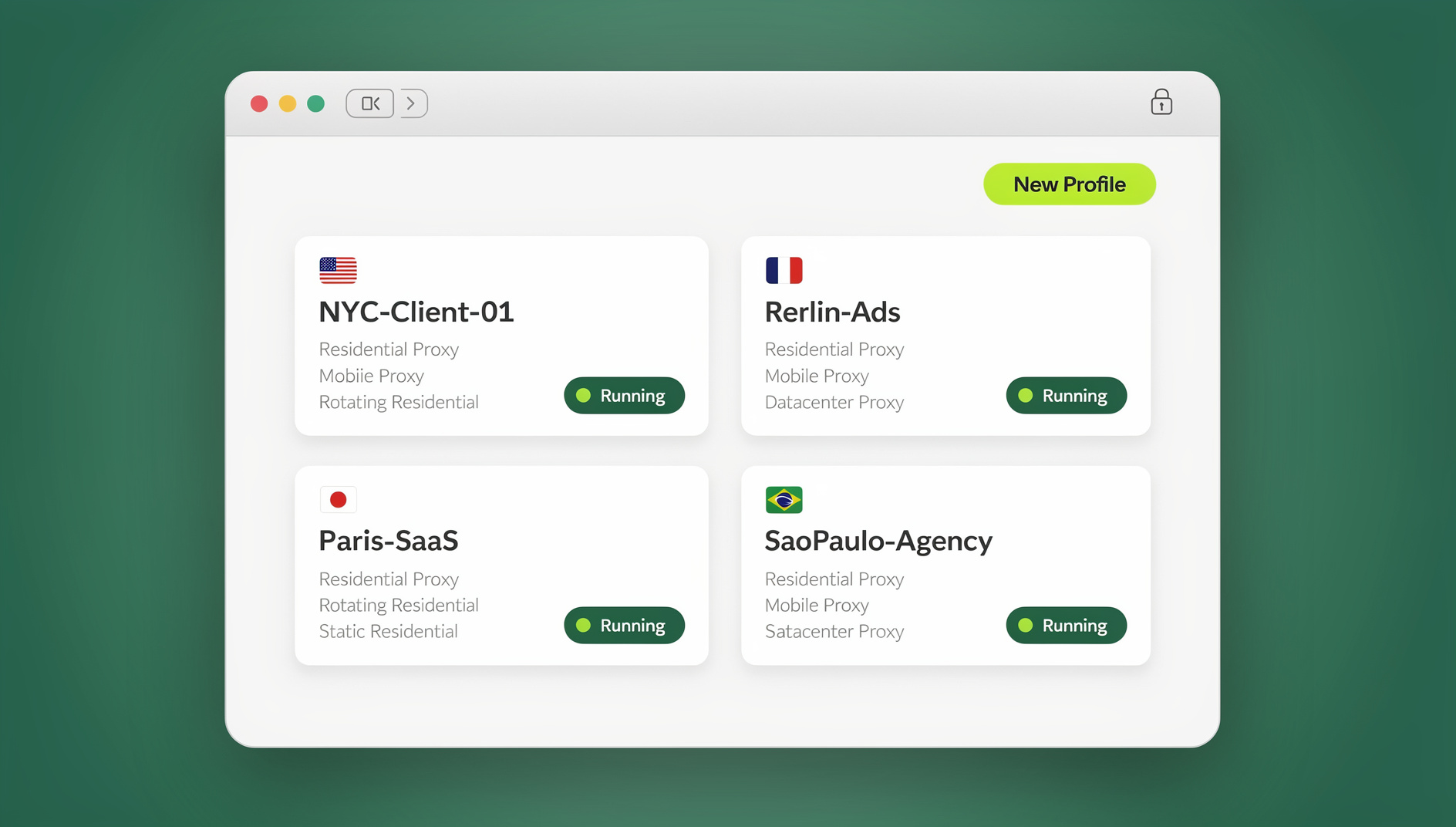
Send.win itself is a browser profile manager: each session gets an isolated cookie jar, local storage, and its own consistent browser fingerprint, so you can be logged into ten Instagram accounts or thirty client ad accounts at once with separate cookies, storage and fingerprint per profile. Grouping is the organizational layer sitting on top of that isolation — it doesn’t change how a session behaves technically, it changes how fast you can find it.
Why Categorizing Sessions Matters as You Scale
The Problem With a Flat, Unsorted Profile List
A handful of sessions is easy to manage by memory. The moment you cross 15-20 profiles — which happens fast for agencies, dropshippers, and social media managers — a flat list becomes a liability. You waste time scrolling and searching, you risk clicking into the wrong client’s account, and onboarding a new teammate means explaining “the third one down is actually the TikTok account for Client B” instead of just pointing at a labeled folder.
This is exactly the scenario session categories solve. Instead of a wall of identically-styled session cards, you get collapsible groups — “Instagram,” “Client A – Ads,” “Amazon Sellers,” “QA Testing” — each holding only the sessions that belong there.
Real-World Use Cases for Session Categories
- Agencies managing multiple clients: one group per client keeps every platform login (Facebook, Google Ads, TikTok) for that client together, so nothing gets mixed up during a busy week.
- E-commerce sellers running multi-store operations: group by marketplace (Amazon, eBay, Etsy) or by store name to avoid accidentally logging into the wrong storefront.
- Social media managers: group by platform first, then by client or account tier, so a 40-profile workspace still feels navigable.
- QA and dev teams: group test accounts by environment (staging, production, regional) so automated test runs always target the right bucket.
- Affiliate and ad buyers: group by campaign or ad account cluster to keep spend, creatives, and login credentials organized per funnel.
How to Create a Session Group From Scratch (Step-by-Step)
Creating a category at the same time you create a new session is the fastest path — it takes one extra field in a form you’re already filling out. Here’s the exact flow:
- Navigate to the page you want to open a session for, then launch the Send.win Desktop app’s new-session panel (or start a cloud browser session).
- Click the option to create a new saved session.
- Give the session a clear, descriptive name — something you’ll recognize instantly six weeks from now, not “Untitled 12.”
- In the group field, either select an existing group from the dropdown or type a new group name to create one on the fly. There’s no separate “create group” screen — the group is created the moment you assign a session to a name that doesn’t exist yet.
- Save the session. It now appears nested under that group in your session list, along with its proxy, fingerprint, and any other configuration you set for it.
Because grouping is just a label attached to the session record, it has zero impact on the session’s isolation properties — the browser fingerprint, cookie storage, and (if configured) the proxy assigned to that profile all behave exactly the same whether the session sits inside a group or floats alone at the top level.
How to Move an Existing Session Into a Group
Didn’t plan ahead when you first created a session? No problem — reassigning it to a group later takes about ten seconds and doesn’t touch any of its saved cookies, login state, or fingerprint data:
- Locate the session inside your Send.win session list.
- Click the three-dot menu on that session’s card.
- Select “Settings.”
- At the top of the settings panel, you’ll find the name field and the group field for that session.
- Choose an existing group from the dropdown, or type a new name to spin up a fresh category right there, then save.
This works identically whether the session was created a day ago or has years of saved login history — reassigning the group is purely metadata, so nothing about the underlying profile changes.
Managing, Renaming, and Reorganizing Groups
Groups aren’t fixed once created. A few things worth knowing as your workspace grows:
- Renaming a group: edit the group name from any session that belongs to it, and every session in that category updates to reflect the new label — you don’t need to rename sessions individually.
- Splitting a group: if a category gets too large (say, “Clients” grows to 60 sessions), reassign a subset of sessions to new, more specific groups (e.g., “Clients – Retainer,” “Clients – One-Off”) using the same settings-panel flow above.
- Deleting a group: removing every session from a group effectively removes the group itself, since categories only exist as long as at least one session references them. Deleting the last session in “Old Campaign 2025” quietly retires that label.
- Collapsing groups for a cleaner view: once you have several categories, collapsing the ones you’re not actively using keeps your workspace focused on what matters today.
If you also rely on proxy assignment on your sessions, it’s worth pairing your grouping strategy with a proxy-per-group convention — for example, keeping every session inside “Amazon – US Store” behind US residential IPs. Grouping doesn’t automate that pairing for you, but a consistent naming scheme makes it much easier to audit at a glance.
Session Groups on the Send.win Desktop App
Send.win’s native Desktop app for Windows, macOS, and Linux is a local-first, downloadable application with encrypted cloud sync, and it’s the first item in Send.win’s own navigation for a reason: heavier multi-account workloads, more concurrent open sessions, and tighter fingerprint/proxy control all run better as a standalone application than inside a browser tab. Session groups carry over completely between the Desktop app and Send.win’s cloud browser sessions — categories you create in one appear the same way in the other, since both read from the same account-level session data.
For teams running dozens of profiles across long work sessions, the Desktop app is generally the better daily driver: it handles more simultaneous open windows without taxing your primary browser, and it gives you the same group-based organization with a bit more screen real estate to work in. If you haven’t installed it yet, it’s worth setting up alongside Send.win’s cloud browser sessions rather than instead of them — many users keep both, using a cloud browser session for quick, zero-install tasks and the Desktop app for heavier multi-profile work.
Organizing Group Assignment at Scale
Once you’re managing session categories at real scale — hundreds of profiles across multiple clients or marketplaces — manually clicking through the settings panel for each session stops being practical. Send.win has no automation interface: there is no API, SDK, headless mode or Selenium/Puppeteer/Playwright support on any plan, so group assignment is done through the app’s interface rather than by script.
Practical patterns teams use this for:
- Bulk onboarding: a script that ingests a spreadsheet of 200 new store accounts and creates a correctly-grouped, correctly-proxied session for each one in a single run.
- QA pipelines: automated test suites that always launch sessions from a specific “Staging” or “Regional-EU” group so tests never accidentally touch production credentials.
- Scheduled account rotation: cron-driven scripts that create fresh sessions inside a designated group on a recurring basis, then archive or reassign older ones.
Best Practices for Organizing Profiles at Scale
The table below compares the three most common ways teams try to keep large profile counts organized, and where each one breaks down.
| Method | Setup Effort | Findability at 50+ Profiles | Team Visibility | Best For |
|---|---|---|---|---|
| Naming convention only (no groups) | Low | Poor — still one long scrollable list | Inconsistent — depends on discipline | Solo users with under 10 sessions |
| External spreadsheet tracker | Medium — must be manually maintained | Good, but requires switching apps constantly | Good, but goes stale fast | Compliance/audit logging alongside the tool |
| Send.win native session groups | Low — built into session creation | Excellent — collapsible categories in-app | Excellent — visible to shared team members instantly | Agencies, e-commerce sellers, teams at any scale |
A few conventions worth adopting once you commit to native groups:
- Pick a hierarchy and stick to it. Client-first (“Client A – Facebook,” “Client A – TikTok”) works well for agencies; platform-first (“Instagram – Client A,” “Instagram – Client B”) works better for social media managers juggling one platform across many clients.
- Avoid duplicate near-identical group names. “Amazon,” “amazon,” and “Amazon Store” will all show up as separate categories — standardize capitalization and phrasing across your team.
- Archive, don’t delete, finished projects. Rename a completed client’s group to “Archived – Client X” instead of deleting sessions outright, so historical logins remain searchable if the client returns.
- Review your group list quarterly. Categories tend to sprawl as new clients and platforms get added — a periodic cleanup keeps navigation fast.
Send.win Session Groups vs Manual Browser Profile Folders
It’s a fair question whether you even need a dedicated grouping feature — couldn’t you just use Chrome’s own profile switcher or bookmark folders? In practice, the two approaches solve different problems, as the comparison below shows.
| Capability | Send.win Session Groups | Native Chrome Profiles/Bookmark Folders |
|---|---|---|
| Unique fingerprint per session | Yes, automatically | No — Chrome profiles share detectable signals unless heavily configured |
| Built-in proxy assignment per session | Yes | No — requires third-party extensions per profile |
| Team sharing of a whole category | Yes, via shared sessions to your team | No native team-sharing model |
| Reassign a session’s category without losing login state | Yes — settings-panel toggle | Not applicable — profiles aren’t nested by category |
| Programmatic bulk creation and grouping | No | No native equivalent |
The short version: browser-native profiles were built for personal multi-user computers, not for running dozens of isolated business accounts side by side. Session groups inside a purpose-built platform like Send.win exist specifically for the multi-account, multi-client use case — which is also why they pair naturally with multi-login browser workflows that need to scale past a handful of profiles.
🏆 Send.win Verdict
Session groups turn Send.win from “a tool that isolates your accounts” into “a workspace you can actually navigate at 50, 100, or 500 profiles.” Whether you’re an agency juggling clients, a seller running multiple storefronts, or a QA team managing many logins, category-based organization — available in both the native Desktop app and cloud browser sessions — keeps growth from turning into chaos.
Try Send.win today — plans start at $19/mo, and your first card purchase is covered by a 7-day money-back guarantee. You can also preview it free in the cloud demo, and see how fast a well-organized multi-login workspace actually feels.
Frequently Asked Questions
What’s the difference between a “session” and a “group” in Send.win?
A session is an individual isolated browser profile — its own cookies, fingerprint, and optional proxy. A group (or category) is simply a label you attach to sessions so related ones display together in your session list. Groups have no effect on the technical isolation of a session; they exist purely for organization.
Can I move a session between groups later without losing its cookies or fingerprint?
Yes. Reassigning a session’s group through its settings panel only changes the label used to organize it in the list — all saved login state, cookies, local storage, and fingerprint configuration remain exactly as they were.
How many groups can I create in Send.win?
There’s no hard cap on the number of categories you can create — you’re only limited by your plan’s total profile count (150 profiles on Pro, 500 on Team). Most teams find a handful of well-named groups far more useful than dozens of overly granular ones.
Do session groups sync across the Send.win Desktop app and cloud browser sessions?
Yes. Groups are tied to your account’s session data, not to a specific device, so a category created in a cloud browser session shows up identically in the native Desktop app for Windows, macOS, and Linux, and vice versa.
Can I share an entire group with my team instead of sharing sessions one by one?
Send.win’s team-sharing feature lets you share individual sessions with teammates without ever exposing the underlying passwords. While sharing currently happens at the session level, keeping related sessions inside one clearly-named group makes it much faster to identify and share the right batch of accounts with the right teammate.
Does grouping sessions affect proxy or fingerprint settings?
No. Proxy assignment and fingerprint configuration are set per session and are completely independent of which group that session belongs to. You can, however, adopt a naming convention that pairs specific proxy regions with specific groups to keep your setup auditable.
Can I create or assign groups programmatically?
No. Send.win has no automation interface — no API, SDK, headless mode or Selenium/Puppeteer/Playwright support on any plan — so sessions are created and assigned to categories through the app’s interface rather than by script.
What happens to a group if I delete every session inside it?
Since a group only exists as long as at least one session references its name, deleting the last session in a category effectively retires that group. If you plan to reuse the same client or project name later, it’s often cleaner to rename the group to something like “Archived – [Name]” rather than deleting every session inside it.