Unlimited virtual profiles are the single biggest reason people switch to Send.win. Instead of juggling five browsers, a stack of incognito windows, or a virtual machine just to keep two accounts apart, you open one browser, click “New Profile,” and get a fully isolated identity with its own cookies, storage, cache, and fingerprint — in seconds. This guide rewrites and expands our original 2022 walkthrough with the current Send.win product: the native Sendwin Browser desktop app for Windows, macOS, and Linux, cloud browser sessions that need zero local install, proxy and fingerprint controls, and team sharing.
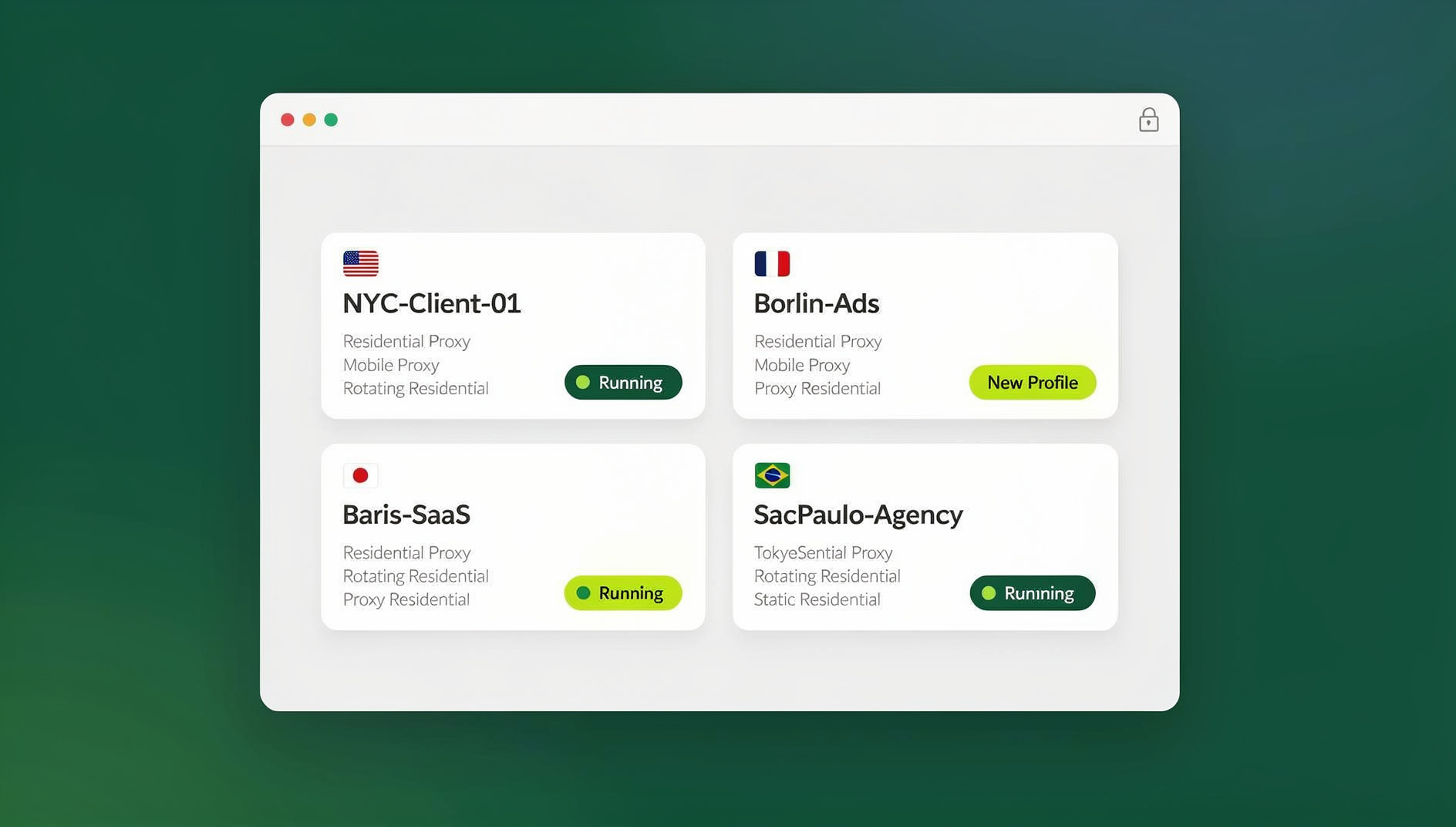
Whether you manage a dozen client ad accounts, run multiple stores on the same marketplace, test a web app across regions, or simply want a clean, tracker-free profile for every hat you wear online, this walkthrough covers exactly how to set up unlimited virtual profiles the right way — plus the plan limits, real limits (yes, “unlimited” has some fine print), best practices, and mistakes to avoid.
What Are Virtual Profiles, Exactly?
A virtual profile (Send.win also calls these “sessions”) is a self-contained browser identity. Each profile has its own:
- Cookies and local storage — logging into Account A never touches Account B’s session data.
- Browser fingerprint — canvas, WebGL, fonts, screen resolution, timezone, and other signals sites use to recognize repeat visitors.
- Cache and history — nothing bleeds between profiles, so recommendation algorithms and ad retargeting stay separated too.
- Optional proxy — each profile can route through its own IP address, so two profiles browsing side by side don’t share a network fingerprint either.
This is a different (and much stronger) form of isolation than opening a second incognito window. Incognito mode still shares your device’s underlying fingerprint and, on most sites, still gets correlated with your other tabs through IP address and browser telemetry. A virtual profile is closer to using a brand-new device for each account — without the cost of buying new devices.
Why “Unlimited” Matters More Than People Expect
When people first hear “unlimited virtual profiles,” they picture managing two or three social accounts. In practice, the demand for profiles grows fast once you start using them:
- An agency managing 15 clients quickly needs 15+ profiles just for one ad platform, then multiplies that across Google, Meta, and TikTok.
- An e-commerce seller running multiple storefronts on Amazon, Etsy, or Shopify needs a dedicated profile per store to avoid cross-account linking flags.
- A QA or dev team testing a web app needs fresh, disposable profiles for every test run so cached state doesn’t skew results.
- A freelancer juggling multiple clients’ CMS logins, ad dashboards, and social accounts needs a profile per client to avoid mixing sessions (and to hand off access cleanly when a project ends).
Profile count scales with use case, not headcount — which is exactly why a hard cap of “5 profiles” or “10 profiles” (common on cheaper multi-login tools) becomes a real bottleneck within weeks. Send.win’s unlimited-profile model, backed by generous plan-level allowances, is built for that growth curve.
Step-by-Step: Creating Unlimited Virtual Profiles in Send.win
Here is the current, accurate workflow for creating virtual profiles in Send.win — updated from our original 2022 post to reflect the full product today.
Step 1: Install Send.win (Desktop App or Cloud Browser Session)
Send.win gives you two ways to work, and picking the right one matters:
- Cloud browser session — the fastest way to get started, with zero local install. Try the free cloud demo at https://send.win/demo-browser/ (a 3-minute preview without signup, 10 minutes a day with a free account) and you’re ready to create your first profile in under a minute, running entirely in the cloud and metered by cloud browsing time.
- Sendwin Browser (Desktop app) — a native Windows, macOS, and Linux client that runs each virtual profile in a genuinely separate, isolated browser instance rather than a browser tab. If you’re managing dozens of profiles, running proxies per profile, or need the strongest fingerprint isolation, install the desktop app from the Send.win homepage’s “Download” link.
Most people start with a quick cloud browser session and move to the Sendwin Browser desktop app once their profile count grows past a handful — you don’t have to choose only one; many teams use both depending on the device they’re on.
Step 2: Create Your First Virtual Profile
- Open Sendwin Browser (desktop app), or start a cloud browser session, and click New Profile.
- Name the profile something you’ll recognize later — for example, “Client A — Meta Ads” or “Store 2 — Etsy.”
- Assign it to a group (e.g., “Ad Accounts,” “E-commerce,” “Social Media”) so profiles stay organized as your list grows.
- Choose a fingerprint template — Send.win auto-generates a unique, consistent fingerprint (OS, browser version, screen size, WebGL/canvas noise) for the profile so it reads as a distinct real device to every site you visit.
- Click Create. The profile launches instantly, ready to log in.
Step 3: Attach a Proxy (Recommended for Serious Multi-Account Use)
A unique fingerprint isolates your browser signals, but if every profile still shares your home or office IP address, platforms can still correlate accounts by network. This is where a dedicated proxy per profile matters. Send.win includes built-in proxies on paid plans, or you can bring your own. If you need step-by-step instructions, our tutorial on how to add a proxy to any session walks through the exact settings.
Step 4: Repeat to Scale Up (This Is Where “Unlimited” Kicks In)
Once the first profile is set up, creating the next 10, 50, or 200 is just a repeat of Step 2 — Send.win doesn’t force you through extra verification or approval steps per profile. For a deeper look at batch-creating and managing many sessions at once, see our guide on how to create multiple sessions in Send.win.
Step 5: Share Profiles With Your Team (Optional)
If you work with a team — VAs, agency staff, or co-founders — you don’t need to hand out passwords. Send.win lets you share a profile’s access directly, so teammates can log into a shared client account without ever seeing the underlying credentials. Full instructions are in our walkthrough on how to share sessions with your team. This is on the Team plan and is one of the most-requested features from agencies managing shared client access.
Sendwin Browser vs. Cloud Browser Sessions: Which Should You Use?
Both create virtual profiles, but they isolate at different levels and suit different workloads.
| Factor | Cloud Browser Session | Sendwin Browser (Desktop App) |
|---|---|---|
| Setup time | Under 1 minute, no download | ~5 minutes (native install) |
| Isolation strength | Strong (isolated cloud session) | Strongest (fully separate local browser processes) |
| Best for | Individuals, quick or on-the-go multi-accounting | Agencies, high-volume sellers, teams managing many profiles |
| Platform support | Any device with a browser, no install | Windows, macOS, Linux (native client) |
| Automation API access | Not applicable | No |
| Resource usage | Runs in the cloud, metered by cloud browsing time | Slightly higher per profile locally, but more stable at scale |
If you’re only running a handful of virtual profiles for personal accounts, a cloud browser session is fine on its own. Once you’re running dozens of unlimited virtual profiles daily — especially with proxies attached to each — Sendwin Browser, the desktop app, is the more stable, professional-grade option.
Creating and Managing Profiles Across Many Accounts
For teams that need to create profiles, log in, or run repetitive tasks across dozens of virtual profiles, manually clicking through the UI doesn’t scale. Send.win has no automation interface — no API, SDK, headless mode or Selenium/Puppeteer/Playwright support on any plan — so the work stays in the app, where each profile keeps its own cookies, storage and fingerprint.
- Spin up new virtual profiles programmatically as part of a deployment or onboarding script.
- Attach proxies and fingerprint configurations to each automated profile the same way you would manually.
- Tear down and recreate disposable profiles for one-off automation runs without polluting your main profile list.
This is a meaningful upgrade over juggling multiple browsers or virtual machines, and it’s the reason many QA and growth teams now standardize on Send.win: each profile keeps its own separate cookies, storage and fingerprint.
How Many Profiles Can You Actually Create? Plan Limits Explained
“Unlimited” refers to the profile creation workflow itself — there’s no artificial cap on the number of profiles you’re allowed to configure — but each plan does have practical resource allowances (proxy bandwidth, seats, active concurrent sessions) worth knowing before you commit.
| Plan | Price | Profiles | Proxy Bandwidth | Team Seats | |
|---|---|---|---|---|---|
| Free Trial | $0 (30 days, no card) | Limited starter allowance | Trial bandwidth | — | 1 |
| Pro | $19/mo ($6.99/mo annual — 63% off) | 150 profiles | 5 GB | — | 1 |
| Team | $49/mo ($20.99/mo annual — 57% off) | 500 profiles | 20 GB | Included | 16 |
Need more than the plan default? Extra profiles and bandwidth are available as add-ons ($0.05 per extra profile, $6/GB), so you’re never hard-blocked from scaling — you simply pay for the additional resources rather than being forced onto an entirely new tier.
Real-World Use Cases for Unlimited Virtual Profiles
E-Commerce Sellers Running Multiple Storefronts
Marketplaces like Amazon, Etsy, and eBay actively look for account-linking signals between stores. A dedicated virtual profile — unique fingerprint plus a matching proxy — per storefront keeps each store operating as an independent seller in the platform’s eyes, reducing the risk of a related-account suspension.
Agencies and Freelancers Managing Client Accounts
Instead of logging in and out of a client’s ad account fifteen times a day (and risking a typo that logs you into the wrong dashboard), each client gets a permanent, named profile. Combine this with a multi-login browser workflow and you can have every client’s Google Ads, Meta Business Manager, and CMS login open in separate windows simultaneously, with zero session bleed.
Social Media Managers
Running five brand accounts on the same platform from a single browser used to mean constant logouts or a pile of separate Chrome profiles that all still shared the same machine fingerprint. Virtual profiles solve this cleanly — each brand’s account looks, to the platform, like it’s coming from an entirely different device.
QA Engineers and Developers
Testing how a web app behaves for a brand-new user — no cookies, no cached state, no prior session — usually means clearing browser data between every test run. A disposable virtual profile gives you that clean slate instantly, so you can spin up and tear down test profiles as part of your workflow.
Privacy-Conscious Individuals
Even outside of professional use cases, some people simply don’t want their banking, shopping, and social browsing correlated by the same fingerprint. Separate virtual profiles for “Finance,” “Shopping,” and “Social” achieve that without needing five different physical devices.
Best Practices for Managing Many Virtual Profiles
- Name and group consistently. “Client — Platform” naming (e.g., “Acme Co — Meta Ads”) scales far better than generic labels once you’re past 20 profiles.
- Match proxy location to the account’s expected region. A profile logging into a US-based store from a proxy in another country is itself a red flag — geo-match your proxies where relevant.
- Don’t reuse a proxy across unrelated profiles. Sharing an IP across profiles undermines the isolation you just set up.
- Rotate stale profiles out. If a client relationship ends or a store closes, archive or delete the profile rather than letting your list balloon indefinitely.
- Use groups/folders, not a flat list. Send.win’s grouping feature exists specifically so unlimited doesn’t become unmanageable.
- Back up critical login recovery details separately. Virtual profiles isolate session data beautifully, but you should still keep your own record of account recovery emails/2FA in case a profile needs to be rebuilt.
Common Mistakes to Avoid
- Treating incognito mode as equivalent. Incognito clears cookies on close but does nothing about fingerprint or IP — it’s not a substitute for a real virtual profile.
- Skipping proxies entirely. Fingerprint isolation without IP isolation is only half the job for account-separation use cases.
- Creating profiles with no naming convention. “Unlimited” profiles with no organization system turns into unusable clutter fast.
- Forgetting the desktop app exists. Many long-time users stick with quick cloud browser sessions out of habit even after their workload has outgrown it — the Sendwin Browser desktop app’s stronger process isolation is worth the five-minute install once you’re managing dozens of profiles.
- Not using separate profiles for repetitive manual work. If you’re clicking through the same login-and-scrape sequence across 30 accounts by hand, separate isolated profiles keep each session’s cookies and storage apart.
Send.win vs. Manual Multi-Account Methods
| Method | Fingerprint Isolation | IP Isolation | Setup Effort | Scales to 50+ Accounts |
|---|---|---|---|---|
| Multiple incognito windows | None | None | Low | No |
| Separate Chrome profiles | Partial | None (unless manually configured) | Medium | Poorly — clutters one machine |
| Virtual machines per account | Strong | Manual | Very high | No — resource-prohibitive |
| Send.win virtual profiles | Strong (auto-generated) | Built-in proxy support | Low | Yes |
🏆 Send.win Verdict
If you need genuinely unlimited virtual profiles — not five, not ten, but as many as your workload actually requires — Send.win is built for exactly that. Fingerprint isolation, built-in proxies, a native Desktop app for stronger process-level separation, and team sharing without password handoffs: it’s a complete stack for anyone managing more than a couple of accounts.
Try Send.win today — plans start at $19/month (Pro) or $49/month (Team), with a 7-day money-back guarantee on your first card purchase, and you can create your first unlimited virtual profile in under a minute.
Frequently Asked Questions
What exactly counts as a “virtual profile” in Send.win?
A virtual profile is an isolated browser identity with its own cookies, local storage, cache, and browser fingerprint. Optionally, it can also route through its own dedicated proxy IP, giving you both device-level and network-level separation from your other profiles.
Is there really no limit on how many profiles I can create?
There’s no artificial cap on the profile-creation workflow itself. Each plan does have a practical allowance (150 profiles on Pro, 500 on Team) tied to resource usage, but you can add more profiles beyond your plan’s default allowance for a small per-profile fee rather than hitting a hard wall.
Do I need the Desktop app, or is a cloud browser session enough?
A cloud browser session is enough for casual use — a handful of personal or work profiles, with zero local install. If you’re managing dozens of profiles, running proxies on each, or need the strongest possible isolation between sessions, the native Sendwin Browser desktop app for Windows, macOS, and Linux gives you fully separate, local browser processes instead.
Can I use unlimited virtual profiles for automation and scripting?
No. Send.win has no automation interface — no API, SDK, headless mode or Selenium/Puppeteer/Playwright support on any plan. Profiles are created and managed in the app, and each one keeps its own cookies, storage and fingerprint.
Do virtual profiles protect against account bans on platforms like Amazon or Meta?
Virtual profiles significantly reduce the risk of accounts being linked and flagged together by separating fingerprint and IP signals. No tool can guarantee immunity from a platform’s enforcement decisions, but proper profile isolation is the industry-standard mitigation used by sellers, agencies, and marketers managing multiple accounts.
How is a virtual profile different from just using incognito mode?
Incognito mode clears local cookies when you close the window, but it does nothing to change your browser or device fingerprint, and it still uses your regular IP address. Sites can and do correlate incognito sessions with your normal browsing through these signals. A virtual profile changes the fingerprint and, optionally, the IP as well — genuine isolation, not just a private tab.
Can I share a virtual profile with a teammate without giving them the password?
Yes. On the Team plan, you can share access to a specific profile directly with a teammate. They get to use the logged-in session without ever seeing the underlying account credentials, and you can revoke access at any time.
What happened to the “Saved Session” feature from earlier versions of Send.win?
That was an earlier name for what’s now called profile creation in the current Send.win product. The core workflow — name a profile, assign it to a group, and launch an isolated session — is the same idea, just built out with fingerprint controls, proxy support, the Sendwin Browser desktop app, and cloud browser sessions added since.
How much does Send.win cost if I need unlimited profiles for a whole team?
Team plan pricing is $49/month or $251.88/year for teams, and the Pro plan is $19/month or $83.88/year for individuals. The first card purchase is covered by a 7-day money-back guarantee. The only free option is the cloud demo at https://send.win/demo-browser/ — a 3-minute preview without signup, 10 minutes a day with a free account.